
Beyond Collapse: Hope, Community and the Future We Can Still Build
In the previous four parts of this conversation, Sudhir Shetty established GCF’s diagnostic foundations, thermodynamic evidence, political economy critique, and operational strategy. In this fifth part, he turns to the most personal dimensions of the framework: how young people can participate without land or capital, how hope is sustained without false optimism, and what would genuinely convince GCF that humanity has begun moving in the right direction. The part also introduces the Cassandra Architecture — GCF’s analysis of why accurate civilisational warnings have historically failed to generate adequate response, and why the current moment may be structurally different.
NAVIGATING CIVILISATIONAL COLLAPSE
A Conversation with Sudhir Shetty — Part Five
How can young people participate meaningfully without owning land or large financial resources?
The question assumes GIC’s definition of what constitutes meaningful participation — and that assumption is precisely what needs replacing.
GIC tells young people that meaningful participation requires credentials, capital, and property. Within GIC’s logic, this is correct. But the coming decades will not be organised around GIC’s logic. They will be organised around what the thermodynamic transition makes necessary — and what the transition makes necessary is almost entirely different from what GIC currently rewards.
What Scenario III participation actually requires is three forms of capital that land ownership and financial resources cannot buy and that the current education system largely does not produce.
The first is practical skills — the ability to grow food, repair and maintain physical infrastructure, build with local materials, preserve and ferment, care for the sick, facilitate collective decision-making, teach. These skills can be learned right now through apprenticeship with communities already practising them: agroecology farms, forest rights organisations, seed sovereignty initiatives, gram swaraj communities. They are not marginal activities awaiting mainstream validation. They are the mainstream of what is coming.
The second is relationships — the social fabric of trust, reciprocity, shared practice, and the ability to navigate conflict without fracturing community. In Kerala specifically, where the Gulf migration economy has produced decades of fragmented families and absent community relationships traded for remittances, the deliberate rebuilding of community social fabric is one of the most important contributions a young person can make — and one that requires presence, not capital.
The third is orientation — an understanding of the predicament clear enough to make choices that align with what the coming decades will actually require rather than what GIC’s credential economy currently rewards. This is what GCF specifically offers to young people: not a career path but a navigational framework.
Choosing to invest in Scenario III skills, relationships, and orientation rather than conventional credentials means making a genuine break from the aspirations that family, community, and cultural context have shaped — the aspiration for the Gulf job, the professional salary, the urban apartment. That break is not easy. GCF’s argument is not that it is costless but that it is strategically intelligent — because the credential economy itself is moving toward obsolescence as the thermodynamic foundation that sustained it contracts.
The institutional vehicle that GCR is developing for this participation is the Bioregional Facilitation Centre — still in its design phase. What exists right now are the existing B-Series initiatives across India: the agroecology farms, the forest rights communities, the seed sovereignty projects, the gram swaraj experiments. Seek them out. Offer your energy. Learn their skills. Build the relationships. Understand the bigger civilisational picture in which their work is situated.
One dimension deserves specific mention here. The form that participation takes will depend significantly on context — on what GCF calls Navigation Safety Infrastructure: the legal, institutional, and civil society conditions that determine how openly community building can proceed in a given place and time. Where civil society space is protected, where the justice system functions independently, where communities can organise and assert their rights without facing harassment or criminalisation, open B-Series building is possible and can proceed ambitiously. Where that space is being narrowed — where civil society actors face surveillance, where community organisers face legal risk, where the right to assemble and advocate is under pressure — building requires different forms: quieter, more networked, more careful about visibility. What we are witnessing across India right now — young people asserting democratic space, civil society organisations demanding that institutional accountability be restored, communities insisting on their constitutional rights — is not separate from the Scenario III project. It is one of its most important preconditions. Every actor working to keep democratic and civic space open, whether or not they have heard of GCF or Scenario III, is doing Navigation Safety Infrastructure work. They are maintaining the conditions within which the Third Force can operate. That work deserves recognition as civilisational in its significance, not merely political.
You are not volunteering for a cause. You are investing in the most valuable portfolio available for the world that is actually arriving.
Our ancestors planted fruit trees whose shade they would never sit under and whose fruit they would never taste. They planted because the act of planting was the responsibility — the gift to those who would come after. That is the orientation GCF invites young people toward.
Many people working on sustainability become overwhelmed by fear or despair. How do you encourage hope without creating false optimism?
The source of the despair matters more than the remedy — treating the symptom without diagnosing the cause produces only temporary relief.
The despair that many sustainability practitioners experience is the rational response to a structural mismatch between effort and outcome. Working on sustainability, in practice, has largely meant working on how to sustain GIC forever — how to make the existing system cleaner, more efficient, more equitable, while leaving its fundamental growth logic intact. The people who have invested their professional lives in this project are increasingly aware, at some level, that the trajectory is not responding to their efforts. GCF does not minimise that gap. It names it honestly — and in doing so, it changes what the despair means.
The despair of the sustainability practitioner who discovers GCF is not the despair of having failed. It is the grief of discovering that the door one has been pushing on does not open in the direction assumed. Kübler-Ross mapped the stages of grief in the context of personal mortality. The grief of civilisational transition follows a similar arc — and on the other side is not paralysis but clarity about what matters, what is worth defending, and what can actually be built.
There is a structural name for the pattern that produces this grief — GCF calls it the Cassandra Architecture. In Greek mythology, Cassandra was the Trojan prophetess given by Apollo the gift of perfect foresight and then cursed so that no one would believe her. She predicted Troy’s destruction accurately and completely — and was dismissed as mad until the city burned. The myth encodes something that has repeated across four millennia of civilisational history: accurate warnings of approaching collapse, delivered by credible people with rigorous evidence, are systematically dismissed until the collapse is underway and too late to prevent. The mechanism is not primarily bad faith or ignorance. It is paradigm immune response: within the BECOMING paradigm, accurate diagnosis of civilisational limits cannot be processed as information requiring response. It can only be processed as a threat to be dismissed.
This is why the grief of sustainability practitioners who encounter GCF is not personal failure. Their work was not insufficient. It was correct. The paradigm dismissed it — as it has dismissed every accurate civilisational warning before it. Now the paradigm is running out of room to keep dismissing.
What GCF specifically offers after the grief is not optimism. It is navigational clarity — an honest map of which doors are closed and which ones remain open. The door of reforming GIC into a sustainable version of itself is closed. The door of conscious civilisational navigation toward a less complex, bioregionally organised, BEING-oriented successor remains open, conditionally and with no guarantee of smooth passage. That conditional openness is not false optimism. It is the honest assessment of what the structural analysis actually shows.
The distinction between two very different things that both go by the name of hope matters here. Passive hope is a feeling — the emotional expectation that things will turn out well. Passive hope collapses when the news stops being encouraging. Active hope is a practice — the committed orientation toward the best available outcome, regardless of the odds, regardless of whether one will live to see the destination. Active hope does not require certainty. It requires only the conviction that what one is doing contributes to the best possible outcome that the situation permits.
The asymmetric preparation logic establishes this conviction on structural rather than emotional grounds. If we prepare for Scenario III and something resembling it becomes possible — communities survive what would otherwise be catastrophic. If we prepare and the crisis is worse than expected — we have still built communities with genuine relationships, real skills, and meaningful work. If we do not prepare and the crisis unfolds as GCF’s analysis suggests — the cost is catastrophic and irreversible. Preparation is the dominant strategy. That is not optimism. It is rational orientation under uncertainty.
GCF does not promise a peaceful and prosperous way down. It offers something more honest: the possibility that what is most worth preserving from the human journey so far can survive what is coming — if enough people commit now to being the ones who carry it through.
You have just named the Cassandra Architecture — the pattern by which accurate civilisational warnings are dismissed until too late. Does GCF face the same fate? What makes it different from the warnings that came before?
GCF may not escape the Cassandra fate — that honest acknowledgement comes first. The Cassandra Pattern has frustrated every previous accurate civilisational warning, and GCF is not immune to it. What GCF claims is not that it will succeed but that it is structurally positioned differently in ways that make success possible rather than merely desirable.
The first difference is that GCF does not merely warn — it navigates. Previous warnings, however rigorous, largely stopped at the diagnosis. The Limits to Growth modellers showed the trajectory. They did not design the lifeboats. Climate scientists proved the physics. They did not provide the community governance framework for living within its constraints. Every previous Cassandra could accurately describe what was coming. None provided the operational architecture — the specific community-scale institutions, governance frameworks, material preparation strategies, and navigational tools — that would allow the warning to be acted upon rather than merely acknowledged. GCF attempts to do both. That is what the “sensemaking and navigation” formulation means: not only diagnosis but navigation.
The second difference is connective capacity. Every previous Cassandra warned largely in isolation — a research team here, a prophetic thinker there, scattered voices without the infrastructure to find each other, recognise their convergence, and coordinate a collective response before the collapse made preparation impossible. The digital infrastructure that GIC built to accelerate its own expansion has inadvertently created the connective tissue through which a globally distributed Third Force can now find its coherence in real time, across cultural and geographic distance, without requiring a commanding institutional centre. No previous generation of transformation-oriented communities could coordinate at this scale and speed.
The third difference is convergence. GCF is not a lone voice making an isolated diagnosis. Independent intellectual traditions are arriving at similar conclusions simultaneously — thermodynamic economics, systems ecology, degrowth scholarship, indigenous knowledge systems, complexity science, civilisational history. The critical mass required for paradigm shift may be approaching in a way it has never approached before — not because any single framework has won the argument, but because the BECOMING paradigm’s anomalies are accumulating faster than its immune system can dismiss them.
The fourth difference is the most important and the most uncomfortable: the physical evidence is becoming undeniable at a pace that previous Cassandras did not live to see. M. King Hubbert predicted US oil peak in 1956 — dismissed until peak arrived in 1971. The LTG modellers’ trajectories were dismissed as fantasy — until they matched reality. David Korowicz’s supply chain cascade analysis was dismissed as theoretical — until COVID-19 made it visceral and global within weeks. The Kerala floods, the Wayanad landslides, the supply chain disruptions, the inflation that conventional economics cannot explain — these are present realities that the BECOMING paradigm’s explanatory framework is increasingly unable to contain. Paradigm shift historically happens not through better arguments but through the accumulation of anomalies the paradigm cannot process. Those anomalies are accumulating faster than the paradigm can absorb them.
What GCF can honestly say is this: the conditions for a different outcome — the first time in history when an accurate civilisational warning might generate adequate preparation before collapse rather than validation after it — are more present now than they have ever been. Whether that possibility is realised depends on what the people who can hear the warning do with the time that remains.
If you had the opportunity to advise India’s policymakers today, what three immediate changes would you recommend?
The question assumes that policymakers would receive and act on such advice — and that assumption is worth examining before offering recommendations.
In its current state of awareness and structural incentive, the Indian state — like every state structurally dependent on the growth trajectory GCF diagnoses as terminal — is institutionally invested in Scenario I. Conventional policy advocacy to mainstream institutions is not GCF’s primary engagement strategy.
What GCF is actually doing is more precise and ultimately more promising: identifying and engaging individual actors within the policymaking space who have the intellectual curiosity, the analytical independence, and the institutional positioning to carry GCF’s framework into spaces GCR cannot directly access. Not institutions. Individuals within institutions. The risk analyst at the National Disaster Management Authority who has been quietly troubled by the inadequacy of single-domain risk models. The district collector in a climate-stressed region whose ground-level experience is increasingly at odds with growth projections from above. The defence planner whose cascade scenario modelling keeps producing outcomes that mainstream economic assumptions cannot explain. The goal is to build a sufficient cohort of credible and influential individuals within the state apparatus who carry GCF’s analytical framework — so that when instability windows open, those individuals are positioned to nudge institutional response toward Scenario III rather than deeper into Scenario I or Scenario II capture.
With that framing, here is what a GCF-literate individual within India’s state apparatus would recognise as strategically rational.
First: commission an honest National Cascade Risk Assessment — not a growth scenario projection, not an SDG progress report, but a rigorous internal analysis of what abrupt GIC simplification would look like for India’s eight keystone systems simultaneously. What happens to food supply chains when energy costs double? Which communities have the indigenous capacity to function without central supply chains, and what would it take to protect and expand that capacity? As Cuba’s Special Period demonstrated, the states that navigate abrupt economic simplification best are those that have conducted honest internal vulnerability assessments and invested in community-level resilience before the crisis arrives.
Second: implement the Forest Rights Act fully, with enforcement, with protection of communities from displacement — not as environmental policy and not as democratic reform rhetoric, but as strategic national resilience infrastructure. The communities with genuine forest governance capacity are India’s most thermodynamically resilient communities. Every displacement, every implementation failure, is the destruction of strategic national resilience assets.
Third: genuinely decentralise gram sabha authority — not as democratic reform rhetoric but as distributed governance resilience architecture. The more genuine decision-making authority exists at community level, the more capable India’s communities are of navigating cascade conditions without central coordination that may become unavailable precisely when it is most needed. The constitutional framework already exists in India’s 73rd and 74th Amendments. Implementation is the only thing missing.
These three recommendations share a common logic: they are demands for the implementation of what India already has in law or institutional capacity. A state actor who understands GCF’s cascade analysis will recognise that these are not idealistic demands. They are the most strategically rational investments available in the preparation window that remains open.
Beyond these three, a GCF-literate individual within the state apparatus would recognise four further priorities — ecological foundations for Scenario III communities and one institutional innovation that no other framework is currently naming.
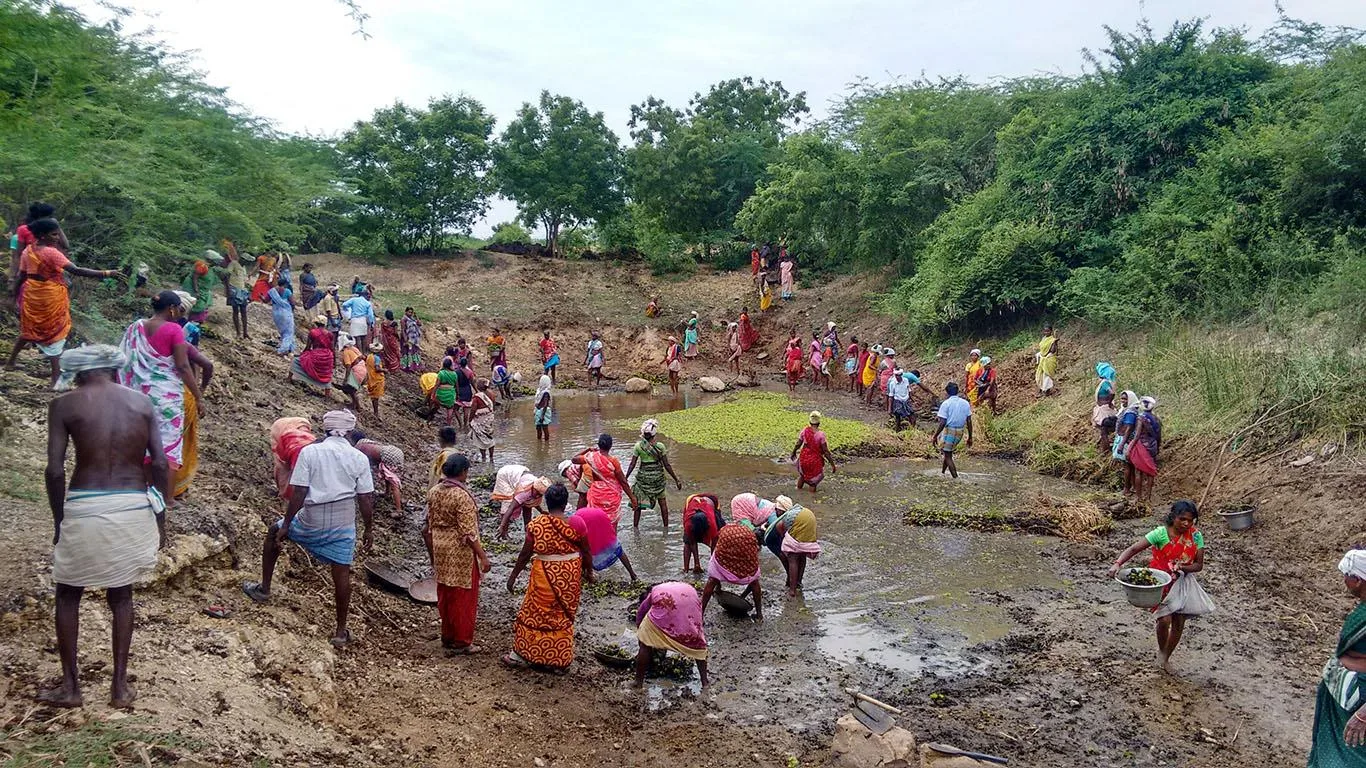
Fourth: community-governed watershed restoration. Redirect MGNREGA and watershed development funding toward community-governed water commons — tank restoration, check dams, forest-based hydrology — with genuine gram sabha authority over water resource management, rather than state-controlled irrigation infrastructure. India’s groundwater crisis is among the most serious in the world; the solutions exist in traditional community water management systems that predate the centralised approach. Actionable by district collectors and panchayati raj departments within existing mandates.
Fifth: agroecological transition in agricultural extension services. Redirect agricultural extension from Green Revolution input promotion toward soil health, food diversity, and traditional seed variety support. Formally recognise and resource community seed banks — already functioning in states like Odisha, Chhattisgarh, and Kerala — as strategic national resilience assets rather than curiosities. India’s food security in a world of declining energy and disrupted supply chains will depend on agroecological systems that function without external inputs. Actionable within existing ICAR and agricultural ministry mandates.
Sixth: National Biocultural Mapping. Commission a mapping exercise — building on existing work by researchers like Dr. Manu Bhatnagar — identifying India’s pre-industrial bioregional units as the planning basis for community resilience infrastructure. These units correspond to the natural watershed, ecological, and cultural boundaries within which genuinely self-sufficient communities are possible. This provides the geographic foundation for BFC placement, community resource governance planning, and Scenario III institution-building at appropriate scale. Requires no new legislation. Commissionable by NITI Aayog or the Ministry of Environment with existing research capacity.
And seventh —the revival and reorientation of India’s Civil Defence Services. The Civil Defence Act 1968 already exists. Civil Defence cadres are legally constituted in every district but largely dormant. The original mandate — wartime community protection against external attack — is a relic. The reorientation GCF proposes is toward transition-phase civic continuity: training citizen leaders who can maintain basic governance functions at community level during multiple simultaneous cascade events, when neither the security apparatus nor the bureaucracy can deliver continuation of governance. The critical insight is what these citizen leaders are not: they are not security forces, they are not administrators, and they do not command. They are trained community members who understand cascade dynamics, can facilitate adaptive resource management, can serve as the human link between whatever state capacity remains functional and the community-scale institutions that have been built — and who operate with community autonomy, not state direction. Under NDMA’s existing mandate, this reorientation requires no new legislation. It requires only the political will to recognise that the transitions ahead are not primarily security threats to be suppressed but governance challenges to be navigated — and that the communities best placed to navigate them are those whose citizen leaders have been prepared in advance.
Seven recommendations where three were asked for. The justification is simple: the preparation window is the current decade, the institutional capacity to act exists across all seven, and the cost of not acting on any of them compounds with every year of delay.
What kind of collaborations is the Foundation currently seeking?
GCR is currently in its A-Series phase — building the intellectual and narrative infrastructure that must precede the B-Series community work. That developmental context shapes what kinds of collaboration are most urgent right now.
From researchers: critical engagement rather than endorsement — the kind that identifies weaknesses in the framework’s evidence base and brings specialised disciplinary knowledge to bear on GCF’s necessarily synthetic analysis. A researcher who finds methodological gaps is more valuable than one who finds the framework generally compelling.
From activists and movement organisations: genuine reassessment of individual and organisational goals — whether current efforts are directed toward the right targets given the scale and pace of the predicament. Not narrative adoption. Strategic reorientation.
From educators, journalists, and cultural influencers: the translation function GCR cannot perform alone. GCF in its current form is primarily accessible to readers already engaged with systems thinking and ecological economics. Reaching the much larger general audience requires translation across different levels of engagement, across languages, and across cultural contexts. This interview is exactly that function.
From local communities: first, ground-truthing — communities already navigating the gap between GIC’s promises and the actual trajectory, whose lived experience can test GCF’s community-level claims against reality. Then, BFC partnership — communities with the ecological setting, governance capacity, and openness to experimentation that would make them viable sites for the first demonstration BFCs.
From private philanthropy: long-term, unconditional, infrastructure-supporting commitment. Most philanthropic funding is project-specific, short-term, and tied to deliverables that impose the funder’s timeline rather than the work’s requirements. GCR needs the kind of sustained investment that cannot be broken into discrete fundable projects without distorting the work. What GCR offers philanthropic partners is association with work that, if the analysis is correct, will matter more than almost any other investment available in the coming decades.
The common thread across all five categories: GCF is not looking for converts who already agree with its conclusions. It is looking for interlocutors who will engage seriously with its analytical claims, challenge what deserves challenge, and co-create the intellectual and practical infrastructure that neither GCR nor any of these collaborators can build alone.
Suppose we meet again ten years from now. What developments would convince you that humanity has genuinely begun moving toward Scenario III?
It is worth naming what would not convince me before naming what would.
Renewable energy deployment continuing to grow while total material consumption also grows — not convincing. Green policy frameworks proliferating in institutional documents while extraction accelerates — not convincing. International agreements being signed with greater ambition while emissions and ecological overshoot continue — not convincing. The reform narrative can generate all of these signals while the underlying trajectory continues unchanged.
The imagined meeting is 2035 — the midpoint of GCF’s critical preparation decade. Civilisational stress will almost certainly be more visible than today. The question is not whether that stress is present by 2035. It will be. The question is whether, against that background, something genuinely different is also becoming visible.
Five indicators — in language that any thoughtful person watching the world carefully would recognise.
The first is a change in the direction of human ambition. When the person who restores a watershed is more admired than the person who builds a new factory — when that admiration is culturally normal in growing pockets of the world — something has moved.
The second is active decommissioning of dangerous and hazardous technologies. Not merely the decision to build no new nuclear plants or large dams — but the organised, politically supported dismantling of existing ones. The willingness to pay the costs of dismantling rather than extending dangerous infrastructure because decommissioning is expensive is one of the most honest available signals of genuine civilisational direction change.
The third is communities demonstrating genuine self-reliance and choosing to maintain it — not communities forced into it by collapse, but communities that chose it, built it deliberately, and are visibly flourishing within it. If those communities exist in sufficient number that others are following their example out of genuine preference, that is the B-Series indicator that cannot be faked.
The fourth is a public conversation about the future that can speak honestly about civilisational limits and the necessity of simplification — in mainstream media, in educational institutions, in community gatherings — with seriousness rather than dismissal.
And the fifth — the most personal and difficult to quantify — is whether the people who have invested their lives in Scenario III work are recognisably less isolated in 2035 than they are today. The seed savers, the watershed restorers, the community governance builders — if they are connected, recognised, and understood as doing something genuinely important by enough people to constitute a real cultural current, something has moved that matters.
If we meet in 2035 and there is genuine movement on even two or three of these five — against whatever background of stress that decade produces — the fruit trees have been planted in sufficient number that the harvest, whenever it comes and for whoever it comes, is more likely than it would have been without the planting.
That is what this conversation is part of. And if Panthi’s readers are still having conversations like this one in 2035 — honestly, without illusion — that itself will be a sign that something worth preserving has survived.
The final part of this series submits GCF’s claims to their hardest tests — the questions that any rigorous framework must be able to answer honestly: does it romanticise the poverty of marginalised communities, does it adequately engage the concerns of Dalit and Adivasi activists, and how confident can GCF actually be in its own scenario probabilities?
Global Crisis Response | www.globalcrisisresponse.org Mumbai, India | 2026
This is the fifth of six parts. Part Six — Testing GCF’s Integrity: The Hard Questions — will be published shortly.
A.K Shiburaj began his journalism career in 2000 with the publication of Samvadam magazine from Kozhikode. He later worked as a teacher on the Maldives island and engaged in social work across North Indian states. He practiced organic farming for a time and served as the Assistant Editor of Keralayam Magazine (Web). He is now a freelance journalist and an advocate for civil society and social movements. He is a recipient of the Maja Koene Social Journalist Award in 2025.