
Beyond Capitalism: From Diagnosis to Civilisational Alternative
In the first two parts of this conversation, Sudhir Shetty established the Global Crisis Framework’s diagnostic foundations — GIC as a living superorganism, the thermodynamic evidence for civilisational simplification, the Three Scenarios available to humanity, and the practical tools for evaluating which responses are genuinely adequate. In this third part, he moves into the most politically contested terrain: the relationship between capitalism, Growthism, and ecological collapse; the justice dimensions that thermodynamic analysis cannot fully address alone; and the economic visions of Mahatma Gandhi and J.C. Kumarappa as inspiring and practically grounded precedents for what a civilisational alternative could look like. Readers will find this the most politically charged part of the series — and perhaps the most historically grounded.
NAVIGATING CIVILISATIONAL COLLAPSE
A Conversation with Sudhir Shetty — Part Three
Many readers may notice that your analysis speaks extensively about growth but relatively little about capitalism itself. Do you think capitalism is the central driver of ecological collapse, or merely one expression of a deeper civilisational logic?
GCF did not arrive at its position on capitalism from a Marxist or equity lens. It arrived from sustained investigation of the biophysical and thermodynamic foundations of the crisis. That origin matters, because the conclusions are different from most left-ecological critique — and they need to be stated precisely.
The impulse toward expansion, accumulation, and increasing complexity is not new to human history. Every major empire and centralised civilisation — Mesopotamian, Roman, Chinese, Mughal, Aztec — exhibited it. But that impulse was always eventually constrained by the ecological and energy limits of its time: soil exhaustion, deforestation, water depletion, the limits of wood and wind and animal power. When those limits were exceeded, civilisations collapsed — locally and regionally, not globally, and the biosphere recovered over centuries. What is genuinely unprecedented about Global Industrial Civilisation is that fossil energy removed those constraints for the first time in human history, converting what had always been a locally destructive but ultimately self-limiting impulse into a planetary-scale force with no functioning ecological feedback to stop it.
This is what GCF calls Growthism — not the ancient human growth impulse itself, but its specific current form: institutionalised, fossil-energy-enabled, and genuinely unconstrained. Growthism is the civilisational operating system of GIC: the imperative of perpetual quantitative expansion of material throughput, energy consumption, and economic complexity, now operating at planetary scale for the first time. It is the cancer, not the growth impulse itself — because cancer is not growth per se but growth that has escaped the regulatory systems that previously kept it within bounds.
Capitalism did not create this. But capitalism was the first institutional machinery to systematise the growth impulse into self-reinforcing cycles that pre-dated fossil energy and then fused with it explosively. Capitalism’s defining architecture — private ownership of productive assets, profit-driven investment as the primary resource allocation mechanism, wage labour as the primary distributive mechanism, market exchange as the primary coordination mechanism — creates a system that must expand to remain solvent. A capitalist firm that stops growing loses to competitors. A capitalist economy that stops growing generates unemployment, debt default, and fiscal crisis. Growth is not an external requirement imposed on capitalism — it is encoded in capitalism’s institutional DNA. When fossil energy arrived, this growth-encoding institutional machinery fused with effectively unlimited energy to produce GIC: the most powerful civilisational growth engine in human history.
Neoliberal Capitalism — the specific phase dominant since the 1980s — is best understood as a turbocharger applied to this already powerful engine. Financialisation, deregulation, privatisation, and the systematic subordination of state capacity to market discipline removed the remaining institutional moderations — labour protections, capital controls, environmental regulations, commons governance — that had been built up over decades to limit capitalism’s most destructive tendencies. The result was Growthism at maximum velocity with minimum friction. The five structural mechanisms through which this propagates across all of GIC’s institutions are: debt-based monetary architecture that requires growth to remain serviceable; the employment-investment-profit chain that makes jobs dependent on expansion; state fiscal systems built on tax revenues that require growing economic output; financial asset values premised on growth expectations; and interstate competitive pressure that prevents any single state from decelerating without suffering capital flight and geopolitical marginalisation. These are not defining features of capitalism itself — they are what happens when capitalism’s growth-encoding logic becomes the operating architecture of an entire planetary civilisation.
The most serious progressive proposals currently on the table — income convergence, global wealth taxation, reformed multilateral governance — share a common structural blind spot. Even if implemented simultaneously, which is itself an enormous political ask, these five mechanisms reassert themselves. The reforms powerful enough to significantly redistribute power trigger precisely the growth slowdown that undermines the fiscal conditions on which those reforms depend. This is not a critique of their moral seriousness. It is a structural observation about what Growthism does to any intervention that does not address Growthism itself.
So to the question directly: capitalism is the most powerful current institutional vehicle of a deeper civilisational force — and naming it that way is not a defence of capitalism. Capitalism specifically accelerates extraction beyond what any political authority can restrain, concentrates the costs of ecological damage on those least able to bear them, and systematically destroys the commons-based governance that any genuine transition requires. These are serious charges, and they stand. The point is that they are more damning, not less, when stated precisely rather than morally.
The justice analysis and the thermodynamic analysis are not in competition. They are incomplete without each other. The thermodynamic analysis shows that simplification is coming regardless — the physics does not negotiate. The justice analysis shows who will control the terms of that simplification and who will bear its costs. A framework that answers only the thermodynamic question describes the conditions under which elite capture becomes inevitable. A framework that answers only the justice question misdirects its energy — fighting to redistribute the proceeds of a shrinking system without understanding why the system is shrinking. GCF needs both. So does every movement that intends to build something that survives what is coming.
If capitalism were replaced by another economic system while industrial growth continued, would the ecological crisis still unfold in the same way?
Yes — and the previous question’s analysis explains precisely why.
Industrial growth is like a cancer. It does not intend to destroy the biosphere. It follows its own expansion logic — more output, more throughput, more complexity — until the host system that sustains it can no longer bear the metabolic demand. The Sixth Mass Extinction already underway is the biological expression of that demand being exceeded. Whether the economy organising that growth is capitalist, socialist, or anything in between does not change the underlying thermodynamic trajectory.
Growthism predates capitalism and has expressed itself with equal ferocity through non-capitalist institutional arrangements. Soviet industrialisation — the Aral Sea drained to irrigate cotton monocultures, Chernobyl pushed beyond safety limits to meet production targets, Siberian ecosystems systematically destroyed in pursuit of industrial output — was pure Growthism without capitalism. Contemporary China operates a state-directed economy that is only partially capitalist, yet its developmental logic produces the largest rapid industrialisation in human history with commensurate ecological consequences. A post-capitalist economy that retained Growthism’s operating logic — that continued to measure success in growth, organise investment around expansion, and solve every problem by adding complexity — would follow the same thermodynamic trajectory toward the same destination. The vehicle changes. The road does not.
But this qualification carries real weight: the political economy of the transition matters enormously even when it cannot change the thermodynamic destination. Three things would be radically different under a genuinely post-capitalist arrangement. The pace of extraction could be collectively governed rather than competitively driven — the five interlocking mechanisms that capitalism encodes into every transaction would not automatically reassert themselves. The distribution of cost during simplification could be determined by democratic deliberation rather than by market power. And the political possibility of building genuine Scenario III alternatives would be dramatically less obstructed without capitalism’s structural hostility to collective ownership.
Cuba’s Special Period in the 1990s is the closest historical case study of what abrupt economic simplification looks like in practice. When Soviet subsidies collapsed overnight, Cuban GDP fell by approximately 35% within three years, and the state was forced to facilitate a rapid transition toward urban agriculture, local food production, and reduced energy dependency. The outcomes were deeply painful. But Cuba’s existing social infrastructure — universal healthcare, strong community institutions, functioning state capacity — meant the transition produced nothing like the mortality and social collapse that comparable economic shocks have produced in countries with weaker social fabric. Political economy did not prevent the simplification. It shaped how the simplification was experienced and survived. That distinction — between the thermodynamic destination and the human experience of arriving there — is one of the most important things GCF has to say.
GCF does not advocate for the abolition of all market exchange or all private enterprise. A version of community-scale, ecologically embedded, sufficiency-oriented economic exchange — market relationships operating within genuine biophysical limits — is not only possible but likely to be a feature of Scenario III communities. What GCF categorically rules out is centralised industrial capitalism at civilisational scale, organised around the growth imperative, dependent on high-EROI fossil energy, and structurally incapable of operating within planetary boundaries. That is not capitalism reformed. That is Growthism dismantled.
Some critics may argue that your framework underplays questions of class, inequality, imperialism and corporate power. How would you respond?
GCF’s primary analytical emphasis is thermodynamic and biophysical rather than political-economic. That emphasis is not accidental — it reflects the conviction that the biophysical Base Layer is the most underanalysed dimension of the crisis. But the emphasis does create a real gap — one that critics from the justice tradition will notice, and they are right to notice it.
What they may be wrong about is the conclusion they draw from it. Class, inequality, imperialism, and corporate power are not absent from GCF’s analysis. Two of GCF’s eight keystone hub stressors — Economy and Finance — map directly onto capitalism’s structural logic. The governance hub’s systematic capture by corporate interests is a named GCF mechanism. The ecological debt of the Global North — two and a half centuries of accumulated emissions from industrial development primarily benefiting Northern populations while its costs are disproportionately borne by Southern communities, Adivasi peoples, and coastal fishing villages — is the foundational injustice that GCF’s biophysical analysis makes more visible, not less.
The Titanic image needs one more deployment here. As long as the ship is afloat, the struggle for equity, justice, and power-sharing among its passengers is fully valid and morally necessary. When the ship is sinking, those struggles need a new strategic frame. The question is no longer only “who gets more of what the ship produces” — it is “who gets off the ship, who builds the islands, and on whose terms does the transition happen?”
Scenario II extends the class analysis further than most progressive frameworks currently reach — and the picture is more alarming. Most left political economy analyses class power within a functioning, expanding GIC. GCF’s Scenario II analysis asks what class power looks like when GIC is contracting. The answer is: deliberate, sophisticated capture of whatever remains viable — land, water, seed banks, energy infrastructure, digital systems, governance capacity — by those who currently control capital and have the resources to insulate themselves from the cascade. The TESCREAL cluster — Transhumanism, Effective Altruism, Longtermism and their associated ideological formations — provides the intellectual legitimation for elite transcendence during civilisational contraction. AI acceleration is the most powerful Scenario II instrument yet developed. This is not a conspiracy theory. It is a structural analysis of where class power goes when the pie stops growing and begins shrinking.
The Third Force is GCF’s answer — and it is an answer rooted in the justice tradition even when it speaks in thermodynamic language. Organised communities governing their own commons, building food sovereignty, maintaining democratic self-governance at bioregional scale — this is what justice looks like when the question shifts from “who gets more of the ship’s production” to “who builds the lifeboats and steers toward the islands.”
Is ecological collapse primarily an energy problem, or also a political problem about who controls resources and wealth?
The question sets up a binary that GCF refuses — not because both dimensions are equally important in some diplomatic sense, but because they operate at different layers of the same system and are structurally inseparable.
At the foundational layer, ecological collapse is genuinely a thermodynamic problem. Declining EROI, planetary boundary transgression, the Growth-Fossil-Complexity Tether — these are physical realities that do not respond to political will. No redistribution of wealth, no change in ownership structures, no international agreement can generate energy from nothing or reverse entropy.
But energy does not arrive in the world as a neutral substance. It arrives embedded in specific systems of ownership, infrastructure, and political control — and who controls those systems determines who survives energy stress and who does not. When the energy foundation of GIC begins contracting in earnest, who will be insulated from that contraction and who will be exposed without buffer? The answer is not thermodynamic. It is political. It is already being determined — through land acquisition, through AI concentration, through the capture of water rights and seed banks — by those who currently control capital and understand, consciously or not, what is coming.
A distinction GCF draws becomes essential at this point: the difference between virtual wealth and real wealth. Virtual wealth — financial assets, derivatives, debt instruments, digital valuations — confers enormous power while GIC’s architecture functions. But virtual wealth has no thermodynamic substance. It cannot be eaten. It cannot power a community through energy descent. The moment GIC’s energy foundation contracts sufficiently, the virtual wealth bubble pops — and what remains is only real wealth: land, water, seeds, skills, place-based knowledge, community trust.
This distinction has a radical implication. The communities currently measured as poorest by GIC’s virtual wealth metrics — Adivasi communities managing forest commons, subsistence farmers reading soil and water, traditional fishing communities tracking fish populations across generations — may be among the most genuinely wealthy in terms of what will matter during and after civilisational simplification. GIC has spent two centuries telling these communities they are poor and marginal. The thermodynamic reckoning will reveal a different accounting.
The question of which scenario unfolds — I, II, or III — is simultaneously an energy question and a political question. The thermodynamic destination is non-negotiable. The political contest over who controls the transition and who builds what comes next is the most urgent struggle of the coming decades. And there is a time dimension that makes this urgency concrete: the virtual wealth bubble has not yet popped. The institutional infrastructure of GIC is still functioning. The political leverage to build Scenario III alternatives, to reclaim commons, to establish community governance — it exists now in a form it will not retain once the contraction accelerates.
You present Gandhi and J.C. Kumarappa as important precedents for your Scenario III. Why do you think Gandhi’s economic vision was ignored for so long?
The question has two answers that must be held together — one biological, one historical.
The biological answer first. William Rees, the ecologist who developed the ecological footprint concept, has written on what he calls humanity’s maladaptation — the evolutionary mismatch between our biological inheritance and our current situation. The human species was shaped by millions of years of evolution in conditions of genuine scarcity, where the drives to acquire, accumulate, consume, and expand were survival advantages. Those drives — what GCF calls the BECOMING orientation — are not cultural inventions. They are biological inheritances. When the negative feedbacks that historically constrained them — food scarcity, disease, climate variability, energy limits — are removed or dramatically reduced, BECOMING runs unconstrained. The fossil energy era removed those feedbacks at civilisational scale for the first time in human history. Gandhi was asking a species hardwired for BECOMING to voluntarily choose BEING — at precisely the moment when cheap fossil energy made BECOMING appear consequence-free.
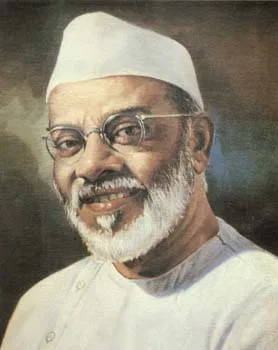
The historical answer second. When India achieved independence in 1947, the world was entering the Great Acceleration — the extraordinary explosion of energy consumption, economic output, and civilisational complexity following World War II. Cheap oil was available at unprecedented scale. The Soviet Union was demonstrating that rapid industrialisation could build a modern state within a generation. In that context, Gandhi’s vision of village economies, appropriate technology, and deliberate smallness looked like what Nehru — representing the consensus view of the leadership and educated class at the time — called it: pre-modern romanticism. The negative feedbacks that would eventually make Gandhi’s diagnosis unavoidable had not yet arrived.
What is remarkable, understood in this light, is not that Gandhi was ignored but that he saw what he saw when he did. Hind Swaraj, written in 1909, makes arguments about the structural violence and thermodynamic unsustainability of industrial civilisation that pre-date the EROI literature by half a century. He was not using energy accounting. He was using something closer to civilisational diagnosis through contemplative attention — arriving at the same conclusion as modern thermodynamic science through entirely different means. Kumarappa then translated this into the Economy of Permanence in 1945 — a formal economic framework for bioregional self-reliance — and Gandhi demonstrated his institutional seriousness by creating the All India Village Industries Association in 1934 and appointing Kumarappa as its Secretary. This was not merely theory. It was the actual construction of an alternative economic architecture.

The manner of Gandhi’s being ignored tells us as much as the fact of it. India did not reject his economic vision after careful examination. India kept his face on the currency, his name on its institutions, his moral authority in its political rhetoric — and quietly set aside the one dimension of his thought that most directly challenged the industrial dream. The Mahatma became a brand. The Economy of Permanence became a footnote.
Gandhi and Kumarappa were not wrong. They were simply early — early in the precise sense that the thermodynamic feedbacks they diagnosed had not yet arrived with sufficient force to make the alternative undeniable. Those feedbacks are arriving now. The question is whether the BEING-oriented economic vision they spent their lives articulating and demonstrating can be recovered and rebuilt fast enough to matter.
Where does your vision differ from Gandhi’s? Are there aspects of Gandhi that you would not adopt today?
A necessary admission first: I am not a scholar of Gandhi’s full spectrum of public works, ideas, or personal evolution. What follows is an attempt to engage fairly with some dimensions of his thought based on limited study — and I hold it with appropriate tentativeness.
Gandhi was a person who evolved continuously — from South Africa through to the last days of his life — and was remarkably transparent about that evolution. Any attempt to reduce him to fixed positions does him a disservice. What I can say is that his economic thinking, taken seriously, offers GCF some of its most important inheritance.
What GCF draws from Gandhi without reservation: the diagnosis that industrial civilisation is structurally violent to both people and nature. The insistence that economic decentralisation is both an ecological and political necessity. The trusteeship principle — that wealth belongs ultimately to the community, not the individual. And the means-ends coherence argument — that you cannot build a genuinely different civilisation through the methods of the existing one.
The differences — stated as directly as the limits of my understanding allow.
On technology: Gandhi is frequently misunderstood on this question, and the misunderstanding matters. His position is often characterised as a blanket rejection of machinery, but a closer reading suggests something more nuanced. What he opposed was machinery that displaced living labour at scale and concentrated productive power in the hands of a few — what he called “production by the masses” versus “mass production.” The spinning wheel was not an anti-technology symbol; it was a demonstration that human-scale, skill-preserving, community-controlled technology could sustain dignified livelihoods without industrial dependency. Kumarappa developed this into a more systematic framework of technologies appropriate to community scale and ecological context. What we now call appropriate technology — small-scale, maintainable, adapted to local conditions, preserving community skills rather than replacing them — is arguably what Gandhi and Kumarappa were pointing toward before the vocabulary existed. GCF’s distinction between technology that increases community dependency and technology that reduces it sits directly in that lineage.
On Theory of Change: Gandhi believed in the moral transformation of individuals as the primary mechanism of civilisational change. GCF’s Theory of Change is structural rather than primarily moral. Individual moral transformation matters and cannot be bypassed. But GCF does not expect it to scale fast enough to match the pace at which the thermodynamic window is closing. The IvLS strategy — building community-scale institutions before they are needed, creating the infrastructure of the Third Force while GIC still functions — is a structural intervention.
On scale: Gandhi was working within a specific national liberation movement at a specific historical moment. GCF is working at civilisational scale, across cultural contexts, in a fundamentally different historical situation. The framework must be translatable — to Kerala and to Catalonia, to Maharashtra and to Mozambique — which means it cannot simply be Gandhian.
The principle that governs all of this: take what is useful, repurpose what needs repurposing, and leave behind what the current journey does not require. That is not disrespect. It is how living traditions remain living rather than becoming museums.
India continues to pursue rapid industrialisation. Do you think Gandhi’s decentralised vision is still politically possible?
The question contains an assumption worth examining. “Politically possible” implies that Gandhi’s decentralised vision is an optional policy choice — something that requires sufficient political will to implement within the existing developmental framework. That framing misses what GCF’s analysis establishes: decentralised bioregional economy is not a political option that India must choose. It is the thermodynamic destination that India is moving toward whether it chooses to or not. The question is not whether Gandhi’s vision is politically possible. The question is whether India will arrive at it through conscious navigation or through the chaos of unprepared collapse.
The thermodynamic argument alone does not address something that needs to be named directly. The hundreds of millions of Indians who aspire to material improvement — better healthcare, more secure livelihoods, educational opportunity — are not wrong to want these things. What GCF says is that the industrial path India is currently pursuing cannot deliver these things on the terms it promises, because the thermodynamic foundation that made industrial development appear to deliver in the Global North is no longer available in that form.
But here is what the bioregional future can provide — and this is where the conversation needs to become concrete. A community organised around its watershed can provision itself with food security through agroecological farming that builds soil rather than depletes it. It can manage water through community-governed systems — the tank traditions, the watershed management practices, the forest-based water harvesting that existed across India before colonial and post-colonial centralisation dismantled them. It can maintain community healthcare through a combination of traditional knowledge and appropriate modern medicine at local scale. It can govern itself through gram sabha processes with genuine deliberative authority. It can sustain meaningful work — the repair, the cultivation, the craft, the care, the teaching — that GIC’s industrial logic has spent two centuries devaluing. These correspond far more directly to what the bulk of India’s population — farmers, rural workers, Adivasi communities, artisans — already knows how to provide than to anything the urban industrial economy offers.
This is the inversion that GCF’s analysis makes visible. In GIC’s accounting, subsistence farmers, Adivasi communities, and traditional artisans are the underdeveloped periphery. In GCF’s accounting, they are the people closest to the skills, knowledge, ecological relationships, and community governance capacity that Scenario III requires. GIC has spent two centuries telling these communities they are poor and marginal. The thermodynamic reckoning will reveal a different accounting — one in which their knowledge and practice places them in the driving seat of what comes next, not as victims of modernisation’s failure but as architects of its successor.
India already made this choice once, in 1947 — Nehru’s path of industrial modernisation versus Gandhi’s path of village economy and the Third Way between capitalism and communism. India chose Nehru. But the path not taken was not erased. The gram sabha tradition survived. The Forest Rights Act encodes community governance of commons into constitutional law. Cooperative institutions in agriculture, banking, and fisheries persist despite everything. Adivasi communities across the Western Ghats and the Eastern Ghats maintain ecological knowledge, governance traditions, and community relationships that embody exactly the bioregional self-reliance that Scenario III requires. India has more surviving Scenario III infrastructure than almost any country at comparable GDP — not because of government policy but despite it.
Gandhi was not wrong. He was simply early — early in the precise sense that the thermodynamic feedbacks he diagnosed had not yet arrived with sufficient force to make his vision undeniable. They are arriving now. The only real question is whether India’s return to bioregional organisation happens through conscious preparation or through the chaos of collapse. And the people best placed to lead that preparation are not the urban middle class or the policy elite — they are the farmers, the forest communities, the artisans, and the rural workers whom GIC has marginalised and whose knowledge it has spent two centuries trying to make them forget.
The architecture for that preparation — what GCF calls the Islands via Lifeboats Strategy — is what the next part of this series addresses directly.
Global Crisis Response | www.globalcrisisresponse.org Mumbai, India | 2026
This is the third of the series. Part Four — Building the Lifeboats: Who Can Lead the Civilisational Transition — and How — will be published shortly.
Featured image credit: Unsplash/CC0 Public Domain


A.K Shiburaj began his journalism career in 2000 with the publication of Samvadam magazine from Kozhikode. He later worked as a teacher on the Maldives island and engaged in social work across North Indian states. He practiced organic farming for a time and served as the Assistant Editor of Keralayam Magazine (Web). He is now a freelance journalist and an advocate for civil society and social movements. He is a recipient of the Maja Koene Social Journalist Award in 2025.