
Beyond Resistance: Building the Pathways to a New Civilisation
After examining the roots of the global civilisational crisis and the need for systemic transformation in the previous parts, Sudhir Shetty now turns to the practical question: who can lead the transition and through what strategy. He introduces the Islands via Lifeboats Strategy — GCF’s operational architecture for civilisational navigation — and the concept of the Third Force as the agent capable of building what states and markets structurally cannot. He examines the role of social movements, the limits and enabling functions of democratic politics, and what a viable bioregional, post-GIC civilisation might actually look like in practice.
NAVIGATING CIVILISATIONAL COLLAPSE
A Conversation with Sudhir Shetty — Part Four
Read Part One
Throughout this interview you have used the images of lifeboats and islands repeatedly. These turn out to be more than metaphors — they describe something called the Islands via Lifeboats Strategy, or IvLS. Can you explain what IvLS actually is and what makes it different from previous community-building or transition frameworks?
The most important sentence in the entire strategy is also the simplest: build the lifeboats while the ship still has functioning workshops.
Everything IvLS does follows from that sentence. The ship is GIC — still running, still providing logistics, communications, financial infrastructure, and material supply chains, though with increasing fragility. The workshops are the institutional capacity the ship still provides: the ability to coordinate at scale, move resources, train people, design governance systems, and build physical infrastructure. The window in which those workshops are available is closing. The lifeboats are not individual survival retreats or privileged enclaves. They are communities at appropriate scale and complexity — genuinely capable of food sovereignty, water security, ecological embeddedness, functional democratic governance, and the interior orientation that makes simplified life genuinely liveable rather than merely survivable. The islands are what those communities become over time: stable, bioregional, BEING-oriented forms of civilisation that function within renewable energy flows — demonstrating through their existence that a different way of organising human life is viable.
IvLS operates across three phases matched to the conditions GIC’s cascade will impose.
Phase 1 — Lifeboats (2025–2035) — is the operational heart. GIC’s infrastructure remains sufficiently functional to enable coordinated community building at scale. The ship is listing but the lights are still on. The work: establishing food production capacity independent of global supply chains; water security independent of distant infrastructure; appropriate energy systems; governance capable of genuine collective decision-making; and social cohesion — trust, reciprocity, shared narrative, the capacity to navigate disagreement without fracturing — without which all physical preparation is fragile. The Great Redistribution Window — the period in which GIC’s accumulated material surplus of seeds, tools, knowledge, and appropriate technology can still be moved toward bioregional communities before cascade makes coordinated redistribution impossible — is open now and closes within this decade. Decisions made in Phase 1 largely determine what is possible in 2035 and beyond. Phase 1 is also the window within which the most dangerous elements of GIC’s physical legacy — nuclear reactors, chemical facilities, large dam systems — can still be responsibly managed and decommissioned using the institutional capacity and energy surplus that GIC still provides. Once that surplus erodes, managed decommissioning becomes structurally impossible. This makes the current decade not just a preparation window for building Scenario III communities, but the only realistic window for preventing the contamination legacy that a disaster transition would leave behind.
Phase 2 — Navigation (2035–2045) — shifts from building to weathering. The question is no longer what to construct but whether what was built in Phase 1 holds under the conditions cascade imposes. Communities in this phase are the spaces within which the worst outcomes of Scenarios I and II can be mitigated for those who reach them. Five priorities govern it: triage, absorption of arriving people, consolidation of what was built, protection from Scenario II capture, and documentation of knowledge that must not be lost.
Phase 3 — Adaptive Islands (2045+) — is the horizon rather than a construction manual. Communities that maintained integrity through Navigation begin building the permanent architecture of Scenario III: governance maturation, inter-community networks, ecological regeneration, cultural production, and the transmission of knowledge and orientation to generations who will inherit a world that looks nothing like the one that was lost.
The institutional lineage of IvLS is explicit and important. The strategy draws directly from J.C. Kumarappa’s design for Gandhi’s All India Village Industries Association — the AIVIA — which Kumarappa directed from 1934. The AIVIA was exactly this: a temporary facilitation institution designed to catalyse local village industries until they could sustain themselves without external coordination. A research visit to Magan Sanghralaya in Wardha — the village industries museum that Kumarappa established, where the hand-operated grain mills, oil presses, weaving equipment, and soil-testing laboratory he designed still function as working demonstrations — was one of the most formative experiences informing IvLS’s design. The lineage is not theoretical. It was built, operated, and demonstrated viability in practice.
What distinguishes IvLS from previous transition frameworks — Transition Towns, permaculture design, intentional communities, degrowth economics — is the combination of thermodynamic grounding, explicit phasing timed to GIC’s cascade, and the BECOMING-to-BEING interior transformation requirement. Most previous frameworks have strong practice and weak theory, or strong theory and weak practice. IvLS insists that the interior transformation is not a spiritual supplement to the practical work but its prerequisite. Communities that reduce material complexity while remaining BECOMING-oriented experience simplification as deprivation and fragment under stress. Communities that have genuinely made the BEING shift do not experience Scenario III life as giving something up. They experience it as recovering something that was lost.
IvLS is not survivalism. Survivalism is individual self-preservation within a BECOMING orientation — hoarding, arming, retreating into isolation. IvLS is the precise opposite: community-scale, cooperative, BEING-oriented, deliberately embedded in the ecological and social fabric of a bioregion, designed not for the survival of any individual or group but for the continuation of what is most worth carrying forward from the human journey.
If governments and markets cannot lead this transition, who actually can?
The honest answer requires first being precise about why states and markets cannot lead — not won’t, but structurally cannot — because that precision shapes everything that follows.
States are institutionally constituted to maintain the system they govern, not to transform it. Tax revenue requires economic expansion. Political legitimacy is measured in GDP growth and employment. A government that told its citizens honestly that deliberate economic simplification is necessary — and acted on that honesty — would face immediate fiscal contraction, unemployment, and electoral defeat. This is not to suggest that individual politicians are blameless — corruption, regulatory capture, and the deliberate subordination of public interest to private gain are real and morally serious failures that demand accountability. But even where politicians act with integrity, the structural architecture of GIC makes genuine transformation functionally impossible from within the system’s own logic. States can play enabling roles — protecting community autonomy, implementing existing constitutional frameworks like the Forest Rights Act or the gram sabha provisions, removing bureaucratic barriers to alternative governance — but they cannot initiate transformation. Their design prevents it.
Markets cannot lead for a structurally parallel reason. Markets require profit, which requires growth, which requires the expanding energy and material throughput the physical system can no longer sustain at civilisational scale. The logic actively selects against what transformation requires.
So who can? The Third Force — organised and networked communities that possess, simultaneously, all the properties that states and markets structurally lack. Communities can function at thermodynamically viable scale. They are not institutionally required to grow. They are resilient through decentralisation rather than fragile through complexity. They can begin acting without permission from the institutions they are building alternatives to. And crucially — they can prefigure Scenario III now, building the successor civilisation within the shell of the existing one, demonstrating that a BEING-oriented life is not just theoretically possible but actually liveable, before the thermodynamic crisis makes it the only available option.
The Third Force operates through two mutually reinforcing tracks. The first is A-Series work — the intellectual and narrative infrastructure that makes transformation thinkable at wider cultural scale. This interview is A-Series work. GCF is A-Series work. The second is B-Series work — the material construction of actual Scenario III communities: food sovereignty, water commons, community governance, appropriate technology, the social fabric of genuine mutual aid. The iron filings are already dispersed everywhere — in Mendha-Lekha’s gram swaraj experiment in Gadchiroli, in Debal Deb’s seed sovereignty work across eastern India, in the community water management traditions still functioning across the Deccan and the Western Ghats. What they currently lack is the magnetic field that would help them recognise each other, understand the bigger civilisational picture in which their work is situated, and orient their collective energy toward Scenario III.
An isolated community, however thoughtfully built, is fragile. It lacks the knowledge specialisation, the mutual aid capacity, and the resilience of a network. Individual lifeboats face odds that a coordinated fleet does not. What makes Scenario III viable is not individual communities but a synchronised network of them — geographically distributed, bioregionally rooted, coordinated by shared frameworks without losing their autonomy. The communities of the Global South — particularly those that retain traditional ecological knowledge, practise subsistence agriculture, and have not fully surrendered food sovereignty to industrial supply chains — are not underdeveloped in this frame. They are in possession of the most strategically important knowledge and practices available right now: how to live well within ecological limits.
The Third Force is not a replacement for existing social movements. It is a reorientation of movement energy — from exclusively resistive work toward the combination of resistance and construction that the strategic situation now requires.
The preparation window is not a single moment waiting at the end of a countdown. It is a series of openings — each significant cascade event in GIC’s progressive stressing creates a moment of instability in which the Third Force can expand its reach, demonstrate its viability, and position itself to shape what follows. GCF estimates the 2025–2040 period as the critical preparation phase. Every financial crisis, every supply chain disruption, every governance failure, every ecological threshold crossing is simultaneously a threat and an opportunity. The Third Force that is most prepared when those windows open will have the most influence over what comes next. That is not passive resilience-building. It is active strategic positioning for a specific and approaching historical moment.
Can a global civilisation transform itself through millions of local initiatives, or will some kind of international political movement also be necessary?
The question presents a binary that GCF’s Theory of Change dissolves rather than resolves in favour of either option.
Millions of local initiatives alone cannot transform a global civilisation for a simple reason: without shared language, shared framework, and shared story, dispersed local work cannot recognise itself as part of a larger movement, cannot learn systematically from itself, and cannot orient its collective energy toward a common direction. The iron filings are already there — in the community water management traditions of the Deccan, in the seed sovereignty work of eastern India, in the gram swaraj experiments of Gadchiroli, in the forest commons governance of Adivasi communities across the Ghats. What they currently lack is the magnetic field.
But an international political movement in the conventional sense — attempting to capture or reform existing global institutions — faces a structural impossibility that previous movements discovered at real cost. The World Social Forum, the global climate movement, the anti-globalisation movement — each attempted to coordinate progressive transformation through or against existing institutional architecture, and each encountered the same structural ceiling: the institutions could be pressured at the margins but not redirected at the core. The Paradigm Trap operates at the international institutional level with the same force it operates at the disciplinary level.
What is actually possible is a third form of coordination: a distributed constellation of communities, thinkers, practitioners, and movements that share a framework, recognise each other across geographic and cultural distance, and coordinate horizontally without requiring a commanding institution at the centre. This kind of distributed coordination was not available at the scale and speed required to previous generations. It is available now — the same digital infrastructure that GIC built to accelerate its own expansion has inadvertently created the connective tissue through which the Third Force can find its coherence.
GCF’s Theory of Change requires both tracks working in tandem. The A-Series track is the magnetic field. The B-Series track is the iron filings given direction. Neither track alone is sufficient. Every viable Scenario III community that exists makes the story more credible. Every person who understands the story more deeply is more likely to commit to building a viable community. The two tracks are not sequential — they are simultaneous and mutually reinforcing.
What kind of story does the situation actually require? Not merely a critique of the existing system — there is no shortage of those. Not merely a vision of an alternative — there is no shortage of those either. What is missing is a mobilising narrative that addresses the full architecture of the question simultaneously: WHAT is actually happening and why existing frameworks cannot see it; WHY the current trajectory is not a policy failure but a structural predicament; WHERE the genuine pathways are and WHICH ones are sophisticated dead ends and which ones are actually desirable, sustainable and viable; WHO has the agency to act and through what mechanisms; and HOW the transition can actually be navigated in the time available. GCF is one attempt to build that kind of integrated mobilising narrative — and whether it succeeds in this ambition is for others to assess. The need for this kind of integrated story is not in question.
History shows that major social transformations often emerge through political struggles and mass movements. How does your framework engage with social movements?
The social movement tradition has genuinely accomplished things — and what follows is not an argument against movements but about what the current strategic situation requires from them.
The great social transformations of the 19th and 20th centuries — the labour movement, the anti-colonial movement, the civil rights movement, India’s own independence struggle — were movements fighting to access and redistribute the benefits of an expanding system. The assumption underlying each of these struggles was that the system being contested would continue to expand. That assumption made resistance and redistribution the primary strategic tools.
The current predicament is different in kind, not just in degree. This crisis is existential and unprecedented — not unprecedented in the sense that crises have not occurred before, but unprecedented in that no previous crisis has simultaneously threatened the biophysical foundations of all human societies at civilisational scale. Previous movements operated within a growing system and fought over its distribution. The Third Force must operate within a contracting system and navigate its simplification. That is a completely different strategic situation.
Social movements in GCF’s framework retain two specific and genuinely important functions. The first is resistance to Scenario II — the active, deliberate capture of remaining viable infrastructure by those who currently control capital. The forest rights movement resisting displacement of communities from mineral-rich land in central India is Scenario II resistance in practice. These communities are being displaced through a combination of corporate-state nexus, regulatory capture, and the broader Scenario II logic of capturing remaining viable resources — all operating simultaneously and reinforcing each other. Resistance to that displacement is essential and honourable.
The second function is widening the Overton window — making it culturally and politically thinkable to speak honestly about civilisational transition, about deliberate simplification, about the successor system that must be built.
But here is what the current strategic situation adds to these two traditional functions. Every movement that resists extraction without simultaneously building alternatives leaves its members with nowhere to go. The Muthanga land struggle in Wayanad, the twenty-year arc that your journalism has documented carefully — the Adivasi communities who occupied that forest land were asserting a fundamental right to the ecological basis of their survival. They were right. They are still right. And yet two decades later they are still struggling for what the Constitution already promises them. The resistance was necessary. But resistance alone does not create the food sovereignty, the water security, and the community governance that those communities need to survive what is coming regardless of what the state does.
The movements that will matter most in the coming decades are those that are simultaneously resisting Scenario II capture and building Scenario III capacity. Debal Deb’s seed sovereignty work is doing both. Mendha-Lekha is doing both. These are not exceptional cases. They are the template.
Do you see hope in democratic politics, or do you think meaningful change must largely happen outside existing political institutions?
Both the naive yes and the cynical no would misrepresent GCF’s actual position on democratic politics — so the answer requires some precision.
Democratic institutions are failing for two compounding reasons. The first is the one most activists rightly name: specific politicians, regulators, and corporate interests who have captured these institutions for private gain, flouted laws, and systematically subordinated public interest to personal and commercial advantage. Corruption is real. Those responsible deserve accountability. The second reason is structural and in some ways more disturbing: even where institutions function with integrity and individuals act in good faith, the architecture of GIC makes genuine transformation functionally impossible from within the system’s own logic. Tax revenues depend on growth. Growth depends on investment. Investment depends on the political conditions that protect capital accumulation. The result is a structural colonisation of democratic institutions by growth-dependent interests that operates not through conspiracy but through the automatic operation of incentives. This is a global pattern — visible across political systems of every ideological stripe, in democracies old and new, in the Global North and the Global South alike.
And yet GCF is not abandoning democratic values. It is distinguishing between democratic values and democratic institutions as currently constituted. Participation, collective self-governance, accountability, the protection of commons from private capture — these are genuinely democratic values, and they are values that Scenario III communities embody more fully in their actual daily functioning than most electoral systems do. A gram sabha with genuine deliberative authority over local resources is more democratically real than a five-yearly election in which the contending parties are structurally committed to the same growth trajectory regardless of their stated differences.
The time dimension must be stated honestly. Democratic processes, working as designed, require decades to produce systemic change. The thermodynamic window GCF identifies — 2025 to 2040 as the critical preparation phase — is not measured in generations. The compression of the action window has not made democracy irrelevant. It has made democratic processes insufficient as the primary mechanism of the transition.
Where democratic politics genuinely matters is in its enabling function. In contexts where democratic institutions retain sufficient independence to act, they can protect the space within which Scenario III alternatives are built. Land access legislation. Legal frameworks for cooperative and commons ownership. Full implementation of existing constitutional provisions — the Forest Rights Act, the gram sabha powers of the 73rd and 74th Amendments. Protection of civil society from the criminalisation that Scenario II consolidation systematically deploys against those who resist it.
GCF formalises these enabling conditions under the concept of Navigation Safety Infrastructure — the institutional, legal, and civil society architecture that determines whether building Scenario III institutions is survivable in a given context. The quality of the justice system, the independence of civil society, the protection of commons rights — these are not peripheral concerns. They are the conditions that determine whether the preparation window is open or foreclosed in any specific community context. Communities in contexts with strong Navigation Safety Infrastructure can build more openly and more ambitiously. Communities in contexts where civil society is being criminalised must build differently — more quietly, more networked, more careful about visibility. The strategy adapts to the conditions. The direction does not change.
The relationship GCF proposes between democratic politics and the transition is therefore neither hope nor abandonment. It is strategic clarity: where democratic institutions retain sufficient functionality to protect and enable the Third Force, deploy them in that service. Where they have been so thoroughly captured that they function primarily as legitimation mechanisms for elite power, build outside them — not in opposition but in patient parallel, demonstrating through the viability of what is built that the captured institutions are progressively less relevant to the lives of the people they claim to represent.
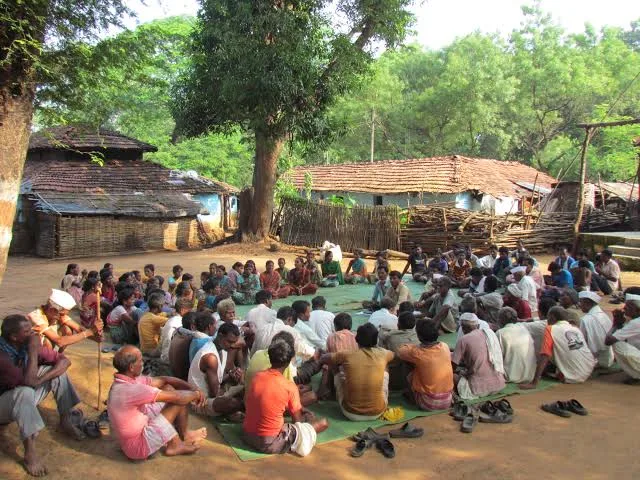
The most genuinely democratic acts available right now are not electoral. They are the gram sabha that actually governs its commons, the community seed bank that actually maintains agricultural diversity, the forest rights community that actually exercises its constitutional entitlement.
Your Foundation is called a “Think and Do Tank.” What practical work has already begun beyond writing and research?
Think & Do Tank is currently, in practice, primarily Think. The Do is aspirational — genuinely so, with specific institutional form and a clear developmental direction, but not yet materialised in the way the name implies.
What has actually been built is this. Six years of sustained independent research — funded by no institution, beholden to no funder’s agenda, conducted outside the Paradigm Trap — has produced the Global Crisis Framework: a civilisational sensemaking and navigation architecture integrating thermodynamic analysis, systems complexity, scenario architecture, theory of change, and Indian civilisational lineage into a single coherent framework. Think of it as the design specification for what needs to be built — not the building itself, but the architectural drawings without which the building cannot be coherently attempted.
The early outreach network is beginning to activate. This interview is part of that activation — the first significant Indian public discourse engagement for GCF. Alongside the Indian civil society outreach, GCF has begun engaging with researchers, study groups, and practitioners internationally who are grappling with the same civilisational questions from different cultural and intellectual traditions. These are the first A-Series nodes in what GCR intends to become a network capable of orienting the dispersed Third Force toward a shared framework.
GCR’s specific identity within this landscape is what I would call a Think Tank for the Third Force. Conventional think tanks serve existing power structures — they provide the intellectual architecture that justifies and refines what states and markets are already doing. GCR serves a completely different constituency: the communities, movements, thinkers, and practitioners who are already working toward Scenario III without yet having a shared language for what they are doing or a rigorous framework for understanding the civilisational context in which their work is situated.
The B-Series work — the material construction rather than the intellectual infrastructure — is oriented toward a specific institutional form: the Bioregional Facilitation Centre. The BFC, as GCF conceives it, is a community-scale demonstration and training institution, embedded in a specific watershed, that simultaneously models Scenario III living, trains community members in the practical skills that bioregional self-reliance requires, and provides the governance framework within which the organic transformation of surrounding communities toward Scenario III can be catalysed. This is still in concept and early design stage — honest acknowledgement required. The next phase is identifying the right community partners, the right bioregional context, and the right resource base to begin the first demonstration BFC with integrity rather than haste.
Building Scenario III is not a project one organisation completes. It is a constellation of work that many actors contribute to. GCR’s role is to provide the analytical infrastructure that makes that constellation coherent — and then to demonstrate, in one specific place with one specific community, that the framework it has developed is not just intellectually compelling but practically liveable.
Can you describe what an actual Scenario III community would look like in India?
A Scenario III community in India is simultaneously a historical reality that was dismantled, a present reality that survives in fragments, and a future reality that must be consciously constructed. All three layers matter.
Before I describe the vision, a disclaimer I consider essential. What follows is an ideal type — the best-case destination that GCF’s analysis points toward — not a prediction or a promise. The transition humanity is entering will be messy, chaotic, and deeply uncertain. Achieving even a partial version of what I am about to describe will require herculean preparation, sustained collective effort, and a substantial measure of luck. If humanity succeeds in wading through this unprecedented transition — and GCF believes that success is possible, not guaranteed — something resembling what I describe may manifest, perhaps for our grandchildren’s generation rather than our own. I offer it not as a blueprint for what will happen but as an ideal type against which prefiguration work today can orient itself. Think of it as the fruit tree our ancestors planted without expecting to taste the fruit themselves — the act of planting was the responsibility, not the harvest.
The historical layer: Dharampal’s meticulous reconstruction of pre-colonial Indian society — drawing on British administrative records that documented what they were in the process of destroying — shows that the Indian subcontinent in the 17th and early 18th century sustained a sophisticated, high-quality-of-life, decentralised civilisation organised precisely along the bioregional lines that Scenario III requires. British records document literacy rates, craft sophistication, agricultural productivity, and community governance that compared favourably with contemporary Europe. This was not primitive subsistence. It was a civilisational alternative that worked — and that was deliberately dismantled. Radhakamal Mukerjee’s Regional Sociology provides the theoretical framework for understanding why it worked. Dr. Manu Bhatnagar’s biocultural mapping of India’s pre-industrial districts gives this historical vision its geographic specificity. Kumarappa then provides the economic architecture — what a village economy of permanence looks like in institutional terms: organised sufficiency, not subsistence poverty; governed commons, not open-access extraction; meaningful work embedded in community life.
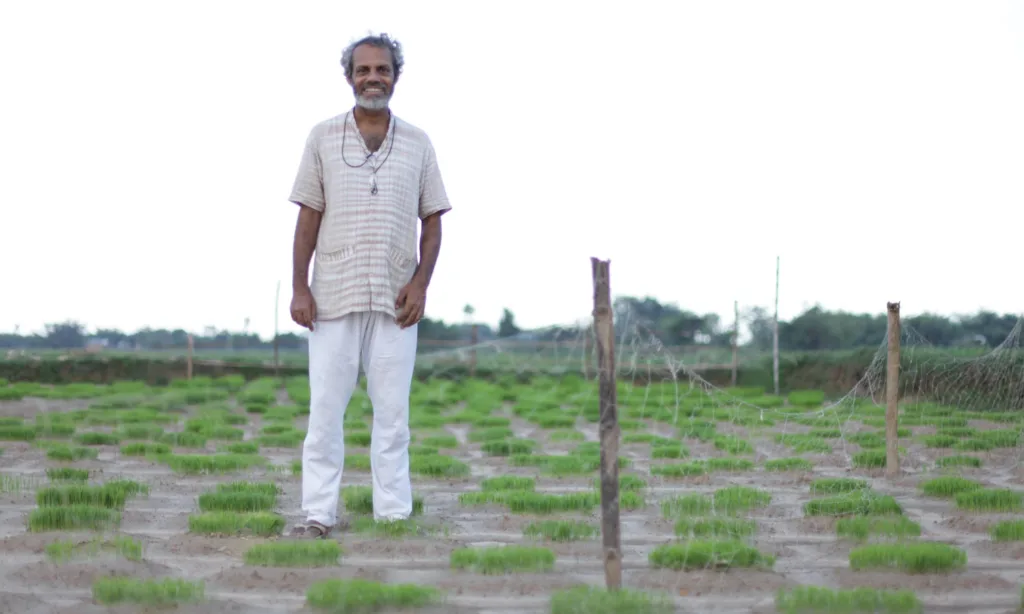
The present reality: this vision is not imagination. It exists in fragments across India right now. Mendha-Lekha in Gadchiroli — the Gond community whose declaration “In our village, we ourselves are the government” is lived practice rather than slogan — demonstrates community forest governance and democratic self-organisation at exactly the scale GCF’s community design requires. Debal Deb’s Vrihi initiative in eastern India — conserving over 1,400 rice varieties in active cultivation with traditional farming communities — demonstrates the food sovereignty infrastructure that a Scenario III community needs. In Kerala specifically — the landscape Panthi’s readers inhabit — the traditional paddy-jackfruit-coconut polyculture systems of Wayanad, the community-managed sacred groves of the midlands, the Adivasi communities of the Ghats whose relationship with forest ecology embodies millennia of accumulated knowledge — these are the living fragments of Scenario III that the current development trajectory is actively dismantling.
The ideal type itself: a community of between five hundred and five thousand people, organised around a specific watershed. Food produced through agroecological methods that regenerate rather than deplete the ecological systems they depend on. Water managed collectively through restored and enhanced traditional systems. Healthcare combining traditional botanical knowledge with appropriate modern medicine at community scale. Governance through genuine gram sabha processes — deliberative, accountable, with real authority over the commons. Work that is meaningful because it is directly connected to the community’s survival — cultivation, repair, teaching, care, craft, governance. Connection to a network of similar communities across bioregions — exchanging seeds, knowledge, governance innovations, and cultural life.
Not nostalgia. Not utopia. Not a promise. A direction worth orienting toward — and worth planting for, even if the harvest belongs to those who come after us.
The next part of this series turns to the most personal questions the framework raises: how young people can participate without land or capital, how hope is sustained without false optimism, and what would genuinely convince GCF that humanity has begun moving in the right direction.
Global Crisis Response | www.globalcrisisresponse.org Mumbai, India | 2026
This is the fourth of six parts. Part Five — Hope, Agency, and the Decade That Decides — will be published shortly.
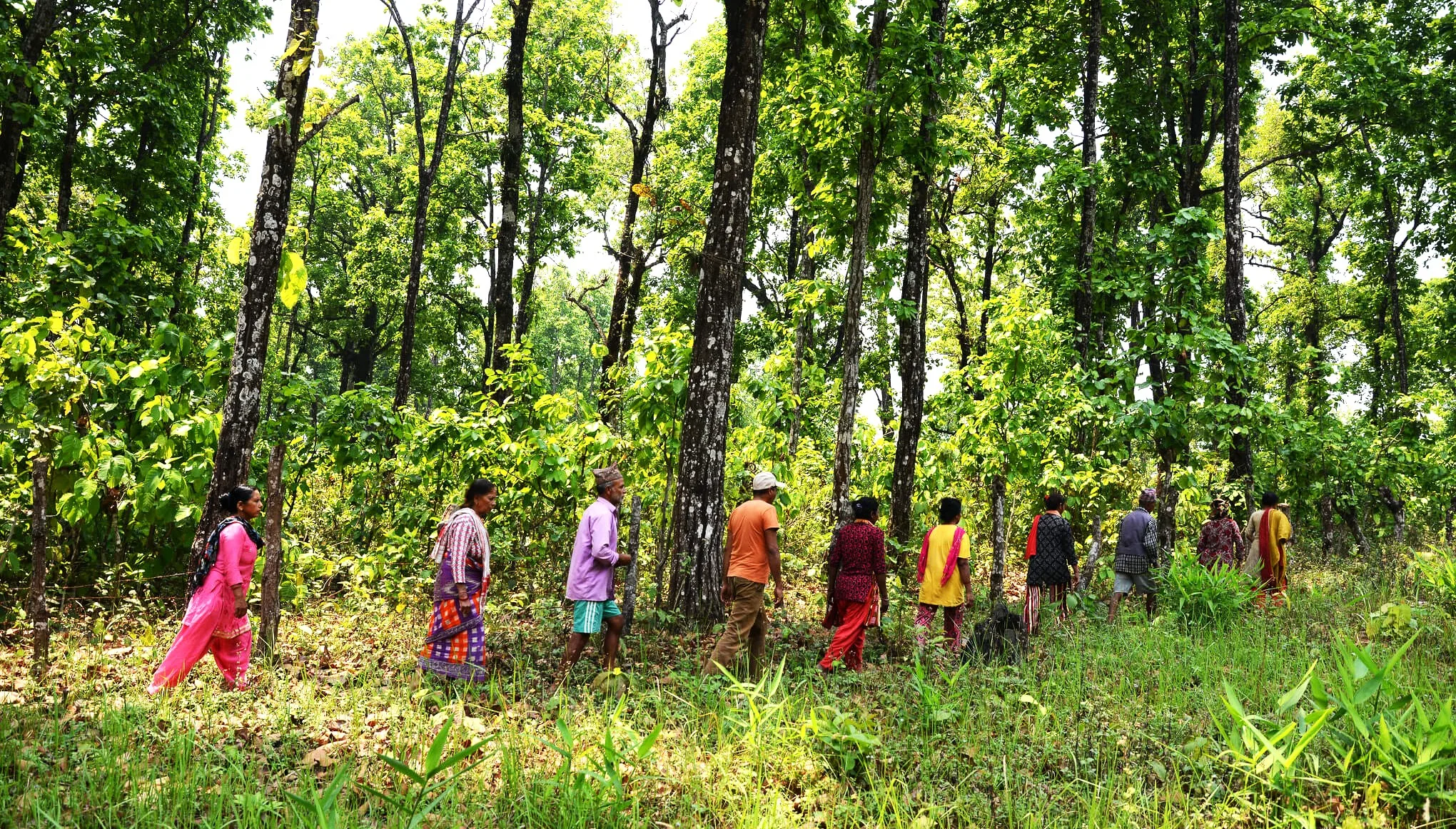
Featured Image: Odisha’s Community Forest, courtesy:iaspoint.com
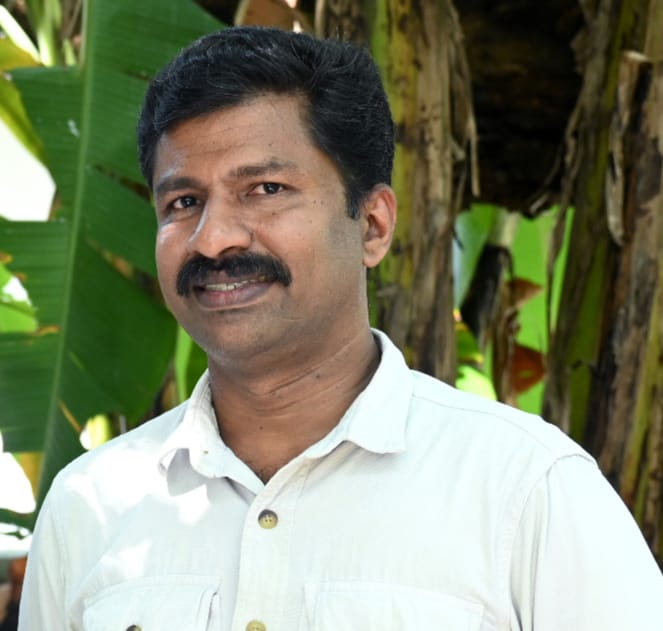
A.K Shiburaj began his journalism career in 2000 with the publication of Samvadam magazine from Kozhikode. He later worked as a teacher on the Maldives island and engaged in social work across North Indian states. He practiced organic farming for a time and served as the Assistant Editor of Keralayam Magazine (Web). He is now a freelance journalist and an advocate for civil society and social movements. He is a recipient of the Maja Koene Social Journalist Award in 2025.