Beyond Reform: The Evidence for Civilisational Transition and the Tools to Navigate It
In the second part of this interview, Sudhir Shetty, founder of the independent research initiative Global Crisis Response (GCR), examines the scientific foundations of the Global Crisis Framework (GCF). He explains why he believes humanity has entered a civilisational predicament shaped by declining net energy, ecological overshoot and systemic complexity, introduces the TERRA assessment framework, and argues that the choices made in the coming decade will determine whether the transition to a less complex society is guided by design or driven by disaster. This interview continues Panthi’s conversation on rethinking the future beyond conventional narratives of development and sustainability.
NAVIGATING CIVILISATIONAL COLLAPSE
A Conversation with Sudhir Shetty — Part Two
One of your strongest claims is that humanity has crossed thermodynamic limits. How certain is the scientific basis for this conclusion?
This question deserves a careful answer, because the degree of certainty varies across different parts of the claim.
Start with what is not seriously contested. EROI — Energy Return on Investment — measures how much energy society recovers for every unit invested in extraction. Think of it as the energy equivalent of agricultural yield: how much grain do you harvest for every grain you plant? Early oil wells returned roughly 100 units for every 1 invested. That ratio has been declining for decades across every fossil fuel source, confirmed across multiple independent research programs: Hall, Balogh & Murphy (2009), Hall, Lambert & Balogh (2014), Murphy & Hall (2010, 2011), and a major harmonisation review by Murphy et al. (2022). The direction of travel — declining net energy surplus — is not seriously contested.
Why does this decline matter concretely? Here is where a concept developed by economist Tim Morgan helps. He calls it ECoE — Energy Cost of Energy. As EROI falls, a rising share of economic output must be spent simply acquiring the energy that runs the economy, crowding out everything else: healthcare, education, infrastructure maintenance, household purchasing power. Morgan’s analysis shows that real global prosperity per capita has been declining since approximately 2007–2008, a trend concealed by GDP metrics that measure financial transactions rather than material value. This is not a future projection. It is already visible in the inflation, the austerity, the infrastructure that cannot be maintained, the declining real wages that populations across the world are currently experiencing.

A net energy cliff makes this decline non-linear. Multiple independent research programs confirm that below an EROI of approximately 10–12:1, the surplus energy available to civilisation does not decline proportionally — it falls off a cliff. Above roughly 11:1, differences in EROI make little practical difference to available surplus. Below it, each further unit of decline removes a disproportionate share of the energy civilisation has available for its non-subsistence functions.
On renewable energy, the same rigour applies. The case GCF makes is not a simple comparison of renewable versus fossil fuel energy returns at the point of production. It is about system EROI and energy density. GIC was built on, and continues to require, fossil fuels for specific functions no currently available renewable technology can replace: industrial process heat above 1,000°C required for steel and cement, liquid fuel for aviation and maritime transport, petrochemical feedstocks for agriculture and manufacturing. Beyond these irreplaceable functions, dynamic energy modelling by Capellán-Pérez et al. found that a fast transition to 100% renewable electricity consistent with Green Growth narratives could decrease system EROI from roughly 12:1 to approximately 3:1 by mid-century — well below the threshold required to sustain industrial civilisational complexity.
Here is a summary of confidence levels. The declining trend in global net energy surplus: very high confidence. The existence of a net energy cliff below approximately 10–12:1 EROI: high confidence, with genuine uncertainty in the precise threshold. The system EROI of a fully renewable GIC falling below civilisational complexity thresholds: high confidence directionally. The critical transition window falling within 2025–2045: moderate confidence — a range, not a prediction. The precise sequence of cascade events: genuinely uncertain, and GCF does not claim otherwise.
The direction of travel is reliable even when the precise timing is not — and in a predicament, direction is what matters most.
If someone accepts climate science but disagrees with your conclusions about civilisation itself, what would you say they are missing?
The climate science itself is serious work done by serious people at real professional cost. The critique here is not of that science. It is of the civilisational frame within which that science is being deployed — and the frame is doing enormous damage precisely because the science within it is credible.
Someone who accepts climate science but stops short of the civilisational conclusion is making three specific errors.
The first error is treating climate change as the crisis rather than as one symptom of the crisis. The Planetary Boundaries framework identifies nine Earth systems that define the safe operating space for human civilisation. Seven are already in overshoot — climate stability is one. The force pushing all seven past their limits simultaneously is not carbon. It is GIC’s metabolic demand — the exponential growth in physical throughput the system structurally requires regardless of what energy source powers it. Soil depletion, freshwater stress, biodiversity collapse, nitrogen cycle disruption — none of these are carbon problems. All of them are GIC problems. India itself is pressing against multiple planetary boundaries simultaneously: forest cover continues to shrink, groundwater is being extracted far faster than it recharges, river systems are biologically degraded, and soil health is declining across large agricultural tracts. Climate change is one of these pressures. It is not the only one, and addressing it alone — however important — does not resolve the others.
The second error is assuming that fuel-switching resolves the structural problem. As the previous discussion established, the system EROI of a fully renewable GIC falls well below the threshold required to sustain current complexity. Net-Zero and 100% RE transition give the impression that a decarbonised version of GIC at current scale is achievable. There is no thermodynamic evidence base for that impression.
The third error is the most uncomfortable to state. Consider who is genuinely honest about GIC’s dependency on fossil energy. Not the mainstream climate movement, which has built an entire political project on the assumption that GIC can be decarbonised without being fundamentally transformed. The fossil fuel industry. These companies are not in denial about the indispensability of their product to GIC’s functioning — their entire business model depends on understanding that dependency accurately. They are not honest out of virtue. They are honest because their survival requires it. Consider this question plainly: if every fossil fuel company announced tomorrow that it was halting all new production immediately to save the climate — would citizens celebrate? Would governments applaud? Every honest person knows the answer. The outcry would be immediate and global. That gap between what we say we want and what we actually depend on is not hypocrisy. It is the structural condition of living inside a civilisation so thoroughly built on fossil energy that its removal would be experienced not as liberation but as collapse. Think of it this way: the United States treats China as a strategic rival while depending entirely on Chinese manufacturing for the consumer goods that define its way of life. The enmity is real. The dependency is equally real. Both cannot be simultaneously resolved without transforming the way of life itself. The same logic applies to fossil fuels and GIC.
The real question — the one the “heat & burn” framing systematically prevents — is this: how do we create the conditions for a less complex civilisation, one that can sustain itself within renewable energy flows? GCF’s purpose is to make that question askable — and then to begin answering it.
Your framework relies heavily on concepts like EROI, complexity and systems collapse. How accessible do you think these ideas are for ordinary people?
The concern is fair — and the answer is not that these concepts are easy but that the urgency driving their adoption is already arriving whether people learn the vocabulary or not.
EROI, systems complexity, and cascade collapse are not concepts that most people carry in their daily vocabulary. Neither are most medical diagnostic terms — and yet a person who receives a serious diagnosis becomes, out of sheer necessity, remarkably literate in the language of their own condition. What drives the learning is not the quality of the explanation. It is the urgency of the situation becoming undeniable in lived experience.
GCF’s core concepts will spread not primarily through education campaigns but through the experience of civilisational stress becoming impossible to ignore in daily life. The inflation that cannot be explained by conventional economics. The infrastructure that cannot be maintained despite available funding. The climate events that arrive faster and harder than the models predicted. Earlier generations could navigate their lives without understanding EROI or cascade dynamics. This generation increasingly cannot — and the cultural shift in awareness will follow from that necessity, just as it has with climate science. Twenty years ago, planetary boundaries and atmospheric carbon concentrations were the specialist vocabulary of a small community. Today these concepts appear in newspaper editorials, school curricula, and political speeches. The ideas did not become simpler. The situation became undeniable.
The communities that already understand these realities most deeply are not the ones with the most technical education. They are the communities that have never been fully absorbed into GIC’s metabolic logic — Adivasi communities managing forest commons, subsistence farmers reading soil and water, traditional fishing communities tracking fish populations across generations. These communities already know, from lived practice rather than academic vocabulary, that you cannot extract more from a system than it can replenish. GCF’s technical vocabulary is, in a real sense, the academic translation of what these communities have always known and what GIC has spent two centuries trying to make them forget.
The accessibility challenge is not primarily about making difficult ideas simple. It is about two things simultaneously: giving people who already sense that something is structurally wrong a rigorous language for what they sense, and giving communities who already live the alternative a framework that shows them why what they are doing matters at a civilisational scale. This interview is part of that work.
GCF describes three broad trajectories for how the civilisational transition could unfold — three scenarios. Can you briefly explain what these are?
GCF identifies three trajectories that describe how the coming transition unfolds depending on who acts, how, and with what preparation. All three are already unfolding simultaneously. The question is which one receives the most energy, resource, and preparation in the decade that remains.
Scenario I — the default trajectory — requires nothing new. GIC continues along its current path, stresses accumulate across the eight keystone hubs, cascade events multiply, and simplification arrives not through preparation but through breakdown. No single catastrophe triggers it. The system degrades progressively, each disruption leaving it less capable of absorbing the next. Most of the world’s institutional energy — governments, international organisations, mainstream civil society — is operating within Scenario I logic: addressing symptoms, proposing reforms, negotiating agreements, and assuming the underlying system will continue to function while these adjustments take effect. The 60–70% probability GCF assigns to this trajectory is not a prediction of disaster. It is a recognition that systems in motion tend to stay in motion, and that GIC’s institutional architecture has no built-in mechanism for the structural self-transformation the predicament requires.
Scenario II is already being actively constructed. The logic is straightforward: if simplification is coming regardless, use the remaining surplus to ensure that a small minority continues living at high complexity while the majority experiences unmanaged transition. This is not a conspiracy theory — it is a structural analysis of where concentrated capital, technological development, and institutional capture are pointing. The accumulation of private land, water rights, and food production capacity by sovereign wealth funds and billionaire investors. The acceleration of AI systems that automate decision-making beyond democratic accountability. The expansion of surveillance and border infrastructure that selectively controls movement. The TESCREAL ideological cluster — Transhumanism, Effective Altruism, Longtermism — which provides philosophical legitimation for elite transcendence during civilisational contraction. GCF assigns this a 20–30% probability — higher than most people assume, because unlike Scenario III, it is being deliberately and resourcefully built by actors who understand what is coming.
Scenario III is the pathway GCF exists to enable: the deliberate, community-scale construction of resilient alternatives while GIC’s infrastructure still functions, so that the transition can be navigated with dignity rather than experienced as catastrophe. It is the hardest pathway — it requires the most preparation, the most paradigm transcendence, and the most departure from everything GIC currently rewards. GCF assigns it a 5–10% baseline probability, rising to 30–45% with adequate mobilisation during the preparation window. The gap between those two numbers is the measure of what is at stake in the next decade.
These probabilities are calibrated assessments, not computed predictions. They express relative likelihood and — most importantly — strategic significance. Scenario III is the only trajectory whose probability is uniquely sensitive to deliberate action. Scenario I proceeds automatically. Scenario II is actively funded. Scenario III only becomes more likely through the specific work of building community capacity, shifting cultural discourse, and positioning communities for the windows that cascade events will open. Every community that builds genuine food sovereignty, every framework that helps people see the predicament clearly, every journalist who asks the questions this interview is asking — each shifts the probability.
Your document argues that the current trajectory is leading toward simplification rather than continued complexity. What signs convince you that this transition has already begun?
Three kinds of evidence tell this story — what is already visible in the present, what is accelerating toward us, and what is approaching threshold.
What is already visible: the financial system’s declining capacity to absorb shocks without extraordinary intervention. The 2008 crisis required unprecedented monetary expansion to prevent cascade failure. COVID required even more — faster, larger, with less hesitation. Each intervention has left the system more debt-laden, more dependent on continued expansion of financial claims against a material economy that can no longer grow at the rate those claims require. This is not a cyclical pattern awaiting correction. It is a structural ratchet. Its human expression is already present in daily life — in the inflation that conventional economics cannot adequately explain, in the infrastructure maintenance deficits accumulating across both rich and poor nations, in the declining real wages that Tim Morgan’s SEEDS analysis shows have been falling in real terms since approximately 2007–2008.
COVID also revealed something more fundamental than a health crisis: the catastrophic fragility of just-in-time global supply chains. When factories in one country stopped, medical equipment, semiconductors, and food inputs became unavailable across the world within weeks. The Russia-Ukraine war then disrupted global grain and energy markets simultaneously, exposing how deeply food security in over fifty countries depended on two nations’ harvests. The ongoing US-China tensions over Taiwan have pushed governments to begin “friend-shoring” — deliberately restructuring supply chains to reduce dependency on geopolitical rivals — a global scramble that would have been unimaginable in the era of seamless globalisation. These are not temporary disruptions followed by recovery. They are the early visible signs of a global system that can no longer absorb the next shock as easily as it absorbed the last. Germany’s Federal Parliament commissioned a study in 2011 — the TAB Report — asking a precise question: how long could a modern industrial society function without electricity? The answer was sobering. Within fourteen days, circular dependencies between energy, water, food, finance, and communications would make restoration structurally impossible even with massive external support. Germany was the best-case scenario. Most nations would reach irreversibility faster.
What is accelerating: the simultaneous stress on all eight keystone hubs of GIC — and the compulsion mechanism that prevents any of them from slowing down. Imagine someone forced to run at full speed through an integrated minefield — all mines serially connected, locations unknown. Any next step could be the trigger. The crucial detail: this person is not running by choice. They are being driven forward by Growthism — GCF’s term for the structural imperative of perpetual expansion that is built into GIC’s architecture regardless of who owns it. Debt must be serviced, employment must be maintained, profits must grow, states must generate tax revenue — none of these can be sustained if the system decelerates. So GIC runs faster, not slower, even as the minefield becomes denser. The trigger could be a military confrontation escalating beyond control, AI-driven mass job displacement, another pandemic, or multiple breadbasket failures in the same season. GCF does not predict which mine is triggered first. The point is that Growthism is the force keeping GIC at full speed through a field it cannot map.
What is approaching threshold: the planetary boundary signals still being framed as future risks but already present in specific landscapes. Kerala knows this directly — and it is worth naming precisely, because Kerala is not a story of neglect. It is a story of how even a progressive state with strong democratic institutions and high human development indices cannot escape GIC’s expansion logic once that logic is embedded in investment patterns, infrastructure decisions, and development targets.
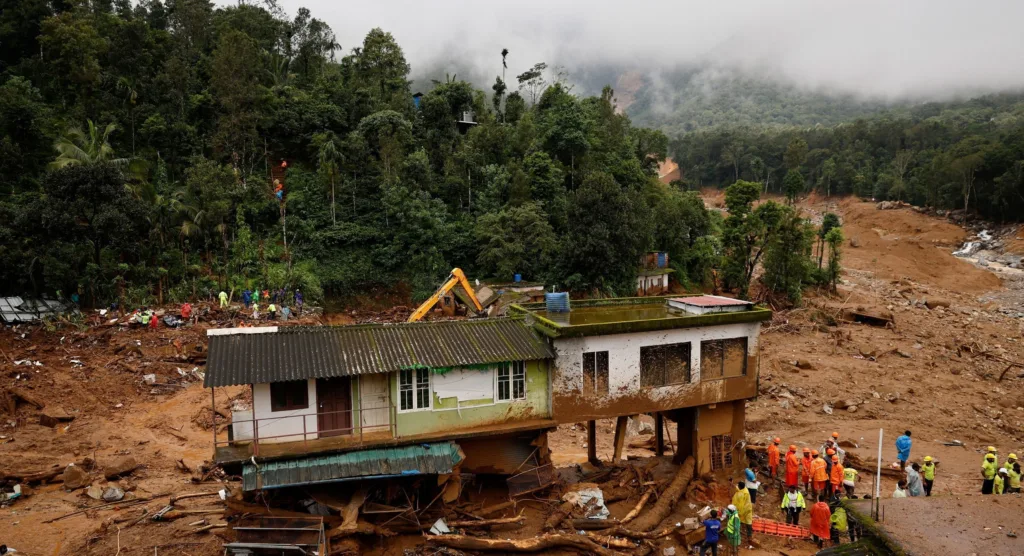
The Madhav Gadgil Committee, commissioned by the central government in 2011, mapped the Western Ghats with scientific rigour and recommended that 64% of the region be declared Ecologically Sensitive Zones, with strict restrictions on mining, quarrying, and construction. The recommendations were systematically diluted under pressure from development and extraction interests. The result was documented in the floods of 2018 — when unprecedented rainfall combined with degraded forest cover, encroached river floodplains, and destabilised hillsides to produce Kerala’s worst flood in a century. Six years later, the Wayanad landslides of July 2024 buried entire villages in minutes — in precisely the areas where deforestation, plantation monocultures, and construction on unstable slopes had been permitted despite repeated ecological warnings. These were not acts of nature alone. They were the intersection of climate change — intensifying monsoons driven by warming oceans — and development-driven ecological destruction that removed the forest systems which once absorbed and regulated that rainfall. Illegal mining, unauthorised quarrying, construction on ecologically fragile slopes — these happened because specific political and business interests captured the regulatory process and flouted protections that existed on paper. GCF does not deny this. Corruption is real, regulatory capture is real, and the communities who lost lives and homes in Wayanad have every right to demand accountability from those who overrode the Gadgil recommendations for private gain.
But the structural argument GCF makes goes further than the accountability argument — and is in some ways more disturbing. Even where there is no corruption, even where regulations are implemented in good faith, the institutional logic of GIC systematically pressures governments toward decisions that prioritise short-term economic expansion over long-term ecological integrity. The pressure comes from investment flows seeking returns, from employment needs requiring industrial activity, from state revenue requirements demanding growth, from electoral cycles rewarding visible development over invisible ecological stewardship. Kerala in 2024 is not simply a story of bad actors making bad decisions. It is a story of what happens when a progressive state with genuine democratic institutions operates within the logic of a growth-dependent civilisation whose structural imperatives are stronger than any particular government’s ecological commitments. The tragedy is not that Kerala’s politicians were uniquely corrupt. The tragedy is that the forces driving ecological destruction are powerful enough to override even the most well-intentioned governance — unless the underlying growth logic itself is challenged. That is the PAP argument in practice. That is what makes the Global Crisis a predicament rather than a problem.
Taken together, what do these three kinds of evidence tell us? Not that something has gone wrong that needs to be fixed. That is the problem-framing. In the predicament-framing: the transition from high-complexity GIC toward a less complex civilisational form has already begun. The question is not whether simplification is coming. The question is whether the communities that will live through it have begun building the capacity to navigate it consciously — or whether they will experience it as pure, unmediated collapse.
TOOLS FOR THE TRANSITION
You have developed something called TERRA. Can you explain what it is and how a philanthropist, a movement leader, or an ordinary citizen could use it as a practical tool?
TERRA — the Tool for Existential Risk and Response Assessment — is a two-question compass for evaluating any initiative, project, policy, or community that claims to be building toward a better future.
The two questions are deceptively simple. First: does this initiative genuinely understand the nature and depth of the predicament it claims to be responding to? Second: has it genuinely moved beyond the growth logic that created the predicament, or is it dressed in transformation language while remaining operationally dependent on the system it claims to be replacing?
Each question is an axis. The first — Crisis Comprehension — is the horizontal. The second — Paradigm Transcendence — is the vertical. Together they produce four quadrants that locate any initiative precisely.
Quadrant I is conventional business-as-usual — low on both axes. This is where most of the world’s economic activity, governance, and institutional work sits: operating entirely within the existing logic, accelerating it, and treating the Global Crisis as a series of manageable problems requiring technical adjustments rather than civilisational navigation. Not conspiratorial — simply the default functioning of GIC’s institutions.
Quadrant II is the most important quadrant to understand — and the primary reason TERRA exists. These are the Sophisticated Impossibilities: initiatives with high crisis awareness that have nonetheless not broken from the growth logic they critique. They are compelling precisely because they correctly diagnose the problem — and then propose solutions that require GIC to continue functioning at full capacity to deliver them.
Consider a few examples:
The SDGs frame seventeen global development goals with genuine ambition — but Goal 8 (sustained economic growth) directly contradicts Goal 13 (climate action) and Goal 15 (life on land). The framework cannot resolve this contradiction because it has not named it.
The Electric Vehicle transition proposes to decarbonise personal transport — a real and important goal — while requiring a massive expansion of mining for lithium, cobalt, and rare earth elements, new global supply chains, and electricity grid infrastructure that itself requires enormous material and energy inputs to build. The carbon arithmetic is contested; the supply chain arithmetic is not.
The Green New Deal, in its various national forms, proposes to retrofit economies for renewable energy while maintaining or increasing the scale of industrial production and consumption. It is a growth strategy dressed in ecological clothing.
Corporate ESG investing — Environmental, Social, and Governance commitments — has generated trillions of dollars of declared sustainable investment while global emissions have continued to rise. The gap between the reporting and the outcome is structural, not accidental.
TERRA identifies the common pattern across these Quadrant II initiatives: the Energy Parasite. An Energy Parasite is any initiative that articulates strong paradigm critique while depending on high energy, high complexity industrial systems for its own functioning. The test is blunt: can this initiative function twenty years into energy descent, when global supply chains are disrupted and grid electricity is unreliable? If the honest answer requires “assuming continued industrial supply chains” — it is a Quadrant II initiative regardless of its rhetoric.
Quadrant III is where most genuine alternatives to GIC’s logic currently sit — genuinely oriented toward a different kind of future, but without the full operational architecture that would allow them to function under actual energy descent conditions. Deep Adaptation — Jem Bendell’s framework — belongs here: it has done something that most frameworks refuse to do, which is accept honestly that significant disruption is not avoidable and that psychological preparation, community resilience, and the cultivation of inner resources matter more than optimising for a future that may not arrive. That intellectual honesty places it well above the Quadrant II threshold. What it has not yet fully developed is the operational architecture — the specific community-scale institutions, governance frameworks, and material preparation strategies — that would allow its communities to actually function when the disruption it names arrives. Permaculture networks, community seed banks, transition town initiatives, and degrowth academic movements share similar terrain: right direction, incomplete operational readiness for the scale of transition ahead. These initiatives need the analytical layer and institutional architecture that GCF attempts to provide — not a different direction.
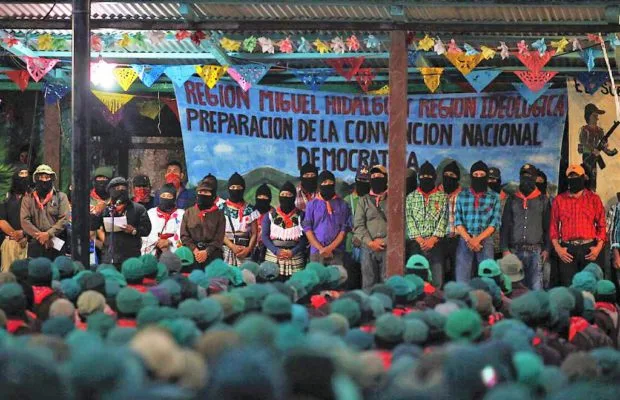
Quadrant IV is both the rarest and the destination — and the honest assessment is that no initiative currently occupies it fully. It remains aspirational even for the most advanced examples. Via Campesina, the global movement of 200 million peasant farmers organised around food sovereignty and agroecology, comes closer than most: it combines genuine thermodynamic literacy with a paradigm that centres sufficiency, community, and ecological relationship. The Zapatista autonomous communities in Chiapas, Mexico, come closer still in their governance and self-reliance — thirty years of functioning autonomous governance outside the State-Market architecture offers the most durable living demonstration that Scenario III community organisation is possible. Mature Transition Towns, particularly in the UK, have built local food, energy, and economic resilience that would survive significant supply chain disruption. What these examples share — and what makes them Quadrant IV-adjacent rather than fully there — is that they are still embedded in and partially dependent on the GIC infrastructure around them. Full Quadrant IV would mean genuine autonomy under energy descent conditions. That destination is not yet occupied by any initiative at scale. It is the work that remains to be done.
The practical application comes down to three filtering questions — applicable whether reviewing a philanthropic portfolio, assessing an organisation’s strategic direction, or evaluating a new climate proposal as an ordinary citizen: Does this initiative treat the Global Crisis as a predicament requiring civilisational navigation, or as a problem to be solved within the existing system? Does it require more industrial complexity to deliver its benefits — or less? Who governs it, and who benefits when conditions get harder?
Three questions. Five minutes. Applicable to an electric vehicle subsidy scheme, a corporate sustainability report, a government welfare programme, or a community solar proposal.
A note on scale: the figures commonly cited — roughly $87 trillion flowing annually toward Quadrant I and II initiatives, and roughly $200 million reaching genuine Quadrant IV work — are order-of-magnitude estimates intended to convey a directional reality, not precise audited measurements. The exact figures are genuinely difficult to calculate and contested in the literature. What is not contested is the structural reality those figures point toward: the overwhelming majority of the world’s capital, talent, attention, and institutional energy is directed toward initiatives that either maintain the existing trajectory or propose to reform it at the margins — and a vanishingly small fraction reaches the communities and initiatives genuinely building outside GIC’s metabolic logic.
This misallocation is not primarily the result of bad intentions. It is the result of asking the wrong questions at the point of decision. TERRA is designed to ask the right ones — and in doing so, to help redirect the resources, talent, and energy that will determine whether Scenario III has the conditions to emerge.
You argue that how the transition happens — whether by design or by disaster — will determine whether humanity reaches something viable or something far worse, including the possibility of mass extinction. Why does the manner of transition matter so much?
Most civilisational collapse discourse ignores one dimension that changes the stakes of this question entirely.
Previous civilisations collapsed and recovered. Rome fell. Mesopotamia collapsed. In each case, the landscape the survivors inherited was essentially clean. Collapse was catastrophic. It was not terminal.
GIC’s collapse carries a dimension no previous civilisational collapse has faced: a contamination and risk legacy that cannot be cleaned up, left behind, or ignored. The manner of transition determines whether that legacy becomes manageable or catastrophic.
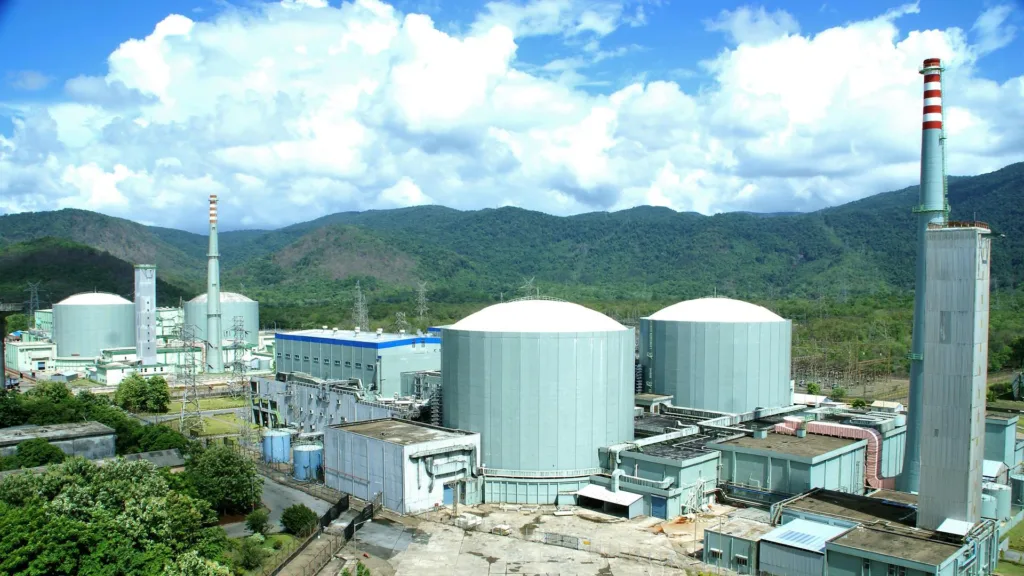
Consider the physical infrastructure. There are 440 nuclear reactors currently operating globally. Each requires continuous active management — cooling systems, fuel handling, waste storage, trained technicians, emergency response capacity, reliable electricity. Safe decommissioning takes decades and costs billions, requiring a functioning industrial civilisation to execute it. A disorganised GIC collapse means those 440 reactors entering uncontrolled deterioration — not one Fukushima but potentially dozens simultaneously, in a world where emergency response infrastructure has itself collapsed. The Western Ghats is downwind of the Kaiga nuclear plant in Karnataka. That is not an abstraction. It is a geographic fact with direct implications for what kind of future is available to communities in that region.
Beyond nuclear: thousands of industrial chemical facilities whose abandonment without proper decommissioning renders surrounding bioregions uninhabitable. Large dam systems whose catastrophic failure during increasingly extreme weather events would produce flooding of civilisation-ending scale for downstream communities. Mining sites with unstable tailings ponds. Biological research laboratories with pathogen repositories.
The AI infrastructure dimension is categorically different and in some respects more urgent. The problem with physical dangerous technologies is that abandonment without decommissioning is catastrophic. The problem with AI infrastructure is the opposite: that systems continue operating, at accelerating capability, after the human institutional capacity to govern them has degraded. Autonomous weapons systems being actively developed by multiple states with no adequate international governance framework, AI-enabled biological weapon design becoming accessible, algorithmic systems making consequential decisions with no meaningful accountability — these introduce civilisational risk vectors that no previous technology has created. A moratorium on the most dangerous AI development trajectories is as urgently necessary as nuclear decommissioning, and the governance window for achieving it is narrower still.
Wars compound all of this catastrophically. A disaster transition creates precisely the conditions under which conflicts over remaining viable resources become structurally predictable — and wars fought with AI-enabled autonomous weapons introduce escalation failure modes that no current governance framework can manage.
GCF’s analysis is precise about the timeline. The decommissioning window for most physical dangerous technologies closes within the 2025–2035 period. The governance window for AI is already closing — the pace of capability development is deliberately outrunning the pace of governance development.
A designed transition can make choices that a disaster transition cannot. It can allocate remaining energy surplus to decommissioning dangerous infrastructure before that surplus disappears. It can establish international agreements for a moratorium on the most dangerous AI development trajectories before capability thresholds are crossed that make governance impossible. It can build community food sovereignty, water security, and governance capacity that allows communities to navigate cascade conditions without depending on centralised systems that may fail simultaneously.
GCF’s founding principle states it plainly: on the current trajectory it is inevitable that humanity will be forced to transition from complex to less complex society. The question is whether this transition comes by disaster or design. Not whether simplification happens — it will. Whether the communities on the other side inherit a liveable world or a contaminated one. Whether the transition is navigated with sufficient foresight to protect the ecological systems that any post-GIC human civilisation will need to inhabit — or whether it produces the conditions for genuine mass extinction. That is what is at stake. The 2025–2035 window is when the work is still possible. Every year of delay narrows it.
The urgency of that window raises the question that Part Three addresses directly: if states and markets cannot lead this transition, who can — and what are they already building?
(Next Part of the interview will be published shortly)
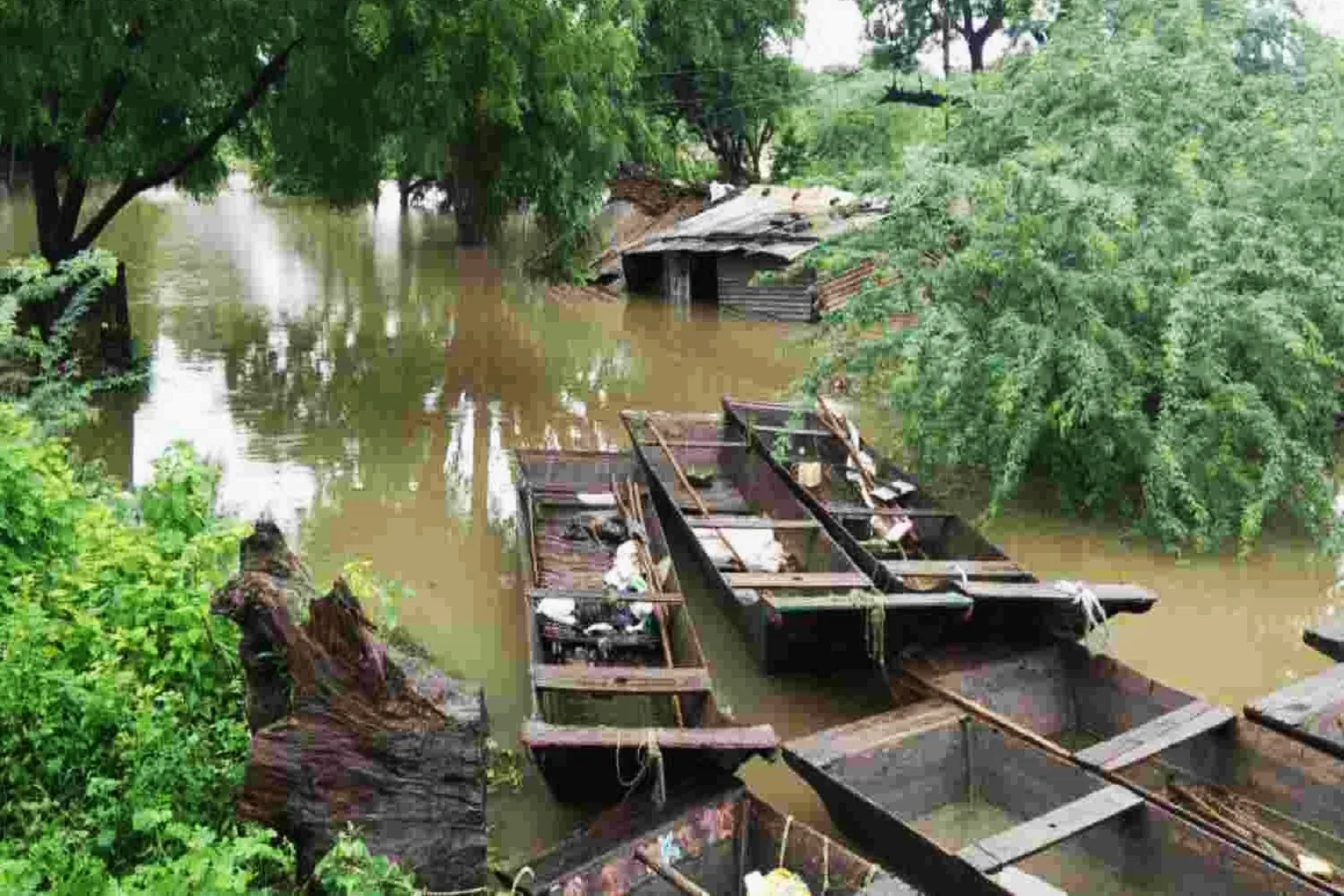
Featured Image: Nisarpur village in Madhya Pradesh submerged under the rising waters of the Narmada River. Image courtesy: IndiaSpend.com.

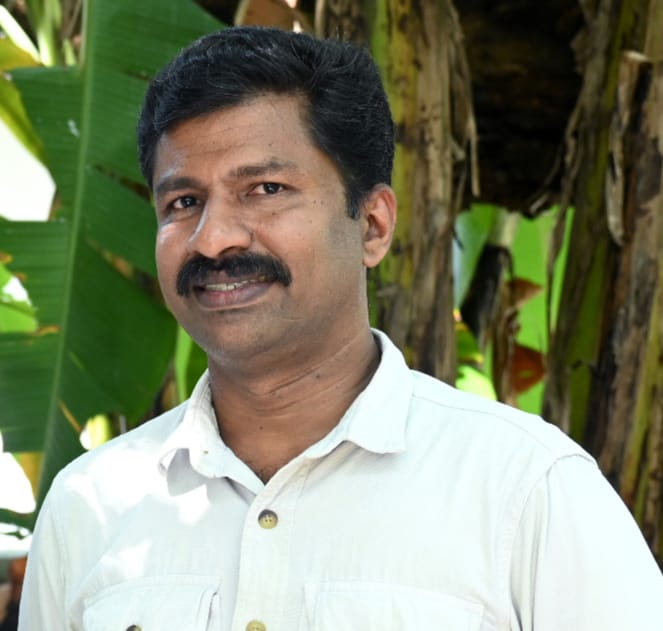
A.K Shiburaj began his journalism career in 2000 with the publication of Samvadam magazine from Kozhikode. He later worked as a teacher on the Maldives island and engaged in social work across North Indian states. He practiced organic farming for a time and served as the Assistant Editor of Keralayam Magazine (Web). He is now a freelance journalist and an advocate for civil society and social movements. He is a recipient of the Maja Koene Social Journalist Award in 2025.