

When the Rhythm Shifts: Mozda in the Present Tense-Part 2
This second part returns to Mozda not through memory or letters, but through lived encounters. Listening closely to villagers, friends, and long-time residents, it reflects on how everyday life in Mozda has been reshaped by markets, technology, state interventions, and changing aspirations. Rather than treating change as loss or failure, the article traces how autonomy, sharing, culture, and knowledge are being reconfigured under pressures far beyond the village’s choosing-raising deeper questions about development, choice, and what it means to live ethically in the present.
Rashmimala, our artist friend, was keen to visit Mozda. Her work has long been intertwined with indigenous lives and landscapes, and the village she had heard us speak about so often exerted an immediate pull. Chinnan, however, was unable to join us this time. Peppe, our dog, was unwell, and he chose to stay back. Saji, in contrast, was visibly excited. The previous night, he had already prepared all his cameras and equipment, already inhabiting the world of light, frames, and faces he hoped to capture. We had also planned to speak with a few people in the village, hoping to create a small video story on Mozda for Panthi’s upcoming YouTube channel.
On the way, we stopped for breakfast-khaman dhokla and poha with tea. Saji’s eyes, however, kept searching for something closer to a Kerala breakfast, and Swati smiled, knowing that this roadside shop would offer him little consolation. Our driver, Bipin, was careful and unhurried, though he occasionally lost his way, prompting gentle reminders from Swati, who seemed to carry the geography of this region in her body.
As the car moved through the landscape, my mind wandered through the many stories Swati and Michael had shared in their letters; stories of dilemmas and fulfilment, disappointments and quiet joys, sadness and stubborn beauty. What I had first encountered through words now accompanied me toward its physical source.
It took us around three hours to reach Juna Mozda from Vadodara. Along the way, we passed the road leading to the Statue of Unity. None of us felt any urge to visit. The monument stood in our mind as a hollow spectacle, its towering symbolism masking the hypocrisy of those who speak of unity while relentlessly dividing people for power. We also crossed near the Narmada dam site, and that proximity stirred a different memory altogether: the struggles of thousands displaced in the name of development, along with forests, fields, and riverine life submerged beneath its promise.
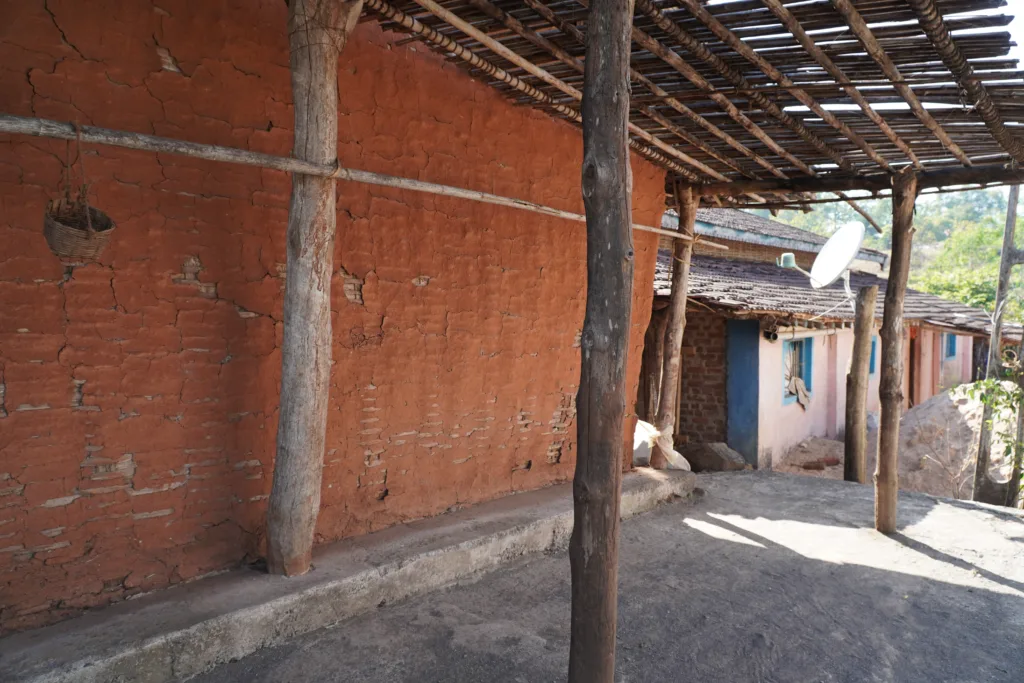
When we finally reached Mozda, we entered the house where Swati and Michael had lived for many years. The structure itself felt like an extension of the values it sheltered. Built with generous open spaces, it invited gathering, conversation, and shared reflection. Mud-plastered walls rested on bamboo; the floor was of mud rather than cement, and the tiled roof offered a cool, grounded comfort. It was a home that breathed with the village, not against it.
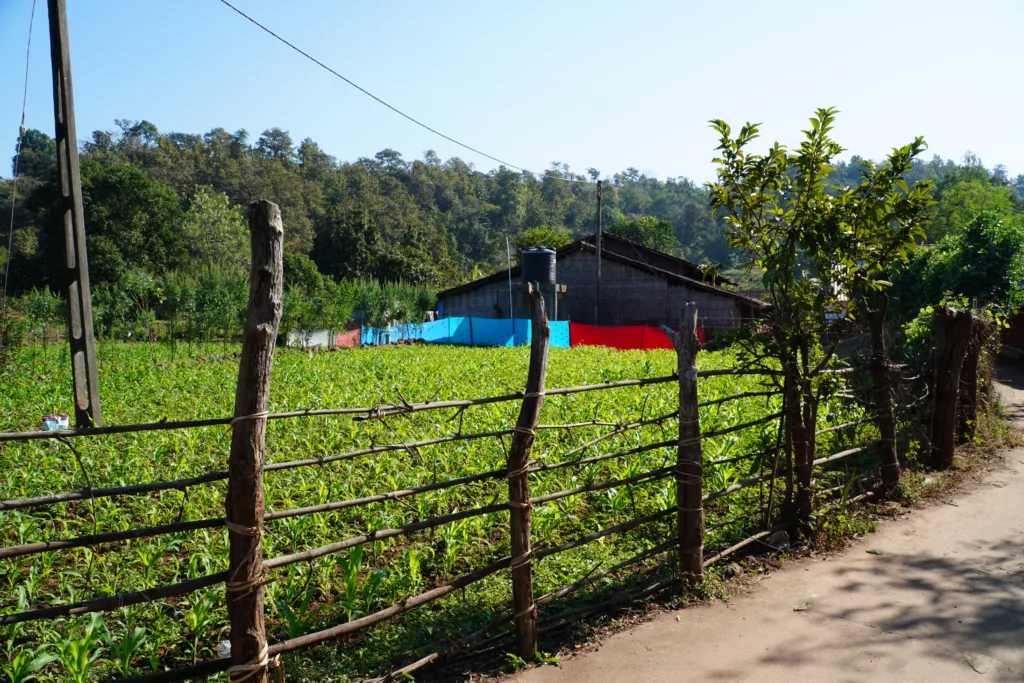
Soon after, Swathi’s friends from the village joined us. Tea was shared, and conversations unfolded slowly. This was where the story of the present Mozda began to take shape hesitantly at first, and then with a quiet honesty that was impossible to ignore.
Ramesh Vasava, a native of the village who works closely with Swati and Michael on social and environmental initiatives, spoke about the changes that have reshaped Mozda over the years. His words carried no drama, only the weight of lived experience.
Earlier, he said, cultivation was a collective activity. People worked together in the fields, singing as they laboured. Seeds were shared freely among families. Over time, hybrid seeds entered the market, and indigenous varieties slowly disappeared. With them went a certain autonomy that had once been taken for granted.
Festivals too had changed. Diwali was no longer what it had been twenty-five years ago. Earlier, people went to the forest to cut trees for building houses, and fellow villagers came together to help. There was no money involved, only shared food and the pleasure of being together. Today, concrete has replaced mud and bamboo. Evening gatherings, once accompanied by mahua and unhurried conversation, have thinned.
Holi, which earlier began fifteen days in advance with dancing and collective celebration, is now reduced to two or three days. DJs have entered village weddings, bringing with them a new soundscape that drowns out older rhythms. Change, Ramesh said, has arrived quickly, almost too quickly to comprehend.
Earlier, when someone built a house, the entire village assembled to help. Now, with money circulating more freely, that practice has faded. Help must be paid for. What was once participation has slowly turned into transaction.
Perhaps the most painful change Ramesh spoke of was political. Twenty-five years ago, political parties had little role in village decision-making. People sat together and resolved matters collectively. Today, parties have entered the village and divided hamlets along lines of influence. Bringing people together has become difficult. Where differences once existed without hostility, political affiliation now breeds tension. Money and liquor are distributed to secure loyalty, and trust is quietly eroded.
As Ramesh spoke, it became clear that Mozda had not simply “developed” or “declined.” It had been pulled into a different moral and economic current; one that rearranged relationships, values, and the meaning of living together.
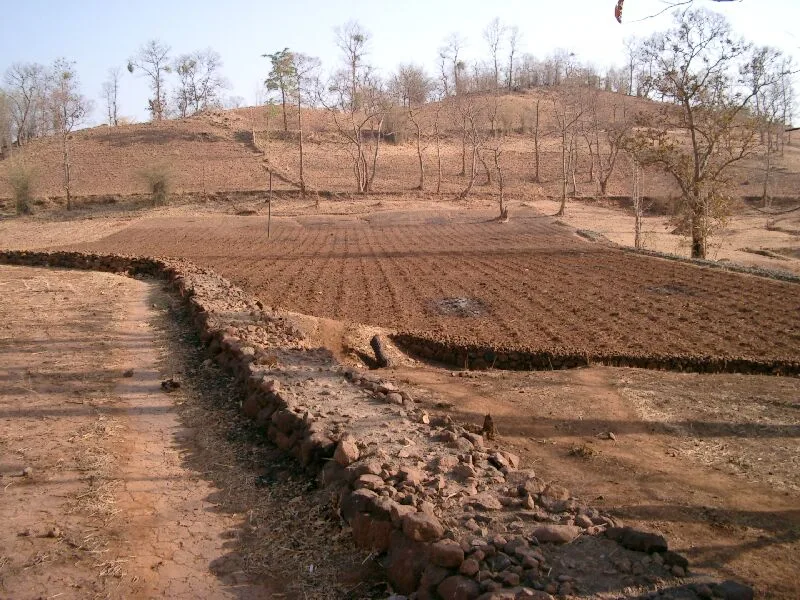
Virsing Vasava spoke next, slowly, as though measuring each change against memory. Agriculture, he said, no longer carries the same rhythm. Tractors have replaced bullocks; engines have taken over from the patient breath of animals working the soil. Millets, once the staple of everyday life, have disappeared from fields and plates alike. Earlier, rice was eaten only once a week. Now it is consumed daily. Oil, once used sparingly, has become routine. Diet, like cultivation, has shifted quietly but decisively. With these changes came a deeper transformation.
Cultivation is no longer guided by need, but by the pressure to earn. Corn has become the dominant crop, grown less for sustenance than for the market. Where pesticides were once unknown, chemical sprays have become common over the last decade. Fertilisers too have entered the soil in large quantities, altering both land and labour.
Virsing paused when he spoke about water. Watershed work, he acknowledged, helped raise groundwater levels and brought relief during difficult years. But newer technologies have complicated that gain. Solar panels have arrived, and with them borewells that draw water faster than the land can replenish. What once felt like recovery now carries the risk of depletion.
Ishwar Vasava added another layer to this story of acceleration, speaking of marriage and social life. Earlier, weddings were collective affairs unfolding over nine days of singing, dancing, and shared labour. Now celebrations are compressed into one or two days. The cost tells the story starkly: fifteen years ago, a marriage might have cost thirty to thirty-five thousand rupees. Today, expenses have risen to five lakhs or more. Earlier, families spent according to their means. Now costs are calculated first, loans are taken, and repayment stretches across years often shaping children’s futures long before they grow into them.
Education, Ishwar said, has become a threshold parents feel compelled to cross quickly. Once schooling is completed, marriage follows almost immediately. Young people enter married life without experience of agriculture, without having worked or earned on their own. The continuity of learning, once passed quietly from one generation to the next, has been broken.
He spoke next about bamboo. Earlier, bamboo was cut carefully, only as much as needed. Building a traditional house was itself a form of learning. Those who participated understood materials, technique, and limits. Children joined the work, absorbing skills without formal instruction. Today, concrete buildings have replaced those structures. With them has come a loss not only of ecological balance, but of knowledge itself. What cannot be built by hand cannot be learned by watching.
Both Virsing and Ishwar returned, in different ways, to the same reflection. Self-reliance, they said, is not only about resources. It begins with satisfaction, knowing how much is enough. Without that contentment, no amount of income or technology can create security.
Ishwar ended with a simple articulation of hope: a village where everyone is safe, where everyone has work and access to health, where people live together not in sameness but in mutual care. That, he said, remains his dream.
Listening to them, Swati did not interrupt or correct. Instead, she situated their experiences within a longer arc of change-one that could not be explained by individual choices alone. What has shifted in Mozda, she said, is not merely habit or preference, but the very conditions under which life is lived.
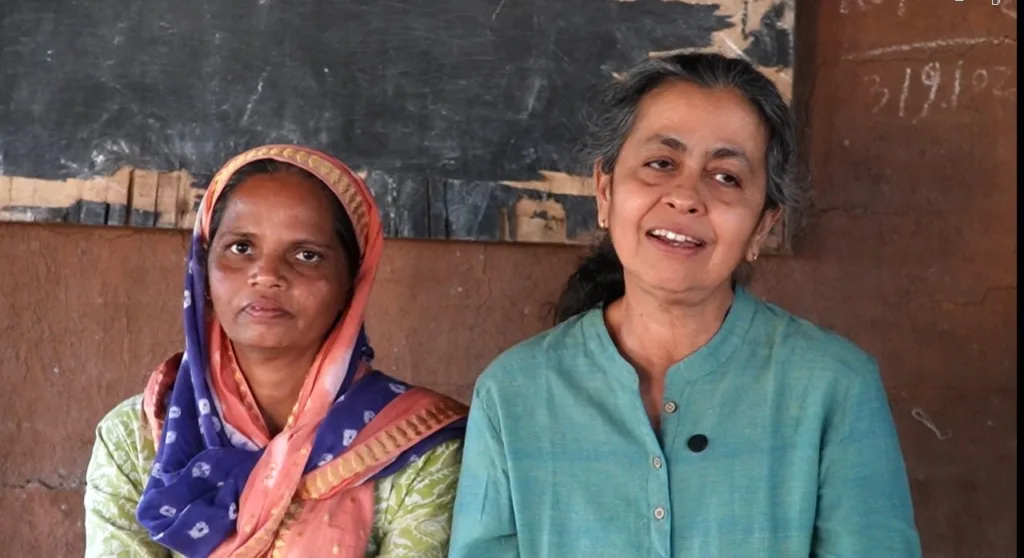
When she first arrived, needs were limited and clearly defined. The village functioned through barter and sharing. Money did not organise everyday life. Mozda felt like a single extended family-Mozda Parivar. Possession was not central; access and mutual dependence were. Over time, however, the market entered the village not abruptly, but persistently. New desires emerged alongside new commodities. Luxury did not arrive as excess, she noted, but as aspiration.
Education played a crucial role in this transformation. The present system does not recognise traditional knowledge. It is oriented toward white-collar employment and urban futures. For many tribal children, this produces a cruel tension: they are detached from inherited learning yet unable to fully succeed within dominant frameworks. With this dislocation comes mental stress, anxiety, and illness that are rarely discussed, but increasingly visible.
Swati spoke with humility about her own position. When she and Michael arrived, life in Mozda appeared to move within a coherent moral universe that she slowly learned. Today, she finds herself having to learn Mozda all over again. Familiarity has given way to the responsibility of listening anew.
She was particularly critical not of the community, but of the state’s inability to understand tribal life. Government interventions are designed without cultural comprehension. Borewells are introduced as preconditions for installing solar panels, intervening in delicate ecological relationships. Water tables fall. Cycles are disrupted. What appears as development on paper often erodes sustainability on the ground.
Culture, Swati emphasised, cannot be reduced to performance. Songs and dances associated with Diwali, Holi, weddings, or harvests are not interchangeable entertainment. Each has context, rhythm, and meaning. Work songs, harvest songs, wedding songs emerge from collective labour and shared time. They generate creativity. People compose as they sing. Expression is embedded in life, not staged. One cannot ask people to sing or dance on demand; these acts arise from season, necessity, and relationship.
The same organic logic shaped celebration itself. Festivals were not fixed by calendars but decided collectively. If harvest was delayed due to climate or labour, celebration shifted accordingly. Life followed a fluid rhythm which was responsive rather than mechanical.
Mozda also unsettled dominant assumptions about social norms. Dowry was traditionally given by the man, not the woman. Widowhood was not a stigma. Second marriages were accepted without moral panic. These were not ideological positions but practical arrangements rooted in cooperation. Living close to nature demanded relationships.
Even the economy functioned differently. Money held little importance. When people from neighbouring communities came to fish in the river, Mozda’s residents would refrain that day. The river was common, not private. Access was governed by ethics, not ownership.
With wages and jobs came a new sense of possession. Sharing became difficult not because people became selfish, but because money teaches separation. What was once ours slowly became mine.
Swati’s reflections did not mourn a lost past, nor did they idealise it. They offered a way of understanding change without moral judgement with due recognition that Mozda, like all living societies, has been drawn into larger political and economic currents. The question is not how to return to an earlier time, but how to live ethically in a present shaped by forces far beyond the village’s choosing.
When we finally left Mozda, our minds were far from settled. We carried with us a quiet unease; questions about a community that had once lived with remarkable autonomy and how that life had been reshaped. Change itself is not the problem. The question is cost: who decides its direction, whose choices it serves, and what is quietly surrendered. What seemed to be receding was not merely a set of practices, but an entire way of living attuned to the rhythms of the earth.
As we drove away, Swati recalled an incident from her early days. Women from a neighbouring village had once arrived at her house carrying two utensils found in the river. Sensing they belonged to someone from outside, they brought them back. In truth, the vessels had slipped away while they were being washed. Nothing was stolen; nothing claimed. What guided them was care-an attentiveness to what was not theirs.
That story lingered with us. Would such an act still be possible in Mozda today? Or does it belong to a moral world slowly slipping beyond reach? We did not answer. We carried the question with us. By the time we reached Vadodara, the sun had set, and darkness had settled in, not as an ending, but as a reminder that some questions are not meant to be resolved, only held.
Featured image: Inside Swati’s kitchen in Mozda. Photo: Saji P. Mathew
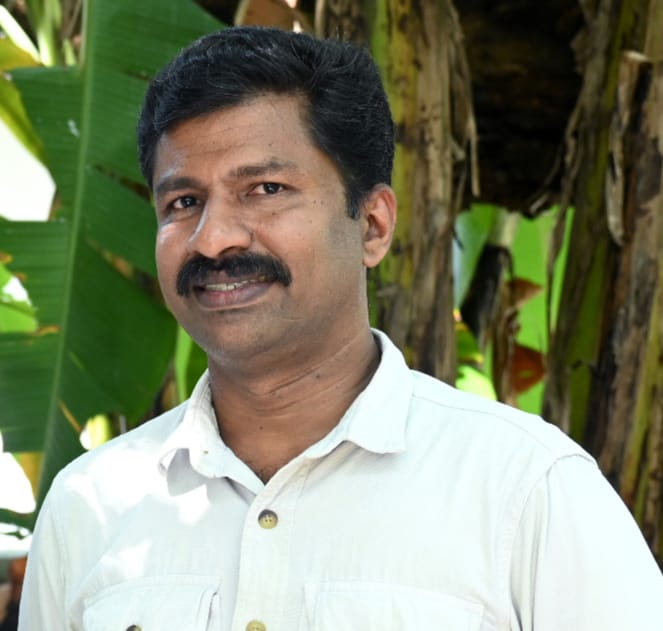
A.K Shiburaj began his journalism career in 2000 with the publication of Samvadam magazine from Kozhikode. He later worked as a teacher on the Maldives island and engaged in social work across North Indian states. He practiced organic farming for a time and served as the Assistant Editor of Keralayam Magazine (Web). He is now a freelance journalist and an advocate for civil society and social movements. He is a recipient of the Maja Koene Social Journalist Award in 2025.