
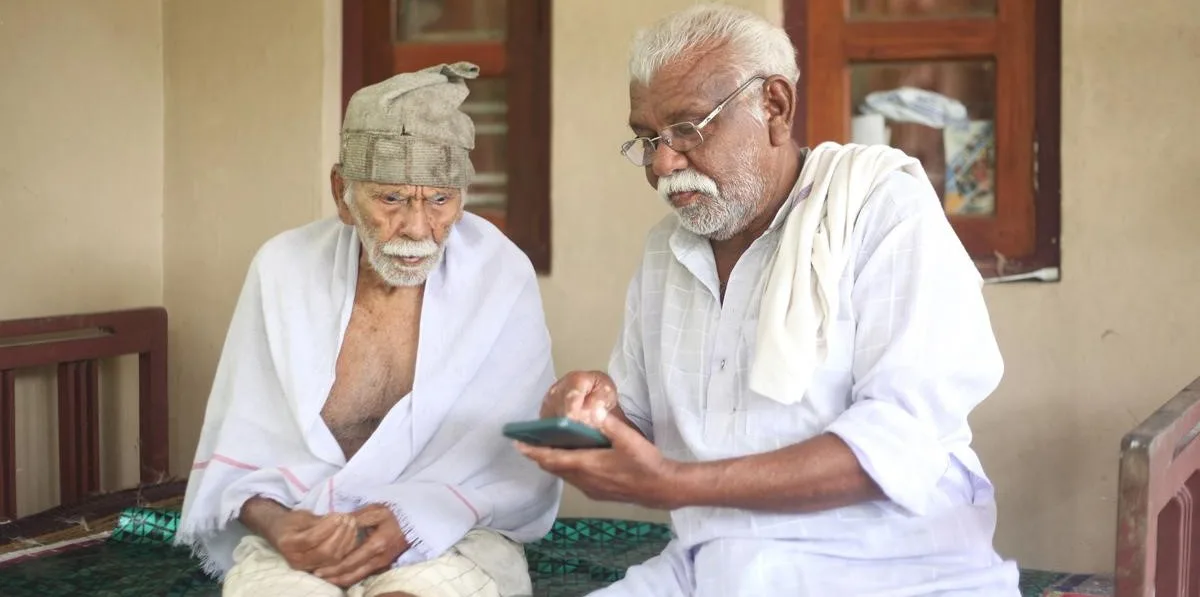
Silver Screen Paradox: How Social Media Both Heals and Harms Kerala’s Elderly
Kerala’s elderly are increasingly embracing smartphones and social media, finding in them new avenues of connection, memory, and independence. Yet beneath this digital inclusion lies a growing concern: excessive use is quietly reshaping mental health, social habits, and vulnerability among seniors. This article by Abhish K. Bose explores the paradox of technology as both a lifeline and a latent risk, drawing on lived experiences and clinical insights to examine how Kerala’s ageing population is navigating the digital age.
At 86, Nottamkandath Padinjakkara Vilasini Amma from Shornur, Palakkad, never imagined she would befriend a smartphone. She began using one only after COVID-19 shut down temple gatherings and neighbourhood kalaris in 2020.
“At first it was just for calls and OTPs for the bank,” she says. With her grandchildren’s patient help, she learned WhatsApp, Facebook, and YouTube. The screen that once seemed alien now streams live Kathakali from Guruvayur, Sopana Sangeetham from temple courtyards, and ulsavam updates from across Palakkad.
Before the pandemic, television was her only window to the world. Now, social media brings real-time news, Bhajans from her childhood, and video calls with great-grandchildren in Bengaluru and Dubai. “I’ve found old friends from my village. I see their children’s weddings. I don’t feel left behind,” she says. The digital shift, she insists, has kept her mind alert, her days full, and her sense of independence intact.
Vilasini Amma’s story shows how technology can expand an elder’s world when mobility shrinks. For her, the smartphone is a bridge.
For thousands of others in Kerala, it has become a tether.
The Other Side of the Screen
The same tools that reconnect Vilasini Amma are also driving a quiet health crisis among the state’s elderly, clinicians and a new study warn.
Consultant Clinical Psychologist Aswathi Prasad’s June 2023 study, _‘Social Media Dependency and Facebook Usage Among Older Adults in Kerala’_, surveyed 210 seniors aged 60-82 across Thiruvananthapuram, Ernakulam, and Kozhikode. The findings overturn the stereotype of elders as reluctant users.
A staggering 88.2% reported spending over three hours daily on social media, with 47.6% on Facebook alone. Nearly half — 48% — had more than 400 Facebook friends, signalling hyper-connectivity rather than passive scrolling.
The pattern wasn’t uniform. “Males and urban respondents showed higher addiction scores, and South Kerala reported 23% higher dependency than North Kerala,” Prasad says. Men, the data showed, used platforms not just for family contact but for peer validation and identity reinforcement. Urban access to fast internet and smartphones widened the gap.
“Our data suggests high digital literacy, yes, but also a tendency toward over-participation,” Prasad notes. “The phone fills a void left by migration, retirement, and bereavement. But the dose matters.”
When Connection Becomes Compulsion
Clinicians across Kerala are seeing the fallout. The symptoms repeat: poor sleep, daytime fatigue, irritability, anxiety, and a paradoxical deepening of loneliness as face-to-face interaction drops.
Dr. Sudhir Kumar, honorary consultant with the Alzheimer’s and Related Disorders Society of India (ARDSI), Kottayam, flags another risk: fraud. “Older adults are soft targets for financial scams, fake health cures, and emotional manipulation on social media. We need digital safety modules in every geriatric check-up,” he says. A non-judgmental approach is key, he adds, because shame stops many from reporting losses.
Dr. PN Suresh Kumar, Professor of Psychiatry in Kozhikode, frames it as a clinical trade-off. “For elders with mobility issues or after a spouse’s death, social media is a lifeline. It cuts isolation and gives them global family access. But excess use triggers inferiority, poor self-esteem, and anxiety. The constant comparison, the fake news, the fear of missing out — it’s real,” he says.
He’s seen working memory slip in patients who scroll late into the night. “Sleep disruption hits daytime functioning. Addictions don’t need a substance. Behavioural addictions show the same withdrawal, craving, and loss of control.”
Dr. Sivakumar P Thankaraju, Professor of Geriatric Psychiatry at NIMHANS, Bengaluru, agrees. “We’re diagnosing headache, emotional dysregulation, and depressive symptoms linked directly to 4–5 hours of daily use. Physical activity drops, real conversations drop, and the brain pays the price.”
The Kerala context makes intervention tricky. High literacy and deep diaspora ties mean social media isn’t ‘entertainment’ — it’s family. “When your son is in Toronto, Facebook isn’t a hobby. It’s how you see your grandchild,” Prasad says. That emotional load fuels compulsive checking and distress when replies are delayed.
The Way Out: Rules, Not Bans
None of the experts advocate digital abstinence. They prescribe boundaries.
“Set a clear time frame. Use app timers. No phone 90 minutes before bed,” says Dr. Suresh Kumar. Dr. Sivakumar adds: replace, don’t just remove. “Yoga, walking groups, cognitive stimulation, temple committees, library hours — the brain needs alternative rewards.”
ARDSI’s Dr. Sudhir Kumar wants public campaigns on cyber hygiene for seniors, much like pension fraud alerts. “Teach them to spot a fake profile, a UPI scam, a miracle drug ad. And families must model it — don’t gift a phone and vanish.”
Prasad’s study recommends “diaspora-inclusive interventions”. Families abroad should agree on call schedules, so elders aren’t left refreshing feeds all day. Offline support — neighbours, ward-level _ayalkoottams_, senior citizen clubs — must be revived as genuine alternatives, not afterthoughts.
“Age-friendly environments are the real prevention,” Dr. Sivakumar says. “If the park is safe, if the library has large-print books, if the community hall runs bhajan evenings, the phone becomes a tool again, not a trap.”
The Balance
Kerala’s elderly are not digital immigrants anymore. They are digital citizens, navigating the same dopamine loops as teenagers, but with added risks of fraud, insomnia, and late-life depression.
Yet the answer isn’t fear. It’s design — of habits, homes, and public spaces that give elders somewhere to look up from the screen.
Back in Shornur, Vilasini Amma has her own rule. An alarm rings at 8 pm. “That’s when I stop,” she laughs. “The phone should serve me, not the other way round.”
For a state ageing faster than any other in India, that might be the wisest notification of all.
Featured Image Courtesy: The Hindu

A journalist with 18 years of experience Abhish K Bose was a staffer at The Times of India and The Deccan Chronicle - Asian Age. As a contributor, his interviews and articles have been published in Frontline magazine, The Wire, The Print, The Telegraph, The Federal, The News Minute, Scroll, The Kochi Post, The Leaflet, The Hindu.com, Outlook.com Countercurrents.org and the Asian Lite international published out of London
- ageing and technology Kerala
- ARDSI Kerala awareness
- cyber safety elderly India
- digital addiction seniors India
- digital literacy seniors Indi
- Facebook usage older adults
- geriatric mental health Kerala
- Kerala ageing population issues
- Kerala elderly social media
- NIMHANS geriatric psychiatr
- smartphone usage older adults
- social isolation elderly Kerala
- social media dependency study Kerala
- social media mental health elderly
- technology and loneliness elderly