
Breaking the silence: Not in Ambedkar’s Name
A student from TISS reflects on a troubling shift within academic spaces, where the legacy of B. R. Ambedkar is invoked even as his core ideas are undermined. Through a firsthand account, the piece questions the growing normalization of ideological contradictions, the silencing of dissent, and the quiet transformation of universities into sites of political appropriation. It is both a critique and a call to think, to question, and to resist.
It was close to 3 in the evening when I received a mail in my institute account regarding the celebration of Ambedkar Jayanthi. As a student of a premier social science institute, engaging daily with debates around the Constitution, being taught about Dalit epistemology, and moreover as an Indian citizen, Ambedkar was always close to my heart. Even though I don’t enjoy celebrating birthdays, Ambedkar Jayanthi was something that I regarded differently. For me, Ambedkar Jayanthi was not just a celebration of one’s birth, but also a reflection, an enlightenment, an empowerment, and a historical marker of our secular, sovereign, republic nation.
So when the mail came, I was excited enough to scroll down to see who the speaker for the program was. To my surprise, the name was new and distinct, Shri Milind Ji Oak, described as a “renowned author.” After thinking about the name for a brief moment, I relied on my beloved friend ChatGPT and posed a simple question:
‘WHO IS MILIND JI OAK?’
The answer was not actually surprising. I am including the AI-generated text below for your reference:
“The ‘Milind ji Oak’ mentioned in your email is most likely Milind Oak, a senior Sangh Pracharak and author/speaker who writes on Indian history, culture, and social thought.”
This raised a series of questions in my mind:
- Why is a Sangh pracharak invited as a speaker in a premier institute like TISS?
- What does the Sangh have to do with Ambedkar?
- Do students not feel uncomfortable, or am I the only one feeling something ‘wrong’ here?
As a student aware of the present political scenario, the answers to these questions were already in my mind. TISS, being a premier institute for social sciences, has, over the past 2–3 years, fallen into the pit of saffronization, where democratic spaces within academia have shrunk, students and professors are being silenced, and dissent is being suppressed.
This incident was not the first where a ‘Sangh’-affiliated speaker was invited. This year’s Republic Day also marked a similar instance, where Dr. Vinay Sahasrabuddhe, a prominent Indian politician closely associated with the Rashtriya Swayamsevak Sangh (RSS) and regarded as one of the BJP-RSS intellectuals, was invited as a guest. It is also worth noting that, alongside such invitations, an agenda-driven documentary titled Demography is Destiny aimed at discussing infiltration, alleged deceitful religious conversions, and the declining Total Fertility Rate (TFR) among Hindus was screened at the institute on August 14, 2025, to mark Partition Horrors Remembrance Day, in the presence of Sunil Ambekar (RSS publicity head) as the chief guest. This list extends to several seminars and programs that have been happening in and around TISS recently.
While raising this issue of ‘Sangh’ invitations, I often hear my neutral peers asking: what is the problem with it? What does the Sangh have to do with Ambedkar? When we look into history, Ambedkar and the RSS were not just different but they were opposed. How can a person like Ambedkar, who burned the Manusmriti, and an organization like the RSS, which is seen as drawing from its principles, be placed on the same platform? How can someone who warned against the vision of a Hindu Rashtra be aligned with an organization that advocates for it? How appropriate is it to invite an organization perceived as standing against secular values to commemorate the birth anniversary of someone who stood firmly for those very values? Inviting a Sangh pracharak to speak on Ambedkar Jayanthi is not merely a political choice; it is, in my view, an intellectual contradiction.
In the present scenario, where power shapes agendas, it is not easy to speak against so-called ‘neutral’ voices, especially when individuals with controversial ideological positions are invited into academic spaces without opposition. This answers my third question. Students, not only in TISS but in many premier institutes, seem to have fallen into what Paulo Freire described as the “culture of silence,” where one neither questions nor resists, but passively accepts what unfolds. I, too, as a student who had fallen into this trap, have now awakened my conscience to speak against this culture of silence and to stand for an academic space where dissent is heard, debated, and respected.
Ambedkar did not simply ask us to remember him. He asked us to think. He asked us to question. He gave us a Constitution precisely so that institutions-including academic ones-could not easily be captured by majoritarian ideology. When management chooses speakers who contradict everything Ambedkar stood for, and does so in his name, on his day, the least we can do is notice. The least we can do is speak.
When academic spaces become saffronized and premier institute administrations turn into vehicles of propaganda, inviting the ‘right’ people into the ‘right’ spaces, it becomes essential to speak for your education, rise for your nation, and stand for the values of B. R. Ambedkar, not just on his Jayanthi, but every day those values are quietly being dismantled around you.
Authored by a student of Tata Institute of Social Sciences (name withheld on request)
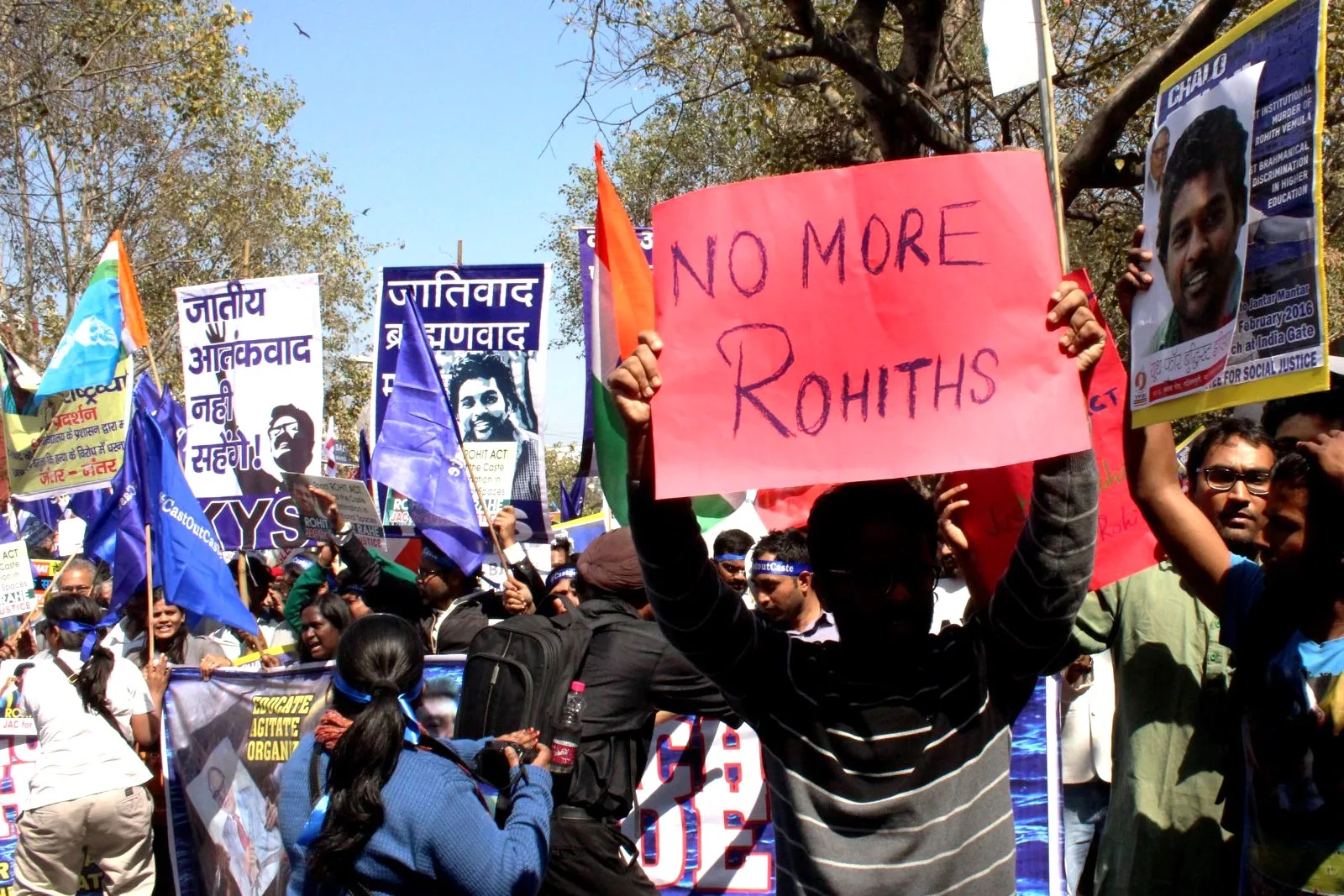
Featured image: The huge march in solidarity with JNU (against the trending #ShutdownJNU) on February 18, 2020.