
Puthuyuga Kerala: Welfare Promises Without a Productive Base?
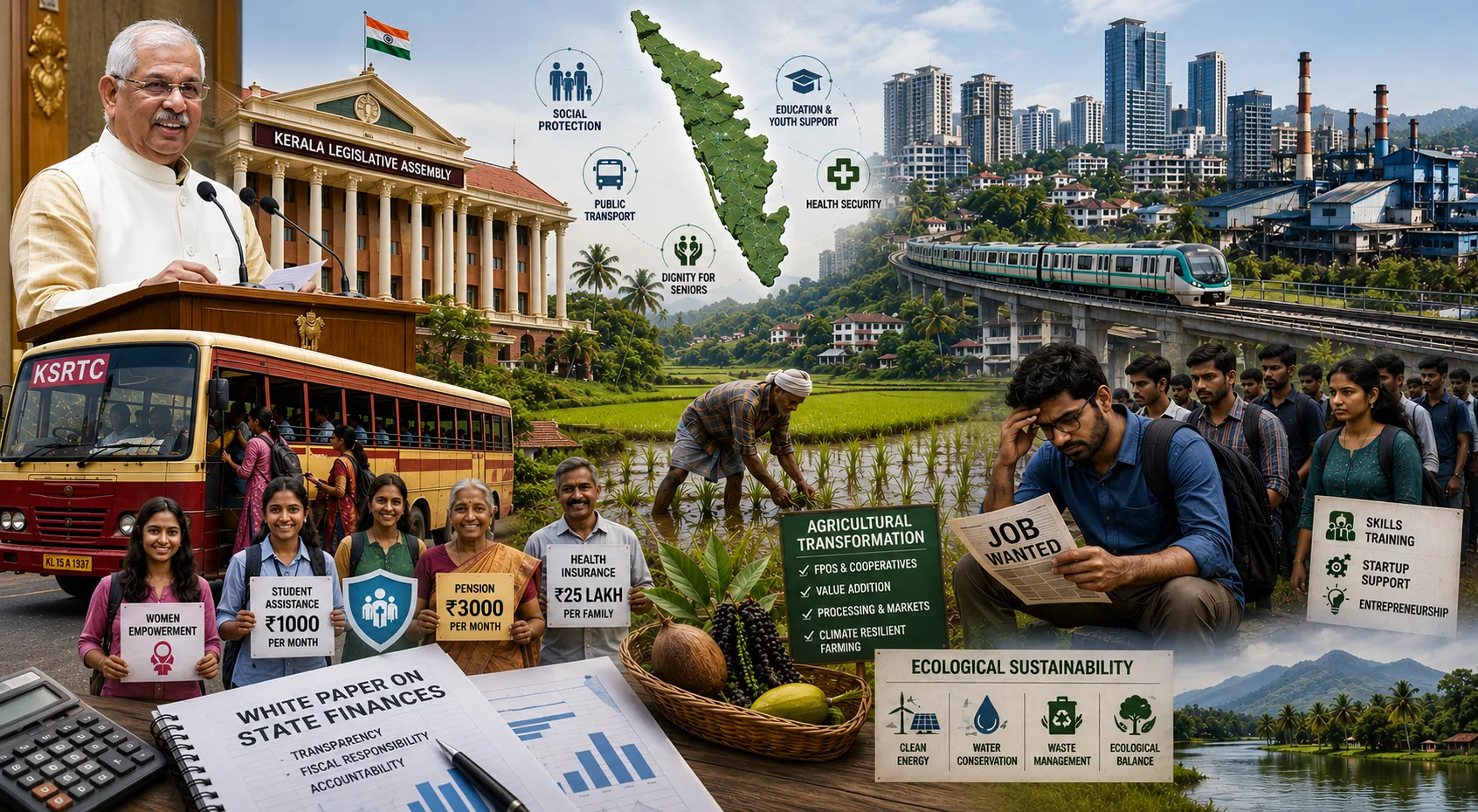
The Governor’s Address to the Sixteenth Kerala Legislative Assembly presents an ambitious vision of “Puthuyuga Kerala” through welfare guarantees, fiscal transparency, agricultural renewal, employment support and ecological concern. This article by Prof. A M Jose and Jos Chathukulam argues that while the Address correctly recognises Kerala’s fiscal stress, educated unemployment, farmer distress and environmental vulnerability, it does not fully resolve the deeper contradiction between expansive welfare promises and the state’s weak productive base. Kerala’s challenge is not to abandon welfare, but to finance it through productive transformation, employment generation, fiscal accountability and ecological planning. A sustainable New Era Kerala requires moving beyond debt-dependent welfare expansion towards public-value creation, value-chain agriculture, knowledge-intensive industry, care economy development and local-government-led ecological governance.
Introduction
The Governor’s Address to the First Session of the Sixteenth Kerala Legislative Assembly on 29 May 2026 is more than a ceremonial constitutional statement. Under Article 176 of the Constitution, the Governor’s Address formally places before the legislature the policy direction of the elected government. In this case, it also marks the beginning of a new political phase in Kerala. The Address presents an optimistic vision of “Puthuyuga Kerala”—a New Era Kerala—built on transparent governance, compassionate welfare, fiscal responsibility, modern infrastructure, environmental concern and social justice.
The speech deserves careful attention because it does not entirely avoid Kerala’s difficult realities. It acknowledges that the state is at a critical juncture. It recognises fiscal stress, youth unemployment, rising cost of living, farmer distress, climate change, ecological degradation and the need to restore public trust in institutions. In that sense, the Address is not merely celebratory. It carries a note of candour.
Yet the Address also reveals a deep paradox. On the one hand, it admits that Kerala faces serious fiscal and structural constraints. On the other, it announces an expansive set of welfare commitments under the banner of the “Indira Guarantees”: free travel for women in KSRTC buses, a monthly educational assistance of ₹1,000 for college girl students, enhancement of welfare pensions to ₹3,000, a health insurance cover of ₹25 lakh per family under the Oommen Chandy Health Insurance Scheme, ₹5 lakh interest-free loans for aspiring youth entrepreneurs, and a separate department for senior citizens (Government of Kerala, 2026a).
Each of these promises has a social appeal. Women’s mobility, student support, elderly dignity, health security and youth entrepreneurship are legitimate public concerns. But the central question is not whether welfare is desirable. The real question is whether Kerala can finance, target and sustain these promises without weakening its already fragile fiscal position. A welfare state without a productive base eventually becomes a debt-dependent state.
Kerala’s present crisis is not the old crisis of poverty, illiteracy or social backwardness. It is a second-generation development crisis: high human development without enough productive employment; a welfare-oriented state without adequate fiscal space; an educated society without sufficient high-quality jobs; a consumption-driven economy without a strong domestic production base; and a remittance-supported society without a sufficiently dynamic internal engine of growth.
This is the background against which the Governor’s Address must be evaluated.
What the Address Gets Right
The Address is significant because it correctly identifies many of Kerala’s pressure points. It recognises that public finance is under stress and proposes a comprehensive White Paper on the state’s finances. This is a welcome step. Kerala needs an honest public account of its liabilities, pending commitments, off-budget borrowings and fiscal risks.
The Address also gives serious attention to agriculture. It notes rising input costs, price volatility, climate uncertainty, fragmented land, inadequate irrigation, low mechanisation and recurring wildlife attacks. Its emphasis on Farmer Producer Organisations, food processing, modern storage, value addition, digital marketing platforms, soil testing and women farmers is directionally correct.
Similarly, the recognition of human–wildlife conflict is important. For farmers in Wayanad, Idukki, Palakkad, Pathanamthitta and other forest-fringe regions, agriculture has become risky not only because of prices and climate change, but also because of repeated crop damage and threats to human life. The Address proposes scientific wildlife counting, AI-based systems, solar fencing, bio-fencing, sensor-based early warning systems and timely compensation. These are useful interventions.
The Address also speaks of skills, apprenticeships, industry linkages, MSMEs, creative industries, tourism, clean energy, electric mobility, waste management, public transport modernisation and elderly welfare. These are all relevant to Kerala’s next phase of development.
But the problem is not the absence of good intentions. The problem is the absence of a clear economic architecture.
The Central Contradiction
The Governor’s Address has two tracks running together. The first is a diagnostic and reform track: fiscal stress, institutional reform, White Paper, tax administration, public-sector improvement, productive sectors and ecological responsibility. The second is a welfare expansion track: free travel, pensions, stipends, insurance, interest-free loans and other guarantees.
The difficulty is that the second track is immediately visible to citizens, while the first requires hard institutional discipline. Welfare promises create expectations quickly. Fiscal reforms, productive transformation and public-sector restructuring take time. Unless the two are brought into a coherent framework, Kerala may end up expanding entitlements faster than it expands revenue, production and employment.
This is the central paradox of Puthuyuga Kerala.
| Table 1: Puthuyuga Kerala: Welfare Promises and Structural Gaps in the Governor’s Address, 2026 | ||
| Policy Area | What the Governor’s Address Promises | The Structural Gap |
| Fiscal management | White Paper on state finances; transparent fiscal recovery | Welfare guarantees are not clearly costed; no detailed financing path is shown |
| Welfare | Free KSRTC travel for women, higher pensions, student assistance, health insurance | Welfare is socially desirable, but needs targeting, budgetary provision and outcome auditing |
| Employment | Interest-free youth entrepreneurship loans and skill initiatives | Startup loans alone cannot solve educated unemployment without productive clusters and market access |
| Agriculture | FPOs, women farmers, price support, digital marketing, soil testing | Needs value-chain transformation, farmer-income focus and cost-of-governance reform |
| Human–wildlife conflict | Compensation, fencing, AI and early-warning systems | Must become a panchayat-level livelihood, safety and ecological planning issue |
| Ecology | Climate action, clean energy, waste management and sustainable development | Requires mandatory climate-risk, hydrological and biodiversity screening of major projects |
| Ageing | Separate department for senior citizens | Needs a full care economy mission generating dignified employment |
| Public transport | Free travel and modernisation | KSRTC reform, direct subsidy accounting and route rationalisation are essential |
| Source: Authors’ compilation based on Government of Kerala (2026a, 2026b), CAG (2025), PRS Legislative Research (2025), MoSPI (2024), Rajan (2024), and Jose and Chathukulam (2026). | ||
| Note: The table interprets the Governor’s policy announcements through the framework of Kerala’s second-generation development crisis, especially the tension between welfare expansion, fiscal stress, weak productive sectors, educated unemployment and ecological limits. | ||
Fiscal Realism: Welfare Must Be Financed
Kerala cannot abandon welfare. Its achievements in public health, education, social protection and decentralisation are historically important. But welfare becomes fragile when it is financed through borrowing rather than production.
Kerala’s audited 2023–24 accounts showed a revenue deficit of ₹18,140.19 crore, or 1.58 per cent of GSDP, and a fiscal deficit of ₹34,258.05 crore, or 2.99 per cent of GSDP. When off-budget borrowings were included, total liabilities rose to 37.84 per cent of GSDP, exceeding the Kerala Fiscal Responsibility Act ceiling of 33.70 per cent (CAG, 2025). For 2025–26, PRS projected a revenue deficit of ₹27,125 crore and a fiscal deficit of ₹45,039 crore (PRS Legislative Research, 2025).
The problem is not debt alone. Debt can be developmental if it builds productive assets, improves infrastructure, raises private investment and creates employment. But debt becomes dangerous when it finances salaries, pensions, interest payments, routine administration, poorly targeted subsidies and politically attractive schemes without measurable returns. The CAG has noted that committed expenditure on salaries, pensions and interest payments reached ₹92,728.15 crore in 2023–24, while capital expenditure remained below 10 per cent of total expenditure during 2019–20 to 2023–24 (CAG, 2025).
This is why the proposed White Paper must be broad and honest. It should not be limited to inherited liabilities. It must examine tax arrears, GST compliance gaps, off-budget borrowing, contingent liabilities, public-sector losses, administrative expenditure, subsidies, consultancy payments, publicity expenditure and the quality of capital expenditure. It should also identify how much of public spending actually reaches citizens as public value.
Kerala’s fiscal debate should not become a crude argument for cutting welfare. The better principle is: cut waste, not welfare; target subsidies, not the poor; borrow for assets, not routine consumption.
The KSRTC Question: Mobility Support or Fiscal Burden?
The promise of free travel for women in KSRTC buses has strong social appeal. Affordable mobility can improve women’s access to education, employment, health care, markets and public life. But the design matters.
KSRTC is already financially fragile. If free travel is introduced without direct budgetary compensation, passenger data, route rationalisation, transparent accounting and fleet modernisation, it may push the corporation into deeper crisis. Welfare should not convert KSRTC into another fiscally exhausted welfare channel.
A better model would be targeted mobility support for students, women workers, caregivers, low-income women, job-seekers and other vulnerable groups. This should be backed by direct reimbursement from the state budget, digital ticketing, social audit of beneficiaries and a broader public transport reform plan. Welfare with design is social investment. Welfare without design becomes populism.
Educated Unemployment and Kerala’s Dutch Disease
The Governor’s Address rightly identifies youth unemployment as a concern. The offer of ₹5 lakh interest-free loans to aspiring youth entrepreneurs is welcome. But cheap credit alone cannot solve Kerala’s labour-market crisis.
Kerala’s youth unemployment is not primarily due to lack of schooling. It is due to the mismatch between education, aspiration and domestic job creation. According to the Periodic Labour Force Survey 2023–24, Kerala’s youth unemployment rate in the 15–29 age group was 29.9 per cent, far above the national figure of 10.2 per cent. Female youth unemployment was even higher, at 47.1 per cent (MoSPI, 2024).
This reflects a deeper structural problem. Kerala’s economy has long shown features of a remittance-driven “Dutch Disease” (Harilal & Joseph, 2000; Jose & Chathukulam, 2026). Large remittance inflows have improved household welfare, housing, education and consumption. But they have also contributed to high reservation wages, rising land prices, construction-led growth and reduced interest in low-return agriculture and labour-intensive manufacturing. The Kerala Migration Survey 2023 estimated total remittances to Kerala at ₹2,16,893 crore, amounting to 23.2 per cent of NSDP (Rajan, 2024).
Kerala therefore has a strange combination: high literacy, high consumption, high social aspiration, high migration, high remittances and high educated unemployment. It imports food, labour, construction materials and many manufactured goods, while exporting people. This cannot be the foundation of a sustainable new era.
The government must make employment the central performance indicator of every department. Agriculture, tourism, health, education, industry, transport, fisheries, IT and local government should all be evaluated by one question: how many decent jobs do they create directly and indirectly?
Agriculture: From Scheme Delivery to Value-Chain Transformation
The Address is right to place agriculture among its priorities. But Kerala cannot revive agriculture through nostalgia. Nor can it survive through scattered subsidy delivery. The state needs a clear transition from low-return cultivation to high-value, climate-resilient and market-linked agriculture. The Kerala Economic Review 2025 shows the limited weight of agriculture in Kerala’s present economic structure, with agriculture and allied activities contributing only 7.64 per cent of real GSVA in 2024–25, while the cropping pattern remains dominated by coconut, rubber, plantation crops and other high-value segments rather than foodgrain agriculture alone (Government of Kerala, 2026b).
Kerala’s agricultural future lies in coconut-based value chains, spices, rubber-based products, jackfruit and banana processing, medicinal plants, vegetables, dairy, poultry, aquaculture, floriculture, organic products and GI-tagged local brands. FPOs, cooperatives, Kudumbashree enterprises, cold chains, processing units, digital marketing and district-level agro-industrial clusters must become central.
The proposed Women Farmers’ Consortium is a promising idea. But it should not become another scheme on paper. It must be linked to land access, credit, training, technology, processing, branding, procurement and assured markets. Women should not merely be counted as beneficiaries; they must become producers, processors, entrepreneurs and owners of local value chains.
Agricultural governance also needs reform. Public expenditure should move from maintaining large administrative structures to producing farmer-level outcomes: higher income, better price realisation, reduced crop loss, lower transaction costs, stronger extension, risk protection and market access.
Human–Wildlife Conflict: Beyond Compensation
The Address’s attention to human–wildlife conflict is welcome. But compensation after damage cannot be the core strategy. For many farmers, wildlife intrusion is not an occasional accident; it is a recurring livelihood shock. It affects income, mental security, crop choice, land use and the willingness to continue farming.
Kerala should treat human–wildlife conflict as an agroeconomic, ecological and local-governance issue. Panchayats in high-risk areas should prepare human–wildlife conflict mitigation plans. These plans should include early-warning systems, well-maintained fencing, community monitoring, crop insurance, rapid response teams, prompt compensation, scientific land-use planning, restoration of forest habitats and promotion of less wildlife-attracting crops in vulnerable fringe areas.
The solution cannot be hostility toward wildlife. Nor can it be indifference to farmers. Kerala needs a humane coexistence model that protects both livelihood security and biodiversity.
Ecology as a Boundary, Not an Afterthought
The Address speaks of climate change, clean energy, water conservation, waste management and sustainable urban planning. But Kerala’s ecological crisis requires stronger institutional discipline.
Kerala is an ecologically fragile continuum from the Western Ghats to the coastal lowlands. Floods, landslides, coastal erosion, heat stress, water stress, wetland destruction, quarrying pressure and unplanned construction are not isolated problems. They are warnings that the state’s development model must respect ecological ceilings (Raworth, 2017).
This is where Doughnut Economics offers a useful policy lens. Kerala must keep people above the social foundation—health, education, housing, food, care, livelihoods, gender safety and social security—without crossing ecological boundaries. This requires climate-risk, hydrological and biodiversity screening for major infrastructure, tourism, quarrying, coastal, hill-area and urban projects.
Local governments should be at the centre of this transition. Panchayats and municipalities should prepare climate budgets, drainage maps, wetland inventories, green asset registers, waste-to-resource plans and ward-level ecological audits. Kerala’s next decentralisation experiment should be ecological decentralisation.
Ageing and the Care Economy
The proposal to create a separate department for senior citizens is a welcome move. But Kerala should not treat ageing only as a welfare burden. It can become a major employment-generating care economy.
Kerala already has strengths in nursing, public health, community care and palliative care. The state can build a Care Economy Mission linking local governments, Kudumbashree, hospitals, nursing institutions, digital health platforms, insurance systems and trained caregivers. Elder care, home nursing, physiotherapy, dementia care, assisted living, rehabilitation, mental health, geriatric tourism and medical devices can create dignified employment, especially for women.
A humane ageing policy can therefore serve two goals: dignity for the elderly and jobs for the young.
Completing the Kerala Model
The Governor’s Address is not without merit. It acknowledges real problems and proposes several useful initiatives. But its weakness lies in the gap between promise and architecture. It announces welfare, but does not sufficiently explain financing. It speaks of youth entrepreneurship, but not enough about productive clusters. It recognises agriculture, but needs deeper value-chain reform. It mentions ecology, but does not fully integrate ecological limits into development planning. It creates a senior citizens’ department, but has not yet articulated a full care economy.
Kerala does not need to abandon its model. It needs to complete it. The first phase of the Kerala model gave people literacy, health, dignity, decentralisation and political voice. The next phase must give them productive employment, fiscal sustainability, entrepreneurial opportunity and ecological security.
The test of Puthuyuga Kerala will not be the number of guarantees announced in the first hundred days. It will be whether welfare is financed through production, whether public money creates public value, whether young people find decent work, whether agriculture becomes profitable, whether KSRTC becomes viable, whether local governments lead ecological planning, and whether growth remains within Kerala’s environmental limits.
A new Kerala cannot be built on guarantees alone. It needs an economic backbone.
References
Comptroller and Auditor General of India (CAG). (2025). Audit Report on State Finances for the Year Ended 31 March 2024: Government of Kerala.
Government of Kerala. (2026a). Governor’s Address to the First Session of the Sixteenth Kerala Legislative Assembly. Thiruvananthapuram, 29 May 2026.
Government of Kerala. (2026b). Kerala Economic Review 2025. Kerala State Planning Board.
Harilal, K. N., & Joseph, K. J. (2000). Stagnation and revival of Kerala economy: An open economy interpretation. Economic and Political Weekly, 35(10), 834–844.
Jose, A. M., & Chathukulam, J. (2026). Kerala’s second-generation development crisis: Welfare, fiscal stress and productive transformation within ecological limits. Kerala Economy (forthcoming), Gulati Institute of Finance and Taxation.
Ministry of Statistics and Programme Implementation (MoSPI). (2024). Periodic Labour Force Survey: Annual Report 2023–24. Government of India.
PRS Legislative Research. (2025). Kerala Budget Analysis 2025–26.
Rajan, S. I. (2024). Kerala Migration Survey 2023. Gulati Institute of Finance and Taxation and International Institute of Migration and Development.
Raworth, K. (2017). Doughnut Economics: Seven Ways to Think Like a 21st-Century Economist. Random House.
Jos Chathukulam is a Professor of Political Economy and Director of the Centre for Rural Management (CRM), Kottayam, Kerala. His academic work focuses on public policy, decentralisation, public finance, local governance, development studies, and political economy in India, with a special emphasis on Kerala. Prof. Chathukulam has authored and edited several influential books and research papers, and has served as a policy advisor to governments and international agencies. He is widely recognised for his critical engagement with development paradigms and for advocating sustainable, people-centred alternatives in economic and governance practices.