
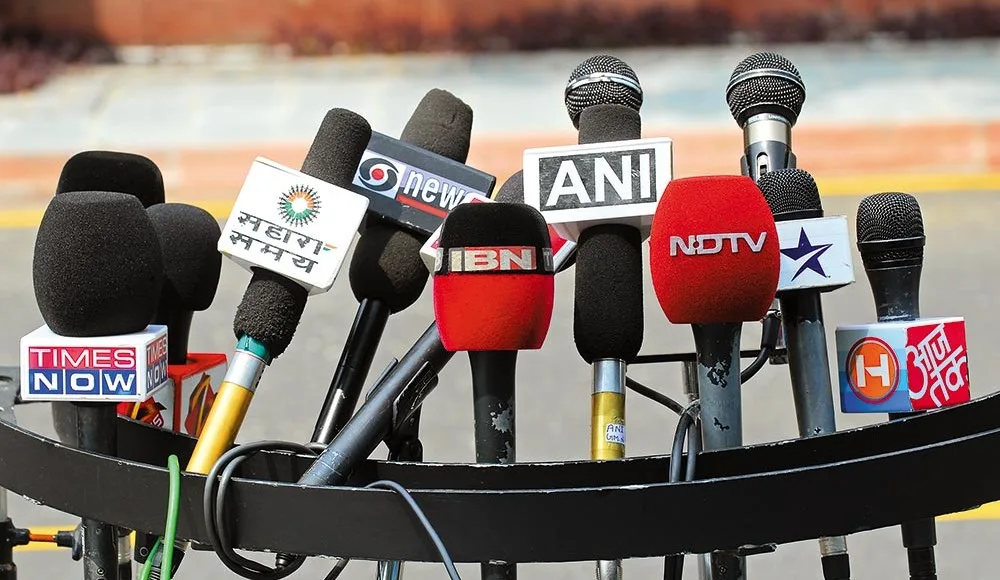
Who Controls the Media? Corporate Power, Caste and the Struggle for Democratic Voice-Part 2
In the second part of his conversation with Abhish K Bose, Mohan J Dutta examines the growing concentration of media ownership, algorithmic power and the relationship between corporate capital and communal politics in India. He discusses self-censorship in newsrooms, the role of Meta, Google and X as powerful information gatekeepers, the corporate ownership of major media houses, and the global spread of caste and Hindutva politics. The conversation also turns to Kerala’s regional media and explores alternatives based on public, cooperative and community ownership of media institutions.
Read Part One here
Abhish K. Bose : With 4 corporate houses owning most newsrooms and journalists facing FIRs and troll attacks daily, has self-censorship now become the business model of Indian media?
Mohan J Dutta : Self-censorship is no longer a deviation from the business model. It is the business model, and it is worth tracing how the political economy produces it. Concentrated ownership means that the media house is one division of a conglomerate whose real revenues lie in telecom, energy, infrastructure, and defence, sectors that live and die by government licence and contract. The newsroom becomes a liability to be managed and an asset to be traded for regulatory goodwill. Advertising dependence, with the government among the largest advertisers, completes the structure of incentive. Reporting critically is a commercial decision with a known price.
Then comes the coercive layer that converts incentive into fear. The FIR has become an editorial instrument. Sedition and UAPA cases against journalists, tax raids timed to critical coverage, the years-long imprisonment of a Siddique Kappan or a Fahad Shah, communicate that the cost of journalism can be your body and your family’s livelihood. Beneath the legal apparatus sits the troll apparatus, and our research on digital Hindutva shows how organized it is. Coordinated campaigns of rape threats against women journalists, apps that auctioned Muslim women journalists, doxxing and swarming that are celebrated rather than sanctioned by political leadership. The genius of the system is that no censor’s order is ever needed. Each layer teaches the anticipation of punishment, and anticipation does the censoring.
The result is what I would call the anticipatory newsroom. Editors kill stories before ministers need to call. Reporters learn which beats end careers. Interviews with power become devotional exercises. The remaining independent journalists, many of them at small digital outlets, absorb the concentrated fury of the state and the trolls precisely because they are the residue that the business model failed to discipline. When Reporters Without Borders ranks India among the most dangerous places in the world to practice journalism, that ranking measures a system working as designed. A media economy in which proximity to power is the revenue strategy and distance from power is the risk profile has made self-censorship rational, and that rationality is the deepest form of capture.
Meta, Google and X decide what 800 million Indians see. With opaque rules and political pressure, are these US platforms now the real editors-in-chief of Indian democracy?
They are editors-in-chief who deny being editors, and that denial is the core of their power. An editor can be named, criticized, held to a code. An algorithm that determines the information diet of 800 million people while its owners claim neutrality is editorial power without editorial accountability. My work situates this within platform capitalism, the regime in which communicative infrastructures are owned as extraction machines, harvesting attention and data, and in which the content that maximizes engagement, which is reliably the content that maximizes outrage and hate, is what the machine amplifies by design.
The Indian case exposes the politics of this regime with unusual clarity, because the platforms’ behaviour is asymmetric in a consistent direction. The record shows Meta’s own India policy leadership intervening to protect BJP-linked figures from hate speech enforcement, internal researchers documenting the flood of anti-Muslim dehumanization on the platform and being overruled, and moderation capacity in Indian languages that is a fraction of what the scale demands. Our analysis of digital Islamophobia in India, developed in our recent CARE white paper on the architecture of impunity, shows how this produces a two-tier speech regime. Hindutva extreme speech, coded in Hindi and regional languages, in memes and devotional idiom, sails beneath moderation systems trained on English and on white supremacist vocabularies. Meanwhile the same platforms comply swiftly with state takedown orders against journalists, farmers’ movement accounts, and documentaries critical of the Prime Minister. Permissive toward the hate that serves power, obedient toward the censorship that power demands. That combination is an editorial line.
There is a further layer that my work insists on naming. The platforms are casteist infrastructures. The IT, platform, and AI sector of Silicon Valley is dominated by dominant-caste Indians, the pipeline running from caste-skewed access to Indian engineering education, through the visa system, into the campuses of Meta, Google, and the AI labs. For years caste appeared nowhere in the platforms’ protected categories, caste slurs in Indian languages circulate unrecognized by moderation systems, and the engineers and policy staff who design those systems come disproportionately from the castes with the least interest in seeing caste at all. The caste blindness of the platforms is a design output of the caste composition of the platforms, and it is one reason the Hindutva hate machine, itself a Brahminical project, moves through these infrastructures with such ease.
Artificial intelligence deepens every layer of this. Generative AI has industrialized the production of communal disinformation, from deepfakes deployed in election cycles to synthetic hate content produced at costs approaching zero. Recommendation systems remain the most consequential AI in Indian democracy, and they are optimized for engagement rather than for democratic life. AI moderation, presented as the solution, encodes the linguistic hierarchies of its training data, which means the erasures of the margins are automated. And the large models now being embedded in search and messaging are trained on data ecosystems already saturated with Hindutva disinformation, laundering hate into the neutral voice of the machine.
So yes, the platforms are the unaccountable editors of Indian democracy, and they share the masthead with the ruling party in an arrangement that suits both. The answer cannot be to hand editorial power to the Indian state instead, which is what the IT Rules attempt. The answer runs through the infrastructural and regulatory agenda I described under NWICO: transparency, public interest obligations, and communicative infrastructures owned by communities rather than by Menlo Park or by Nagpur.
Today Adani owns NDTV, Ambani owns Network18. How do you read the merger of corporate capital and communal media? Is swadeshi rhetoric now just a brand for monopoly capital?
I read it as the consummation of a marriage that structures the entire Hindutva project, the marriage of Brahminical majoritarianism and neoliberal capitalist extremism. My scholarship has long argued against treating Hindutva as merely a cultural or religious politics. It is a political economy. The Modi years have delivered the most aggressive upward transfer of wealth in independent India’s history, the concentration of ports, airports, energy, telecom, defence, and now media in a handful of conglomerates whose fortunes track their proximity to the regime. Communal media is the ideological department of this arrangement. The nightly manufacture of the Muslim enemy performs the essential function that racism performs for capital everywhere, displacing class antagonism onto a communal enemy, so that the farmer dispossessed by corporate agriculture and the worker informalized by labour codes directs his rage at his Muslim neighbour rather than at the conglomerate that owns both his workplace and his news channel.
The Adani acquisition of NDTV was the symbolic completion, and the manner of the takeover deserves to be read as method. For years before Adani moved, the state machinery worked over the Roys. The CBI raided Prannoy and Radhika Roy’s homes in 2017 over a loan that had long been repaid, a raid understood across Indian journalism as retribution for NDTV’s reporting. Enforcement Directorate and income tax cases multiplied, SEBI orders barred the Roys from the securities market and squeezed their hold on their own company, and years of legal siege drained the institution and depressed its worth. Then came the harvest. Adani quietly acquired VCPL, the obscure entity holding a decade-old convertible loan to the Roys’ holding company, converted that loan into control of the company without the founders’ consent, and completed the open offer as the Roys resigned. No censorship order was ever issued, and none was needed. The state machinery softened the target and crony capital collected it, the last major broadcaster with a memory of independence passing to the industrialist most emblematic of crony concentration. That sequence, investigation as siege, siege as devaluation, devaluation as acquisition, is now the template every remaining independent owner in India has studied. But the deeper story is the circuit this creates. The same house that acquires coal blocks in the Hasdeo forests over Adivasi resistance acquires the channels that decide whether that resistance is ever news. Extraction and erasure become divisions of one enterprise.
This is where the swadeshi question answers itself, and where my work on Hindutva’s ab/use of decolonization becomes essential. Swadeshi, and the newer register of decoloniality that Hindutva intellectuals have learned to speak, functions as what I call communicative inversion, the deployment of an emancipatory vocabulary to legitimize precisely what that vocabulary emerged to fight. Decolonization, in the traditions I work within and that emerge from Indigenous struggles, is anchored in anti-capitalism. In the Indian context its living form is Adivasi resistance to extractive capitalist expansion, the defence of forests, land, water, and the resources of livelihood, the constitutional and extra-constitutional struggles from Niyamgiri to Hasdeo to the Pathalgadi movement.
Hindutva’s decolonization inverts this entirely. The language of decolonization and indigeneity is co-opted by the Brahminical caste and the hyper-capitalist class and made to serve the interests of Brahminism and extreme capitalism, two projects that have always moved as one. It renames airports and rewrites textbooks while handing the forests to the very corporate houses draped in the national flag. It attacks Macaulay while enforcing Manu. It performs civilizational recovery while executing the most colonial of economic operations, the dispossession of Indigenous peoples for extraction. And here the inversion completes itself in violence. The Adivasis who actually embody indigeneity, who resist the seizure of their forests, land, and resources of livelihood, are marked, targeted, and killed as anti-national. The Pathalgadi villages that painted the Constitution onto stone were charged with sedition by the thousands. Father Stan Swamy, who spent his life beside Adivasi undertrials, was jailed under UAPA and died in custody, denied even a sipper straw. In Bastar and across the mineral belt, resistance to the mine is read as insurgency, and the security operation clears the ground for the lease. The ones who speak decolonization from the seminar stage hold the concessions, while the ones who live it are in prison or in the ground. That is the communicative inversion laid bare, and its goal is unambiguous, the total capture of resources and power. So yes, swadeshi is now a brand, and what it brands is monopoly capital wearing saffron. The test of any decolonization worth the name is where it stands on Adivasi land. By that test, Hindutva is a recolonization or what I call neocolonialism, dressed up in Brahminical saffron.
As caste discrimination lawsuits explode in US tech and the BJP lobbies in Washington, is caste becoming America’s next civil rights battle, and who is trying to stop it?
Caste is already an American civil rights battle, and the only question is how long its recognition can be delayed. The Cisco case broke the silence, a Dalit engineer alleging discrimination by dominant-caste managers in the heart of Silicon Valley, and what followed showed how deep the fault line runs. Surveys by Ambedkarite organizations documented caste discrimination across US workplaces, universities, and housing. Seattle became the first US city to add caste to its anti-discrimination ordinance. Universities from Brandeis to the California State system wrote caste into their non-discrimination policies. And California’s legislature passed SB 403 to protect caste-oppressed people statewide, before the governor vetoed it under intense pressure. That trajectory, discrimination documented, protection demanded, protection organized against, is the shape of every civil rights struggle in American history.
Who organized against it is the question that reveals everything, and my answer is direct: the groups mobilizing to stop caste discrimination protections are Hindutva-aligned networked groups, and they mobilize because Hindutva is a Brahminical project. Organizations presenting themselves as civil rights bodies for Hindu Americans campaigned against SB 403, litigated against caste protections, and flooded hearings with the claim that naming caste defames Hindus. The claim is itself a communicative inversion of the kind I have described throughout. Protection for the caste-oppressed is reframed as persecution of the dominant. The victim of the caste order is made to disappear so that the beneficiaries of the caste order can occupy the position of victim. This mirrors, precisely, the inversion through which Hindutva in India converts the lynched into the threat and the majority into the besieged.
Understanding why these networks fight caste protection so fiercely requires understanding Hindutva as hegemony in the Gramscian sense. Brahminical hegemony does not operate by excluding Dalits and Adivasis. It operates by incorporating them, offering symbolic inclusion in the Hindu fold, foot-soldier roles in its campaigns, and the psychological wage of standing above the Muslim, while preserving intact the hierarchy that dispossesses them. The diaspora is a vital site for this hegemonic work, because the model minority narrative of Indian American success depends on erasing the caste composition of who got to migrate, who dominates the tech pipeline, and whose networks reproduce themselves in hiring. Caste protection law threatens the project at its foundation, because it names in public, in the language of American civil rights, the hierarchy that Hindutva must keep unnamed to keep intact. The same diaspora networks lobby Washington for the BJP’s interests, campaign against congressional scrutiny of India’s human rights record, and feed the Islamophobic circuits I described earlier. It is one apparatus.
There is a bitter historical irony at the centre of this diaspora formation. The dominant-caste professionals who staff Silicon Valley are the beneficiaries of the development architecture built on the vision of Nehruvian planning, the IITs, the public universities, the subsidized scientific and technical education that stand among the great postcolonial contributions, whatever their failures and their limited reach to the margins. Caste privilege converted that public investment into private mobility, monopolizing the seats, the English, the credentials, the networks. And it is precisely this class, having extracted its mobility from public education and public infrastructure, that now bankrolls and cheers the destruction of that very architecture, the privatization of public resources and public welfare, the gutting of the public university, the replacement of the scientific temper with textbook mythologies. They climbed the ladder that planning built and are burning it behind them, so that the margins who were only beginning to reach it never will.
The stakes here extend well beyond India, because Hindutva poses a direct threat to social cohesion and peace in the societies of the diaspora itself. My work on the Leicester violence of 2022 points to the networked structure beneath what was reported as spontaneous communal tension, the digital amplification moving across continents in hours, the imported vocabularies of Hindutva supremacy, the coordinated mobilization that turned a cricket match into weeks of street confrontation in an English city. Australia has seen Hindutva-led intimidation and violence directed at Sikh, Muslim, and dissenting Indian community spaces. Here in Aotearoa we have seen the threats up close, including the organized campaigns of intimidation directed at those of us who research and name Hindutva. It matters, then, that Aotearoa New Zealand’s security establishment has marked Hindutva as an extremist ideology of concern in its threat assessments. More work of exactly this kind is critical, the marking, monitoring, and regulating of Hindutva’s influence across diaspora spaces, treating its networks with the seriousness that white supremacist networks now receive, because the two, as our Christchurch research showed, are in conversation with each other.
But the diaspora is a site of struggle rather than a settled possession of the Sangh, and the registers of resistance are multiplying across it. In Australia, PATCA, the Periyar Ambedkar Thought Circle Australia, has led anti-caste organizing that forces caste into public conversation and into institutional complaint mechanisms, and alliance-building against Islamophobia has brought South Asian progressives together with Muslim communities against the Hindutva networks that import hate into Australian multiculturalism. Here in Aotearoa New Zealand, the Aotearoa Alliance of Progressive Indians, AAPI, organizes precisely at the intersections my work maps, standing against Hindutva and against caste, in solidarity with Muslim communities and with tangata whenua, in a country still carrying the wound of March 15. In the United Kingdom, Dalit organizations and South Asian solidarity networks have fought for caste protections in equality law against the same dominant-caste lobbies that fought them in California, and stood against the street mobilizations of Hindutva that surfaced in Leicester. The Indian American Muslim Council documents the machinery of Hindutva’s Islamophobia and carries the testimony of its victims into congressional hearings and international forums, refusing the silence that the lobbies work to purchase. Hindus for Human Rights does the vital work of internal contestation, demonstrating that the struggle against Hindutva includes Hindus who refuse to let their faith be conscripted into supremacy, holding the distinction I hold throughout my work, that the critique of Hindutva is a defence of Hinduism’s plural traditions rather than an attack on them. And running through all of these spaces, Dalit movements are being built and connected transnationally, from Equality Labs to the Ambedkarite associations across North America, Europe, and Oceania, a networked counter-diaspora answering the Sangh’s global infrastructure with an infrastructure of solidarity. In the CCA’s terms, these are the voice infrastructures of the diaspora’s margins, and their connection across spaces is resistance mirroring, and outdoing, the networked form of Hindutva itself.
The Ambedkarite movement in the US, led by Dalit organizers with the solidarity of Black, Indigenous, and labour movements, has already changed the terms of the struggle. Babasaheb Ambedkar wrote that caste travels wherever Hindus travel. The struggle against caste has now followed it across the ocean, and my scholarship, and my solidarity, stand with those building the voice infrastructures to win it.
When national media sets a precedent of one-sided narratives, do regional channels simply copy it? How do we stop dubiously funded Malayalam news channels — like those promoted by accused in the high-profile tree-cutting case — from weaponizing journalism to whitewash money and push partisan propaganda?
Regional channels copy the national template because the template pays, and it is important to see the imitation as structural rather than as a failure of imagination. The shouting studio, the nightly enemy, the verdict delivered as a question, this format is cheap to produce, safe from the state, rewarded by the algorithm, and legible to advertisers. Critical ground reporting is expensive, slow, and dangerous. When the national channels demonstrated that propaganda is a better business than journalism, they set the incentive structure for every regional market, and the pressures I described earlier, the advertising squeeze, the regulatory intimidation, the algorithmic centralization, push regional newsrooms toward the template even where their own traditions resist it. Kerala complicates the story precisely because its media ecology grew from the highest literacy in the country, from library movements, from the Left and social reform public spheres, and that inheritance has held longer than most. Which is why the second route of capture that your question names matters so much. Where the template cannot conquer from outside, capital captures from within.
What the question describes, channels promoted by those accused in cases of environmental plunder, is the ownership of journalism as an instrument of impunity, and I would name it in the terms my work has developed. A news channel is among the cheapest forms of reputation laundering available to dubious capital. Ownership buys the friendly narrative about one’s own case, the political access that ownership of an audience confers, the capacity to intimidate investigators, rivals, and honest journalists, and the halo of the press to sanctify money that cannot explain itself. This is communicative inversion operating at the level of the institution itself. The watchdog is purchased by the watched, and journalism’s forms, the anchor, the graphic, the breaking-news band, are retained precisely so that propaganda can wear journalism’s authority. The tree-cutting case pattern, capital accused of stripping the commons acquiring the means to narrate the commons, is the Adani-NDTV circuit in miniature, extraction and erasure joined at regional scale.
The temptation is to answer with state power, with licensing muscle and bans, and I want to warn against it with everything the Indian record teaches. The government’s power to deny security clearance was used against MediaOne, one of the most independent channels in the country, and never against the captured ones. Any censorship instrument created to stop dubious channels will be aimed, within a news cycle, at honest ones. The remedies have to work on ownership and money rather than on speech. Radical and public transparency of beneficial ownership and funding for every news licence, every investor and creditor named, searchable, and updated, so that a channel’s capital is as visible as its logo. Independent media regulation constituted with journalist unions, press councils, and civil society rather than ministerial discretion. Enforcement of the money-laundering and environmental law already on the books against the capital itself, since the scandal in these cases is the money, and the channel is only its costume. Newsroom charters that give editorial staff contractual independence from owners, so that capture of the boardroom does not automatically mean capture of the bulletin. And the strengthening of Kerala’s own tradition of organized journalists, because a unionized newsroom is the hardest one to buy.
But my deepest answer runs through the framework I work with, the culture-centered approach. The durable protection against captured media is media that cannot be captured because its audience owns it. Kerala is better placed than almost anywhere in the world to build this, with its literacy, its library movement, its cooperative traditions, and the mass communicative pedagogy pioneered by its people’s science movement. Subscription-funded newsrooms, cooperative and worker-owned channels, community media anchored in panchayats and reading rooms, media literacy taught through the public education system that Kerala built and must defend, these are voice infrastructures in the sense the CCA gives the term, owned by publics rather than by accused parties. A channel owned by its readers has no money to whitewash and no master to serve. That, rather than any censor, is the standard to organize toward.
Featured Image Courtesy: sabrangindia.in
A journalist with 18 years of experience Abhish K Bose was a staffer at The Times of India and The Deccan Chronicle - Asian Age. As a contributor, his interviews and articles have been published in Frontline magazine, The Wire, The Print, The Telegraph, The Federal, The News Minute, Scroll, The Kochi Post, The Leaflet, The Hindu.com, Outlook.com Countercurrents.org and the Asian Lite international published out of London