
Capitalism Is Not Inevitable: Clara Mattei on Austerity, Power and Economic Alternatives
This is an edited transcript of economist Clara Mattei’s interview with journalist Krishnan Guru-Murthy for Channel 4 News’ Ways to Change the World, originally published in February 2026. In the conversation, Mattei challenges the idea that capitalism is a natural or inevitable way of organising society. She examines how wage labour, private investment and austerity sustain a system organised around profit rather than human need, and explores its connections to inequality, economic insecurity, ecological crisis and political power. She also discusses the historical emergence of capitalism, Marx’s critique of the system, the role of economic ideas in legitimising it, and the possibilities for building democratic, solidarity-based alternatives.
Krishnan Guru-Murthy:How can you escape capitalism? We are all brought up to believe, or to think, that it is just the way of the world—that it is human nature to want to accumulate things and wealth, and to have the freedom to choose what you want and what your destiny is.
Clara Mattei: The first point is to escape the mental trap that naturalizes the system and makes us think, as you just said, that we have a spontaneous tendency towards a capitalist economy. What I show in my book, Escape from Capitalism, is that capitalism is far from spontaneous. It requires the constant, often violent enforcement of austerity policies to preserve the system. The state protects the market by keeping the majority of us subordinated to it, maintaining a situation in which we have no alternative but to work for a wage, usually a very low wage and under precarious conditions.
So what is capitalism in your terms?
Capitalism is a system based on two pillars. One is wage labour: the idea that the majority of people have no option but to sell their capacity to work in return for a wage, producing much more value than they actually receive in their paycheque, while having very little say in how things are produced and why. The other is private investment-the fact that, as a society, we have essentially delegated the power to decide what is produced and why to a very small number of people. Wage labour and private investment are the two pillars. The roof is production for profit: nothing around us would be produced if there were not an expectation of getting more money back than was initially invested.
To what extent are you different from the anti-capitalist protesters who have been around forever and who are a tiny minority? You’re respectable, you’re at a university, and you’re not hiding your face.
I think we are now in a situation in which the violence of the economy has reached a very, very obscene peak. We have extreme inequality and soaring poverty. We have climate catastrophe, constant wars, militarism and genocide. People are suffering. If we want basic needs to be met, if we want people even to be fed, then we have to confront capitalism, because two billion people suffer from food insecurity. The system is not designed to provide for need; it is designed to provide for profit.
What I am trying to do is shift the logic and propose a different lens. We cannot simply blame crony capitalism, excessive greed, or the idea that the system is not working as it should. The opposite is true: the system is working as it has always been structured to work. That is why we have such high accumulation at the top while the majority suffers.
Even in Britain, where wealth is extremely unequally distributed, one in three children is in poverty, while since 2014 the number of billionaires has grown six fold. So while billionaires keep growing, children keep getting poorer.
And the reality is that the West bases much of its capacity to develop on the structural underdevelopment of the Global South. Even today, when supposedly colonialism is over, $65 billion or more flows every year from the Global South, especially Africa, to Europe and the United States through debt, resource extraction and the way capital is invested and profits are taken out. Development happens alongside the creation of underdevelopment. We are not all on an equal path in which everyone is progressively growing and getting better. Countries that have developed have often done so because other countries were pushed down, underdeveloped and structurally damaged.
This is what austerity policies are about. Austerity is a basic feature of capitalism, and this is what distinguishes my work from other critical political economy approaches. Austerity is not irrational. It is irrational from the perspective of human need, but it is very rational from the perspective of profit because it keeps us in a subordinate condition. It keeps us needing to work whatever job we can find in order to pay our bills and for healthcare and education.
If you cut social services, as the capitalist state does, while financing private investors, de-risking investment, militarizing the surveillance economy and protecting borders, this is what capitalism needs because it protects its two pillars: wage labour and private investment.
So when people say austerity is a necessity, in a way they’re right because it is a necessity of the system?
Yes. And this is the point. It is a necessity, but it is not a natural necessity. This is the big point: it is not a technical fix. Austerity is not simply a tool that economists, using neutral models, adopt to save us all. It is the opposite.
As I show in the book, economic models are deeply classist because they depict economic problems as being caused by workers misbehaving. This is how inflation is often understood: why is there inflation? Because the cost of labour is too high, or because people are consuming too much. If the workers are the culprits, the solution becomes increasing interest rates, which creates harsher levels of unemployment.
And unemployment, guess what, is actually important for the system. We would not have capitalism without a good dose of unemployment. Why? Because if workers achieved bargaining power, they would not accept the conditions that allow profits to keep accumulating. It is therefore important to realize that austerity is not neutral. It is political, but it is also necessary for this economic system.
I think the empowering element of this conversation is that capitalism is not spontaneous and has been around for very little time. Only about 0.1% of the time that Homo sapiens has been on the planet have we been under industrial capitalism. In that very short time, we have managed to destroy much of our ecology and cause enormous suffering.
Did you mean just the period after the Industrial Revolution, basically?
Yes.
But even before that, wasn’t it essentially a capitalist system?
Yes, definitely. Capitalism was born in the UK. The cradle of capitalism is right here where I stand today, through the enclosure system. This is important because it is a story that economics rarely tells you. Economics as a discipline is deeply ahistorical, purposefully making you think that this is a natural, spontaneous order.
The reality is that, if you look at history, our economic system was born through violence. What was this violence? It was the exclusion of people from the land. Land was the basic means of subsistence through which people could reproduce themselves autonomously, without depending on the market. Once you eliminate self-sufficiency, people become market-dependent and therefore have to accept whatever work they can find.
Wasn’t that a product of human nature to acquire things and exercise power over others?
I don’t think so. If you look at indigenous cultures in many places around the world, I am in Oklahoma right now, this was reservation land after indigenous people had been expelled. They endured the Trail of Tears, in which many died, and reached this reservation land. Then the oil was stolen from indigenous people.
The Cherokee Nation, for example, was based on circular, horizontal organization through councils, and women had a very important role. It was about caring for the commons and caring for nature rather than extracting from it. Indigenous values tell us that humanity does not have an inherent essence of self-interest. What we see as self-interest is an adaptation under capitalism. We can be different according to the social relations we construct.
In Tulsa, the Forum for Real Economic Emancipation, which I founded, is a very interesting experiment trying to bring back these different social relations. They need to start locally, because at the local level we can associate through assemblies, learn how collectively we can live together differently, and pressure local and national institutions for democratic decision-making over budgets and much else, rather than austerity.
Where does democracy come in? Defenders of the system will say these are choices that people have deliberately made through their democratic rights.
I would say that these choices have been made by a tiny elite from the very beginning, and by definition they require the majority to lack economic agency. Liberal democracy is therefore really only a superficial façade.
This is why, in my historical work, I also show how, at moments when people challenge the capital order, liberals and fascists can be great allies. In my work on the period after the First World War, you see that Benito Mussolini was admired by the Bank of England and by Montagu Norman because he was seen as the right man at a critical moment to keep workers in check and prevent post-capitalist experiments.
The point is that liberal democracy presupposes economic coercion. When people rise up against that economic coercion, liberals and fascists can become allies in implementing austerity.
So these are choices that people are making within a framework of coercion, in your framing. Why, then, when we have seen alternative economic models in the 20th century, have they all gravitated towards capitalism? Why, in Russia, China and parts of India, do they all end up like us?
I don’t think it is because we have a magnetic attraction to a fair system. It is mostly because we impose our capital order globally. If one reads about the post-Second World War, Golden Age period, the United States was actively imposing capitalism across the globe through militarism and coups. The CIA was involved in taking over governments during the Cold War to protect capitalism.
There was nothing spontaneous about this. It was a political struggle. That struggle happens geopolitically, but also within each country.
And, luckily, with Trump, we are seeing what capitalism actually looks like. He is revealing the face of the brutality of the United States. In Tulsa, where I live, people cannot afford anything. People don’t have teeth. People cannot afford a roof over their heads.
Many of the people we have organized through the Forum for Real Economic Emancipation are unhoused. They barter food stamps as the only way to make a living. It is a situation in which the money exists, but it is concentrated in the hands of a very small number of philanthropists who, by the way, then benefit from lending money to governments and receiving the interest back.
And yet some of the poorest people in America are Trump supporters. So how have they achieved this hegemony over people who have nothing to gain from it?
This is why I think my book can be relevant for people: it is about the narrative. Again, the way we break free is first mentally. Trump is thriving on a narrative that mainstream economists have constructed for a very long time, telling people that there is nothing unjust about this economy.
If you are at the bottom, the narrative says it is because you deserve to be there. This is constructed through mathematics as well, by telling us that those at the top are there because they save, behave more rationally and benefit everyone else by employing them, and therefore deserve their wealth.
This mythological individualism, the idea that if you are poor, it is your fault, is spread everywhere. People have internalized it so deeply that, when they are living a dehumanized life, they blame those who are even weaker than themselves because those are the people they fear most. They do not see who is actually benefiting.
They do not see the tiny number of people who have accumulated enormous wealth. In the United States, for example, 19 people—an extraordinarily small fraction of the population—have increased their wealth over the past two years by almost $2 trillion. This is what we are talking about when we talk about extreme inequality. These people are not taxed on capital gains, which is part of the austerity policy I was describing.
But isn’t it also the case that, when you have very little and great economic insecurity, you are desperate to hold on to whatever you have? So, when you talk to people about breaking the system, they fear that they will lose everything in the short term.
I think that, right now, many people have very little to lose in the United States. Really. Seventy-seven percent of American workers live from paycheque to paycheque. The homeless population keeps skyrocketing in the US—there were 118,000 more homeless people in just one year, according to the official statistics.
And half of the homeless population actually has a job. So working is not enough to secure your survival.
This is what I am seeing with the Forum for Real Economic Emancipation. People want to come together around alternative models, solidarity-based economies and mutual aid, with the idea that we should break our dependence on the market.
We need to take back our relationship with nature, land and resources. We need to create alternative infrastructure that can actually serve the logic of need, which governments, both at the local and federal levels, and also in Europe, can no longer support because our governments are there to maintain the capital order.
The fact that Europe is militarizing like crazy while people are losing their social services is not by chance. It is not simply something to attribute to the bad person in power at a particular moment. It is a tendency of the system that we have the power to fight against.
Because the system is us. This is the empowering message of the book: we have built it. We need to see how systemic forces trap us and shape us, but we are the architects. So there is space for alternatives if we build them.
Are we also trapped by our education system and the way economics is framed and taught?
Completely. I am a professor of economics, and for years I have tried to introduce alternative frameworks into the economics discipline. They do exist, but they are at the margins. Anyone who studies economics rarely gets exposed to alternative frameworks.
In my book, I try to expose the classical political economy framework. It is not built only on my ideas; it comes from a strong tradition that dates back to Adam Smith, the founding father of modern economics.
People talk about Marx, don’t they? Isn’t that the only alternative way of looking at the world?
Yes. Marx has been demonized in many ways, but he was one of the most important economists who ever existed. Again, he did not accept the narrow idea that things happen because of individual choices. Things happen because of systemic forces that have been built by us.
What Marx says that is important and liberating is that capital, as wealth and money, is only the surface expression of capital as a social relation—the fact that we relate to one another through production processes that are deeply anti-democratic.
What I mean is that you say people are not taught any alternatives. I’m saying they are taught about Marxism. Are you saying the problem is the way Marxism is taught?
This is important. I think very few people are actually taught about Marxism. If you take an economics class, you will often not hear his name or even the word capitalism. Instead, you hear about markets, individual choices and maximization.
When you do hear the word Marx, it is usually attributed to some crazy, deterministic way of seeing the world, which does not make sense because the critique of political economy that Marx develops is precisely about saying: you economists take capitalism for granted.
As a scholar, and as a historically minded scholar, I would say that capitalism is a specific socio-economic system that requires specific social relations. We can change it because we are the ones who built it.
(to be continued)
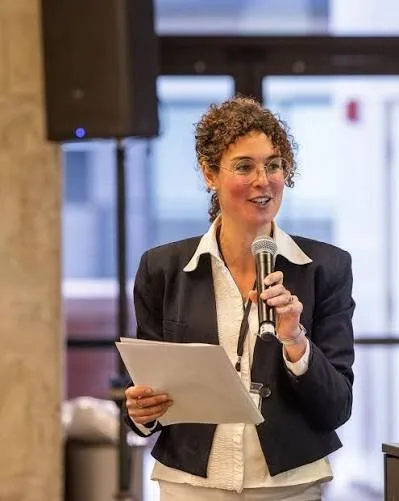
Learn more @ freefreeforum.org, where she hosts the weekly FREE podcast.
Clara was previously associate professor at The New School for Social Research Economics Department and has been a fellow of the Institute for Advanced Studies, Princeton. Her research contributes to the analysis and history of capitalism, exploring the critical relation between economic ideas and technocratic policy making.
Her first book, Capital Order: How Economists Invented Austerity and Paved the Way to Fascism (University of Chicago Press, November 2022), has been translated into over a dozen languages. It was named one of the Financial Times’ Ten Best Economics Books of 2022 and was awarded the 2023 Baxter Adams Prize from the American Historical Association, as well as the 2026 Hans Matthöfer Prize in Germany. The book investigates the origins of austerity in the aftermath of the First World War, uncovering its logic as a tool of reaction deployed against alternatives to capitalism.
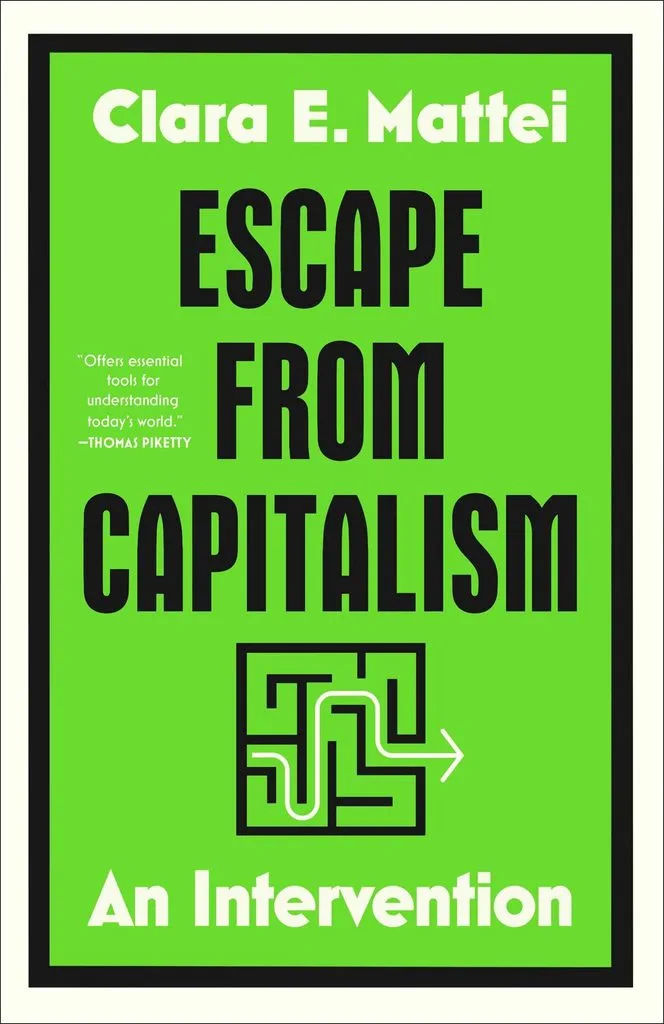
Clara recently published her trade book Escape from Capitalism (Allen Lane, Penguin Press, and Simon & Schuster, January 2026), which will soon be translated into multiple languages, including French, German, and Italian.
She is currently working on a book project which critically reassesses the Golden Age of Capitalism (1945-1975) and its Keynesianism through the lens of austerity capitalism.
Featured Image Credit: thedailyeconomy.org
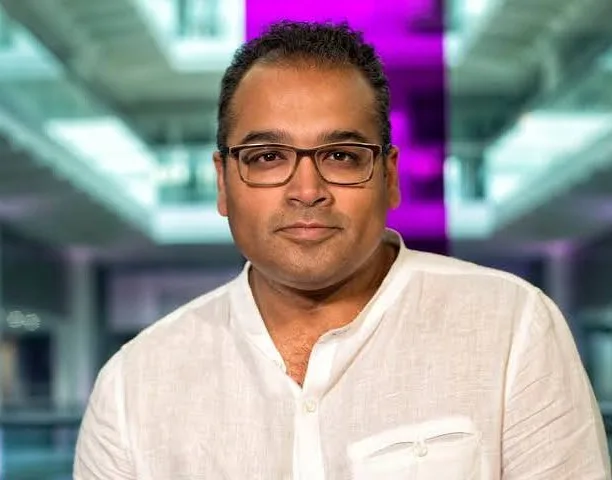
Krishnan Guru-Murthy is an English journalist and the lead presenter of Channel 4 News. He also presents Unreported World, a foreign-affairs documentary series