

Media and Suffering: Reclaiming the Human Purpose of Journalism
This report reflects on the annual Vijayalakshmi Teacher Commemoration Lecture organized by the Pain and Palliative Care Society, Thrissur, where media professional S. Sharath explored the evolving relationship between journalism, ethics, and human suffering. The lecture called for reclaiming empathy and humanity in an era increasingly shaped by algorithms and the attention economy.
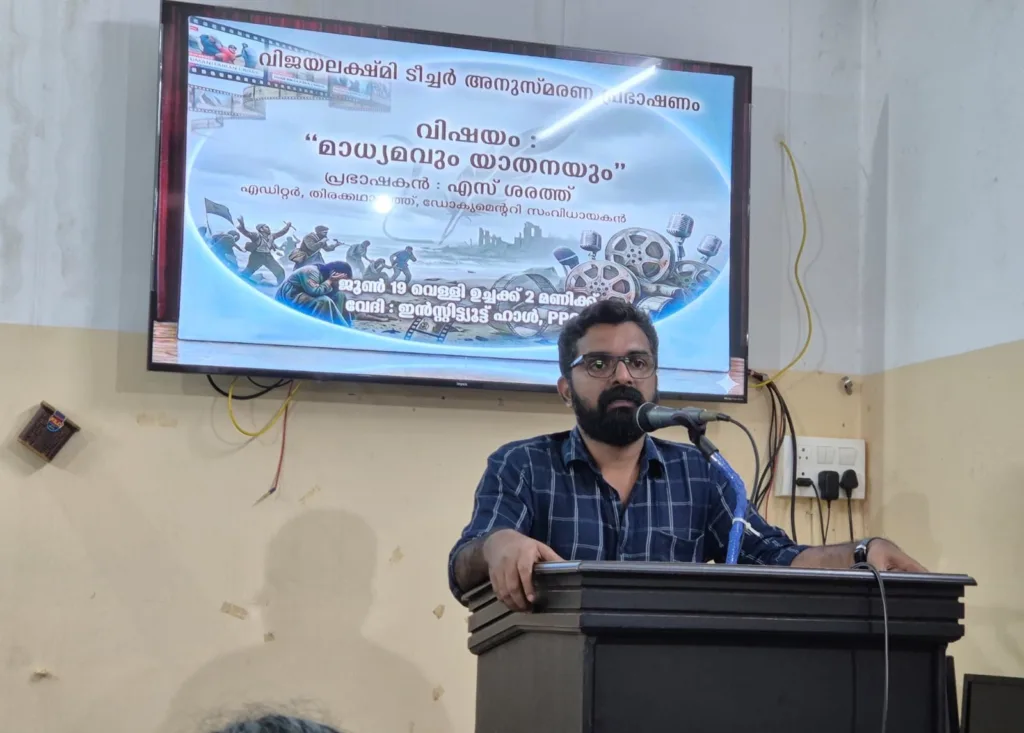
As part of the Vijayalakshmi Teacher Commemoration, an annual memorial lecture organized by the Pain and Palliative Care Society, Thrissur, this year’s lecture was delivered by Mr. S. Sarath, Editor of Keraleeyam on the theme “Media and Suffering.” The session was held on 19 June 2026 at 2:00 p.m. at the Institute of Palliative Care Hall, Thrissur in Keralam.
The relationship between media and human suffering has always been complex. While journalism is often described as the fourth pillar of democracy, its deeper purpose lies beyond reporting events, it lies in responding to human realities. This perspective formed the essence of an insightful lecture delivered by Sarath who reflected on the changing nature of media and its responsibility towards society. “The purpose of journalism is not merely to inform, but to stand with humanity in its moments of suffering.”
Tracing the historical evolution of journalism, Sarath observed that journalism was once deeply rooted in ethics and social commitment. The earliest journalists viewed their profession as a mission. Their work sought not only to document events but also to address social injustices and alleviate suffering. In this sense, journalism was fundamentally ethical, a practice guided by compassion and responsibility.
Over time, however, ethical journalism gradually transformed into what came to be known as objective journalism. The emphasis shifted towards neutrality and detachment. While objectivity remains indispensable for credibility, the insistence on maintaining distance from the subjects of suffering has often produced a form of journalism that is clinically factual but emotionally disconnected. As Sarath pointed out, the danger lies in forgetting that behind every statistic is a human story and behind every headline, a lived experience.
The relationship between power and media has also undergone profound changes. In earlier decades, the tension was visible and direct—between governments and the press. Today, however, a new authority has emerged, one that is largely invisible yet immensely powerful: the algorithm.
In the age of social media and the attention economy, algorithms decide what people see, what they ignore, and ultimately what they think about. News is no longer distributed solely by editors or institutions but by digital systems designed to maximize engagement. Users themselves have become products, their attention commoditized and sold. Consequently, stories of suffering that do not generate clicks or outrages often disappear into silence.
Algorithmic bias has created a culture of selective visibility. Sensational and emotionally charged content is amplified, while deeper and more complex human experiences remain marginalized. The result is not merely misinformation, but a gradual erosion of empathy. Constant exposure to fragmented information and endless streams of content has led to public desensitization and the formation of echo chambers, where individuals are exposed only to perspectives that reinforce their existing beliefs.
Yet, amidst these challenges, hope persists. Civil society continues to strive towards addressing social suffering and building communities rooted in solidarity. New-generation digital journalism and independent media initiatives offer possibilities for reclaiming the original spirit of journalism, one that stands with people rather than with power, and one that prioritizes understanding over virality.
For those engaged in palliative care and humanitarian work, these reflections hold particular significance. Suffering is not a spectacle to be consumed; it is a reality that demands presence, compassion, and collective responsibility. Media, when guided by ethical principles and a commitment to humanity, can become a partner in healing rather than merely a witness to pain.
As Sarath’s reflections remind us, the future of journalism depends not only on technological innovations but on our ability to preserve empathy in an age increasingly governed by algorithms. For media to truly serve society, it must recover its original vocation to give voice to suffering, strengthen civil society, and stand firmly on the side of humanity.
And reflections shared by Sarath resonate deeply with the philosophy and practice of the Pain and Palliative Care Society. Long before the language of algorithms, virality, and digital engagement came to dominate public discourse, palliative care had already embraced a fundamentally ethical approach one rooted in compassion, solidarity, and an unwavering commitment to relieving suffering. Since its inception, the Society has sought to stand alongside those who suffer, offering comfort, dignity, and hope in moments of vulnerability.

AmruthaLakshmi VV, Works as a Medical Social Worker at Pain and Palliative Care Society for 3 years.