
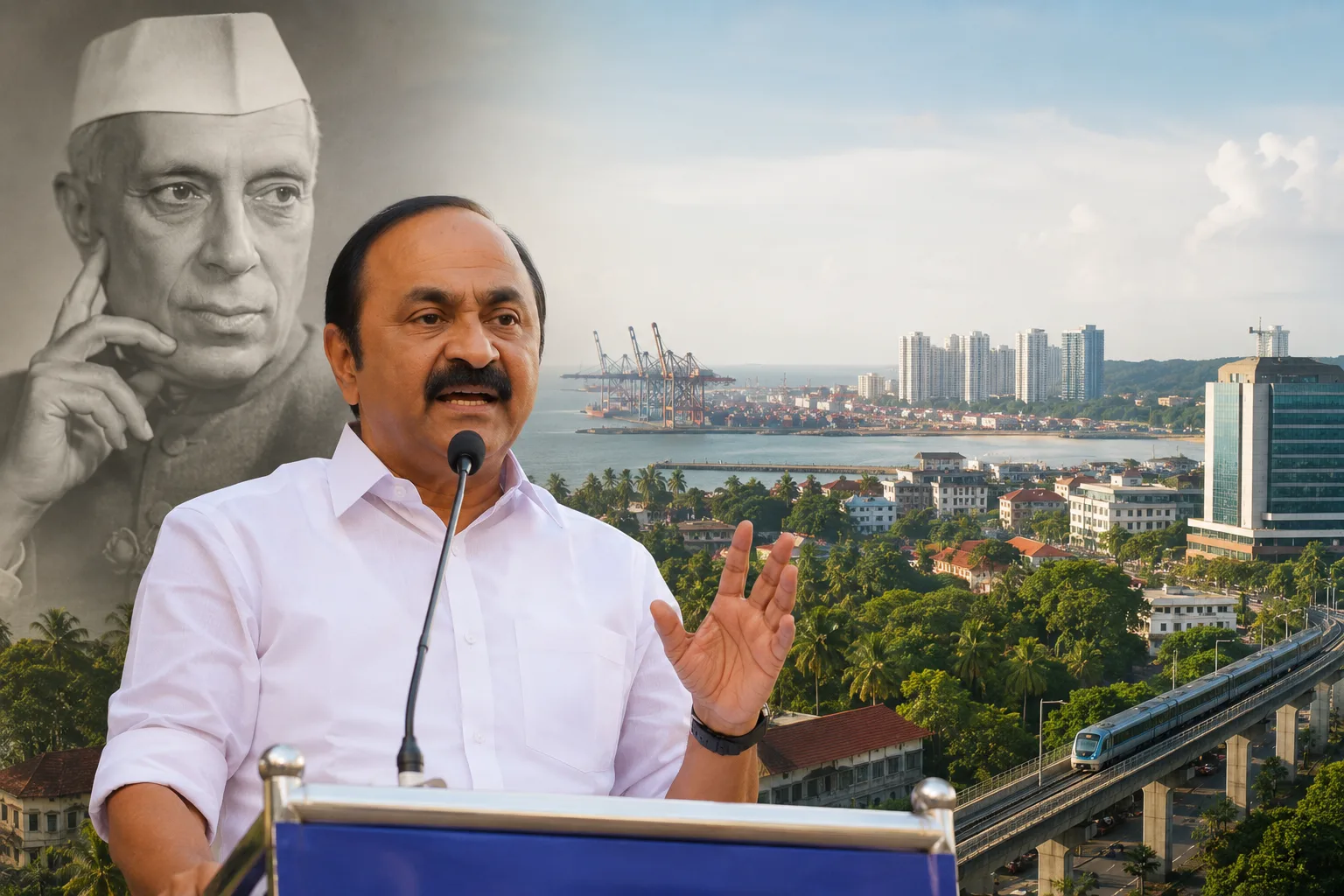
Re-reading Nehruvianism in Kerala: V. D. Satheesan, the Enabling State and the Politics of Responsible Growth
What does it mean to be a Nehruvian in Kerala today? In this thought-provoking essay, Dr. Jos Chathukulam and Dr. A. M. Jose argue that Nehruvianism should not be reduced to 1950s-style state-led economics. Instead, they propose an “enabling state” that combines fiscal responsibility, social justice, productive growth, decentralisation and secular governance as the foundation for Kerala’s future development.
Introduction
The description of V. D. Satheesan as a “Nehruvian revivalist” has generated an important debate on the future of Kerala’s development politics. The phrase is attractive because it evokes a tradition of politics that is constitutional, secular, democratic, developmental and intellectually serious. Yet, it also invites a demanding question: what does it mean to be Nehruvian in Kerala today?
Pulapre Balakrishnan’s recent intervention raises this question sharply. He argues that Satheesan must “walk the Nehruvian talk” and suggests that the Chief Minister’s early emphasis on welfare schemes and fiscal balancing does not yet amount to a Nehruvian development strategy (Balakrishnan, 2026). The criticism is valuable because it insists that Nehruvianism cannot be reduced to a slogan. However, it also risks treating Nehruvian economics as a fixed policy package rather than as a historically situated developmental philosophy.
This article advances a different argument. It draws substantially on Tirthankar Roy and Ravi Raman’s recent economic history of Kerala, which shows that Kerala’s contemporary transformation is better understood through the interaction of welfare legacies, migration, globalisation, private investment and market-led change than through the older welfare-centred Kerala Model alone (Roy & Raman, 2024). Satheesan should indeed be held to a high standard if he claims the Nehruvian inheritance. But that inheritance must be read historically, not mechanically. Nehru’s public sector-led planning was not an abstract dogma. It was a response to a particular national condition: an economy drained by colonialism, weak domestic private capital, low industrial capacity, poor infrastructure and the urgent need to build scientific, technological and institutional foundations for a modern republic. Kerala today is not India of the 1950s. Therefore, a contemporary Nehruvian approach in Kerala cannot mean simply expanding the old public sector or distributing public money. It must mean building an enabling state that combines growth with welfare, private investment with public purpose, fiscal responsibility with social justice, and secular governance with democratic inclusion.
Nehruvianism as a Historical Project
Nehru’s political philosophy rested on democracy, secularism, scientific temper, planning, social justice and national development. His economic philosophy is often described as democratic socialism or the mixed economy. But this label must be understood carefully. Nehru did not advocate a command economy of the Soviet type. Nor did he believe that the market alone could overcome poverty, backwardness and structural inequality. His model placed the state at the centre of long-term development because postcolonial India lacked the capital, technology and infrastructure required for self-sustaining industrialisation (Nehru, 1946; Frankel, 2005).
The early Five Year Plans reflected this historical compulsion. The First Five Year Plan focused on agriculture, irrigation, community development and stabilisation after Partition. The Second Five Year Plan, influenced by the Mahalanobis strategy, gave greater emphasis to heavy industry, capital goods and public sector expansion (Mahalanobis, 1955; Planning Commission, 1951, 1956). This was not merely “state ownership” for its own sake. It was an attempt to create productive capacity where private capital was either absent, risk-averse or insufficient.
Therefore, Nehruvian economics had two sides. One was distributive: it was concerned with poverty, inequality and social transformation. The other was productivist: it aimed to raise the productive capacity of the economy through public investment, infrastructure, science and industry. Any serious Nehruvianism must hold these two dimensions together. Distribution without production becomes fiscally fragile. Production without social justice becomes ethically empty.
Why Kerala Requires a New Nehruvian Reading
Kerala’s development experience is remarkable in social indicators but weaker in productive transformation. The state has achieved high levels of literacy, health, life expectancy and social mobilisation. Yet its economy has long struggled with limited industrialisation, high dependence on remittances, educated unemployment, fiscal stress and weak employment-generating investment. Its celebrated welfare architecture requires a stronger productive base.
This is where a contemporary Nehruvian reading becomes necessary. Kerala cannot abandon welfare. Public health, education, social protection, decentralisation and social justice remain central to the Kerala model. But Kerala cannot finance welfare indefinitely through debt, remittances and revenue expenditure alone. It requires a larger economic “cake” before distribution can become more meaningful and sustainable.

This is the context in which Satheesan’s idea of an enabling state deserves serious consideration. The enabling state is not a neoliberal state that withdraws from responsibility. It is a capable state that creates the conditions for growth: infrastructure, transparent regulation, investor confidence, skill formation, quality higher education, technology adoption, decentralised governance, ecological safeguards and public accountability. It does not treat the private sector as an enemy. Instead, it uses private investment within a public-purpose framework.
In this sense, Satheesan’s position may be read not as a rejection of Nehru, but as a contemporary adaptation of Nehru’s developmental spirit. If Nehru used the public sector to build India’s economic foundations when private capital was weak, a modern Nehruvian in Kerala must use the state to mobilise all productive forces—public, private, cooperative, community-based and knowledge-driven—for socially accountable growth.
Nehru, Panchayats and Cooperatives: Democratising Development from Below
This contemporary reinterpretation of Nehruvianism must also recover a dimension that is often neglected in discussions of Nehru: his emphasis on community development, Panchayati Raj and cooperatives. Nehru did not see development merely as a matter of central planning, public sector investment or bureaucratic direction from above. He repeatedly argued that development would remain incomplete unless ordinary people became active participants in shaping it. His support for Panchayati Raj was rooted in this democratic understanding of development. Panchayats were not merely administrative units; they were meant to become institutions through which village communities acquired voice, responsibility and initiative. In this sense, bottom-up planning and decentralised development were not departures from Nehruvianism, but part of its democratic core: they represented a vision of democratic development from below (Nehru, 1969). For Kerala, this point is especially important. A Nehruvian enabling state cannot be confined to the Secretariat, the Planning Board/ Think Tank, and line departments. It must strengthen Local Self-Government Institutions as sites of participatory planning, local economic mobilisation, welfare delivery, ecological management and democratic accountability.
Nehru’s understanding of cooperatives was equally significant. He saw cooperatives not simply as business organisations, but as instruments for combining production, social responsibility and democratic participation. Cooperatives, in this sense, was a middle path between bureaucratic statism and unregulated private accumulation. It allowed people to pool resources, organise production, overcome scale disadvantages, build trust and share benefits more equitably (Nehru, 1969). This is directly relevant to Kerala, where cooperatives, producer collectives, Kudumbashree-type networks, self-help groups, farmer organisations, fisher collectives and local enterprise platforms can become instruments of productive social democracy rather than merely welfare delivery mechanisms.

Here, the idea of a social solidarity economy is particularly relevant. It refers to a development framework in which private initiative, cooperatives, self-help groups, producer collectives, local governments, community organisations and public institutions work together to expand production, employment and social justice. Such an approach avoids both bureaucratic statism and unregulated market individualism. It is precisely in this space that Nehru’s emphasis on Panchayati Raj and cooperatives can be reinterpreted for contemporary Kerala.
If Satheesan’s Nehruvianism is to become a practical development strategy, the UDF government must strengthen genuinely democratic cooperatives, Local Self-Government Institutions, producer collectives, women’s self-help groups, Kudumbashree-type community networks, farmer organisations, fisher collectives, MSME clusters and local enterprise platforms. Such institutions can help Kerala move beyond welfare distribution towards productive social democracy. The task is therefore not only to invite private investment, but also to democratise development by linking private initiative, cooperative ownership, Panchayati Raj institutions and public purpose within one integrated framework. This is where Nehru’s neglected legacy on Panchayats and cooperatives can become central to Kerala’s twenty-first-century development strategy.
Roy and Raman’s Kerala: From Welfare Exceptionalism to Productive Growth
A useful theoretical anchor for this argument is provided by Tirthankar Roy and K. Ravi Raman’s recent economic history of Kerala. Their central contribution is to shift the discussion away from the older question of how an income-poor state achieved high human development, towards the more contemporary question of how Kerala later broke out of economic stagnation. In their reading, Kerala’s recent transformation cannot be explained by welfare spending or social development alone. It must be understood through the interaction of globalisation, labour mobility, commercially usable human capabilities, remittances, private investment and the reintegration of Kerala with wider markets after India’s economic reforms (Roy & Raman, 2024).
This interpretation is important for re-reading Nehruvianism in contemporary Kerala. If Kerala’s recent income growth was enabled not merely by the state, but by the interaction of welfare legacies with market-led change, migration, private capital and global linkages, then a modern Nehruvian strategy cannot be confined to expanding the old public sector. It must instead create an enabling state: one that protects social welfare, but also mobilises investment; one that values public institutions, but also recognises private initiative; one that defends social justice, but also builds productive capacity. In this sense, Satheesan’s emphasis on an enabling state is not a betrayal of Nehruvianism. It is a necessary reinterpretation of Nehruvian developmentalism for a Kerala that is no longer poor in the old sense, but remains constrained by weak employment generation, fiscal stress, public-sector inefficiency and inadequate productive investment.
Roy and Raman’s account also helps us respond to the criticism that Satheesan’s approach is insufficiently Nehruvian because it does not reproduce the public-sector-led model of the 1950s. Nehru relied on the public sector because independent India inherited a colonially drained economy with weak private capital and inadequate infrastructure. Kerala today faces a different historical challenge. Its problem is not the absence of human development, but the absence of a sufficiently dynamic productive base capable of financing welfare and creating quality employment. Therefore, the Nehruvian task in Kerala is not to repeat the instruments of Nehru’s time, but to recover his larger purpose: democratic planning, secular governance, scientific temper, social justice and growth-oriented public purpose.
Fiscal Responsibility Is Not Anti-Nehruvian
Balakrishnan is right to emphasise that Nehruvianism cannot be reduced to cash transfers. But it does not follow that every welfare measure is anti-Nehruvian. The more important question is whether welfare is linked to capability expansion, social mobility and long-term development.
Kerala’s fiscal situation is undeniably severe. The White Paper has pointed to a large debt burden, accumulated liabilities, high committed expenditure and limited capital spending (Government of Kerala, 2026a). When salaries, pensions and interest payments consume a major share of revenue receipts, the fiscal space for development shrinks. This is not merely an accounting concern. It is a development concern. A state trapped in revenue expenditure cannot adequately invest in infrastructure, education quality, health systems, technology, climate resilience or productive employment.
Satheesan’s insistence on fiscal transparency and expenditure discipline should therefore not be dismissed as conservative economics. In the Kerala context, fiscal responsibility is a precondition for sustaining welfare. A government that borrows continuously to finance current expenditure risks weakening the very welfare commitments it claims to defend. Responsible borrowing for productive investment is different from habitual borrowing for routine expenditure.
Nehru himself valued public investment because it created future capacity. The Nehruvian question is not whether the state spends, but what the state spends on, how it finances that spending and whether it expands future social and economic possibilities. By this standard, Satheesan’s challenge is to shift Kerala from a consumption-heavy fiscal structure to a capability-creating and productivity-enhancing fiscal structure.
Welfare, Gender and Mobility
Balakrishnan’s criticism of “distributing public moneys” needs qualification. Some welfare schemes are indeed politically populist and fiscally unsustainable. But others can be development-enhancing. For example, subsidised or free public transport for women, if properly designed, is not merely a handout. It can improve mobility, labour market access, education continuation, safety and participation in public life. Gender-sensitive public expenditure can be part of a capability approach to development (Drèze & Sen, 2013).
The real issue is not whether welfare exists, but whether it is linked to productivity, dignity and social empowerment. A Nehruvian state must not retreat from welfare. But it must redesign welfare so that it expands human capabilities, improves access to opportunity and strengthens the productive participation of citizens.
Public Sector Reform, Not Public Sector Romanticism
Kerala’s public sector has symbolic importance, but symbolism cannot substitute performance. Many public sector enterprises have become fiscally burdensome, administratively weak and politically protected. To say this is not to embrace privatisation as ideology. It is to insist that public ownership must serve public purpose.
A modern Nehruvian approach would ask three questions of every public sector institution. Does it produce a public good? Does it generate social or economic value? Is it accountable to citizens? If the answer is yes, it deserves investment and professional strengthening. If the answer is no, it requires restructuring, merger, conversion, partnership or closure.
Nehru’s public sector was meant to build national capacity. It was not meant to become a permanent shelter for inefficiency. Therefore, Satheesan’s call for public sector reform is not necessarily anti-Nehruvian. It may be closer to Nehruvian rationality than the uncritical defence of loss-making institutions in the name of socialism.
Secularism and the Kerala Question
Nehruvianism is incomplete without secularism. Here Satheesan’s politics assumes special significance. Kerala’s political field is increasingly shaped by pressures from religious, caste and community organisations. Such pressures are not new, but their intensity and bargaining power have grown. A democratic government cannot ignore communities, but it must not become captive to communal organisations.
Satheesan’s public refusal to subordinate politics to caste or religious pressure is therefore important. At the same time, critics have raised the question of the Congress alliance with the Indian Union Muslim League (IUML). This criticism requires a careful response. Nehruvian secularism does not mean excluding minorities from democratic power. Nor does it mean treating every party with a community base as equivalent to communal majoritarianism. The real test is whether public policy is determined by constitutional values or by sectarian bargaining.
In Kerala’s coalition politics, democratic inclusion and secular autonomy must go together. A Nehruvian leader must engage all communities while ensuring that the state remains constitutionally secular. Satheesan’s challenge is to maintain equal distance from all forms of communal pressure—majority or minority—without denying legitimate democratic representation.
Education, Universalism and Targeted Justice
Balakrishnan also questions proposals such as a tribal university, arguing that universities should embody universal knowledge and access. The concern is worth taking seriously. Higher education must not be reduced to identity symbolism. However, targeted institutions need not contradict universalism if they are designed to correct historical exclusion and expand capabilities.
India’s constitutional democracy has always combined universal citizenship with special provisions for disadvantaged groups. Nehruvian modernity was not blind to social backwardness. The issue, therefore, is not whether a tribal university is symbolically attractive, but whether it genuinely improves access, quality, research, employment and social empowerment among historically marginalised communities. If such an institution becomes a token gesture, it deserves criticism. If it becomes a centre of excellence linked to tribal knowledge, ecological sustainability, public health, livelihood systems and inclusive higher education, it can be defended as a modern Nehruvian intervention.
The Real Test: Operationalising Nehruvianism
Satheesan’s claim to Nehruvianism must ultimately be judged by action. A contemporary Nehruvian programme for Kerala should include the following ten priorities.
First, the state must rebuild fiscal credibility through transparent budgeting, realistic revenue estimates and disciplined expenditure management.
Second, welfare must be protected but redesigned toward capability expansion, especially in health, education, gender mobility, elderly care and social security.
Third, Kerala needs a serious employment strategy for educated youth, linking higher education reform, skills, start-ups, tourism, health services, the care economy, digital industries and small enterprises.
Fourth, public sector reform must be undertaken without ideological panic. Strategic public institutions should be strengthened; chronically unproductive ones should be restructured.
Fifth, private investment must be welcomed within a framework of labour dignity, ecological safeguards and public accountability.
Sixth, universities and colleges must be freed from political capture, poor teaching standards and communal management pressures. Quality in higher education is central to Kerala’s future.
Seventh, scientific temper must guide public policy in climate adaptation, waste management, health, urbanisation, agriculture and technology.
Eighth, secular governance must be practised, not merely proclaimed. The government must not become hostage to any religious or caste pressure group.
Ninth, Kerala must move from rule-bound bureaucracy to role-and-outcome-based governance, where officials are evaluated not only by procedural compliance but also by timely service delivery, citizen experience, field knowledge and public-purpose outcomes. Such a shift is essential because citizens experience the state through frontline officials, local institutions and co-produced public services (Lipsky, 1980; Ostrom, 1996).
Tenth, Kerala must strengthen Panchayati Raj institutions and democratic cooperatives as core instruments of bottom-up planning and social solidarity economy. A modern Nehruvian strategy should enable local governments, cooperatives, producer collectives, self-help groups and community organisations to become active partners in expanding productive capacity, employment and social justice.
From Leader-Centred Nehruvianism to Organisational Social Democracy
However, Satheesan cannot operationalise this Nehruvian project by personal conviction alone. If his politics is to become a durable development strategy, the Congress party in Kerala must internalise it as a programme of modern social democracy. This requires a conscious ideological transmission from the state leadership to the district, block, mandalam and panchayat-level party structures. The Congress cannot remain merely an electoral platform or a coalition manager; it must become a programmatic social democratic party capable of explaining to its workers and supporters why Kerala needs private investment, cooperatives, self-help groups, start-ups, productive public expenditure, public-sector reform and welfare protection within one common framework. In other words, Satheesan’s enabling-state approach must be translated into a social solidarity economy, where private enterprise, cooperative institutions, community organisations, women’s collectives, local governments and public institutions work together to enlarge Kerala’s productive capacity while preserving social justice. This also requires administrative reorientation. The state, district and local bureaucracy must be brought into the same developmental philosophy, not as a parallel power structure, but as accountable public servants working with elected functionaries at all levels of local self-government. Without such party-level mobilisation and bureaucratic fine-tuning, Satheesan’s Nehruvianism may remain a personal style of leadership rather than a transformative political movement.
The Administrative Condition of Nehruvianism
There is also an administrative condition for the success of Satheesan’s Nehruvian project. An enabling state cannot be built merely through budget announcements, party mobilisation or ideological clarity. It requires a bureaucracy that is capable of translating public purpose into timely, lawful and citizen-sensitive outcomes. Kerala’s administrative paradox is that a socially advanced, politically mobilised and decentralised society still often experiences the state through files, delays, repeated documentation, fragmented departmental authority and defensive decision-making. This is particularly important because policies are finally experienced by citizens through street-level officials, whose discretion and behaviour shape the actual meaning of public programmes (Lipsky, 1980). Therefore, modern Nehruvianism in Kerala must also mean a transition from rule-bound administration to role-and-outcome-based governance. Officials at the state, district and local levels must be encouraged to work with elected representatives, local governments, cooperatives, self-help groups and citizen collectives as partners in development rather than as distant controllers of procedure. Such a state must combine professional autonomy with social embeddedness, so that bureaucracy remains competent while remaining connected to people’s lived realities (Evans, 1995). It must also recognise that development is increasingly co-produced through cooperation between state agencies, citizens, community organisations and local institutions (Ostrom, 1996). This requires field immersion, interdepartmental coordination, public file tracking, service-time accountability, social audit and periodic citizen consultations. In this sense, Satheesan’s enabling state must also become a responsive state: one that listens, learns and acts through the lived realities of people. Without such administrative reorientation, the promise of social democracy may remain trapped in policy documents rather than becoming a transformative experience for citizens.
Conclusion
The debate on whether V. D. Satheesan is truly Nehruvian should not be reduced to whether he reproduces the economic policies of the 1950s. Nehruvianism was never a frozen doctrine. It was a modernising project rooted in democracy, secularism, planning, scientific temper, public purpose and social justice. Its instruments must change when historical conditions change.
Balakrishnan is right to demand a clearer development strategy from Satheesan. Kerala cannot afford gesture politics, fiscal drift or welfare without productive foundations. But it is equally important not to mistake old-style public sector expansion for the only authentic form of Nehruvianism. In contemporary Kerala, Nehruvianism must mean a capable enabling state: one that protects welfare, expands production, mobilises investment, reforms institutions, resists communal capture and creates opportunities for the young.
Seen through Roy and Raman’s framework, the central question before Kerala is not whether the state should choose welfare or growth, but whether it can build an institutional architecture in which welfare, investment, productivity and social justice reinforce one another. Satheesan’s claim is therefore neither fully proven nor empty. It is a political promise awaiting operationalisation. Its success will depend not only on Satheesan’s leadership, but also on whether the Congress organisation, the UDF coalition, the bureaucracy, cooperatives and local self-government institutions can collectively convert this enabling-state philosophy into a social democratic development movement rooted in democratic development from below. If he can build a Kerala model that combines fiscal responsibility with social justice, private initiative with public purpose, secularism with democratic inclusion and growth with redistribution, he would not be abandoning Nehru. He would be translating Nehruvianism into the language of twenty-first-century Kerala.
References
Balakrishnan, P. (2026, June 22). Why Kerala needs Satheesan to walk the Nehruvian talk. The Wire.
Drèze, J., & Sen, A. (2013). An uncertain glory: India and its contradictions. Princeton University Press.
Evans, P. (1995). Embedded autonomy: States and industrial transformation. Princeton University Press.
Frankel, F. R. (2005). India’s political economy, 1947–2004: The gradual revolution (2nd ed.). Oxford University Press.
Government of Kerala. (2026a). Kerala’s fiscal health: A status report. Finance Department, Government of Kerala.
Government of Kerala. (2026b). Revised Budget Speech 2026–2027. Government Central Press, Thiruvananthapuram.
Lipsky, M. (1980). Street-level bureaucracy: Dilemmas of the individual in public services. Russell Sage Foundation.
Mahalanobis, P. C. (1955). The approach of operational research to planning in India. Sankhyā: The Indian Journal of Statistics, 16(1/2), 3–130.
Nehru, J. (1946). The discovery of India. Signet Press.
Nehru, J. (1969). Jawaharlal Nehru on community development, Panchayati Raj and co-operation (Reprint; original work published 1965). Ministry of Community Development and Co-operation, Government of India.
Ostrom, E. (1996). Crossing the great divide: Coproduction, synergy, and development. World Development, 24(6), 1073–1087. https://doi.org/10.1016/0305-750X(96)00023-X
Planning Commission. (1951). The first five year plan. Government of India.
Planning Commission. (1956). Second five year plan. Government of India.
Roy, T., & Raman, K. R. (2024). Kerala, 1956 to the present: India’s miracle state. Cambridge University Press.
Sudhi, K. S. (2026, May 17). The “Nehruvian” revivalist: V. D. Satheesan. The Hindu.
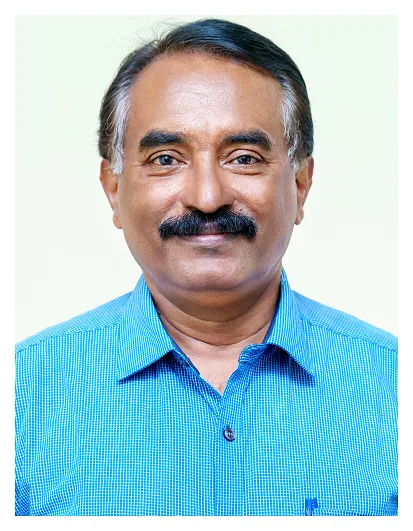
Prof. (Dr.) A. M. Jose is Professor and Head, Amity School of Economics, Amity University Haryana, India. With over 42 years of academic experience, he specialises in Development Economics and Managerial Economics. He previously served at Kerala Agricultural University as Associate Director of the MBA in Agri-Business Management Programme, and at the National University of Rwanda. He is an alumnus of ISEC Bengaluru, IIM Ahmedabad, and York St John University, UK.
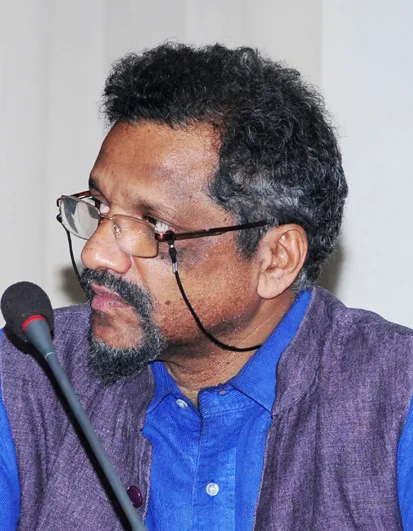
Jos Chathukulam is a Professor of Political Economy and Director of the Centre for Rural Management (CRM), Kottayam, Kerala. His academic work focuses on public policy, decentralisation, public finance, local governance, development studies, and political economy in India, with a special emphasis on Kerala. Prof. Chathukulam has authored and edited several influential books and research papers, and has served as a policy advisor to governments and international agencies. He is widely recognised for his critical engagement with development paradigms and for advocating sustainable, people-centred alternatives in economic and governance practices.