
Who Owns the Sea? The Blue Economy, Corporate Expansion and the Erosion of Food Sovereignty
The blue economy is promoted as a pathway to sustainable ocean development and economic growth. But behind this promise lies a growing conflict over who controls the seas and coastal resources. As corporate interests expand into ports, aquaculture and marine industries, traditional fishing communities face displacement, livelihood insecurity and the erosion of their rights. This article examines how the commercialisation of oceans threatens not only fisher people’s lives but also ecological sustainability and the food sovereignty of millions.
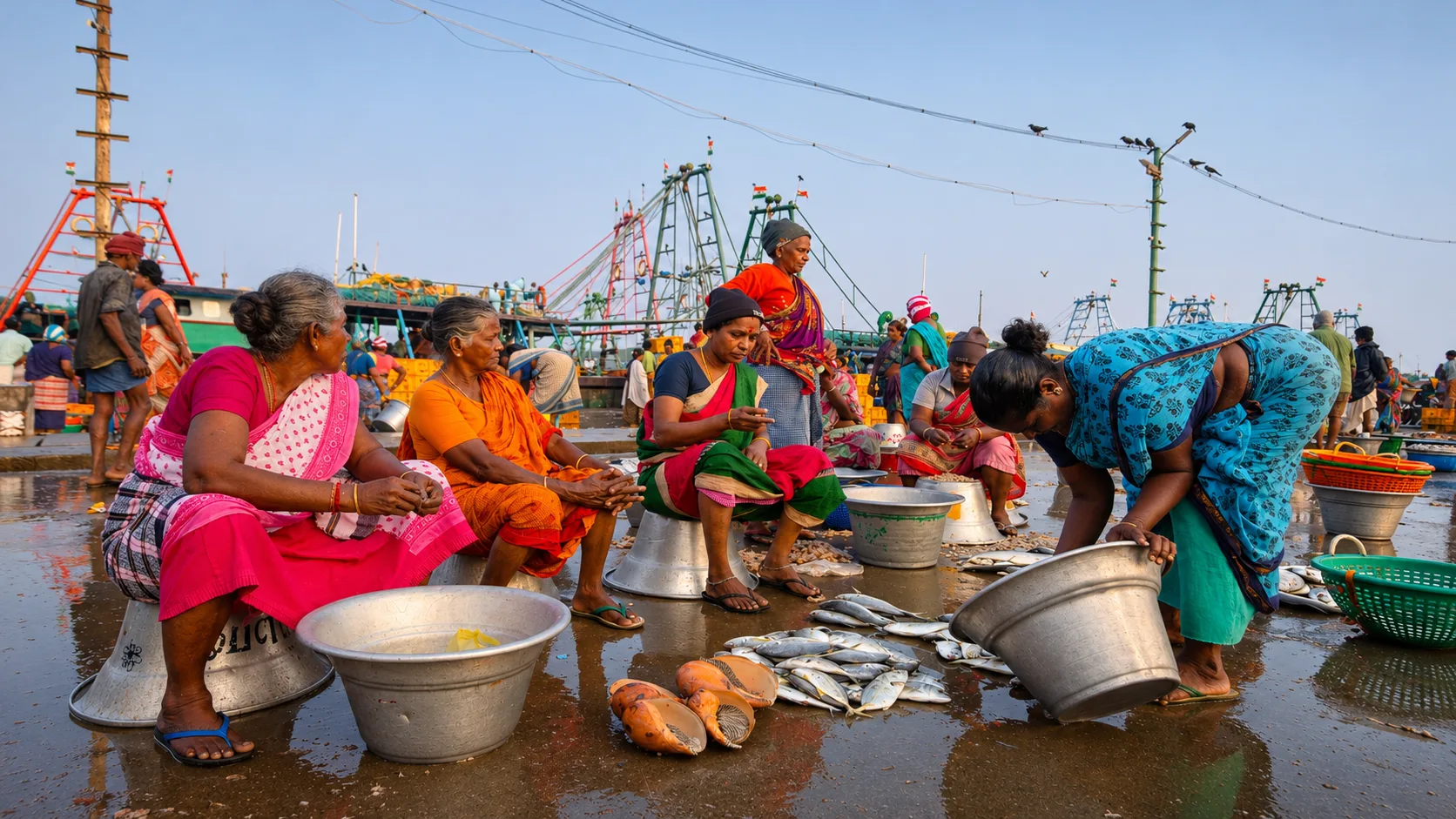
Today, fisher communities across the world are celebrating the women who sustain aquatic life, community economies and generations of ecological knowledge. This day was declared by the World Forum of Fisher Peoples in Brazil in 2024, and the first International Fisher Women’s Day was celebrated globally on 5th November 2025. A dream of making women’s role in fisheries visible is now a day the whole world marks together.
The sea is more than an economic resource
For generations, fishing communities have lived in close relationship with the sea. Their lives, livelihoods, food habits, cultures and knowledge systems have evolved around the rhythms of the ocean. The sea is not simply a workplace for these communities but it is a source of food, a shared commons, a cultural landscape and the foundation of their social and economic existence.
Traditional fishing communities have developed an intimate understanding of marine ecosystems through generations of experience. They know seasonal variations, fish migration patterns, breeding grounds, coastal currents and the ecological relationships that sustain marine life. Their fishing practices, although diverse, have historically been closely connected to the natural cycles of the sea.
Women occupy an equally important place in this relationship. They are involved in fish processing, drying, preservation, marketing, net-making, shell collection and numerous other activities that sustain fishing economies. They also play a crucial role in ensuring that fish reaches local households and markets. Yet, this relationship between people and the sea is increasingly being challenged by a new economic vision: the Blue Economy.
Promoted as a strategy for sustainable ocean development, the blue economy promises economic growth through the utilisation of marine resources. It encompasses fisheries, aquaculture, shipping, ports, coastal tourism, offshore energy, seabed mining, marine biotechnology and other ocean-based industries.
At first glance, the idea appears attractive. Oceans are under increasing environmental pressure, and developing sustainable ways of managing marine resources is undoubtedly important. However, the critical question is: sustainable for whom, and beneficial to whom?
When ocean development is organised primarily around investment, infrastructure, industrial production and export earnings, the interests of traditional fishing communities can become secondary. The sea, which has sustained millions of people as a shared ecological resource, risks being transformed into an economic territory controlled by governments, corporations and private investors. The problem is not the idea of managing marine resources sustainably. It is the growing tendency to equate sustainability with investment-led economic expansion, technological modernisation and increased commercial production.
The blue economy must therefore be examined not only as an economic policy but also as a question of power, ownership, social justice and the right to food.
From a shared commons to a corporate economic frontier
India’s blue economy ambitions are closely connected to its larger development strategy. The country’s draft Blue Economy Policy identifies several areas for expansion, including marine fisheries and aquaculture, coastal tourism, shipping and logistics, infrastructure, coastal and deep-sea mining, offshore energy and emerging marine industries.
The Sagarmala programme, port modernisation, industrial aquaculture and investments in coastal infrastructure are also part of this broader transformation of the relationship between the economy and the ocean. These initiatives are frequently presented as opportunities to modernise the fisheries sector, increase productivity, create employment and strengthen India’s position in international markets. But the expansion of these activities raises fundamental questions about the ownership and control of coastal and marine spaces.
The fact remains that a fishing community does not depend on the sea alone. It requires access to beaches, landing centres, fish-drying spaces, traditional markets, coastal roads, harbours and the surrounding ecosystems and these spaces are interconnected. So, restricting access to even one of them can disrupt the entire livelihood system. When coastlines are converted into port infrastructure, industrial zones, tourism destinations and commercial aquaculture facilities, fishing communities lose more than physical space. They also lose access to the resources and social networks that make their livelihoods possible.
The process can take place through land acquisition, restrictions on traditional fishing grounds, changes in coastal land use, environmental degradation or the gradual displacement of small-scale fishing activities by larger commercial interests.
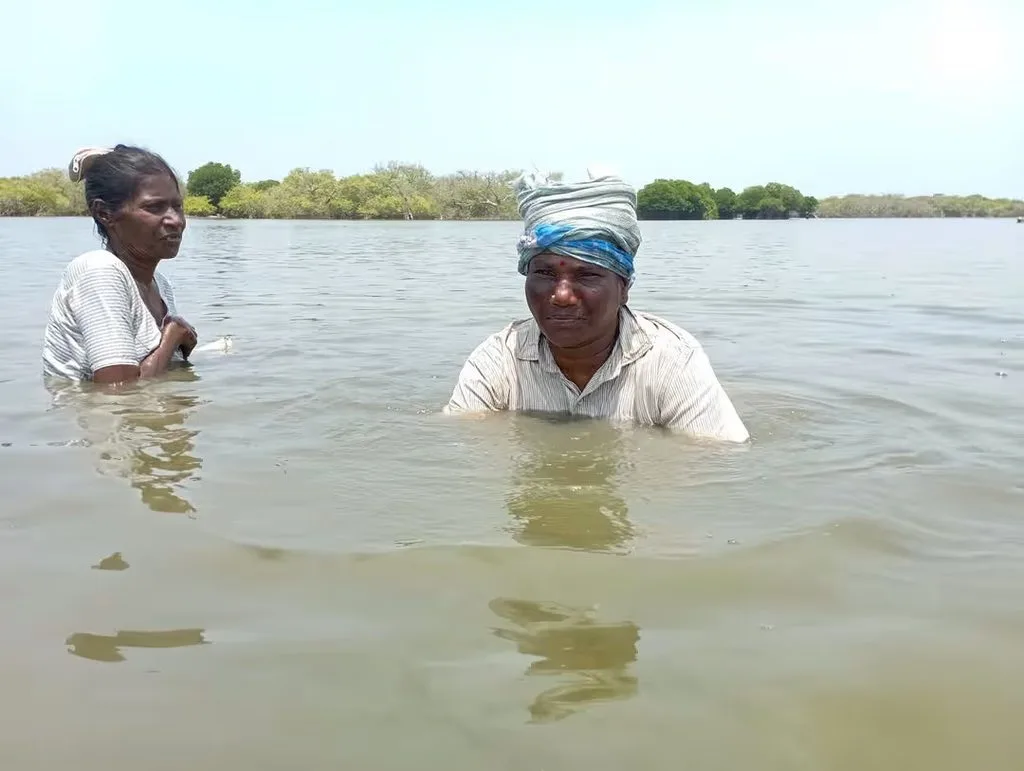
Its seen that corporate expansion does not always require the direct ownership of the sea. Control can also be established through infrastructure, market access, processing facilities, cold chains, distribution networks, technology and financial arrangements. For instance, when a small-scale fisher becomes dependent on a commercial buyer for access to credit, equipment, storage and market opportunities, the fisher’s independence can gradually diminish. The price of fish, the conditions of sale and the distribution of profits may increasingly be determined by actors who have little direct relationship with the fishing community. Moreover, the traditional fisher, who once had a relatively direct relationship with the sea and local markets, risks becoming a labourer or a supplier within a much larger commercial chain.
This is an important dimension of the corporate transformation of fisheries: the appropriation of economic value without necessarily taking direct ownership of the natural resource.
Ports, industrial infrastructure and the dispossession of coastal communities
The expansion of port infrastructure is among the most visible expressions of the new coastal development model. Major ports and transshipment facilities are promoted as engines of economic growth, international trade and employment. However, their environmental and social consequences for neighbouring fishing communities cannot be treated as incidental costs.
Port construction, dredging, breakwaters, reclamation and associated infrastructure can alter coastal processes, interfere with sediment movement and affect marine habitats. Depending on the location and design, these changes can contribute to erosion, sedimentation and disruptions to fishing grounds.
For fishing communities, the consequences are immediate and material. A beach that disappears is not simply a geographical change. It may mean the loss of a place to land boats, repair nets, dry fish and conduct everyday economic activities.
The experience of Vizhinjam in Kerala illustrates these tensions. The development of the international seaport has generated serious concerns and conflicts around coastal erosion, livelihood disruption and the rights of fishing communities.
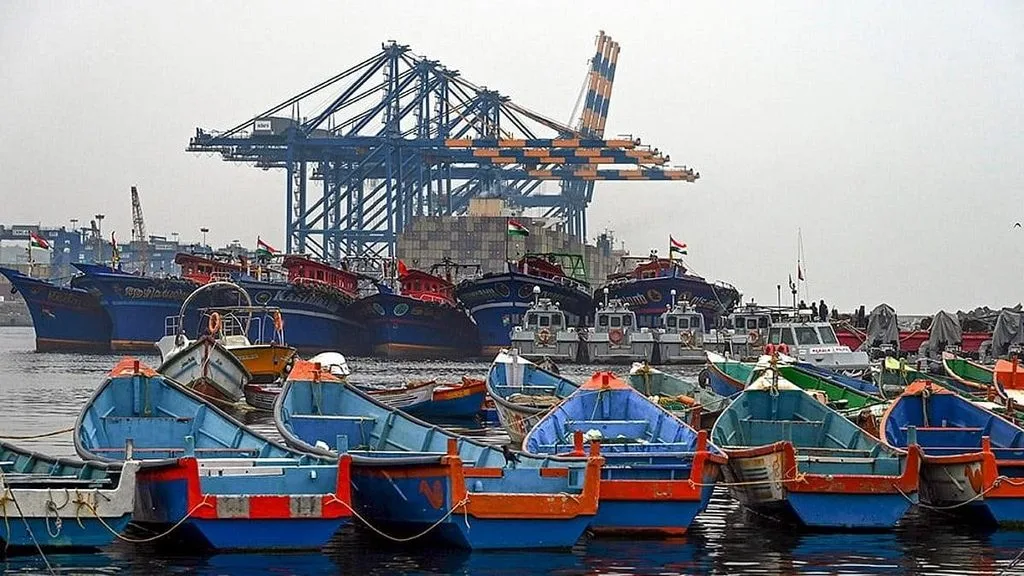
A study published in the journal Development and Change in December 2025, examining the Vizhinjam project, highlights how port-led development and private investment have transformed coastal economies while marginalising fishing communities. It draws attention to the exclusion of fish workers from meaningful participation in decisions concerning their own territories and livelihoods. The important question is whether the economic benefits of such projects justify the social and ecological costs imposed on communities that have historically depended on these coastlines.
A port may increase cargo movement and strengthen international trade. But what happens to the people whose access to the sea is restricted in the process? How should the loss of traditional livelihoods, ecological knowledge and community resources be accounted for when measuring the success of a development project?
Economic assessments often emphasise investment, cargo-handling capacity, employment and revenue. The disappearance of traditional occupations, the erosion of local food systems and the loss of community control over natural resources receive far less attention. This imbalance is not accidental. It reflects a development model in which the economic value of infrastructure is more visible than the social and ecological value of the commons.
Industrial aquaculture and the changing ownership of fish production
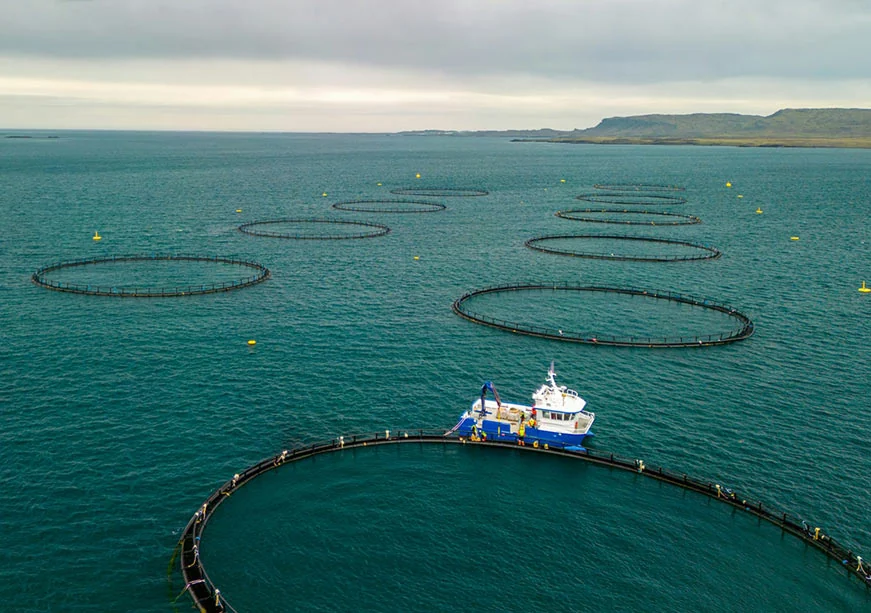
Aquaculture is another major component of the blue economy. Fish farming and other forms of aquaculture can contribute to food production and livelihoods when they are ecologically responsible and locally controlled. However, the industrial expansion of aquaculture raises serious concerns.
Large commercial operations require land, water, infrastructure, feed, technology, capital and access to markets. Their expansion can place pressure on coastal wetlands, estuaries, mangroves and other ecologically sensitive areas. In some regions, intensive shrimp aquaculture has been associated with the conversion of coastal ecosystems, pollution, salinisation of agricultural land and conflicts over access to water and land.
The problem becomes more serious when small-scale producers and traditional communities are pushed into unequal relationships with large companies that control inputs, processing, finance and marketing. Corporate involvement can extend across the entire production chain, from hatcheries and feed to farming, processing, cold storage, export and retail. As these chains become concentrated, the power to determine what is produced, how it is produced, where it is sold and at what price increasingly shifts away from local producers. This transformation can change the very purpose of fisheries.
Fish is not merely a commodity for international trade. It is an important source of nutrition for millions of people, particularly those who cannot afford more expensive sources of animal protein.
When fisheries production becomes increasingly oriented towards export markets and high-value commercial products, the needs of local consumers may receive less attention. This does not mean that exports necessarily reduce domestic fish availability in every circumstance. But it does mean that food distribution and access must be examined alongside production and export growth.
An economy may report increasing fish production and export earnings while local fishing communities experience declining incomes, insecure access to fish and increasing difficulties in obtaining affordable food. The question is not simply how much fish is produced. It is who controls its production, who receives its economic value and who gets to eat it.
The erosion of food sovereignty
The debate over the blue economy must be connected to a larger question: food sovereignty. Food security and food sovereignty are related, but they are not identical. Food security is concerned with whether people have access to sufficient, safe and nutritious food. Food sovereignty goes further. It concerns the rights of communities and people to determine their own food systems, including how food is produced, distributed and consumed.
It challenges the concentration of control over food production in the hands of corporations and insists that producers and communities should have a decisive role in shaping food policies. This distinction is particularly important in the context of fisheries.
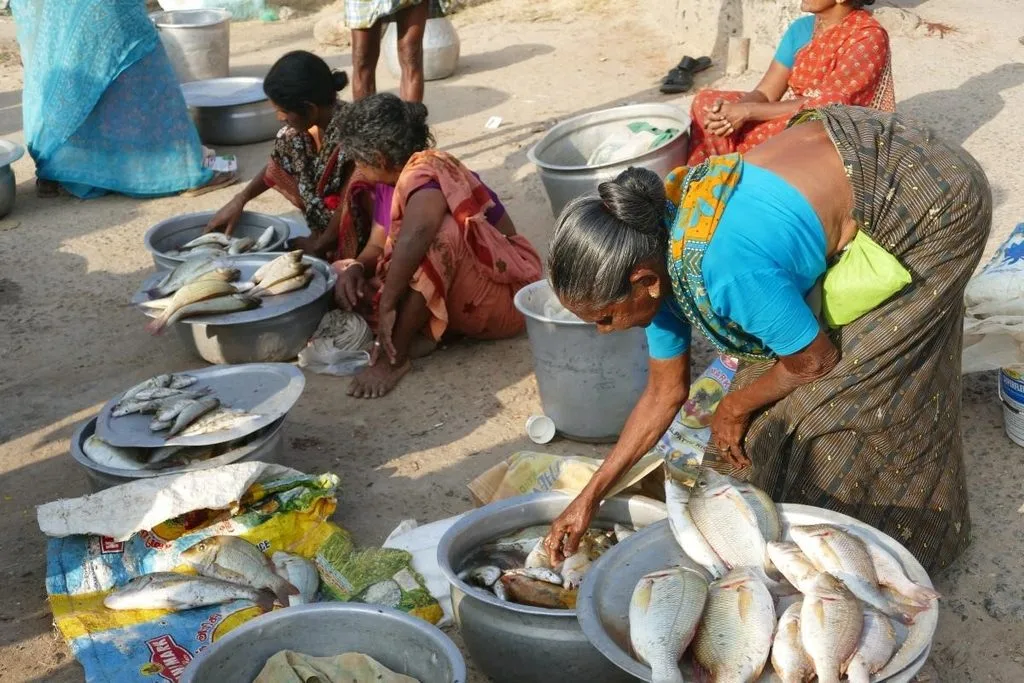
Traditional fishing communities are not merely occupational groups seeking employment. They are food-producing communities. Their access to coastal ecosystems, fishing grounds and local markets contributes directly to the nutritional needs of the wider population.
Small-scale fisheries supply fish to local markets and provide affordable sources of protein and essential micronutrients. Their importance extends beyond the coastal villages where fishing takes place. They sustain food networks that connect coastal producers with consumers in towns, cities and inland regions.
The Food and Agriculture Organization (FAO), through its Voluntary Guidelines for Securing Sustainable Small-Scale Fisheries, recognises the central contribution of small-scale fisheries to food security and nutrition. It also emphasises that international fish trade should not undermine the availability of fish needed to meet the nutritional requirements of domestic populations. This is an important warning.
If the future of fisheries is determined primarily by export competitiveness, corporate profitability and large-scale commercial production, the nutritional needs of ordinary people may become subordinate to the purchasing power of international markets. Fish that was once accessible through local landing centres and traditional markets may increasingly move through commercial supply chains. The benefits of value addition and export growth may accrue disproportionately to companies controlling processing, storage, transport and distribution. Meanwhile, the traditional fisher may receive only a small share of the final market value.
The consequences extend beyond the fishing community. For working-class households, poor families and communities with limited access to diverse sources of nutrition, fish is an important part of their diet. Any transformation that makes locally available fish more expensive or less accessible has implications for public nutrition.
Food sovereignty requires that fish should not be treated exclusively as an export commodity. It requires policies that protect the right of fishing communities to produce food and the right of the wider population to access nutritious food at affordable prices.
Women bear a disproportionate burden
The transformation of coastal economies has a particularly significant impact on women. Fisherwomen are often less visible in official definitions of fisheries, which tend to prioritise activities directly associated with catching fish. Yet women sustain a substantial part of the fisheries value chain.
According to the Government of India’s account of the FAO’s Illuminating Hidden Harvests study, approximately 4.8 million women are engaged in small-scale fisheries in India. They account for around four out of every ten people involved in the sector. Their contributions extend from net-making and boat operations to harvesting, processing, handling and marketing. These figures demonstrate that fisheries cannot be understood merely as an occupation performed by men who go to sea.
Women maintain the connection between fishing, food distribution and household nutrition. They process and preserve fish, sell it in local markets, manage household resources and transmit knowledge about fish varieties, seasons and preservation practices. However, their work is frequently informal, underpaid and inadequately recognised. They often have limited access to institutional credit, social protection, insurance, infrastructure and decision-making spaces. The commercial transformation of fisheries can deepen these inequalities.
When traditional fish markets disappear, when beaches and landing spaces become inaccessible, or when processing activities move into industrial facilities, women lose the spaces through which they have historically exercised economic independence.
A fisherwoman who purchases fish directly from a landing centre and sells it in a local market has a degree of control over her livelihood. If that access is replaced by a commercial procurement system controlled by large traders or processing companies, her independence can diminish. The displacement of women from traditional fisheries is therefore not simply a question of employment. It is also a question of economic autonomy, gender justice and the survival of community-based food systems.
Whose knowledge counts in managing the ocean?
The corporate model of ocean development is frequently justified through the language of science, technology, productivity and efficiency. There is no doubt that scientific research, technological innovation and effective resource management are essential for protecting marine ecosystems. But the assumption that modern technology and commercial investment are the only legitimate sources of knowledge is deeply problematic.
Traditional fishing communities possess generations of ecological knowledge. They understand local marine environments through continuous interaction with them. Their knowledge of seasonal fishing patterns, breeding cycles, changing currents, fish behaviour and coastal ecosystems can contribute significantly to sustainable fisheries management.
Women also possess specialised knowledge about species, processing, preservation, local markets and seasonal food availability. Yet these forms of knowledge are often excluded from formal decision-making. When coastal development plans are prepared without the meaningful participation of fishing communities, the state effectively treats them as beneficiaries who must adjust to development rather than as people with rights over the resources and territories that sustain their lives. This is a fundamental political issue.
Communities that have historically managed and depended on marine resources should not be reduced to stakeholders invited to express their concerns after major development decisions have already been taken. They must have a decisive role in determining how their ecosystems are governed and how the benefits of marine resources are distributed.
The contradictions of sustainable development
The blue economy is often associated with the promise of balancing economic growth with environmental sustainability. But this promise deserves critical examination.
Can the destruction of coastal ecosystems be justified in the name of economic development? Can a development model be sustainable when it displaces the very communities whose livelihoods depend on the continued health of marine ecosystems? Can the expansion of industrial production be considered progress if it increases pressure on natural resources and concentrates economic power in fewer hands?
These questions become especially important in an era of climate change, rising sea levels, coastal erosion, ocean warming and declining marine biodiversity. Fishing communities are among those most exposed to these changes. Their livelihoods depend directly on the health of coastal and marine ecosystems. Yet, they often have the least influence over the decisions that determine how these ecosystems are used.
The irony is that the people who have contributed least to the industrial destruction of the environment are frequently expected to bear its greatest consequences. A genuinely sustainable approach to the ocean must begin by recognising ecological limits. Marine ecosystems cannot be treated as endlessly expandable sources of raw materials, nor can coastal territories be regarded as vacant spaces awaiting investment.
The question of sustainability must include the rights of people who depend on these ecosystems, the ecological integrity of the ocean and the needs of future generations.
Reclaiming the sea as a commons
The alternative to corporate-led ocean development is not the rejection of all economic activity, technology or investment. Nor does it mean romanticising every traditional fishing practice or ignoring the ecological challenges facing fisheries.Traditional and small-scale fisheries require responsible resource management, protection of breeding grounds, regulation of destructive fishing practices and adaptation to climate change.
But these changes must be guided by ecological responsibility, social justice and democratic control rather than the pursuit of corporate profitability.
The rights of traditional fishing communities to fishing grounds, beaches, landing centres and associated coastal resources must be legally recognised and protected. Decisions concerning ports, tourism, aquaculture and other coastal infrastructure must include meaningful community participation and rigorous social and environmental assessment. Local markets and community-based fisheries must be strengthened. Women fish workers must receive formal recognition, access to credit, social protection, infrastructure and an equal role in fisheries governance.
The benefits of marine resources should be distributed equitably, and the nutritional needs of local populations must be prioritised alongside commercial and export interests. Ultimately, however, the challenge is political. It concerns who has the power to decide how natural resources are used and who benefits from them.
The sea cannot become another frontier for capital accumulation at the expense of people and ecosystems. It must remain a living commons that sustains biodiversity, livelihoods, cultures and food systems.
Beyond the blue economy
The celebration of International Fisher Women’s Day should therefore be more than an occasion to recognise the contribution of women to the fisheries sector. It should also be an opportunity to question the economic and political structures that make their work invisible and threaten the ecological foundations of their livelihoods. The struggle of fisherwomen is connected to the struggle of traditional fishing communities, coastal ecosystems and ordinary consumers who depend on fish as an important source of nutrition. It is also connected to a much larger question about the future of our economy.
If the ocean is transformed into a commercial space controlled by corporations, the consequences will not remain confined to fishing villages. They will affect food prices, public nutrition, ecological security and the distribution of natural wealth.
The right of fishing communities to live and work with dignity is inseparable from the right of society to access healthy and affordable food. Protecting their livelihoods is therefore not simply a matter of occupational welfare. It is a matter of protecting the foundations of a democratic and ecologically sustainable food system.
We need to move beyond an understanding of the ocean as a source of economic growth and recognise it as a shared ecological inheritance.
The real measure of a sustainable blue economy should not be the volume of investment attracted, the number of ports constructed or the value of seafood exports. It should be whether marine ecosystems remain healthy, whether fishing communities retain control over their livelihoods, whether women enjoy economic independence and whether ordinary people continue to have access to nutritious food.
The sea belongs neither to corporations nor to the markets that seek to commodify it. Its future must be shaped by ecological responsibility, collective rights and the people whose lives are inseparable from it.
The struggle to protect the sea is also a struggle to protect food sovereignty. And the struggle of fisherwomen is a struggle for the right of all of us to a just and sustainable future.

A.K Shiburaj began his journalism career in 2000 with the publication of Samvadam magazine from Kozhikode. He later worked as a teacher on the Maldives island and engaged in social work across North Indian states. He practiced organic farming for a time and served as the Assistant Editor of Keralayam Magazine (Web). He is now a freelance journalist and an advocate for civil society and social movements. He is a recipient of the Maja Koene Social Journalist Award in 2025.