
The Green Mask : How Hindutva sanctifies extraction
In this interview, Abhish K. Bose speaks with environmental scholar Professor Mukul Sharma about the relationship between Hindutva, ecology, corporate extraction and the politics of environmentalism in contemporary India. Sharma examines how ideas of sacred ecology, green growth and civilisational pride intersect with mining, large-scale renewable projects, land dispossession and the marginalisation of Adivasi, Dalit and pastoral communities. He also discusses the criminalisation of environmental dissent, the changing role of climate science in education, and the limitations of the Left’s environmental politics.
Abhish K. Bose: Hindutva claims a civilizational ethos of prakriti puja and sacred ecology. Yet we see large-scale forest and wildlife degradation under BJP governments — for example, mining in Hasdeo Aranya by the Adani Group, with documented deforestation, biodiversity loss, and Adivasi displacement in Chhattisgarh. Apart from the instrumental use of environmental rhetoric for polarization, is there any substantive environmental commitment in Hindutva politics? Or is green growth just a tool to camouflage extraction as progressive?
Mukul Sharma : Hindutva’s engagement with the environment has to be understood as a multi-layered project – spanning the RSS and its constellation of affiliate organisations, the BJP-led governments at the Centre and in the states, and the singular figure of Narendra Modi, who has fused personal image-making with civilisational claims about Bharat’s ecological wisdom. Seen this way, the apparent contradiction between sacred-ecology rhetoric and episodes like the Hasdeo Aranya coal-block clearances in Chhattisgarh is not really a contradiction. It reflects a movement operating in two registers simultaneously: one cultural-political-organisational, where it is quite substantive, and one concerning actual resource governance, where it is largely hollow.
On the substantive side, the RSS has built durable institutional infrastructure around ecology since 2014 – a Paryavaran Vibhag, an ‘India Declaration on Environment,’ mass tree-plantation and river-worship campaigns, and Panch Mahabhoot conferences with government ministries. My analysis of the RSS mouthpiece Organiser across 2014-2019 shows how this is conveyed visually as much as textually: rivers rendered as mothers demanding ‘purification,’ the cow as simultaneously ecological and national icon, and Modi himself photographed taking ‘holy dips’ or receiving garlands from RSS functionaries against a backdrop of the Himalayas. This is a coherent variant of what scholars call ‘right-wing ecology’ – distinct from European far-right ecologism because it braids eco-nationalism with Brahminical notions of purity and a civilisational narrative in which ancient, ‘golden age’ India possessed ecological and scientific perfection later destroyed by Muslim and colonial rule.
This can be also extended into the specific idiom of climate change, seeing how Modi has been cast – and casts himself – as a ‘Solar Superman,’ linking the saffron of Hindutva iconography to the ‘energy of the Sun,’ and repeatedly invoking the Atharva Veda, Rig Veda, and Panch Tatvas to frame renewable energy and yoga as ancient Hindu wisdom being ‘restored’ to the world. International recognitions, from the UN Champions of the Earth award to the founding of the International Solar Alliance, are absorbed into this narrative of India as jagatguru – world teacher – reclaiming a stewardship role it supposedly always possessed.
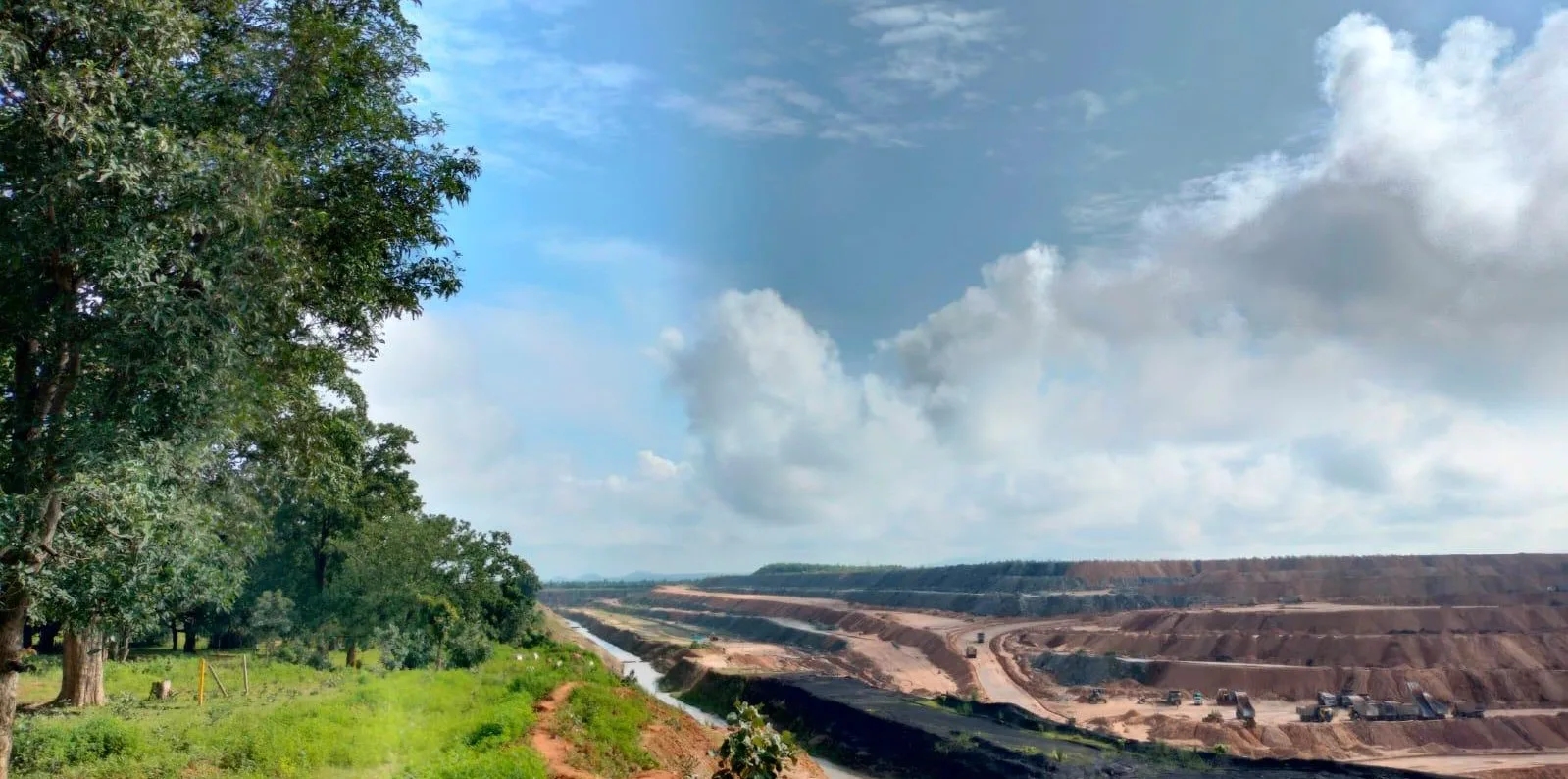
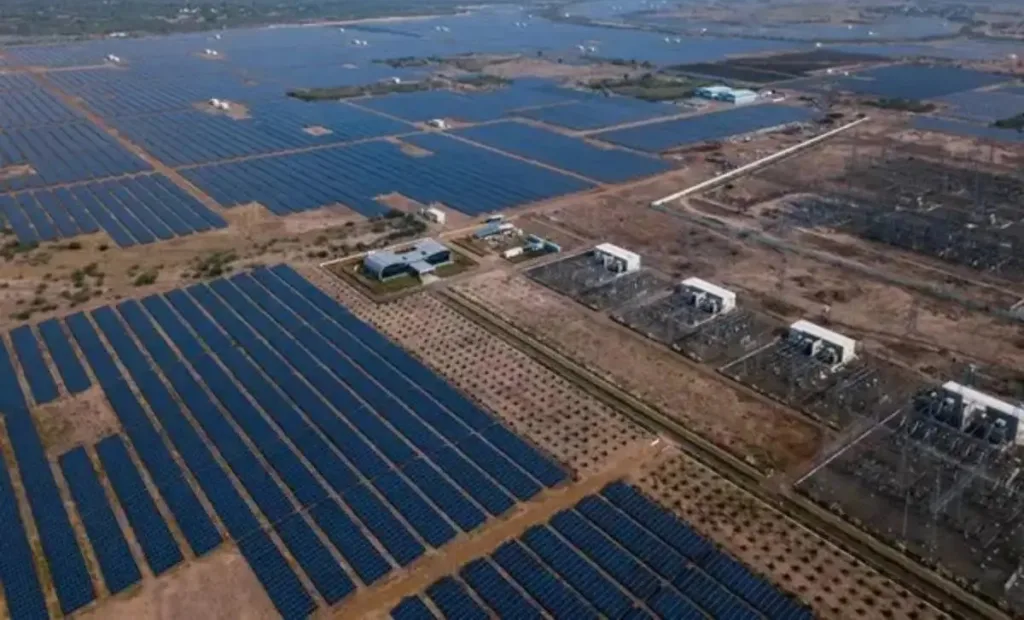
But this is where the hollowness becomes visible. Both texts converge on the same structural point: when it comes to actual forest, land, and mining governance, the pattern is one of centralisation and corporate consolidation rather than the decentralised, community-based models (gram sabhas, swadeshiself-reliance) that Hindutva rhetorically celebrates. I can document this concretely – coal production up 58% since 2013-14, fifty coal mines auctioned to private players, and renewable energy itself reorganised around mega-corporates like Adani Green Energy, Reliance Power, and Tata Power rather than local energy systems, with land conflicts affecting thousands of hectares and displacing Adivasi communities. Hasdeo Aranya fits this pattern precisely: a forest and Adivasi homeland cleared for Adani’s coal blocks under fast-tracked clearances, even as the same governmental apparatus invokes sacred nature elsewhere.
The throughline in both texts is that ‘nature’ in Hindutva discourse functions as a synecdoche for the nation and its Hindu ownership, not as a claim about non-human ecosystems or Adivasi relationships to land. Adivasis appear either as folk to be assimilated or obstacles to development – never as rights-holders over the forests being cleared. Green growth, then, is not simple camouflage for extraction; it is a genuinely productive ideological and electoral project that happens to carry almost no binding content once it meets capital and state power – because the sacred and the extractive were never in tension within the ideology to begin with.
Gau-raksha is central to Hindutva politics. But what is the actual ecological footprint of the post-slaughter-ban cattle economy — abandoned cattle, gaushalas, fodder pressure? Is the cow being used for politics more than for sustainable agriculture?
Gau-raksha sits at the very center of Hindutva politics, but the actual ecological footprint of the post-slaughter-ban cattle economy suggests this centrality is almost entirely political and symbolic. The claims of ecological virtue and agricultural sustainability made on the cow’s behalf do not hold up once the material consequences of cow-protection enforcement are examined.
The most immediate effect has been the collapse of the ordinary market mechanism through which unproductive cattle were once absorbed. With slaughter effectively criminalised and cattle transport rendered dangerous by vigilante enforcement, holding an unproductive animal has simply become uneconomic. Farmers respond, predictably, by releasing cattle to fend for themselves rather than bearing the cost of feeding an animal with no productive or resale value. The scale is considerable: India’s stray cattle population runs into the millions, with sharp increases recorded in states like Uttar Pradesh following the 2017 slaughterhouse crackdowns. This is not a marginal side effect but a systemic one – abandoned cattle now damage standing crops, disrupt traffic, and have pushed villagers into extraordinary measures, from trucking cattle across the Nepal border to locking them inside schoolrooms.
Gaushalas, the official Hindutva answer to this ‘menace,’ do not so much solve the ecological pressure as relocate and monetise it. Ethnographic accounts of individual gaushalas – including the well-documented Simhachalam Temple case in Andhra Pradesh – show these institutions functioning less as genuine sanctuaries than as selectively ‘pure’ dairy operations, excluding crossbreeds and buffaloes while having little real use for male calves and aged cattle, who are often quietly sold onward toward slaughter under euphemisms like ‘donation.’ Reports of gaushalas where hundreds of calves died from fodder and water scarcity and overcrowding are not isolated failures but a structural feature: gaushalas are chronically under-resourced relative to the scale of abandonment they are meant to address, and one dairy scientist’s blunt assessment – that unproductive cattle ‘are still eating valuable green fodder which could be diverted toward productive cattle’ – captures the agricultural irrationality at the heart of the model. Layered onto this is a political economy in which gaushalas have become sites of vigilante-driven cattle seizure (disproportionately from Muslim owners), lucrative state and corporate CSR funding streams, and, in states like Rajasthan, ‘fake gaushalas’ that draw government grants while housing few or no actual cattle.
The broader ecological ledger is worse still. India is widely identified as the largest single contributor to the global livestock methane budget, with dairy cattle alone responsible for a majority of the country’s enteric methane emissions. Zero-grazing confinement, plastic ingestion by foraging strays, and mounting water stress linked to fodder cultivation and dairying round out a picture in which the cattle economy – far from embodying ‘sacred ecology’ – imposes real and rising environmental costs, costs that even sympathetic Indian environmentalists have been reluctant to weigh against the livelihood arguments for animal husbandry.
Taken together, this suggests the cow functions overwhelmingly as a political-symbolic resource- organising communal violence, redistributing ‘cattle wealth’ toward Hindutva-aligned institutions, and reinforcing a civilisational narrative – while its role as a genuinely sustainable agricultural asset is neglected and, in important respects, actively undermined by the very policies enacted in its name. For a fuller empirical grounding of this argument, Jostein Jakobsen and Kenneth Bo Nielson’sAuthoritarian Populism and Bovine Political Economy in Modi’s India and Yamini Narayanan’s Mother Cow, Mother India are useful reference points, documenting respectively the political economy of stray cattle and gaushalas, and the multispecies and environmental dimensions of India’s dairy economy in granular ethnographic detail.
Adani, Reliance are now talking renewables, green hydrogen, while funding Hindutva. How does corporate capital reconcile with a Hindutva base that often voices anti-globalization, swadeshi, anti-dam sentiment? Is green growth the new compromise?
Adani and Reliance now speak fluently the language of renewables and green hydrogen, even as they fund and align with a Hindutva ecosystem whose base often voices swadeshi anti-globalisation and anti-large-dam sentiment. This is not a contradiction the movement has had to strain to resolve – it has done this reconciliation once before, and green growth is simply its latest form.
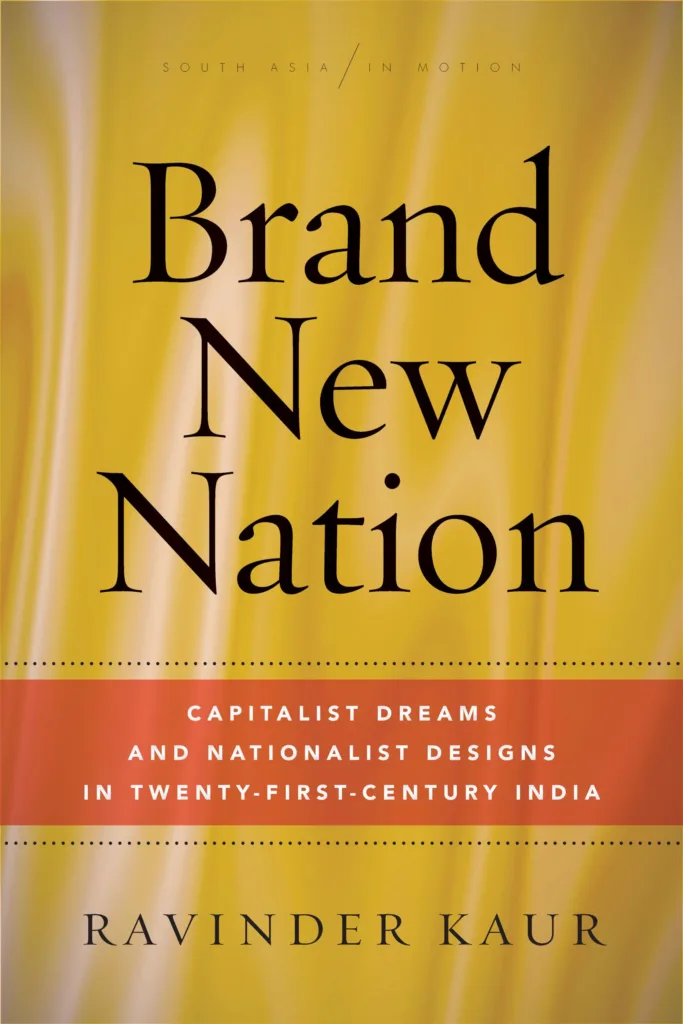
Ravinder Kaur’s Brand New Nation traces the template. In the 1990s, the RSS-backed Swadeshi Jagran Manch opposed economic liberalisation on grounds of indigeneity and self-reliance, sharing the Left’s suspicion of the market. But by the 2000s the RSS made a complete volte-face, absorbing economic reform into its own political agenda to compete with the Congress Party’s pro-reform credentials. Swadeshi did not disappear; it was re-coded – self-reliance shifted from autarchy to national economic assertion on the world stage, the same move visible in the India Shining campaign’s language of a country now investable and radiant. Kaur shows how this fused capital and nation so completely that, as with demonetisation-era digital finance, players like Reliance-Ambani’s Jio Money could present private profit as literal service to the nation. Capital, in her words, is firmly harnessed to the nationalist cause; the old myth that economy and politics are separate domains collapses.
Green growth performs exactly this manoeuvre for the renewable-energy moment. Modi’s climate discourse resolves the coal-versus-renewables tension not by picking a side but by giving each pole its own nationalist register: coal expansion is framed as Atmanirbhar Bharat (self-reliance, satisfying the swadeshi instinct), while solar and green hydrogen are cast as civilisational leadership and jagatguru stature. Both are subsumed within a single growth imperative treated as India’s sovereign right as a Global South nation. This lets Adani Green Energy and Reliance’s hydrogen ambitions proceed as ordinary corporate strategy while being narrated domestically as Bharat reclaiming ancient solar wisdom – the ‘Solar Superman’ idiom – rather than as globalised, foreign-capital-linked expansion.
The anti-dam and anti-globalisation instincts of the base are managed the same way: not confronted, but outnarrated. Mega renewable parks are presented not as globalisation but as swadeshi energy sovereignty – India generating its own power rather than depending on foreign oil – a claim that borrows the emotional charge of self-reliance while delivering a thoroughly corporate-capital-intensive model, complete with 100 percent FDI, land conflicts, and financing from EDF, SoftBank, and Goldman Sachs.
So yes, green growth is the new compromise, but ‘compromise’ undersells how rehearsed the reconciliation is. Hindutva’s economic ambivalence was never a fixed commitment to autarchy; it is a rhetorical resource redeployed however capital’s expansion currently requires – anti-liberalisation in the 1990s, pro-reform by the 2000s, pro-renewable-corporate now – each time relabelled as self-reliance and civilisational destiny rather than admitted continuity with global capital.
NCERT and new textbooks are inserting Vedic science, ancient water management, and rishi ecology. Is this an attempt to create an alternative environmental pedagogy that bypasses climate science? What gets erased in that process?
The NCERT insertions on Vedic water management, ‘rishi ecology,’ and ancient Indian science are not simply additive – a supplement of local knowledge alongside climate science – but part of the same ideological project traced across Hindutva’s engagement with science more broadly. As Banu Subramaniam’s Holy Science argues, when Hindu nationalists invoke the Vedas, the move is rarely to claim a separate, non-Western epistemology; instead Vedic revivalism tends to meld with rather than supplant Western science, folding modern scientific findings into the rubric of an already-omniscient ancient tradition. Applied to climate, this becomes: the greenhouse effect, water cycles, and ecological balance were already known to the rishis, and modern climate science is merely catching up. Textbook content follows the same script as Modi’s invocation of the Atharva Veda’s Prithvi Sukta and the Panch Tatvas, treating scripture as if it already contained, in embryo, findings that took two centuries of instrumentation to establish.
This is a pedagogy of replacement rather than addition. Climate science rests on falsifiable, quantified, revisable claims – atmospheric CO2, radiative forcing, IPCC scenarios – subject to correction and peer verification. ‘Vedic ecology’ as inserted into textbooks instead offers scriptural authority: harmony between man and nature as an eternal civilisational truth. This is also not a new maneuver but an institutionalised one: the book notes that when Hindu nationalists first came to power nationally, they established a National Curriculum Framework specifically to reshape textbooks – replacing frameworks grounded in democratic values and social justice with a ‘value education’ oriented toward cultivating national pride and civilisational spirit. Today’s NCERT revisions extend that project rather than departing from it.
What gets erased is threefold. First, historical specificity: ancient water-harvesting systems (johads, stepwells, tank irrigation) were real, localised, caste- and community-embedded practices, often sustained by Dalit and other subordinated labour whose contribution the ‘Vedic’ framing airbrushes into a generalised Brahminical golden age. Second, the actual record of Indian environmental struggle – Chipko, anti-dam movements, forest rights campaigns, frequently led by Dalit and Adivasi communities – is sidelined in favour of a genealogy that treats environmentalism as flowing from scripture rather than from decades of grassroots, often anti-state contestation. Subramaniam, drawing on Sivaramakrishnan’s distinction between ‘thin’ and ‘thick’ nationalism, would place this within thin nationalism: environmental politics invoked mainly to express ethnic affiliation or serve as empty ritual for political ends, a nostalgic return to a ‘native,’ pre-invasion past rather than a substantive ethical program for present conduct. Third, and most consequentially, erasure extends to present-day accountability. If climate change is framed as lost civilisational virtue rather than industrial emissions, land use, and corporate extraction, the actual drivers – coal expansion, mining-driven deforestation, land acquisition for renewable mega-parks – vanish from the pedagogical frame. Students learn to locate the crisis in a forgotten past, not in present political economy.
The effect is not a genuine synthesis of traditional ecological knowledge with modern science, which serious environmental scholarship does attempt, but a substitution that forecloses inquiry into who is causing environmental harm now. It replaces that inquiry with a story about who once knew how to live in harmony with nature and lost that knowledge to invaders – restaging, in the classroom, the same ‘return of the native’ fantasy that structures Hindutva’s wider biopolitical imagination.
If ecology is now framed as national security and civilizational pride, who gets to be called an environmentalist in India? Does this make Adivasi and anti-dam movements anti-national by default — and has the Left lost the plot?
When ecology is reframed as national security and civilisational pride – the ‘Superman’, ‘Jagatguru’ idioms – the definition of who counts as an environmentalist shifts with it. The approved environmentalist becomes the one who plants trees for Namami Ganga, performs river-purification rituals, or celebrates India’s renewable-energy targets on the international stage. The disqualified environmentalist is anyone whose ecological claim collides with a mining lease, a dam, or a corporate land acquisition – precisely the Dalits, Adivasi, anti-dam, and forest-rights movements that have historically constituted India’s most substantive grassroots environmentalism.
Yes, this does make such movements anti-national by default, and not merely rhetorically. Protests against Hasdeo Aranya coal clearances, anti-dam mobilisations, and land-rights struggles are routinely described in the language of ‘foreign agents’ and conspiracies against India’s economic greatness – the same ‘anti-national’ grammar used against farmers protesting the 2020 farm laws, who faced water cannons, sedition charges, detention under anti-terror statutes, and WhatsApp-driven smear campaigns branding them Khalistani separatists or Maoist proxies. Environmental activists and land defenders have faced comparable treatment: police cases and arrests targeting individuals, groups, organisations and movements have been documented as part of a shrinking space for ecological dissent. This is not incidental repression but what scholars have termed the autocratisation of environmental governance – a systematic loosening of institutional checks (draft EIA notifications diluting public consultation requirements, fast-tracked forest clearances, weakened community consent processes) running in parallel with the criminalisation of those who object to it. The state gets to relax the rules and prosecute the people pointing out the consequences.
Has the Left lost the plot? In important respects, yes. Beyond defending farmers and Adivasis reactively, and beyond a residual anti-corporate posture, the Indian Left has not built a compelling, popularly legible alternative environmental development vision – no equivalent counter-narrative to ‘green growth’ or civilisational solar leadership that could contest Hindutva’s framing on its own terrain. Older Left-aligned environmental politics – anti-nuclear, anti-big-dam, decentralised-energy movements – have persisted as protest formations but have rarely translated into a governing alternative capable of being tried, tested, or electorally rewarded. This leaves a vacuum that the Modi-RSS-BJP nexus has filled almost by default: a hybrid of green capitalism and exclusionary nationalism that survives less because it is coherent than because no rival vision has been made to compete with it at scale. The result is a climate politics sustained through contradiction, coercion, and the branding of dissent as disloyalty – a mode of governance whose durability says as much about the absence of an alternative as it does about the strength of Hindutva’s own environmental narrative.
In BJP-ruled states we see two things together: massive tree plantation drives branded as ‘ Ek Ped Maa Ke Nam’ and simultaneous bulldozing of urban wetlands, lakes, and informal settlements for smart city projects. Is urban environmentalism under Hindutva becoming aesthetic and upper-caste — focused on cleanliness, beautification, and pilgrimage towns — while ignoring air pollution, waste, and the rights of the urban poor?
Urban environmentalism in India has never been ideologically innocent – long before Hindutva captured the discourse, India’s civic-improvement campaigns already carried a strong upper-caste, middle-class inflection. The ‘hearts and minds’ city campaigns of the 2000s – Clean Kolkata, Mission Mumbai, Chalo Dilli – treated ‘the urban citizen’ as synonymous with the newly prosperous middle class, while street hawkers and slum dwellers were cast as intruders and ‘excess weighing down the city infrastructure,’ their claims dismissed as vote-bank patronage rather than as a right to the city. This is the scholarly phenomenon sometimes called bourgeois environmentalism: pollution, beautification, and encroachment-removal framed as neutral civic hygiene while functioning to clear the poor from valuable urban land.
What Hindutva-capitalist governance has added to this template is not the exclusion itself but its sacralisation and its scale. Tree plantation drives like Ek Ped Maa Ke Naam borrow the same personalisation strategy visible throughout Modi’s climate branding – a civic-ecological act folded into filial devotion to the ‘Mother,’ echoing the wider idiom in which rivers, cows, and the motherland are rendered as maternal, sacred, and in need of purification.
Urban beautification in BJP-ruled states now runs disproportionately through pilgrimage-town ‘corridor’ projects – Kashi Vishwanath, Ujjain’s Mahakal corridor, Ayodhya’s temple-town remodelling – where religious tourism infrastructure investment and slum or informal-settlement clearance proceed together, dressed in the vocabulary of restoring sacred geography rather than simply redeveloping real estate. Cleanliness itself, as in Swachh Bharat, carries an unexamined caste dimension: sanitation labour remains overwhelmingly performed by Dalits, even as the campaign’s imagery centers upper-caste volunteers wielding brooms for photo opportunities rather than confronting manual scavenging or waste-worker conditions.
Meanwhile, ‘smart city’ projects operate on the same techno-corporatist logic that characterises Modi’s renewable-energy programme – centralised, capital-intensive, elite-designed – but applied to urban space: wetlands and lakes that serve as flood buffers and commons for the poor are drained or built over for real-estate and infrastructure value, informal settlements are bulldozed as encroachments on ‘reclaimed’ public land, with rehabilitation, if it happens at all, pushed to city peripheries far from livelihoods.
What gets erased in this aesthetic-religious register is precisely what actually kills and sickens the urban poor: air pollution, which disproportionately harms low-income and informal workers with the least shelter from it; unmanaged solid waste, whose processing burden again falls on Dalit and migrant labour; and water and sanitation access for settlements that ‘beautification’ drives displace rather than serve.
After Kedarnath 2013 and Joshimath 2023, the official narrative shifted from ecological fragility to divine will and national duty to develop. Hydropower, widened Char Dham highways, and pilgrimage tourism were pushed as dharmic infrastructure in the fragile Himalayas. Is Hindutva environmentalism structurally incapable of saying no to projects in disaster-prone zones because every dam and road is framed as civilizational and national? Who pays the price when science is replaced by faith in disaster governance?
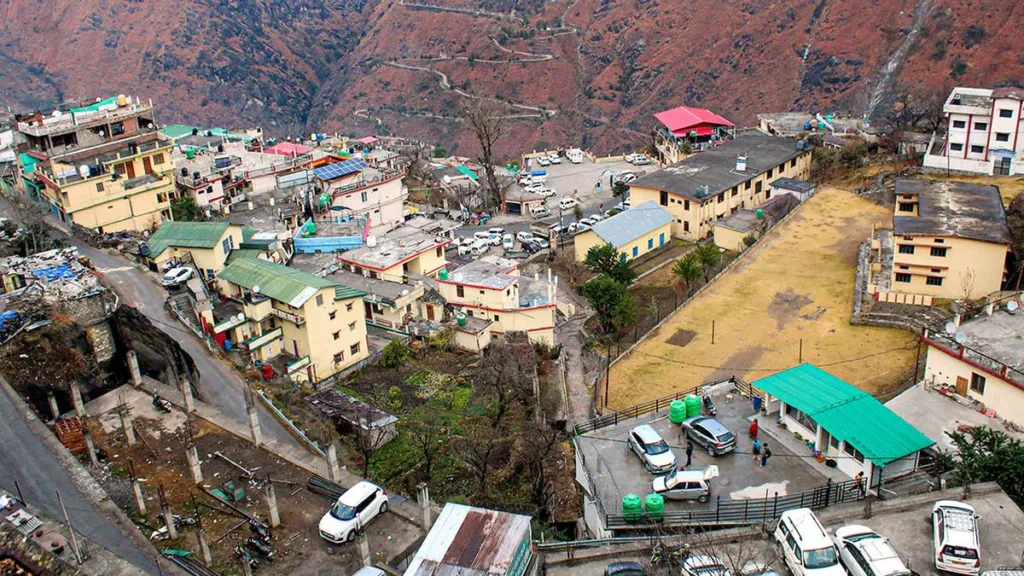
Kedarnath (2013) and Joshimath (2023) are not really two separate warnings – they are the same warning, ignored twice in a decade, each time overwritten by the same governing reflex: reframe ecological fragility as an obstacle to dharmic duty rather than a limit on it. The pattern in Joshimath is especially telling. A 1976 government-appointed committee had already found the town built on unstable landslide debris and called for restricted construction; by 2001, twelve scientific institutions had produced detailed hazard-zonation mapping showing over 99 percent of the area as landslide-prone. Both warnings sat unactioned for two decades while the NTPC’s hydropower project and the Char Dham highway-widening scheme proceeded regardless. When cracks finally appeared in hundreds of homes in January 2023, the government’s own power minister denied any link between the hydropower project and the subsidence, and later expert panels commissioned by the state largely exonerated the hydropower project too, attributing the collapse instead to unplanned population growth and pilgrim-tourism pressure – a framing that quietly protects the infrastructure while blaming the town’s own success as a pilgrimage destination.
This is the structural bind the question identifies. Once a road or dam is designated dharmic infrastructure – serving Char Dham pilgrims, linking Kedarnath, Badrinath, Gangotri, and Yamunotri, expressed as Bharat’s civilisational and devotional destiny rather than an engineering decision with a risk profile – refusing or scaling back the project stops being a technical judgement and becomes something closer to an act of faithlessness. A committee recommending restraint is not just contradicting an environmental impact assessment; it is seen as standing in the way of national duty and Hindu civilisational assertion. This is why Hindutva-inflected disaster governance in the Himalayas keeps recurring in the same shape: warnings are received, acknowledged even, and then subordinated to a developmental-devotional imperative that cannot easily accommodate the answer ‘no’ or ‘not here.’ The same logic that lets coal expansion be framed as Atmanirbhar Bharat and solar as civilisational leadership operates here too – infrastructure gets a nationalist-religious register that makes ordinary risk-based refusal politically costly, almost impossible to articulate without appearing anti-national or anti-Hindu.
Who pays the price is straightforward and consistent: not the planners or the corporations executing the hydropower contracts and highway tenders, but the residents of fragile Himalayan towns – many of them small farmers, shopkeepers, and pilgrimage-economy workers with no exit options – alongside migrant construction labour on the projects themselves, and, cumulatively, the millions of downstream pilgrims and residents exposed to future glacial-lake outbursts, flash floods, or landslides that geologists have been flagging for half a century. As Chipko veteran Chandi Prasad Bhatt observed after Joshimath, the crisis was less a natural disaster than the result of successive governments’ apathy toward repeated, specific, documented expert warnings.
Whether Hindutva environmentalism is structurally incapable of saying no is perhaps too strong a claim – the state can and does pause projects temporarily under acute pressure, as happened briefly at Joshimath. But it has shown no capacity yet to say no in advance, before the cracks appear, precisely because ‘before’ is when the civilisational and developmental framing is at its most politically useful and least contested.
Since 2014, lakhs of hectares of common lands, grazing grounds, and wastelands in Rajasthan, Gujarat, and Ladakh have been diverted for mega solar parks and green hydrogen projects. These are branded as climate action, but they displace pastoralists, kill commons, and benefit big corporate power buyers. Is green growth under Hindutva creating a new form of carbon colonialism — where Adivasi, Dalits and pastoral commons are sacrificed for corporate renewables, all in the name of national energy security?
Since 2014, the mega solar parks and green hydrogen corridors in Rajasthan, Gujarat, Ladakh and North-East are better understood through a just transition lens than a carbon colonialism one. Carbon colonialism presumes an external coloniser extracting from a colonised periphery; what is happening here is domestic fossil-fuel capitalism relaunching itself through renewable infrastructure, using Hindutva nationalism as its legitimating idiom rather than its underlying cause. The dispossessing actor is the Indian state and Indian corporate capital, and the sacrifice-zone logic runs through caste, class, and religious hierarchy rather than a national border.
Girard, Shokrgozar and Sareen’s study of federal solar discourse identifies two governing narratives – ‘solar nationalism’ and ‘win-win techno-solutionism’ – that together convert renewable rollout into a national mission built around fixed capacity targets. Their interviews with federal bureaucrats show this favoring of utility-scale mega-parks over decentralized rooftop solar is a political choice, not a technical necessity – rooftop-first models were explicitly set aside as too slow to hit headline numbers. David Singh’s ethnography of the Kutch wind frontier supplies the land-side mechanics: commons and grazing grounds are reclassified as ‘wasteland,’ a colonial-origin legal category revived to make pastoral and communal land legible for cheap corporate lease, after which what he calls ‘infrastructural colonisation’ proceeds through negotiation, consent-engineering, and, when needed, coercion mediated by local brokers and caste hierarchies. Both studies converge on the same mechanism: the nation functions as what Ryan Stock terms a ‘deus ex mitigata,’erasing differentiated responsibility and internal power asymmetries by presenting 1.4 billion Indians as a single collective actor pursuing solar glory, so that who bears the cost of that pursuit never enters the frame.
A genuine transition would need to satisfy three tests this model currently fails. Recognition: acknowledging Orans, Khadeens, and gauchar commons as legitimate land use rather than ‘backward’ wasteland awaiting monetization – the kind of recognition that pastoralist-NGO mapping and litigation efforts documented around Jaisalmer are fighting to establish against solar expansion. Procedure: real free, prior, and informed consent rather than what Singh calls ‘consent engineering,’where village sign-offs are technically required but practically manufactured through brokers and asymmetric bargaining, while district officials routinely decline to meet village sarpanches at all. Distribution: benefit-sharing and community or cooperative ownership instead of utility-scale plants that export power outward while host districts like Jaisalmer see under ten hours of daily electricity despite being ringed by solar and wind capacity. Alternatives exist – Barefoot College, SELCO, feminised decentralized energy programs – but remain marginal to a federal policy machinery organised around investor summits and an industry-state nexus, Adani being the clearest instance.
The deeper problem a just-transition framework surfaces, which ‘carbon colonialism’ can obscure, is that this buildout is additive rather than substitutive. Coal production and consumption have risen through the same years as the solar boom; India remains, as the literature puts it, caught in a carbon lock-in. Green capacity is being layered onto an unreformed extractive economy, not replacing it. Hindutva’s role here is not to cause this pattern but to dress it: neo-traditionalist rhetoric about India’s ancient harmony with nature and Vedic sun-worship gives corporate-led, top-down extraction a civilisational cover, making the dispossession of Dalit, Adivasi, and pastoral communities discursively invisible precisely as it intensifies materially.
Dismantling fossil-fuel capitalism therefore means decoupling green growth from both its business-first financing architecture and its nationalist branding – replacing capacity targets with siting, ownership, and consent criteria; redirecting subsidy and land-access advantages toward decentralised and cooperative models; and measuring success by actual fossil-fuel phase-out rather than parallel renewable expansion. Absent that shift, solar and hydrogen simply become the newest resource frontier in a much older pattern of extraction – one that will outlast the present ideological regime unless the political economy beneath it changes.

Featured Image: mining project in Hasdeo Aranya Courtesy: https://pucl.org/

A journalist with 18 years of experience Abhish K Bose was a staffer at The Times of India and The Deccan Chronicle - Asian Age. As a contributor, his interviews and articles have been published in Frontline magazine, The Wire, The Print, The Telegraph, The Federal, The News Minute, Scroll, The Kochi Post, The Leaflet, The Hindu.com, Outlook.com Countercurrents.org and the Asian Lite international published out of London