
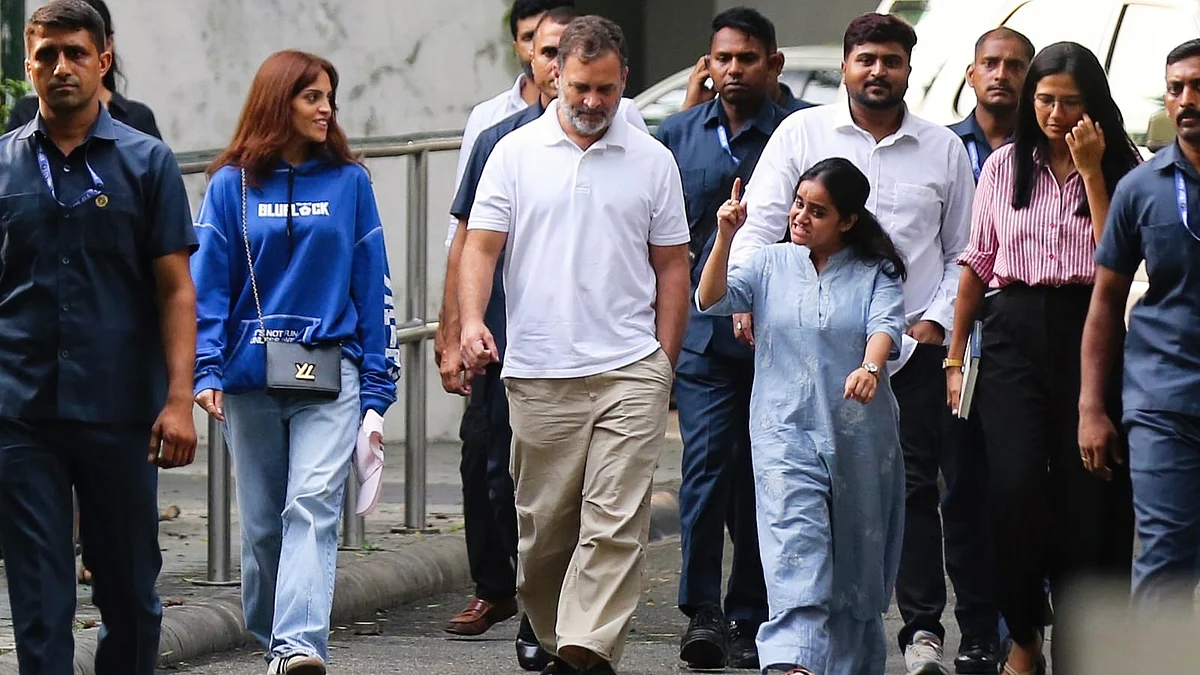
Rahul Gandhi and the Politics of Desire
In this essay, K. Vinodchandran interprets Rahul Gandhi’s recent political interventions through the idea of a “politics of desire.” Drawing on Deleuzean concepts of the political “event,” Gandhian Satyagraha, and Ambedkarite struggles for social justice, the article argues that the youth agitation and the subsequent protests have opened new possibilities for democratic resistance. It examines Rahul Gandhi’s engagement with students and women, his confrontations with the Modi government, and his emerging politics of love, fearlessness and solidarity as an alternative to the politics of fear and hatred. The essay also explores the relationship between Hindutva, caste, patriarchy and contemporary forms of political power.
The youth agitation that sent shockwaves through Indian politics was called off following the resignation of Dharmendra Pradhan. The students and youth dispersed after holding victory celebrations. Shaking the Modi government to its core and rewriting political equations, the tsunami of the protest has receded. The tremors have subsided. However, the subsequent agitations led by Rahul Gandhi indicate that the protest is not ending, but is rather gaining intensity and shifting in a different direction.
The agitation successfully broke through the dark clouds of fear and hatred created by twelve years of Modi rule. The “event” of agitation gave birth to a new subjectivity that is courageous and defiant, transcending caste, religion, and party divisions. Indian politics and society became polarized into two opposing camps: ‘evental’ and counter-‘evental’ forces.
I view the “Cockroach uprising” as a political “event.” Furthermore, my contention is that events emerge through the explosions of people’s desire. (“Evental Dimensions of the Youth Uprising,” K. Vinod Chandran, Panthi Magazine, August 17, 2026). Ontologically speaking, an event is a process of “becoming. The event engenders a new subjectivity through the process of self-metamorphosis. It is through the compositions between the agitator and the cockroach, through the molecular transformations of the self, or through a series of “becomings” (in Deleuzean terms) that the new subject is born in India. This subjective transformation is marked by libidinal acts of self-metamorphoses into cockroaches, butterflies, birds, wind, flows, vortices, and whirlwinds.”
A crucial breakthrough occurred in the trajectory of the agitation with Rahul Gandhi’s entry into the scene. It was Rahul Gandhi’s lightning march to Modi’s residence that catalyzed the youth agitation into assuming the form of an ‘event’ and surging toward victory.
With the conclusion of the agitation, the ‘event’ temporarily faded. Nevertheless, a certain current of the protest, a flow of the event, persisted unabated. What do Rahul’s political counter-attacks indicate, as he fans the embers of the event into a flame and redirects the course of the agitation toward Modi, Amit Shah, and the RSS? Is it not that even though a phase of the event has concluded, its undercurrents are surging into new directions and dimensions? Is Rahul, as the faithful new subject born of the event, preparing for yet another ‘event’ by coordinating the flows of desire of the people? By transforming the ‘event’ of the agitation into an “evental” politics, Rahul’s politics is forging a revolutionary shift in the course of Indian politics.
Surgical Strikes
Even though the youth had dispersed, Rahul was not ready to stop the agitation. He engaged in tactical political maneuvers to escalate the agitation into Parliament and subsequently out into the streets. By integrating the Gandhian methods of Ahimsa and Satyagraha with the political acts of desire, a novel mode of struggle was invented—one that minorises Indian politics.
Since July 29, Rahul has been leading the democratic agitation against the Modi regime by aligning the truth of the event with the new possibilities and consequences unleashed by the ‘event.’ The agitation, as an event, generated revolutionary shifts in political sensibilities, styles of struggle, and modes of practice. The counter-surgical strike devised by Rahul is precisely such an eventalized political practice—a fierce mode of struggle stamped by the event, dramatically channeling its explosiveness and unpredictability. Spanning both the period of the youth agitation and its aftermath, Rahul Gandhi has already executed three surgical strikes that altered the course of Indian politics, thereby marking the victory of democracy and the Constitution over Modi’s autocratic regime.
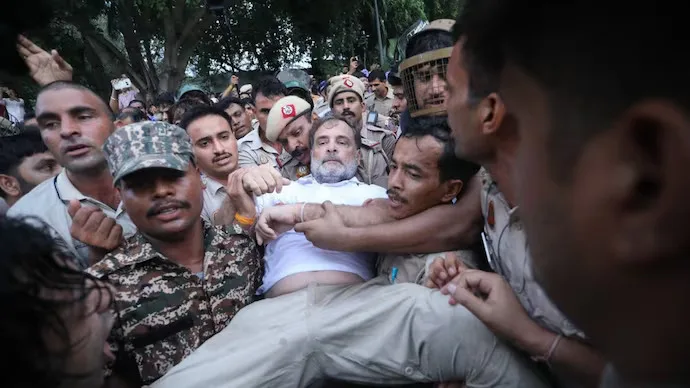
The first was the flash march to Modi’s residence on July 21—a masterstroke that redirected the youth struggle into a political agitation against the Modi regime, steering the protest toward a victorious conclusion. The ironic statement made by Rahul during the clash with the police must be viewed as an evental statement: “Indian democracy is happening here”. It was the voice of a new subjectivity, brought forth by the event.
The second was the flash protest staged inside Parliament starting July 29, following the conclusion of the youth agitation. Rahul Gandhi’s address in the Lok Sabha on July 29, along with his evening press conference and subsequent maneuvers, marked this second surgical strike. It was yet another mode of lightning struggle—one that was non-violent, yet cut to the core.
Rahul made it clear in the House that the issues do not end with Dharmendra Pradhan’s resignation, and that Modi and Amit Shah cannot evade responsibility for the examination paper leak. He declared that Parliament would be stalled until Amit Shah answered for authorizing the attacks on the youth. This sent a clear message to the public: the political opposition was taking charge of the agitation that the students had suspended.
Rahul Gandhi succeeded in putting Modi and Amit Shah on the defensive with a single ethical and democratic question, pinning them down outside Parliament. Coming from the very essence of justice and the Constitution, this question was sharper than a bayonet: ‘Who ordered the use of pellet guns against the students?” This was not merely a question; it was an evental statement, or rather, an order-word (mot d’ordre). Whatever the answer to this question, Amit Shah would be in jeopardy. If Amit Shah admitted to giving the order, he would have to accept constitutional guilt. If the order was given without his knowledge, it would mean he is unfit to remain in governance. Whatever the answer, it meant Amit Shah had to step down. This was the trap embedded in the question. Fearing this question, Modi and Amit Shah—once considered invincible—were evading the House, refusing to attend Parliament until its concluding day.
Rahul slammed the Prime Minister and Home Minister’s failure to appear in the House as an act of cowardice, while holding the RSS responsible for the collapse of India’s education system. Protesting the Speaker’s refusal to let him continue his speech, he held a press conference that evening. Rahul announced that Amit Shah must be ousted and declared that the protests would persist until then.
In the following days, the INDIA bloc succeeded in stalling Parliament by intensifying protest slogans and demonstrations. Amit Shah, who arrived at his parliamentary office every day, presented a pathetic sight to the Indian public in the ensuing days—hiding in the burrow of his own office, terrified of facing the opposition. With a single sharp and precise question emerging from the very heart of the Constitution, Rahul Gandhi managed to lock the Home Minister inside his office. The trajectory of the agitation was thus successfully redirected toward Modi and Amit Shah, the commanders-in-chief of the Hindutva regime.
It was a shattering counter-strategy that deployed democratic and ethical questioning to strike fear into the heart of a Hindutva regime that had silenced its people through a politics of dread—and conquered it purely through non-violence. It was the subversion of a politics of war through a ludic politics—a politics of desire. This was an exercise of democratic power rarely witnessed in modern history; the most contemporary and subversive political manifestation of Gandhian Ahimsa and Satyagraha. Although Modi and Shah, who had spent twenty days in hiding to evade Parliament, finally appeared in the House on its closing day, the Monsoon Session was concluded before any questions could be raised.
“Rahul Gandhi effectively held Amit Shah—the war machine of the Hindutva regime—and Modi—its command center—hostage through the power of democratic and ethical order-words. This flash agitation succeeded in temporarily halting the regime’s menacing counter-offensives and clandestine maneuvers.
Dialogic engagements with the youth
The Youth Assemblies convened to promote dialogic engagements were the brilliant, creative manifestation of the politics of desire shaped by Rahul. This series of dialogic sessions functioned as a micropolitical initiative, awakening the political sensibilities of the Indian youth and channeling the undercurrents of desire. The Youth Summit held at Prayagraj on August 24 was a continuation of the Chhatron Ki Goonj (Echo of the Students) dialogue series previously held in Kota, Rajasthan, and Dehradun, Uttarakhand. Rahul’s engagement with thousands of students evolved into a celebration of youth. These dialogues provided a space to listen to the students, politicizing them and rendering them event-oriented. This was achieved by drawing sharp focus toward the severe crises confronting Indian youth.
Rahul’s conversations laid bare the very core of the youth agitation. “In this darkness, you have achieved what even your parents could not. You faced your fears… and you raised your voice not with hatred, but with love.” Rahul urged the youth to confront their struggles without resorting to paths of hatred or violence. ‘We will never choose the path of hatred or violence. We will change this system through love and compassion.” He was reiterating the core formula of the politics of desire right there: “Open shops of love in the marketplace of hatred. Fight with love”
These libidinal political practices opened up entirely new frontiers of resistance. In this war of sensibilities waged against the grim, reactive affects of fear and hatred, the active affects of love and solidarity gained the upper hand.
This impassioned series of dialogues between the Leader of the Opposition and the student youth marks a crucial turning point in Indian politics—a shift from the politics of power to a politics of desire, from “major” politics to “minor” politics, and from a “monologic” politics to a “dialogic” politics. Rahul is forging revolutionary political practices right here that libidinalises Indian democracy and the Gandhian methods of Ahimsa and Satyagraha. Rahul Gandhi has thus emerged as a magnificent model of the novel Indian subjectivity generated by the event.
At the National Convention of the Rachanathmaka Congress on August 13—a platform facilitating dialogues with civil society organizations and activists—Rahul clarified that the agitation launched against Hindutva will remain firmly rooted in love, fraternity, and non-violence: ‘Our country does not belong to hatred; it belongs to love, compassion, fraternity, and non-violence… We will prove this to everyone.”
Rahul went on to discuss the politics of expression. He highlighted how the Modi government has consolidated its power by suppressing people’s voice, whereas the opposition stands firmly for freedom of expression. Even though the regime attempts to obstruct this freedom, the people of India have begun to articulate their true soul—a surge of expression that the government can no longer contain. The youth agitation was the precise embodiment of this liberty. Sharply criticizing the reactionary politics of the RSS and the BJP, Rahul declared that those who fear expression are fundamentally driven by cowardice. He asserted that there is no need to fear them, as they are the ones who are truly afraid. The message Rahul delivered was one of pure fearlessness—which is, after all, the unconditional expression of freedom. Here, Rahul actively coordinates political, social, and cultural resistances. Within this creative style of ‘trans-politics’, one can clearly trace the historical succession of Gandhian politics.
The Politics of the Pellet Gun
Sahil Lochab, who participated in the youth protest, was a student at Delhi University and a victim of the exam paper leak. The RAF forces fired a pellet gun at Sahil Lochab. Pellets pierced his chest, back, arms, and face, causing him to lose vision in his right eye. Doctors were unable to extract most of the pellet fragments lodged throughout his body; there were around 200 pellets inside him. After being discharged from the hospital, the young man visited various police stations in Delhi with his complaint, but the police were not even ready to file an FIR.
On August 21, at 11:30 AM, Rahul Gandhi personally arrived at the Mandir Marg Police Station along with Sahil and his mother to lodge the complaint. The police authorities responded that nothing could be done and directed them to approach the DCP office operating at the Parliament Police Station. As the police officers shrugged off their responsibility, they went to the Deputy Commissioner’s office at the Parliament Street Police Station. The police still refused to register the case. Rahul then warned DCP Sachin Sharma that they would remain seated in the station for as many days as it took until the case was registered. They staged a dharna inside the police station until evening.
Congress workers gathered in massive numbers. Panicked police officers called in the Rapid Action Force (RAF), equipped with tear gas and other riot gear. The early arrivals joined Rahul inside the station. When Priyanka Gandhi arrived, a wave of workers surged into the police station. Sensing danger, the police shut the station doors, forcing subsequent arrivals, including MPs, to wait outside. The Congress workers began chanting ‘Raghupati Raghav Raja Ram’ alongside various other songs. The atmosphere grew charged with intense enthusiasm as workers raised slogans against Modi and Amit Shah. On the walls of the police station, on the roads, and on government signboards, they wrote ‘Amit Shah Murdabad,’ ‘Sack Amit Shah,’ and ‘Kick Amit Shah.’ It was an open proclamation that fear had finally left the land. Rahul’s breathtaking maneuvers completely paralyzed the Delhi Police, which operates under the direct control of Amit Shah.
The dharna inside the police station lasted for nearly seven hours. Following discussions with higher authorities, the police initiated the process of registering the FIR around 5:30 PM. The order to register the case had come directly from the Ministry of Home Affairs. Rahul remarked that this situation clearly demonstrated how even the filing of a simple FIR now required the explicit orders of the Home Minister. The protest was called off only after receiving a written assurance that the case would be registered.
Rahul described the victory of the protest as the first step toward justice. “We demanded nothing but justice for an Indian citizen, a mother, and a father. The case was registered only after Amit Shah and the Home Secretary gave the final approval. This makes it absolutely clear who had blocked the FIR in the first place,” he stated.
The capitulation of the police was a public admission that it was Amit Shah himself who ordered the use of pellet guns. The protest successfully forced the authorities to admit that the claims made by the police and ministers—that pellets were never used against students—were an outright lie.
This flash protest proved the ultimate strength of the Constitution and democracy. It was a battle for justice that reclaimed the rule of law. This confrontation publicly demonstrated the victory of Indian democracy and the moral defeat of the Modi government. The success of the protest made it absolutely clear that the Modi government fears non-violent, constitutionally grounded, and democratic modes of struggle. It was also a tactical triumph for a novel struggle for justice, where Gandhian and Ambedkarite traditions merged. The protest successfully diverted public attention from controversies surrounding the national anthem to real political issues. It sent a clear message to the people that the agitation inside Parliament was now escalating out into the streets, transforming into a mass movement. By casting aside the long-standing criticism of being an inconsistent leader, Rahul succeeded through this protest in convincing the public that he is the most resolute and consistent political leader in Indian politics
The Women’s Conference in Pune
The fourth conference of the student and youth dialogue series, Chhatron Ki Goonj, took place in Pune on August 22. It was an assembly exclusively attended by female students, drawing active participation from over 15,000 young women. Rahul opened the dialogue by mentioning in Marathi that the meaning of Pune is love. Both Rahul and the girls arrived wearing badges that read ‘Girl Power.’ Free to express themselves, the girls spoke openly, laughed out loud, sang songs, and erupted against patriarchal power. It was a pure, unfiltered expression of the female psyche and women’s power.
Rahul stated right at the outset that he was there not to deliver political speeches or offer advice, but to listen to the ideas and thoughts of the new generation. The female students presented their real-life issues on stage. Rahul’s speech was conducted in an entirely interactive, conversational format. Lauding women’s power, Rahul emphasized that the 70 crore women in India are more important than its 70 crore men. He highlighted resilience, foresight, and compassion as qualities where women excel over men. He further accused the RSS and BJP of being responsible for the resurgence of the Manusmriti, a text that discriminates against women.
A video clip presented on stage illustrated Modi expressing shock at the profane language used by female protestors at Jantar Mantar. He remarked that while male protestors also used abusive language, it was the words of the girls that caused him a distinct cultural shock. Rahul Gandhi cited this statement as a definitive manifestation of patriarchy, arguing that it reflects a deep-rooted gender bias.
Rahul explained that patriarchal society enforces controls on Indian women through various forms of violence. He noted that alongside direct physical assault, violence is also inflicted through systemic economic deprivation and the denial of opportunities. Consequently, he issued a definitive call to action to dismantle this patriarchal structure. It was highly significant that this progressive message was delivered to young women from Pune, long considered a bastion of Hindutva conservatism.
Rahul attacked the “Manusmriti mindset.” He condemned the text’s instruction that a woman must be controlled by male relatives at every stage of her life, calling it shameful. He stated that women belong only to themselves, not exclusively to their fathers, husbands, or sons. He urged women to recognize their own identity, break free from imposed frameworks, and move forward by trusting their abilities. He declared, “India’s greatest strength is the 70 crore unique journeys, unique imaginations, and unique dreams of its women.” These intimate dialogues served as an awakening song for female yearnings.
“We do not want a Hindustan that cages, discriminates against, and oppresses girls.” Women and girls are the strength, foundation, and future of India. “Patriarchy oppresses, frightens, threatens, and controls you.” “Together, let us smash patriarchy!” …“Speak up loudly, stand with pride,” and fight for your own space in society”—these were not mere pieces of advice. They were powerful incantations.
The Power Structure of Hindutva
What is the power structure of Hindutva? The truth is that neither the resistance movements, political thinkers, nor historians in India have been able to find a correct answer to this question. I believe it is this shortcoming that weakens the resistance efforts against Hindutva. Political thinkers and democrats in India viewed the rule of Hindutva as an accidental aberration or deviation that occurred in Indian democracy. As a fascist aberration.
Resistance thinkers focused on the fascist legacy and Nazi character of Hindutva. However, contemporary politics gives us the realization that Hindutva is a Zionized Hinduism, and the Hindutva state is fundamentally a Zionist settler-colonial rule. A corporate Zionist ethnocratic regime that maintains subservience to America and Israel. The simple definition of fascism only served to obscure the colonial nature of Hindutva and its camaraderie with Zionism. However, Zionism should be seen as a historical mutation of fascism. A global, domestic, and colonial racist rule that is even more diabolical, surpassing fascism itself.
This means that the Indian people today are facing a Zionist, racist colonial power that is more cruel and vile than British colonialism. The ‘eventfulness’ of the youth protests and the ongoing political struggle led by Rahul Gandhi lies in the fact that such a diabolical force could be temporarily brought to its knees through democratic and non-violent agitation. However, Gen Z protesters or their sympathizers do not yet seem to have realized that the Modi government is preparing for a much stronger counter-attack after a temporary retreat.
Political Romance
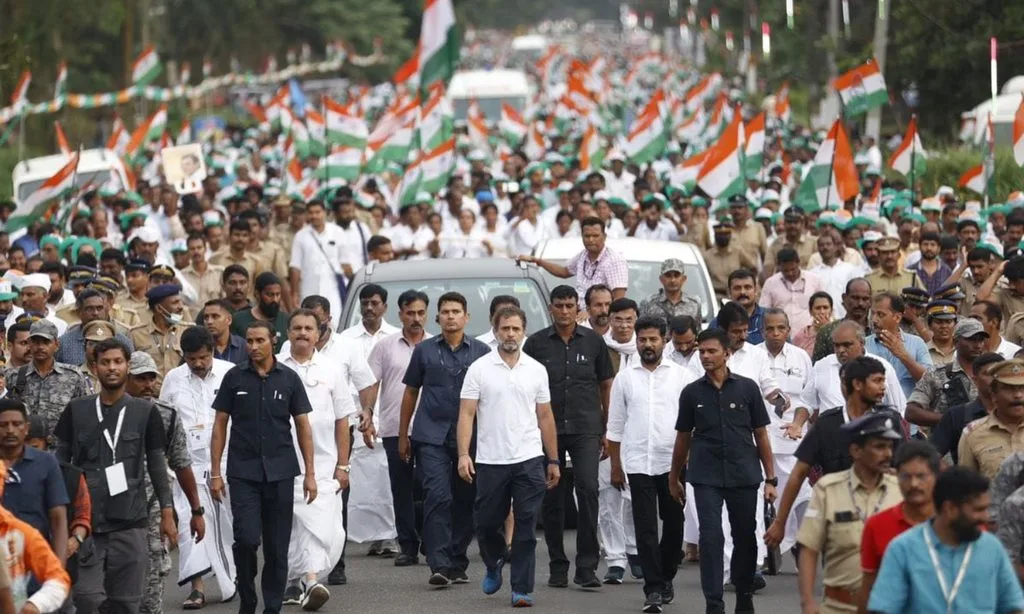
It is against this political backdrop that the success of Rahul Gandhi’s politics of desire becomes crucial. By shattering the Hindutva-Zionist narratives that produce fear and hatred, Rahul’s narratives of romance—which prioritize love, friendship, unity, dreams, and justice—succeeded in winning the narrative war. From the Bharat Jodo Yatra onwards, Rahul held high the messages of the politics of desire. The call to ‘open shops of love in the market of hatred’ was a love-mantra that Rahul offered to the Indian people. It marked the rise of a new political leader who, after Gandhi and Nehru, elevated Indian politics to the realm of of ideas and dialogues.
This political narrative of desire not only overpowered Hindutva in the war of narratives, but it also triumphed in the war of affects. It devastated Hindutva in aesthetic terms, as well as in terms of political sensibility, sensitivity, and micro-political practices. This re-invigorated aesthetic sensibility should be seen as a historical-political romance. Rahul’s new politics transforms resistance into an act of romance. It creates a people’s sublime. Freeing politics from the lower domains of party conflicts, power struggles, and rigid ideologies, Rahul elevates it into a practice of desire. This is the inner revolution that Rahul Gandhi is creating in Indian politics.
Rahul’s political persona is a harmonious synthesis of the ideas and legacies of resistance of Gandhi, Ambedkar, and Nehru. Rahul has succeeded in linking Gandhian methods of struggle and Ambedkar’s anti-caste politics with the acts of desire. By weaving Nehruvian political romance with Gandhian satyagraha and the struggle for social justice, Rahul, the political romancer par excellence, expands it into new horizons.
It is the realization that this struggle against Zionist occupying forces is far more complex and challenging than the freedom struggles waged against British occupation that sets Rahul apart from other political leaders. Yet, this insight did not deter him. Instead, he constructed an alternative politics rooted in love, fearlessness, and justice—one that pushes back against the politics of fear. By meticulously mapping the internal vulnerabilities and structural fractures of the Hindutva-Zionist war machine, Rahul devised playful yet strategic methods of struggle to strike at its vital core. The battlefield was successfully shifted from violent confrontations to moral, intellectual, affective, and aesthetic planes. What is emerging here is a non-violent method of libidinalised struggle—one that traps the adversaries within the very rules of the democratic game, subduing them ethically, intellectually, and psychologically.
De-Hindutvization and de-Zionization
Resistance against the Hindutva-Zionist ethnocratic regime demands deep decolonizing processes and multi-layered struggles for freedom. This is precisely the significance of the new satyagraha politics led by Rahul, which unifies political and cultural resistance. In this context, decolonization means de-Hindutvization. And de-Hindutvization means de-Zionization. Zionism is a war machine of necropolitics that can only survive by annihilating all forms of desire and historical events. Hindutva-Zionist narratives are toxic factories that manufacture hatred, fear, and death. This struggle of desire waged by Rahul—by generating the affective forces of love, compassion, and friendship—must be viewed as a deep process of de-Zionization and de-Hindutvization. Through the libidinization of democracy and resistance, Rahul Gandhi’s politics gives a new direction to both Indian and global politics. Here, politics is being elevated to the sublime as a harmonious expression of the desire for truth, justice, and life itself.
Rahul is now entering a more powerful battle against the caste system and the Manusmriti—an upper-caste ideology that has internally divided the Indian people, suppressed popular desire, and denied justice to Dalits and the oppressed. The next political move has already begun, demanding that a case be registered against the BJP members who performed a ‘purification ritual’ at the venue where Congress President Mallikarjun Kharge had spoken. Rahul declared that what the BJP did in Haldwani, Uttarakhand, was the criminal offense of ‘untouchability,’ and that the protests would continue until justice is served for the party president. Ironically, instead of registering a case against the accused BJP members, the police booked the Leader of the Opposition, who had raised the complaint. This indicates that Rahul’s politics is moving toward a path of ethical and symbolic struggles for social justice, and against the caste system and the Manusmriti—the code of law of Brahminical dominance.
This politics of desire cannot be reduced to a mere party political movement. After all, those who follow Rahul’s vision remain a minority within the Congress even now. Ultimately, he represents the political desire of the Indian people rather than that of the organization itself. Do these leaps, these torrents—from defense to non-violent counter-attacks, and from power politics to the politics of desire—signal the initial explosions of another imminent event?
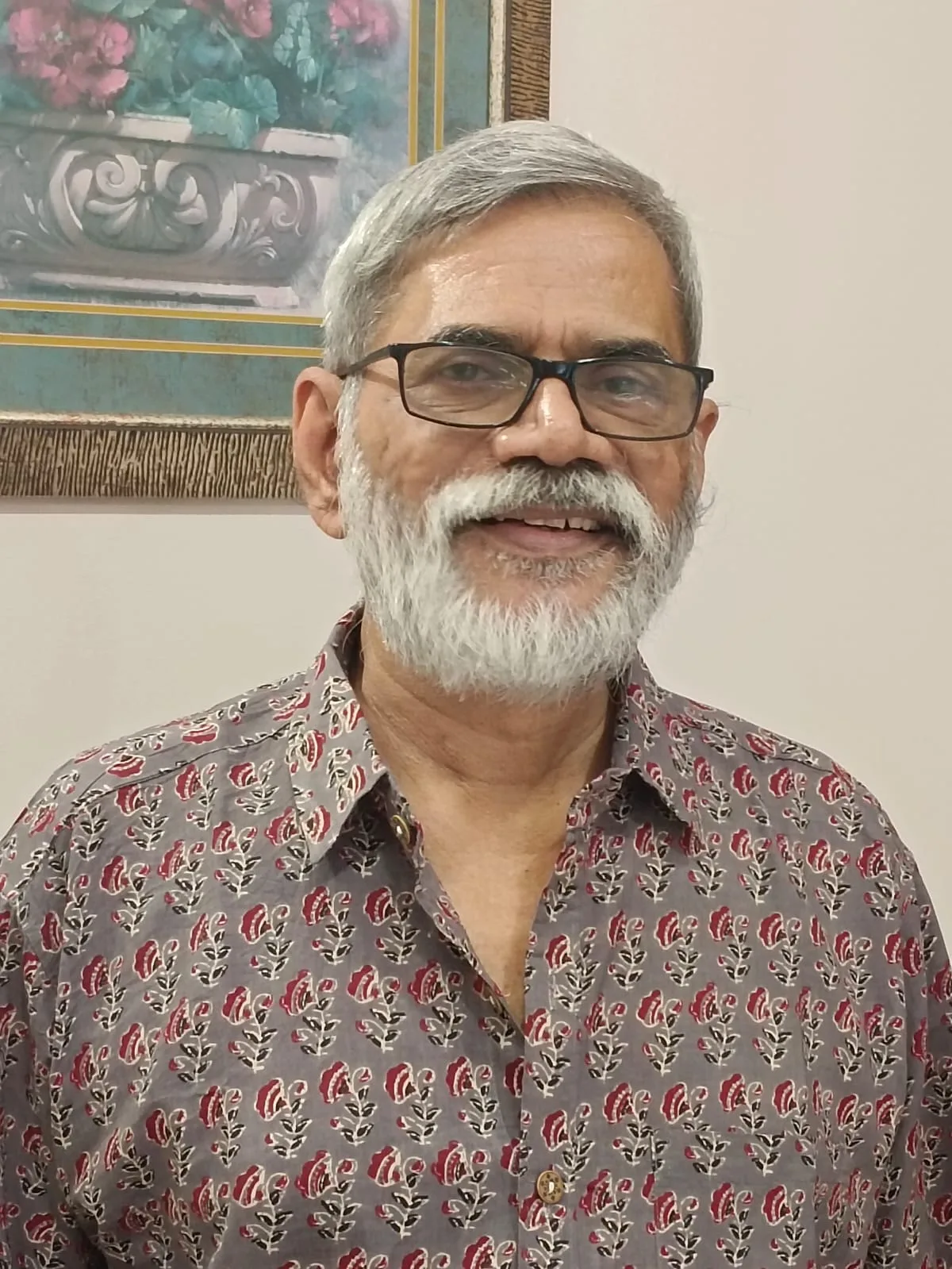
He earned his PhD in History from JNU in 2005. His research focused on an inquiry into narratives of power and identity in Kerala, based on the historical novels of C. V. Raman Pillai. He retired in 2011 while serving as the Head of the Department of History at Sree Kerala Varma College, Thrissur.He has written numerous papers and essays in both English and Malayalam in the fields of literary criticism, cultural studies, intellectual history, and philosophy. His book Gurunērangaḷ, published in July 2025 (Freelance Books, Thrissur), rethinks the Kerala Renaissance and the poetry and philosophy of Narayana Guru through a novel meta-historical perspective.