
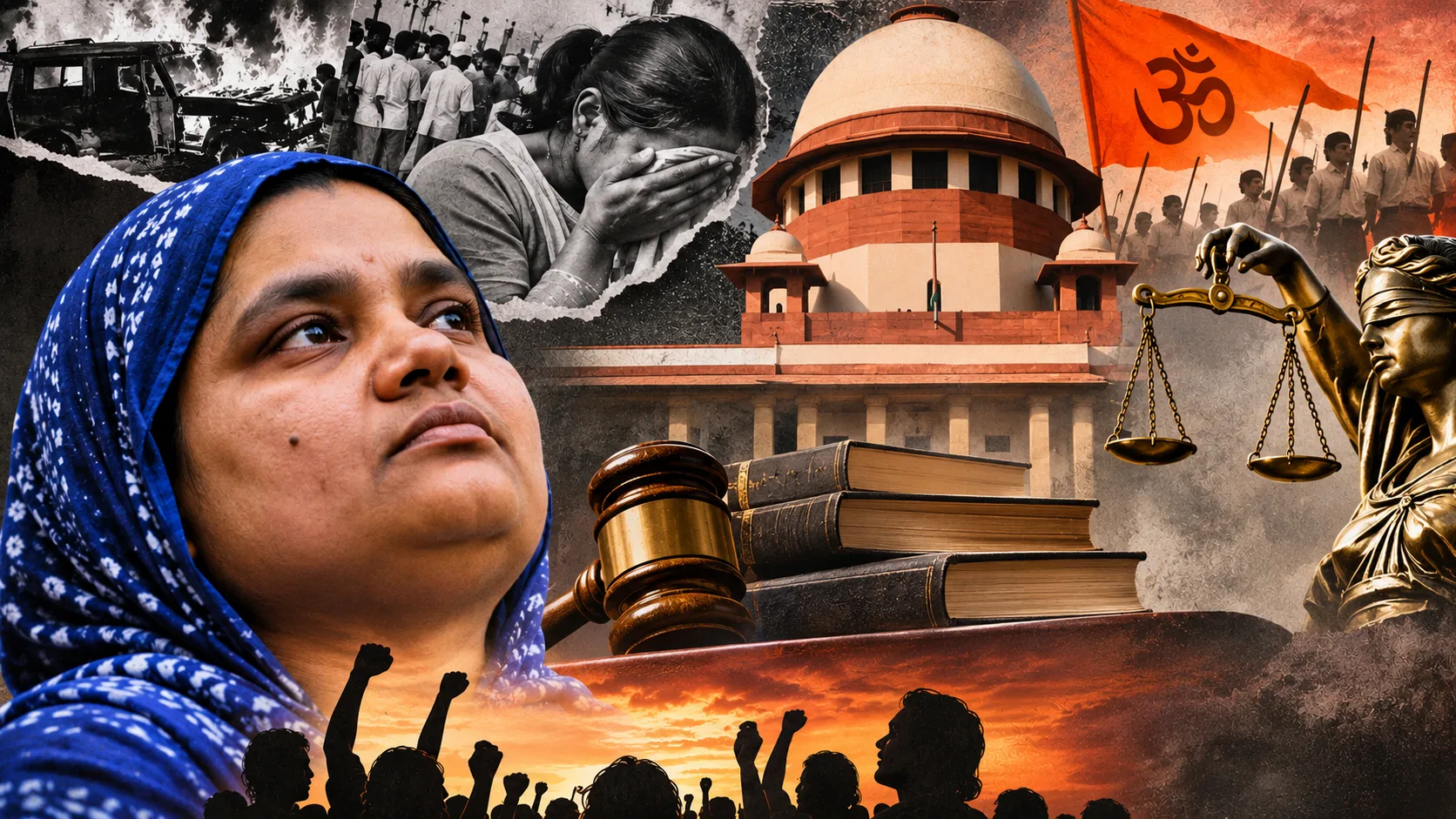
Bilkis Bano and the Collapse of Constitutional Justice: How Hindutva Majoritarianism Is Reshaping India’s Judiciary
The struggle of Bilkis Bano is not merely the story of a survivor seeking justice; it is a powerful testament to courage, resilience and the fight for constitutional values in India. More than two decades after the 2002 Gujarat communal violence, her struggle continues to expose the failures of political institutions and the challenges facing India’s judicial system. From the public celebration of convicted rapists to controversial judicial developments, this article examines how Hindutva majoritarianism is reshaping India’s democratic institutions and why standing with Bilkis Bano is essential to defending a secular, just and constitutional society.
The woman India should have stood beside
On October 28, 2026, the Supreme Court of India suspended the life sentences of two men convicted in the Bilkis Bano gang rape and murder case and granted them bail pending their appeals. The two men, Bipinchand Kanaiyalal Joshi and Pradip Ramanlal Modhiya, had spent more than 17 years in prison. The Court took note of their prolonged incarceration, the severe disability of one appellant and questions of fact and law that remain to be examined.
The order became public in November,2026. For Bilkis Bano, however, it represented another painful development in a struggle that has already consumed more than two decades of her life.
According to reports, she was not informed of the proceedings or given an opportunity to be heard before the latest order was passed. In her response, she expressed shock that a decision affecting the men convicted of crimes against her and her family had been made without hearing her side. She announced her intention to challenge the order.
The latest development cannot be considered in isolation. It is part of a much longer history involving communal violence, institutional failure, political indifference and the extraordinary determination of a woman who refused to surrender her demand for justice.
Bilkis Bano should have become one of India’s most respected public figures. Not because she was a victim, but because of what she did after becoming one. She demonstrated extraordinary courage in confronting a system that repeatedly placed obstacles in her path. Her struggle should have been celebrated across political and ideological boundaries as an example of resistance, dignity and the pursuit of justice. Instead, India has allowed her to remain largely isolated in her struggle.
This raises a disturbing question: why has a woman who represents such an extraordinary struggle for justice not become an enduring symbol of solidarity for India’s democratic and secular political movements? More importantly, what does her experience reveal about the transformation of India’s institutions under the growing influence of Hindutva politics?
The violence that attempted to destroy an entire family
The story of Bilkis Bano begins in the aftermath of the Godhra train burning in February 2002, when Gujarat was engulfed by communal violence. Bilkis was just 21 years old and five months pregnant. On March 3, 2002, she was travelling with members of her family and relatives when a violent mob attacked them near Randhikpur in Dahod district.
She was gang-raped. Seven members of her family, including her three-year-old daughter Saleha, were killed. Other relatives were also caught up in the violence. The brutality was not simply an attack on an individual woman. It was an assault on an entire family, its security, its relationships and its right to exist without fear.
Imagine the psychological and physical consequences of surviving such an experience. A young woman loses her child and several members of her family, suffers sexual violence while pregnant, and is left to confront a world in which the people who committed these crimes belong to the same society from which she must seek protection.
The violence did not end with the attack. The subsequent institutional response exposed another dimension of the injustice. The initial police investigation was deeply compromised. The first information report did not properly record the sexual assault or name the accused, despite Bilkis identifying some of them. The police initially sought to close the case. There were serious irregularities in the investigation, including the conduct of police officers and doctors.
Bilkis approached the Supreme Court. The investigation was eventually transferred to the Central Bureau of Investigation, and the Supreme Court transferred the trial from Gujarat to Mumbai in 2004 because of concerns about threats and the possibility of an unfair trial.
In January 2008, a special court convicted 11 men and sentenced them to life imprisonment. In May 2017, the Bombay High Court upheld their convictions and also set aside the acquittals of police officers and doctors involved in the compromised investigation.
These developments were not gifts from a benevolent state. They followed Bilkis’s persistent efforts to make the institutions of justice perform their constitutional responsibilities. In April 2019, the Supreme Court directed the Gujarat government to pay her compensation of Rs 50 lakh and provide employment and accommodation.
What deserves particular recognition is her refusal to disappear. Sexual violence survivors in patriarchal societies are frequently subjected to a second punishment: social stigma, victim-blaming, isolation and pressure to remain silent. Women are often expected to protect the so-called honour of their families by withdrawing from public life.
Bilkis refused that expectation. She pursued justice despite threats, uncertainty, repeated legal proceedings and the emotional cost of revisiting the violence. Her husband, Yakub Patel, also stood beside her throughout this struggle. Asad Ashraf’s recent account, The Promise Yakub Patel Made to Bilkis Bano, published in Karvaan India on November 18, 2026, offers a moving account of their relationship and the promise he made not to let her face the struggle alone.
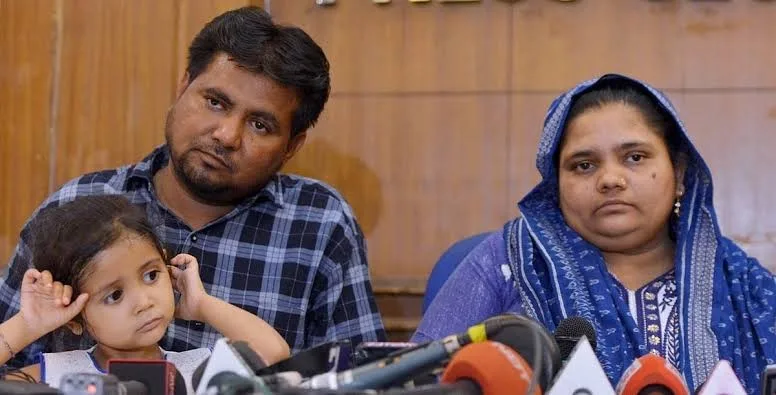
The story is important because it reminds us that solidarity with survivors must challenge the patriarchal attitudes that frequently isolate them. Bilkis was not somebody whose dignity needed to be restored by a husband or society. She possessed that dignity already. What she needed was companionship, protection and a society willing to stand behind her demand for justice. Her courage should have become a source of inspiration for every Indian who believes in equality and human dignity.
The political failure: Why was Bilkis not made an icon of resistance?
One of the most disturbing aspects of the Bilkis Bano case is the failure of India’s mainstream opposition parties to make her struggle a sustained political and moral priority. The Indian National Congress, the principal national opposition party for much of the period, has repeatedly criticised the BJP’s communal politics. It has spoken about constitutional values, secularism, women’s rights and the protection of minorities. Yet the Bilkis Bano case has never received the sustained political recognition that its significance demands.
This criticism is not an argument that no Congress leader or opposition politician ever expressed solidarity with Bilkis. Several did. Nor should the responsibility for the Gujarat violence or the subsequent actions of the Gujarat government be transferred to the Congress. The criticism is about the absence of a sustained political commitment.
Why did opposition parties not consistently place Bilkis at the centre of their campaigns for women’s dignity, secularism and constitutional accountability? Why was her struggle not transformed into a national movement against communal sexual violence and the impunity enjoyed by perpetrators of such crimes?
Consider what happened on August 15, 2022, when the Gujarat government released all 11 convicts under its remission policy. The date itself was deeply disturbing. India was celebrating 75 years of independence under the government’s Azadi Ka Amrit Mahotsav programme. On that very day, men convicted of gang rape and murder were released from prison.
Their release was followed by public celebrations. Some were welcomed with garlands and sweets by people associated with the local Hindutva establishment. BJP MLA and member of the remission committee, C. K. Raulji, defended the convicts, describing them as Brahmins and men of good sankaar (values or culture), despite their convictions for exceptionally grave crimes.
The spectacle was an assault on the dignity of the survivor and a disturbing illustration of how caste and religious identity could be invoked to defend those convicted of horrific crimes.
The Supreme Court eventually quashed the remission orders on January 8, 2024. It found that Gujarat was not the appropriate government to grant remission because the trial and sentencing had taken place in Maharashtra. The Court also found that the May 2022 order directing Gujarat to consider remission had been obtained through suppression of material facts and misrepresentation.
The judgment was a significant judicial correction. But why did it take such a prolonged legal battle to reverse a decision that had inflicted further pain on the survivor? The opposition’s response to the remission episode was also inadequate in its long-term political impact. There were statements of condemnation, protests and expressions of solidarity. But these did not develop into a sustained national campaign that could make Bilkis a symbol of resistance against the political normalisation of communal violence.
There is a larger political problem here. Opposition parties frequently criticise Hindutva when it becomes electorally advantageous. But opposing Hindutva requires more than electoral criticism. It requires an alternative moral and political imagination.
Bilkis Bano represents precisely such an alternative. She stands for a country in which a Muslim woman can demand justice against powerful social and political interests and receive the protection of the state without having to negotiate her citizenship or prove her loyalty.
She should have been adopted as an icon of courage, justice and resilience by every political party that claims to defend the Constitution. The failure to do so raises questions about whether these parties fully understand the nature of the political transformation taking place in India.
From a secular republic to a majoritarian political order
To understand the significance of the Bilkis Bano case, we must look beyond individual incidents and examine the wider political transformation of India. The Constitution established India as a democratic republic founded on equality, liberty, fraternity and secular principles. It did not establish a state belonging to any particular religious community.
The Hindutva political project, however, has consistently sought to redefine Indian nationhood through a majoritarian understanding of Hindu identity. This transformation is not simply about the electoral strength of the BJP or the presence of religious symbolism in public life. It concerns the gradual reorganisation of institutions, public discourse and the relationship between citizenship and religious identity.
A citizen’s constitutional rights should not depend on whether that person belongs to the religious majority or minority. But the growing normalisation of anti-Muslim rhetoric, the political mobilisation around historical religious grievances and the unequal treatment of communities have created an increasingly unequal environment.
The judiciary is central to this debate because it is constitutionally entrusted with protecting citizens against arbitrary state power and majoritarian excesses. It would be simplistic to argue that every controversial judicial decision is evidence of Hindutva influence. Indian courts have also delivered important judgments defending fundamental rights, minority protections and constitutional principles. The Supreme Court’s January 2024 judgment in the Bilkis Bano remission matter is one such example. Nevertheless, several judicial developments deserve serious examination.
The Babri Masjid judgment: A contradiction that continues to haunt secular India
The Supreme Court’s November 2019 Ayodhya judgment is among the most consequential judicial decisions in independent India’s history. The Court unanimously awarded the disputed land to the deity Ram Lalla Virajman, paving the way for the construction of the Ram temple. It directed that an alternative five-acre plot be provided for a mosque.
The judgment also acknowledged that the demolition of the Babri Masjid on December 6, 1992, was an egregious violation of the rule of law. It recognised that the mosque had been unlawfully demolished and that the destruction of the structure could not be justified. Yet the final outcome awarded the disputed land to the Hindu side.
The Court relied on its assessment of the evidence concerning possession and the historical use of the site, rather than accepting that the mosque had been lawfully displaced. It also distinguished the question of title from the question of the demolition.
The difficulty is not that courts should decide property disputes according to political expectations. They must decide them according to law and evidence. The larger constitutional question, however, remains: what message does a judicial settlement send when a place of worship destroyed through an acknowledged violation of law ultimately becomes the site for the religious structure sought by those associated with the movement that mobilised around its destruction?
The judgment attempted to balance competing claims through legal reasoning. But its political and social consequences cannot be separated from the history of the demolition and the majoritarian mobilisation that preceded it. For India’s Muslim community, the decision reinforced anxieties about whether constitutional guarantees can protect places of worship and minority rights against organised majoritarian pressure.
The Places of Worship (Special Provisions) Act, 1991, was enacted to preserve the religious character of places of worship as it existed on August 15, 1947, with the Ayodhya dispute specifically excluded from its operation. The Act was intended to prevent the reopening of historical religious disputes that could threaten communal peace.
Its constitutional significance is therefore considerable. It represents a commitment that contemporary India should not become trapped in an endless cycle of religious claims based on competing interpretations of the past.
The Judge Loya case: Questions about judicial accountability
The death of special CBI judge Brijgopal Harkishan Loya in December 2014 generated serious public questions. Judge Loya was presiding over the Sohrabuddin Sheikh encounter case, in which senior political figures, including Amit Shah, were implicated. His death attracted scrutiny because of the sensitive nature of the case and questions raised by journalists and members of his family concerning the circumstances surrounding it.
In April 2018, the Supreme Court dismissed petitions seeking an independent investigation. It accepted the accounts of judicial officers who had accompanied Loya and concluded that the available documentary material indicated death from natural causes.
The Court also strongly criticised the petitioners and described their conduct as lacking bona fides. It is important to state that the Supreme Court did not find evidence establishing that Loya was murdered. Nor can allegations surrounding his death be presented as proven facts.
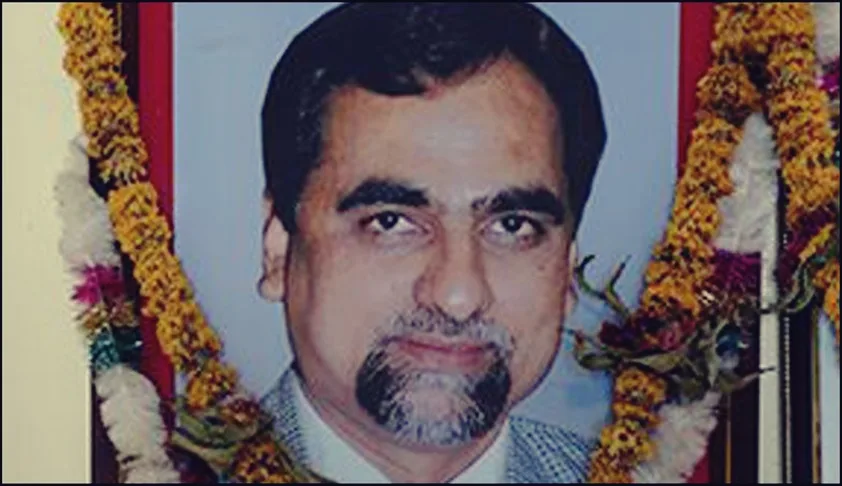
Nevertheless, the episode raised an important question about institutional accountability: when concerns emerge about the circumstances surrounding the death of a judge handling a politically sensitive case, how should the judiciary ensure public confidence in the process used to examine those concerns?
The controversy demonstrated the importance of transparency and institutional independence. A judiciary that expects citizens to trust its decisions must also be willing to address legitimate questions about its own functioning.
The unprecedented press conference of Supreme Court judges
In January 2018, four senior Supreme Court judges-Justices Jasti Chelameswar, Ranjan Gogoi, Madan B. Lokur and Kurian Joseph-held an unprecedented press conference. They publicly expressed concern about the administration of the Supreme Court and the allocation of cases by the then Chief Justice of India, Dipak Misra.
Justice Chelameswar indicated that the administration of the institution was not functioning as it should. The judges had previously written to the Chief Justice raising concerns about the allocation of sensitive cases and the exercise of the Chief Justice’s powers as master of the roster. This was an extraordinary moment in the history of the Supreme Court.
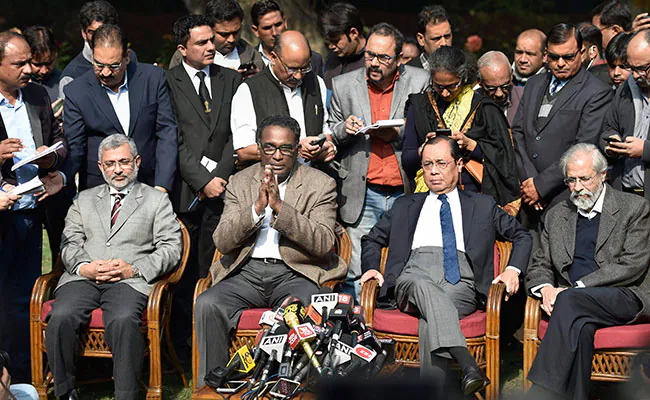
The public had rarely witnessed such a direct expression of institutional disagreement among its most senior judges. Their intervention exposed tensions over judicial administration, transparency and the concentration of power within the office of the Chief Justice. The incident revealed that the judiciary itself was experiencing serious internal disagreements over its independence and functioning.
The independence of the judiciary is not merely about whether judges are formally appointed without executive interference. It also concerns the transparent administration of courts, the fair allocation of cases and the ability of judges to perform their duties without institutional pressure.
Post-retirement appointments and the question of independence
Another issue that deserves attention is the appointment of retired judges to politically significant constitutional and public offices. In 2014, former Chief Justice of India P. Sathasivam was appointed Governor of Kerala by the NDA government. The appointment generated debate about the propriety of offering gubernatorial positions to former judges.
In March 2020, former Chief Justice of India Ranjan Gogoi was nominated to the Rajya Sabha, just four months after his retirement. Gogoi had presided over important cases during his tenure, including the Ayodhya dispute, the Rafale case and matters relating to the National Register of Citizens in Assam.
The concern is not that a retired judge loses the right to accept public office or participate in public life. The concern is institutional. When judges who have occupied the highest constitutional offices subsequently receive appointments from the political executive, citizens may reasonably question whether such possibilities could influence perceptions of judicial independence.
The problem is structural, not necessarily evidence of an individual judge’s motives or the impropriety of a particular judgment. Judicial independence requires not only actual impartiality but also public confidence that judicial decisions are free from political rewards and expectations. A credible system should therefore establish clear restrictions and safeguards against appointments that create real or perceived conflicts of interest.
The mosque disputes and the return of historical grievances to courtrooms
The recent developments concerning the Shahi Jama Masjid in Sambhal, Uttar Pradesh, are another important example. In November 2024, a civil court ordered a survey of the mosque following a suit claiming that it had been constructed over a pre-existing Hindu temple. The rapid proceedings and the subsequent survey generated considerable controversy. Violence during the second survey resulted in deaths.
The mosque committee challenged the proceedings. In May 2025, the Allahabad High Court rejected its challenge and upheld the trial court’s survey order, holding that the suit was not prima facie barred by the Places of Worship Act, 1991.
The case raises a serious constitutional concern. The 1991 Act was designed to prevent the reopening of disputes concerning the religious character of places of worship as they existed at independence. Yet litigation based on claims about historical religious structures is increasingly placing the protection offered by this law under pressure.

The question is not whether historical research should be prohibited. It is whether historical allegations, sometimes advanced by interested political or religious groups, should be allowed to destabilise the present religious character of places of worship and create new communal conflicts.
When courts permit such disputes to proceed, they must carefully consider the constitutional consequences, the purpose of the Places of Worship Act and the potential for violence. The judiciary must not become an arena in which majoritarian political projects acquire legal legitimacy through repeated attempts to reopen historical religious grievances.
The Sambhal case is therefore not merely a local dispute. It raises questions about the future of secularism, minority security and the constitutional promise that the religious character of places of worship would not become a permanent source of political conflict.
Is the judiciary becoming an instrument of majoritarian politics?
The incidents discussed above are different in their legal circumstances. They cannot simply be placed in one category or treated as proof of a coordinated judicial agenda. However, taken together, they invite a larger examination of the relationship between India’s judiciary and the political transformation taking place under Hindutva.
The judiciary does not operate outside society. Judges are products of the same social, political and institutional environment in which other citizens live. Their interpretations of constitutional principles, their understanding of historical disputes and their responses to challenges involving state power are inevitably influenced by institutional cultures and prevailing political ideas.
This does not mean that judges necessarily share the ideological positions of the ruling establishment. But it does mean that judicial institutions must be examined for the ways in which majoritarian assumptions can enter legal reasoning and institutional practices.
There are at least four developments that deserve particular attention. First, the normalisation of majoritarian historical claims. When disputes over mosques and temples repeatedly enter courtrooms, the judiciary must decide whether constitutional protections are being respected or whether the legal process is becoming a means of pursuing political and religious objectives.
Second, the weakening of institutional accountability. The controversy surrounding Judge Loya’s death and the 2018 press conference demonstrated the importance of transparency, internal accountability and institutional independence.
Third, the relationship between the judiciary and the political executive. Post-retirement appointments and other institutional arrangements can create perceptions of proximity between judges and the government. These perceptions are damaging even when no direct evidence of improper influence exists.
Fourth, the unequal experience of justice. The willingness and ability of institutions to protect vulnerable citizens must be assessed through their actual experiences. The question is not simply whether a constitutional remedy exists on paper, but whether a poor Muslim woman, a Dalit agricultural labourer, an Adivasi community or a political dissenter can realistically obtain that remedy.
This last point is particularly important. A judiciary that delivers justice in individual cases but remains inaccessible to large sections of society cannot fulfil its constitutional purpose. India may continue to have a Constitution, an independent judiciary in formal terms and regular elections. But constitutional democracy requires much more than the continuation of these institutions.
It requires that institutions actively protect the rights of those who have the least social, economic and political power. The danger of an emerging majoritarian state is not necessarily that constitutional institutions disappear overnight. It is that they continue to exist while their ability to protect constitutional minorities and vulnerable citizens gradually becomes weaker. The distinction between a constitutional republic and a majoritarian state lies precisely in this question.
Justice in India: A system beyond the reach of ordinary citizens
There is another dimension of the Bilkis Bano case that deserves greater attention: the extraordinary resources required to pursue justice in India. Bilkis’s struggle lasted more than two decades. It involved repeated legal proceedings, changes in investigative agencies, transfers of jurisdiction, appeals, petitions and challenges to government decisions.
How many ordinary citizens could sustain such a struggle? The Indian judicial system is extraordinarily complex. A person seeking justice must navigate police stations, magistrate courts, district courts, High Courts and, in some cases, the Supreme Court. Each stage involves procedural requirements, legal representation, documentation, travel, time and money.
For a poor person, even the first step can be difficult. The cost of engaging lawyers, obtaining documents, travelling to courts and repeatedly attending hearings can become prohibitive. For people dependent on daily wages, spending several days pursuing a case can mean losing the income required to feed their families.
Women facing domestic violence, sexual assault or discrimination often encounter additional barriers. They may depend economically on the very families or communities from which they need protection. Dalit and Adivasi communities may face intimidation, social boycotts and pressure from locally powerful groups.
The constitutional promise of equality before the law becomes hollow when access to justice depends heavily on one’s financial and social position.
The scale of the problem is visible in official statistics. According to the Ministry of Law and Justice, as of December 31, 2025, approximately 4.43 crore cases were pending in district and subordinate courts, while more than 63 lakh cases were pending in the High Courts. The Supreme Court had over 92,000 pending cases. These figures represent millions of people waiting for their disputes to be resolved.
Behind every pending case is a human being whose life may be suspended by the judicial process. A worker awaiting compensation, a family fighting for land, a woman seeking protection, a person wrongfully imprisoned or a community resisting dispossession cannot simply put their lives on hold indefinitely.
Delay is not merely an administrative inconvenience. It can itself become a form of injustice. The famous legal principle that justice delayed is justice denied has particular significance in a country where the poor cannot afford prolonged litigation.
Legal aid exists under Article 39A of the Constitution and the Legal Services Authorities Act, 1987. But the existence of legal aid provisions does not automatically guarantee meaningful access to quality legal representation. There is a need for stronger public legal services, adequate funding, more judges, simpler procedures, greater accountability and mechanisms that protect vulnerable litigants from intimidation.
The question we must ask is whether the Indian judicial system is designed around the needs of ordinary citizens or whether ordinary citizens are expected to adapt to an institution that is increasingly difficult to navigate.
Bilkis Bano had the courage and determination to continue her struggle. But justice should not depend on finding another Bilkis Bano, someone with extraordinary resilience who can withstand extraordinary suffering. Justice must be accessible even to those who cannot fight for decades.
The meaning of the latest Supreme Court order
The October 28 order deserves particular scrutiny because of the history of the case. There is an important distinction between the latest bail proceedings and the earlier remission controversy. In January 2024, the Supreme Court quashed the Gujarat government’s decision to grant remission to the 11 convicts. The Court found that Gujarat was not the appropriate government to make the decision and that the remission orders were legally unsustainable.
The latest proceedings involve two convicts challenging their convictions and sentences. The Supreme Court has now granted them bail and suspended their life sentences pending the appeals. The Court’s reasons include their prolonged incarceration, the disability of one appellant and questions requiring adjudication.
There are, nevertheless, important questions about the procedural history. According to the January 2024 judgment and subsequent reporting, earlier challenges by the convicts to the Bombay High Court judgment had been dismissed by the Supreme Court in 2017. The latest proceedings have now resulted in fresh appeals against that judgment.
The legal implications of successive proceedings deserve careful examination. The existence of earlier dismissals does not automatically establish that a subsequent appeal is legally impermissible, but the circumstances and grounds for entertaining the fresh appeals require transparency.
There is also the question of the survivor’s participation. Bilkis has said that she was not informed or heard before the latest order. Sabrang India’s report highlights this concern and raises questions about the procedural history of the proceedings.
It is important not to assume that a victim must have an absolute veto over bail decisions. Criminal law does not work that way. But survivors have legitimate interests in proceedings that directly affect their safety, dignity and the consequences of the crimes committed against them. The opportunity to be heard is especially important in cases involving sexual violence and mass communal crimes.
The Supreme Court should ensure that the procedural rights of survivors are not treated as secondary considerations. There is another disturbing possibility. The release of two convicts may encourage other convicted men to seek similar relief, although every application will have to be decided on its own legal and factual merits.
The concern, therefore, extends beyond the two individuals. The larger question is whether the institutions of justice understand the continuing human consequences of decisions made in cases involving mass violence. A legal system should not lose sight of the survivor simply because the proceedings have moved from the original trial to successive appellate stages.
The need for public outrage: Solidarity must become a political force
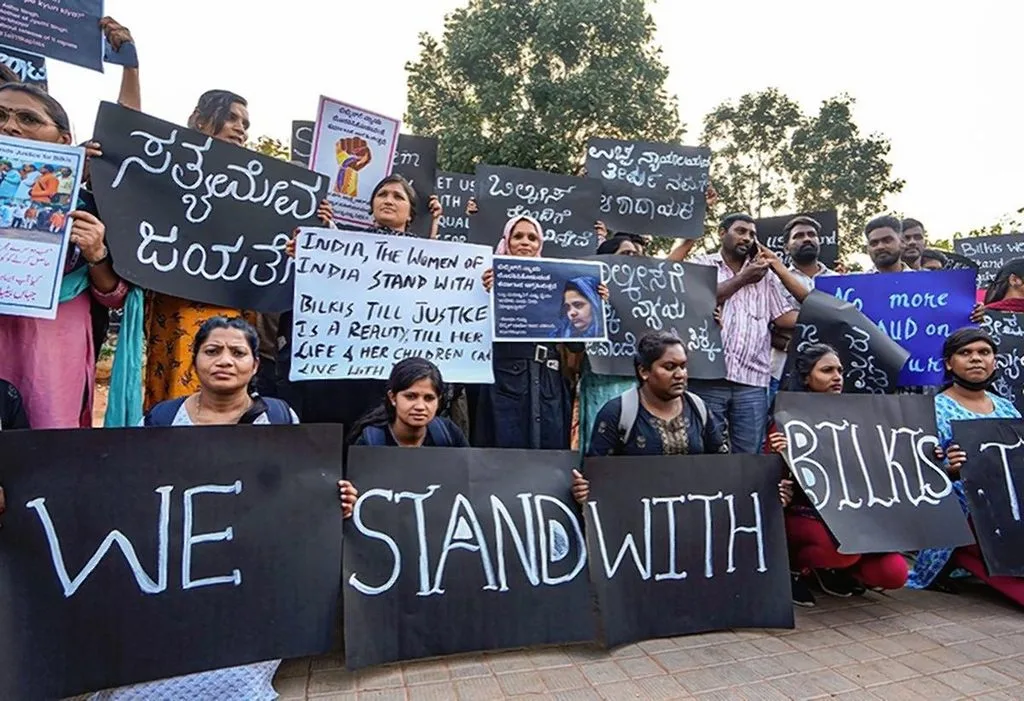
What should Indian society do now? The first requirement is to refuse to allow Bilkis Bano’s struggle to disappear from public memory.
One of the greatest advantages enjoyed by political power is the public’s limited attention span. A horrific event generates outrage, political parties issue statements, television channels conduct debates and social media becomes active. A few days later, another controversy replaces the previous one. The people affected by these events, however, cannot move on so easily.
For Bilkis, the violence of 2002 was not an episode that ended when the television cameras disappeared. It has shaped her life for more than two decades. Her struggle should become a continuing public concern.
Journalists, civil society organisations, women’s movements, Dalit and Adivasi organisations, minority rights groups, trade unions, student movements and democratic political parties must recognise the importance of standing together.
There are several things that need to happen.
- Public solidarity: Organise public meetings, discussions and peaceful demonstrations demanding that the survivor’s rights and concerns receive appropriate consideration.
- Institutional accountability: Demand transparency in judicial proceedings, particularly where decisions have serious consequences for survivors of communal and sexual violence.
- Political responsibility: Challenge political parties that use secularism as an electoral slogan but fail to sustain their commitment to vulnerable citizens.
- Women’s movements: Bring Bilkis’s experience into wider discussions about sexual violence, patriarchy, communalism and the rights of survivors.
- Public education: Explain the history of the case, the failures of the initial investigation, the remission controversy and the latest legal developments.
- Legal support: Support organisations and lawyers working to ensure that survivors have meaningful access to justice.
The objective should be to demand that the law treats survivors with dignity, that institutions remain accountable and that political power cannot be used to protect perpetrators of communal violence. Public outrage is necessary because silence creates the conditions in which injustice becomes normal. But outrage must also become organised democratic action.
Secularism is not a favour to minorities
The Bilkis Bano case should also force us to reconsider how we understand secularism. In contemporary political discourse, secularism is frequently portrayed as a political concession to religious minorities. Hindutva politics has successfully popularised the idea that protecting minority rights means appeasing minorities at the expense of the Hindu majority. This is a fundamental distortion.
Secularism is not a favour extended to Muslims, Christians or any other religious community. It is a constitutional principle that protects every citizen from the arbitrary exercise of religious majoritarian power. It ensures that the state does not discriminate between citizens on the basis of their religious identity. It also protects the freedom of the Hindu majority itself from the political appropriation of religion.
The distinction between Hinduism as a diverse religious and philosophical tradition and Hindutva as a political ideology is important. Criticism of Hindutva should not be confused with hostility towards Hindus or Hindu religious practices. A democratic society must protect the right of people to practise their faith while ensuring that no religious identity becomes the basis for unequal citizenship. The Bilkis Bano case is a powerful reminder of why this distinction matters.
If a Muslim woman cannot expect equal protection from the state because she belongs to a religious minority, the constitutional promise of secularism has already been seriously weakened. And if a person convicted of a grave crime can receive public support on the basis of religious and caste identity, the very foundations of equal citizenship are being challenged.
A secular state must protect the rights of all citizens, including those who belong to the majority. Its legitimacy comes from the principle that no citizen is more entitled to justice than another.
Beyond solidarity: Building a different political imagination
There is one final point that deserves consideration. The struggle of Bilkis Bano should not be reduced to a demand that the existing political establishment become more sympathetic towards her. The deeper issue is the nature of the society we are trying to build.
India’s constitutional democracy is being challenged not only by communal politics but also by entrenched social and economic inequalities. Caste oppression, patriarchy, economic exploitation, land dispossession and the marginalisation of Adivasi communities continue to determine who can exercise rights in practice.
A person may formally possess constitutional rights but lack the economic and social power to defend them. This is why the struggle for secularism cannot be separated from the struggle for social justice. The defence of Muslim minorities must go hand in hand with the defence of Dalits, Adivasis, women, workers, farmers and other marginalised communities.
Similarly, the independence of the judiciary cannot be separated from the demand for accessible justice, transparency and institutional accountability. We need a political culture in which public institutions are judged not by their proximity to power but by their commitment to those who are most vulnerable.
We need a society in which a woman who survives sexual violence is not abandoned to fight alone; where a religious minority does not have to demonstrate its patriotism to claim equal rights; where a Dalit family does not have to endure generations of humiliation before receiving justice; and where an Adivasi community does not have to sacrifice its land and livelihood in the name of development.
This requires more than changing governments. It requires building a democratic movement that places human dignity, equality, fraternity and ecological and social justice at the centre of public life. The defence of constitutional democracy must become a collective responsibility.
India must stand with Bilkis Bano
More than two decades have passed since Bilkis Bano survived one of the most horrific episodes of communal violence in modern India. She has fought through a compromised investigation, threats, legal uncertainty, the release of convicted men and repeated judicial proceedings. She has had to defend not only her demand for justice but also her right to live with dignity after an atrocity that should never have happened. Her struggle is not merely a personal story. It is a measure of the condition of Indian democracy.
The latest Supreme Court order should not be treated as an isolated legal development. It must be examined in the context of the larger institutional and political environment in which the rights of minorities, women and other vulnerable communities are increasingly contested.
We must also recognise that the judiciary is not beyond criticism simply because it occupies a constitutional position. Judicial independence and judicial accountability must reinforce each other. A court that cannot be questioned cannot command the confidence of a democratic society.
The question before India is not whether Bilkis Bano deserves sympathy. She deserves far more than sympathy. She deserves solidarity, dignity, protection and the assurance that the constitutional institutions of this country will not abandon her.
The political parties that claim to defend secularism must demonstrate their commitment through sustained action. Civil society must refuse to forget. Women’s organisations must recognise her struggle as part of the larger fight against patriarchy and sexual violence. And citizens must reject the idea that religious identity can determine whose suffering deserves attention and whose rights deserve protection.
Bilkis Bano should have become an icon of modern India, not an icon of victimhood, but an icon of courage, resistance and the refusal to surrender to injustice. The real question is whether India is still willing to stand for the constitutional principles that made such a struggle meaningful in the first place.
If we allow her to fight alone, we are not merely failing one woman. We are surrendering a part of our collective democratic responsibility. India must stand with Bilkis Bano. And in doing so, it must stand for a secular, democratic and just society.

A.K Shiburaj began his journalism career in 2000 with the publication of Samvadam magazine from Kozhikode. He later worked as a teacher on the Maldives island and engaged in social work across North Indian states. He practiced organic farming for a time and served as the Assistant Editor of Keralayam Magazine (Web). He is now a freelance journalist and an advocate for civil society and social movements. He is a recipient of the Maja Koene Social Journalist Award in 2025.