
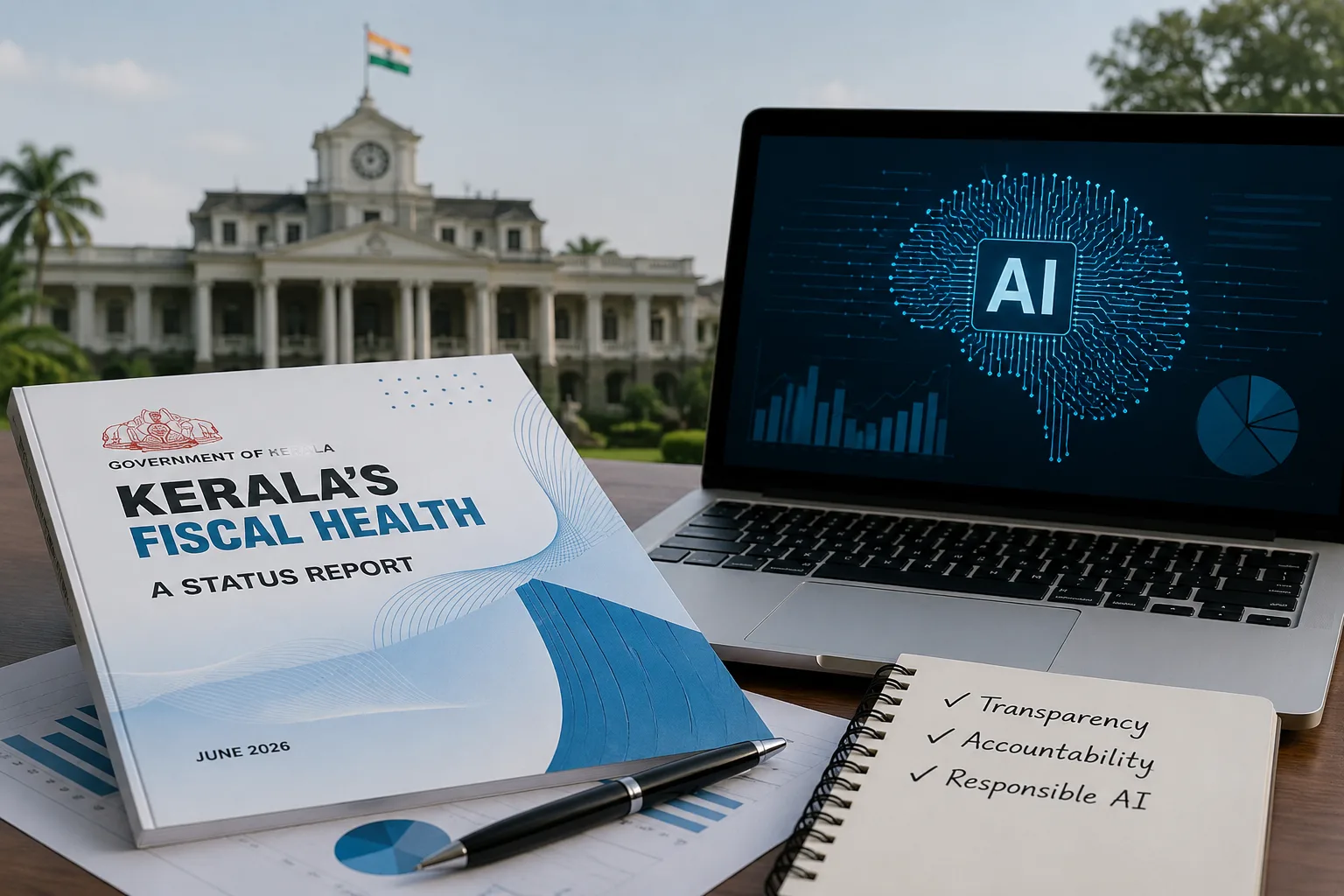
Artificial Intelligence, Public Finance and Democratic Accountability: Rethinking the Kerala White Paper Controversy
The controversy surrounding Kerala’s fiscal White Paper has sparked a wider debate on the role of artificial intelligence in governance. Rather than asking whether AI was used, this article argues that the real questions concern transparency, accountability, data security, and democratic oversight. Drawing on contemporary research in economics and public policy, Prof. A M Jose and Prof. Jos Chathukulam explore how AI can strengthen public administration when used responsibly and under human supervision.
Introduction: From Suspicion to Serious Debate
The controversy surrounding the Kerala Government’s White Paper on the state’s fiscal situation, released on 4 June 2026, has opened up an important debate on the role of artificial intelligence in public administration. Former Finance Minister Dr. T. M. Thomas Isaac reportedly criticised the document on the ground that substantial portions of it appeared to have been generated with the assistance of artificial intelligence and that AI tools may have been used to analyse information from sensitive sections of the Finance Department. Such concerns cannot be dismissed casually. Questions of data security, institutional responsibility, and accuracy in public documents are serious matters in a democracy.
However, the debate should not be reduced to a simplistic opposition between “human-written” documents and “AI-generated” documents. Such a framing misunderstands both the nature of modern administrative work and the contemporary role of AI in knowledge production. The central question is not whether AI was used, but how it was used, under what institutional safeguards, with what degree of human verification, and under whose accountability.
In this sense, the Kerala White Paper controversy provides an opportunity to move beyond technological suspicion and ask a more serious question: Can AI, when responsibly deployed, improve the quality, speed, transparency, and accessibility of public reasoning?

Authorship Is Not Accountability
A White Paper is not a literary essay whose legitimacy depends on the personal authorship of every sentence. It is a public policy document. Its authority derives from the evidence it presents, the methods it follows, the conclusions it draws, and the responsibility assumed by the government or institution that releases it. Whether a paragraph is first drafted by an officer, a consultant, a statistical software output, or an AI-assisted writing system is secondary to the more important question of whether the final document is accurate, verifiable, and institutionally accountable.
This distinction between authorship and accountability is crucial. Modern governance has always depended on tools. Budgets are not prepared with hand calculations alone; they use spreadsheets, databases, forecasting models, and statistical software. Policy reports are not produced only through handwritten notes; they involve word processors, digital archives, data dashboards, and increasingly, analytical platforms. AI is the latest stage in this longer technological transformation of administrative work.
To object to AI-assisted drafting merely because AI was used is therefore similar to objecting to a budget because it was prepared using spreadsheet software rather than manual arithmetic. The issue is not the tool; the issue is the quality of verification and the accountability of those who approve the final outcome.
AI as Labour-Augmenting Technology
The most productive way to understand AI is not as a replacement for human intelligence but as a labour-augmenting technology. It can assist human beings in collecting information, summarising documents, identifying patterns, improving language, checking consistency, translating technical material into accessible prose, and supporting decision-making. It can reduce the time spent on routine cognitive tasks and allow human experts to focus more on judgement, interpretation, and public reasoning.
This is precisely the point made by several leading economists. Erik Brynjolfsson, Danielle Li, and Lindsey Raymond, in their study of generative AI at work, found that AI assistance increased worker productivity, particularly among less experienced workers, by helping them learn from the tacit practices of more skilled workers (Brynjolfsson et al., 2023). The broader lesson is not that AI eliminates the human worker, but that it can redistribute knowledge within organisations and raise the productivity of human labour.
Anton Korinek, writing in the Journal of Economic Literature, has shown how generative AI can assist economists in ideation, writing, background research, data analysis, coding, and mathematical derivations (Korinek, 2023). His argument is directly relevant to the present controversy. If economists themselves can use AI to improve research productivity, it is difficult to argue that public officials must be prohibited from using AI to improve policy drafting, provided that the final output is verified and accountable.
Ajay Agrawal, Joshua Gans, and Avi Goldfarb conceptualise AI primarily as a technology that lowers the cost of prediction (Agrawal et al., 2019). Prediction, however, is only one input into decision-making. Human beings must still define objectives, assign values, interpret trade-offs, and take responsibility for consequences. This is a powerful framework for understanding AI in governance: AI may support prediction and analysis, but democratic institutions must retain judgement and accountability.
Even economists who are cautious about AI, such as Daron Acemoglu, David Autor, and Simon Johnson, do not argue for rejecting AI. Rather, they call for a pro-worker and human-complementary path of AI development, where technology expands human capabilities rather than merely replacing labour (Acemoglu et al., 2026). This distinction is vital. The democratic task is not to block AI, but to shape it in a way that strengthens human agency, institutional responsibility, and social welfare.
The False Fear of “AI Thinking for Humans”
One reason for the anxiety around AI is the fear that machines will begin to “think for humans.” This fear is understandable, but it is not the most accurate way to frame the issue. AI should not think instead of humans. Rather, AI should assist, accelerate, and discipline human thinking. It can help organise information, detect inconsistencies, generate alternative formulations, and make complex data more intelligible. But it cannot replace normative judgement, political responsibility, or ethical reasoning.
In public finance, this distinction becomes especially important. Fiscal data are often complex, dispersed, and difficult for ordinary citizens to understand. If AI can help convert complex fiscal material into clearer public explanation, it may actually deepen democracy rather than weaken it. A White Paper is meant to inform the public. If AI helps make public finance more understandable, its use should be welcomed, not automatically condemned.
The danger lies not in AI-assisted drafting as such, but in unverified, opaque, or irresponsible use. A badly written human document is not superior to a carefully verified AI-assisted document. Similarly, an AI-assisted document is not legitimate merely because it is technologically advanced. The test must be substantive: Are the facts correct? Are the sources traceable? Are the assumptions disclosed? Are the conclusions open to scrutiny? Are responsible officials willing to stand by the document?
Confidentiality, Secrecy and Public Finance
The more serious part of the criticism concerns the possible use of sensitive or confidential departmental information. Here, a distinction must be made between legitimate confidentiality and bureaucratic secrecy.
Certain categories of government information may require temporary confidentiality. Personal data, legally protected material, cabinet-level deliberations, procurement-sensitive information, and security-related records cannot be casually uploaded into public AI platforms. Any such use would raise genuine ethical and legal concerns. Governments must therefore ensure that AI tools used in administration operate within secure digital environments, with audit trails, access controls, anonymisation protocols, and clear responsibility structures.
At the same time, public finance is not the private property of the bureaucracy. Fiscal information concerns public money, public debt, public revenue, public expenditure, and public obligations. In a democratic polity, the default principle should be transparency, subject only to clearly justified exceptions. A White Paper on state finances is precisely meant to bring fiscal information into public reasoning. Therefore, the mere fact that departmental data were analysed cannot itself be treated as improper. The real question is whether the data were lawfully accessed, securely processed, accurately interpreted, and responsibly disclosed.
Here again, AI does not change the basic democratic principle. It only intensifies the need for stronger institutional safeguards. Whether analysis is done by a human committee, a spreadsheet model, an econometric package, or an AI system, public institutions must ensure legality, accuracy, confidentiality where necessary, and accountability at all times.
Responsible AI, Not No AI
Global and Indian frameworks on AI ethics do not call for a ban on AI in governance. They call for responsible AI. The OECD principles emphasise human-centred, trustworthy AI with transparency, robustness, accountability, and human oversight (OECD, 2024). UNESCO’s Recommendation on the Ethics of Artificial Intelligence insists that AI systems should not displace ultimate human responsibility and that they must remain auditable, transparent, and subject to oversight (UNESCO, 2021). In India, NITI Aayog’s Responsible AI framework identifies safety, reliability, equality, inclusivity, privacy, transparency, accountability, and positive human values as core principles for AI deployment (NITI Aayog, 2021).
These frameworks provide a balanced approach. They do not support technological romanticism. Nor do they support technological conservatism. They recognise that AI can generate benefits, but only when embedded within ethical, legal, and institutional safeguards.
For public finance documents, this implies a few minimum principles. First, AI should be used only as an assistive tool, not as an autonomous authority. Second, sensitive data must be processed only within secure and authorised systems. Third, all quantitative claims must be independently verified by competent officials. Fourth, the final document must clearly remain the responsibility of the government, not of an AI system. Fifth, where AI has been substantially used in preparing public documents, an appropriate disclosure protocol may be developed to strengthen public trust.
Such principles would move the debate from suspicion to reform. Instead of asking whether AI was used, we should ask whether Kerala has a responsible AI protocol for public administration. That is the real institutional question.
AI and the Productivity of Governance
The productivity argument is central. Governments face increasing informational complexity. Fiscal policy, welfare delivery, climate adaptation, public health, agriculture, urban governance, and infrastructure finance all require the processing of large volumes of data. Traditional bureaucratic systems often struggle with delays, fragmentation, and limited analytical capacity. AI, if carefully used, can help reduce these constraints.
This is not merely a technical matter. It is a governance issue. A state that can analyse data faster, detect fiscal stress earlier, communicate policy choices more clearly, and prepare evidence-based documents more efficiently is better placed to serve citizens. In this sense, AI can become part of democratic capacity-building.
The fear that AI will make governments less accountable is valid only when AI is used opaquely. But when used transparently, AI can make governments more accountable by improving documentation, traceability, comparison, and public communication. The same technology that can obscure responsibility can also be designed to strengthen it. The outcome depends on institutional design.
Beyond Technological Conservatism
The history of public administration is also a history of technological change. The typewriter, the calculator, the computer, the spreadsheet, the database, the internet, and now AI have all altered the way governments work. Each stage produced anxieties. Yet no modern government can function by rejecting such tools. The mature response is not rejection but regulation, adaptation, and capacity-building.
A progressive view of governance must therefore avoid both extremes. It should not celebrate AI uncritically, as if technology automatically guarantees better policy. But it should also not dismiss AI as illegitimate merely because it changes traditional modes of drafting and analysis. The correct position is one of democratic technological modernisation: use AI to improve public reasoning, but keep humans responsible for public judgement.
This is especially important in a state like Kerala, where public debate, literacy, political consciousness, and civil society engagement are unusually strong. AI-assisted public documents, if responsibly prepared, can actually enrich democratic discussion by making complex fiscal issues more accessible to citizens, researchers, legislators, journalists, and social organisations.
Conclusion: Human Judgement in the Age of Machine Assistance
The Kerala White Paper controversy should therefore be used not to create fear about AI, but to develop norms for its responsible use in governance. The question is not whether AI entered the drafting room. The question is whether democracy entered the algorithmic age with sufficient safeguards.
Dr. Isaac’s concerns about accuracy and confidentiality deserve serious engagement. But a blanket suspicion of AI-assisted drafting risks missing the larger transformation taking place in knowledge work across the world. Leading economists increasingly recognise that AI can improve labour productivity, research capacity, and decision support when it complements rather than replaces human judgement. Public administration cannot remain outside this transformation.
Governments must not become slaves of AI. But neither should they become prisoners of outdated administrative habits. The task is to ensure that AI serves public reason, democratic transparency, and human accountability.
The future of governance will not belong to machines that replace human beings, nor to bureaucracies that fear machines. It will belong to institutions that know how to combine machine intelligence with human wisdom. “AI must not govern us; but a government that refuses to learn from AI may fail to govern intelligently.”
References
Acemoglu, D., Autor, D., & Johnson, S. (2026). Building pro-worker artificial intelligence (NBER Working Paper No. 34854). National Bureau of Economic Research. https://doi.org/10.3386/w34854
Agrawal, A., Gans, J. S., & Goldfarb, A. (2019). Artificial intelligence: The ambiguous labor market impact of automating prediction. Journal of Economic Perspectives, 33(2), 31–50. https://doi.org/10.1257/jep.33.2.31
Brynjolfsson, E., Li, D., & Raymond, L. R. (2023). Generative AI at work (NBER Working Paper No. 31161). National Bureau of Economic Research. https://doi.org/10.3386/w31161
Korinek, A. (2023). Generative AI for economic research: Use cases and implications for economists. Journal of Economic Literature, 61(4), 1281–1317. https://doi.org/10.1257/jel.20231736
NITI Aayog. (2021). Responsible AI for all: Approach document for India, Part 1—Principles for responsible AI. Government of India. https://www.niti.gov.in/sites/default/files/2021-02/Responsible-AI-22022021.pdf
OECD. (2019, updated 2024). Recommendation of the Council on Artificial Intelligence (OECD/LEGAL/0449). Organisation for Economic Co-operation and Development. https://legalinstruments.oecd.org/en/instruments/OECD-LEGAL-0449
OECD. (2024). OECD AI principles. Organisation for Economic Co-operation and Development. https://www.oecd.org/en/topics/ai-principles.html
UNESCO. (2021). Recommendation on the ethics of artificial intelligence. United Nations Educational, Scientific and Cultural Organization. https://www.unesco.org/en/legal-affairs/recommendation-ethics-artificial-intelligence
OnManorama Staff. (2026, June 5). Grey area in ‘white paper’: Thomas Isaac says ‘substantial portion’ AI-generated. OnManorama. https://www.onmanorama.com/news/kerala/2026/06/05/grey-area-in-white-paper-thomas-isaac-says-substantial-portion-ai-generated.html


Jos Chathukulam is a Professor of Political Economy and Director of the Centre for Rural Management (CRM), Kottayam, Kerala. His academic work focuses on public policy, decentralisation, public finance, local governance, development studies, and political economy in India, with a special emphasis on Kerala. Prof. Chathukulam has authored and edited several influential books and research papers, and has served as a policy advisor to governments and international agencies. He is widely recognised for his critical engagement with development paradigms and for advocating sustainable, people-centred alternatives in economic and governance practices.