
Strengthening the District Planning Committees(DPCs): An Institutional Framework for Democratic Monitoring of the 15th Five Year Plan in Kerala
Kerala’s decentralised planning system faces an important institutional question as the state prepares to implement its 15th Five-Year Plan. Should district-level monitoring be entrusted to a newly proposed committee jointly headed by the State Planning Board and the District Collector, or should the existing District Planning Committees (DPCs) take the lead? In this paper, Prof. Jos Chathukulam and Prof. A. M. Jose argue for strengthening the DPCs as the institutional foundation of district-level planning and democratic accountability. They propose placing the quarterly District Plan Review Committees under the chairpersonship of the elected District Panchayat President, while retaining the participation of the State Planning Board and district administration.
1. Introduction
The decentralisation of governance and development planning has been one of the significant institutional reforms in India following the 73rd and 74th Constitutional Amendments. These amendments sought to transform Panchayats and Municipalities from institutions primarily concerned with local administration into institutions of democratic self-government with responsibilities for planning and implementing economic development and social justice programmes. Kerala has pursued decentralised planning as an important component of its development strategy. The People’s Plan Campaign (PPC) and subsequent institutional reforms created a framework in which Local Self-Government Institutions (LSGIs) participate in identifying development priorities, preparing plans, allocating resources and implementing development programmes.
An important institutional element of this framework is the DPC, established under Article 243ZD of the Constitution and provided for under Section 53 of the Kerala Municipality Act, 1994.The DPC is intended to provide an institutional link between the plans of rural and urban local governments and the broader development priorities of the district and the State. It is therefore not merely an administrative coordination committee, but an important constitutional institution intended to facilitate integrated and participatory district-level development planning.
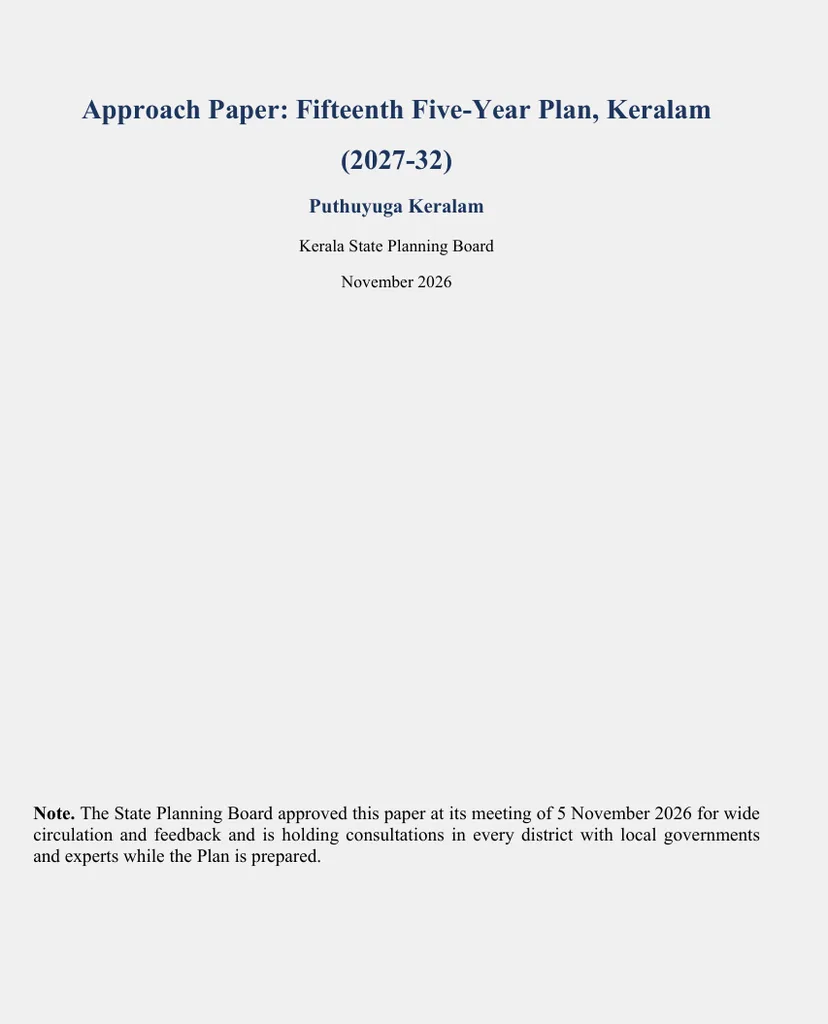
The Draft Approach Paper of the 15th Five-Year Plan proposes a new arrangement under the heading ‘Tracking and Review’. It states: “Below the State level, a Plan Review Committee in each district, headed jointly by a designated Member of the State Planning Board and the District Collector, will review the implementation of the Plan every quarter.” The objective of periodic district-level monitoring and review is understandable and desirable. Effective monitoring is essential for identifying implementation bottlenecks, improving interdepartmental coordination, assessing development outcomes and ensuring that the objectives of the Plan are achieved.
However, the proposed composition and leadership of the Review Committee raise an important institutional question: Should district-level Plan review be undertaken through a new committee headed by a State Planning Board member and the District Collector, or should the existing constitutionally mandated DPC be entrusted with this responsibility? This paper argues that the latter arrangement would provide a more appropriate institutional framework. The proposed Plan Review Committee may be retained, but it should function under the DPC and be headed by its statutory Chairperson, the President of the District Panchayat.
2. Constitutional and Legal Framework of District Planning
2.1 Article 243ZD of the Constitution of India
Article 243ZD of the Constitution provides for the constitution of a District Planning Committee (DPC) in every State at the district level.
The principal responsibilities of the DPC include:
- Consolidating the plans prepared by the Panchayats and Municipalities in the district.
- Preparing a draft development plan for the district as a whole.
- Taking into account matters of common interest between rural and urban local governments.
- Considering spatial planning, sharing of water and other natural and physical resources, integrated infrastructure development and environmental conservation.
- Considering the availability of financial and other resources.
The Article also provides that not less than four-fifths of the total membership of the DPC shall be elected by, and from among, the elected members of the Panchayats at the district level and the Municipalities in the district, in proportion to the rural and urban population. This provision reflects the constitutional intention that district planning should be based on the participation and leadership of elected functionaries of local governments. Article 243ZD also provides that the Chairperson of the DPC shall forward the development plan, as recommended by the Committee, to the State Government. Thus, the DPC is envisaged as an important democratic institution for integrating local development priorities into district-level planning.
2.2 Section 53 of the Kerala Municipality Act, 1994
Kerala has given institutional expression to Article 243ZD through Section 53 of the Kerala Municipality Act, 1994. Section 53 provides for the constitution and composition of the DPC. The Committee consists of fifteen members, including:
- Twelve elected representatives from Panchayats and Municipalities in the district.
- The President of the District Panchayat.
- One person nominated by the Government having considerable experience in administration and planning.
- The District Collector as an ex-officio member.
Most importantly, Section 53(3)(ii) specifically provides that: “The President of the District Panchayat mentioned in clause (b) shall be the Chairman of the Committee.” Section 53 also provides that the District Collector shall be the Secretary of the Committee and district-level officers of Government departments shall function as Joint Secretaries. This statutory arrangement is significant. It establishes a clear distinction between political and democratic leadership on the one hand and administrative coordination on the other. The President of the District Panchayat, as the elected functionary and statutory Chairman of the DPC, provides democratic leadership. The District Collector, as Secretary, provides administrative coordination and facilitates the functioning of the Committee.
The proposed arrangement in the Approach Paper, which places the district-level review mechanism under the joint leadership of a State Planning Board member and the District Collector, would introduce a different institutional leadership structure without adequately recognising the existing statutory arrangement.
2.3 Kerala Town and Country Planning Act, 2016
The relevance of the DPC is further strengthened by the Kerala Town and Country Planning Act, 2016. Section 13 provides that the DPC constituted under Section 53 of the Kerala Municipality Act shall prepare the development plan for the district as a whole, comprising a long-term Perspective Plan and five-year Execution Plans. More importantly, Section 14 assigns several functions to the DPC, including:
- Formulating development goals, objectives, policies and priorities for the district.
- Preparing district-level Perspective Plans and Execution Plans in consultation with Local Self-Government Institutions.
- Continuously monitoring and evaluating the physical achievements of investments made by Local Self-Government Institutions and quasi-government agencies within the district in the context of district plans.
- Submitting consolidated reports to the Board.
- Coordinating planning and development activities among Government departments and quasi-government institutions.
Section 14(3) also empowers the DPC to constitute one or more special committees to assist it in exercising its powers, discharging its duties and performing its functions. It may also constitute sectoral working groups to provide guidance and support. This provision offers a practical institutional route for establishing the proposed Plan Review Committee without creating an independent parallel body.
The DPC can constitute a dedicated District Plan Review Committee as a special committee under its institutional authority, subject to the applicable statutory provisions and the scope of its mandate.
3. Institutional Concerns Regarding the Proposed Plan Review Committee
The proposal in the Approach Paper deserves consideration from the perspective of institutional coherence, democratic accountability and the existing decentralised planning framework.
3.1 Possibility of creating a parallel institutional mechanism
The Constitution and State legislation have already established the DPC as the principal institution for district-level planning. The DPC has an established composition, statutory leadership and defined responsibilities relating to planning, coordination, monitoring and evaluation.
Creating another district-level committee for reviewing the implementation of the Plan, without establishing its relationship with the DPC, may result in overlapping institutional responsibilities. Such parallel arrangements may lead to duplication of meetings, reporting systems, review processes and administrative responsibilities. Instead of strengthening the existing district planning institution, this could create uncertainty regarding institutional accountability. The proposed review mechanism should therefore be integrated with the DPC rather than operate independently of it.
3.2 Insufficient recognition of elected representatives
The proposed composition specifically identifies a designated Member of the State Planning Board and the District Collector as joint heads of the Review Committee. However, it does not expressly provide for the leadership or institutional participation of the elected functionaries of Panchayats and Municipalities. This raises an important question concerning the place of democratic decentralisation in the implementation and review of the State Plan. Local governments are not merely implementing agencies. They are institutions of democratic self-government entrusted with responsibilities for identifying local needs, preparing development plans and implementing programmes.
The review of development programmes at the district level should therefore provide an institutional space for elected functionaries to assess progress, identify problems and influence corrective measures. The leadership of the DPC would ensure that the review process is rooted in democratic representation.
3.3 Administrative coordination should complement democratic leadership
The District Collector plays an important role in district administration and development coordination. The participation of the District Collector in the review process is essential. Similarly, the involvement of a designated Member of the State Planning Board would help ensure that district-level implementation is aligned with the objectives and priorities of the State Plan. However, administrative and technical coordination need not necessarily translate into joint chairpersonship.
Kerala’s existing DPC structure already provides an institutional distinction between the Chairperson and the Secretary. The District Panchayat President provides democratic leadership, while the District Collector provides administrative support and coordination. The proposed review mechanism can follow the same institutional principle. The designated Member of the State Planning Board can provide policy guidance and technical inputs, while the District Collector can coordinate the participation of district-level departments and ensure follow-up action.
3.4 Risk of weakening the decentralised planning process
Decentralised planning is meaningful only when local governments and their elected functionaries have a substantive role not only in preparing and implementing development plans but also in reviewing their outcomes. If the district-level review mechanism operates primarily through a committee led by State-level and administrative authorities, the role of local governments may become largely confined to providing progress reports. This would weaken the institutional connection between planning, implementation and democratic accountability. The proposed review mechanism should instead enable elected functionaries to assess whether the development interventions are addressing the priorities identified by local communities.
3.5 Need for institutional continuity
Kerala has developed a substantial institutional framework for decentralised planning over several decades. The DPC is an important component of this framework. It has experience in integrating local government plans, scrutinising development proposals, coordinating departmental activities and monitoring implementation. The 15th Five-Year Plan provides an opportunity to strengthen and modernise this existing institution. Rather than establishing a separate institutional structure, the State should build upon the DPC and improve its technical, analytical and monitoring capacities. Institutional strengthening is preferable to institutional duplication when the existing statutory body has an appropriate mandate and organisational structure.
4. Why the Proposed Quarterly Review Mechanism Should Be Retained
It is important to clarify that the objection raised in this paper is not against the idea of a district-level Plan Review Committee. On the contrary, the proposal for quarterly review is a useful opportunity to strengthen district-level development monitoring. The implementation of a Five-Year Plan involves multiple departments, Local Self-Government Institutions, public sector agencies and other development institutions.
A regular review mechanism can help (i) Identify delays in project implementation (ii) Examine financial and physical progress,(iii) Assess whether development targets are being achieved,(iv) Identify interdepartmental coordination problems,(v) Review the quality and effectiveness of public expenditure,(vi) Examine the outcomes and impact of development interventions,(vii) Suggest corrective measures and facilitate timely decisions, and (viii) Strengthen accountability among implementing agencies. The proposed Plan Review Committee can therefore serve a useful purpose, provided that its institutional design is consistent with the constitutional and statutory framework of decentralised planning. The appropriate approach is not to reject the committee but to constitute it under the DPC.
5. Proposed Institutional Arrangement
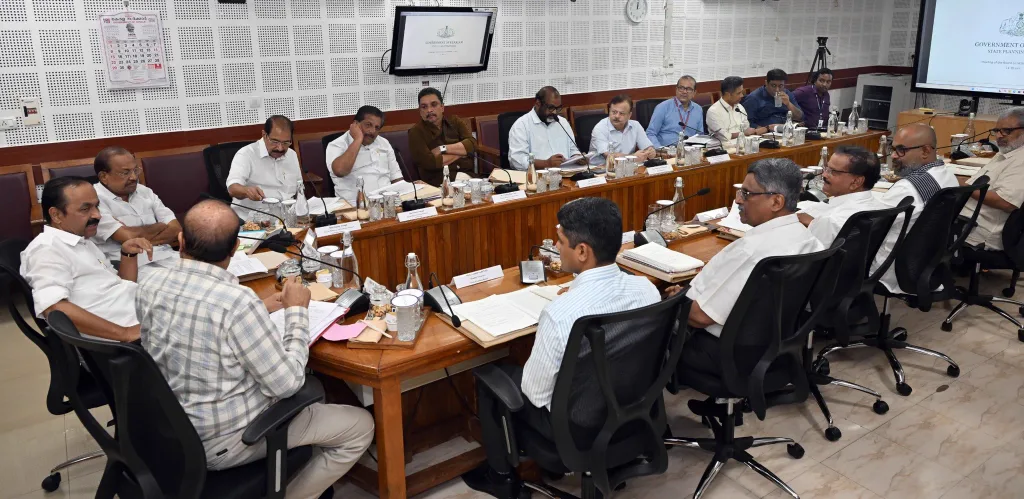
It is proposed that a District Plan Review Committee be constituted in every district as a special committee under the DPC. The following institutional arrangement is suggested:
5.1 Chairperson
The President of the District Panchayat shall be the Chairperson of the District Plan Review Committee, being the statutory Chairman of the DPC under Section 53(3)(ii) of the Kerala Municipality Act, 1994.
5.2 Participation of the State Planning Board
The designated Member of the State Planning Board shall be a member of the Review Committee and shall provide policy guidance, technical inputs and coordination with the State Planning Board. The Member may also facilitate the resolution of issues requiring intervention at the State level.
5.3 Role of the District Collector
The District Collector shall coordinate the participation of district-level Government departments and agencies, facilitate the preparation of review reports and ensure follow-up action on decisions taken by the Committee. The District Collector shall continue to discharge the responsibilities assigned under the existing statutory framework of the DPC.
5.4 Participation of elected functionaries
The elected members of the DPC representing the District Panchayat and Municipalities should participate in the quarterly review. Elected functionaries of other tiers of Panchayats, particularly Block Panchayats and Gram Panchayats, should also be invited wherever their programmes and development activities are under review. This would ensure that the review process reflects the experiences and priorities of different levels of local government.
5.5 Participation of departmental officials
District-level officers of Government departments and heads of implementing agencies should participate in the review meetings relevant to their respective sectors. They should provide information on targets, financial expenditure, physical achievements, implementation constraints and proposed corrective measures.
5.6 Technical support
The District Planning Office, District Economics and Statistical Office, District Town Planning Office and relevant technical institutions should provide data analysis, monitoring support, preparation of review documents and follow-up assistance. The State Planning Board should develop a common reporting framework to ensure comparability of district-level performance.
6. Suggested Terms of Reference for the District Plan Review Committee
The District Plan Review Committee should undertake the following responsibilities:
6.1 Quarterly review of implementation
Conduct a comprehensive review of the implementation of the 15th Five-Year Plan in the district every quarter.
6.2 Financial and physical progress
Examine expenditure, fund utilisation, project completion and physical achievements against approved targets.
6.3 Outcome and impact assessment
Go beyond financial and physical progress and examine whether development interventions are producing the intended social, economic and environmental outcomes.
6.4 Review of Local Self-Government Institutions
Examine the progress of development programmes implemented by Grama Panchayats, Block Panchayats, District Panchayats, Municipalities and Municipal Corporations.
6.5 Departmental coordination
Review the implementation of departmental schemes and identify issues requiring coordination between different departments and Local Self-Government Institutions.
6.6 Identification of implementation bottlenecks
Identify administrative, financial, technical and procedural constraints affecting implementation and recommend appropriate corrective measures.
6.7 Social accountability
Examine the extent of public participation, transparency, beneficiary involvement, grievance redressal and social audit in development programmes.
6.8 Equity and inclusion
Review the extent to which development interventions address the needs of women, SCs and STs, children, elderly persons, persons with disabilities and other vulnerable sections ( third gender and all groups of different sexual orientations).
6.9 Environmental sustainability
Examine whether development activities are consistent with environmental conservation, climate resilience and sustainable use of natural resources.
6.10 Reporting and follow-up
Prepare a consolidated quarterly report and forward it to the State Planning Board and the Government, with specific recommendations and action points. The report should also be placed before the DPC for discussion and appropriate decisions.
7. Ensuring Democratic Accountability and Effective Monitoring
The proposed institutional arrangement would help reconcile two important requirements of development planning. The first is the need for effective monitoring and coordination by the State Government and its administrative machinery. The second is the need to preserve the democratic character of decentralised planning and ensure that elected local governments have a meaningful role in reviewing development outcomes. The DPC-led Review Committee can provide an institutional platform where both requirements are addressed.
The State Planning Board would obtain district-level information on the implementation of the Plan. The District Collector would facilitate administrative coordination. Departmental officers would be accountable for implementation. Elected functionaries would have the opportunity to examine progress, raise local development concerns and suggest corrective measures. Such a mechanism would also help strengthen the link between the State Plan and the plans prepared by Local Self-Government Institutions. It would ensure that district-level monitoring is not reduced to an exercise in administrative reporting but becomes an instrument of participatory development governance.
8. Specific Recommendations
In view of the constitutional and statutory provisions and the institutional considerations discussed above, the following recommendations are submitted for consideration:
- The proposal to constitute a Plan Review Committee in every district and conduct quarterly reviews may be retained.
- The District Plan Review Committee should be constituted under the DPC as a special committee, in accordance with Section 14(3) of the Kerala Town and Country Planning Act, 2016, subject to the applicable legal provisions.
- The President of the District Panchayat, being the statutory Chairman of the DPC under Section 53(3)(ii) of the Kerala Municipality Act, 1994, should be the Chairperson of the District Plan Review Committee.
- The designated Member of the State Planning Board should be included as a member of the Review Committee to provide policy guidance and facilitate coordination with the State Planning Board.
- The District Collector should coordinate the participation of district-level departments and agencies and facilitate the administrative and technical work of the Committee.
- Elected functionaries of Panchayats and Municipalities should have an active role in the quarterly review process.
- The review should cover all relevant components of the 15th Five-Year Plan, including departmental schemes and programmes implemented by Local Self-Government Institutions.
- A standardised quarterly monitoring and reporting framework should be developed by the State Planning Board in consultation with the DPCs.
- The consolidated quarterly review report should be placed before the DPC and subsequently forwarded to the State Planning Board with recommendations for appropriate action.
- The Government should issue suitable guidelines clarifying the relationship between the State Planning Board, DPCs, District Collectors and the proposed District Plan Review Committees, so that duplication of functions and conflicting institutional responsibilities are avoided.
- Adequate technical and administrative support should be provided to the DPCs to enable them to undertake this additional responsibility effectively.
9. Conclusion
The 15th Five-Year Plan should not be viewed merely as a framework for achieving economic growth, improving infrastructure and delivering development programmes. It should also be an opportunity to strengthen the democratic institutions through which development priorities are identified, resources are allocated and public programmes are implemented. Kerala has made considerable progress in institutionalising decentralised planning. The DPC is an important component of this achievement. The constitutional framework under Article 243ZD, the statutory provisions of Section 53 of the Kerala Municipality Act, 1994, and the functions assigned under the Kerala Town and Country Planning Act, 2016, provide a strong institutional foundation for district-level planning, coordination and monitoring. The proposal to introduce quarterly Plan Review Committees is welcome in principle. However, the proposed arrangement of placing these committees under the joint chairpersonship of a designated Member of the State Planning Board and the District Collector does not adequately recognise the existing constitutional and statutory institutional framework.
The issue is not whether the State Planning Board or the District Collector should participate in district-level review. Their participation is essential. The issue is the institutional leadership under which such a review should take place. The District Panchayat President, being the statutory Chairman of the District Planning Committee, should also head the proposed District Plan Review Committee. This would not diminish the role of the State Planning Board or the district administration. Rather, it would provide a framework in which State-level policy guidance, administrative coordination and democratic leadership function together. The District Collector and the designated Member of the State Planning Board can play important roles in facilitating the review process, ensuring interdepartmental coordination and resolving implementation bottlenecks. However, the democratic leadership of the Committee should remain with the elected Chairperson of the DPC.
The proposed arrangement would retain the advantages of quarterly monitoring while avoiding the creation of a parallel institutional mechanism that could weaken the role of the DPC. The 15th Five-Year Plan should strengthen the institutions of decentralised planning, not create parallel structures that may dilute their role. The DPC should therefore be the institutional anchor of district-level Plan review, with the District Panchayat President as its Chairperson. This is consistent with the constitutional vision of democratic decentralisation and Kerala’s long-standing commitment to participatory development planning.
References
- Constitution of India, Article 243ZD – Committee for District Planning.
- The Kerala Municipality Act, 1994, Section 53 – District Planning Committee.
- The Kerala Town and Country Planning Act, 2016, Sections 13 and 14 – District Planning Committee and its powers and functions.
- Government of Kerala, State Planning Board, Draft Approach Paper of the Fifteenth Five-Year Plan, 2027–2032, section titled ‘Tracking and Review’.
- Government of Kerala, Local Self Government Department, District Planning Committee – institutional structure and functions.
Jos Chathukulam is a Professor of Political Economy and Director of the Centre for Rural Management (CRM), Kottayam, Kerala. His academic work focuses on public policy, decentralisation, public finance, local governance, development studies, and political economy in India, with a special emphasis on Kerala. Prof. Chathukulam has authored and edited several influential books and research papers, and has served as a policy advisor to governments and international agencies. He is widely recognised for his critical engagement with development paradigms and for advocating sustainable, people-centred alternatives in economic and governance practices.