
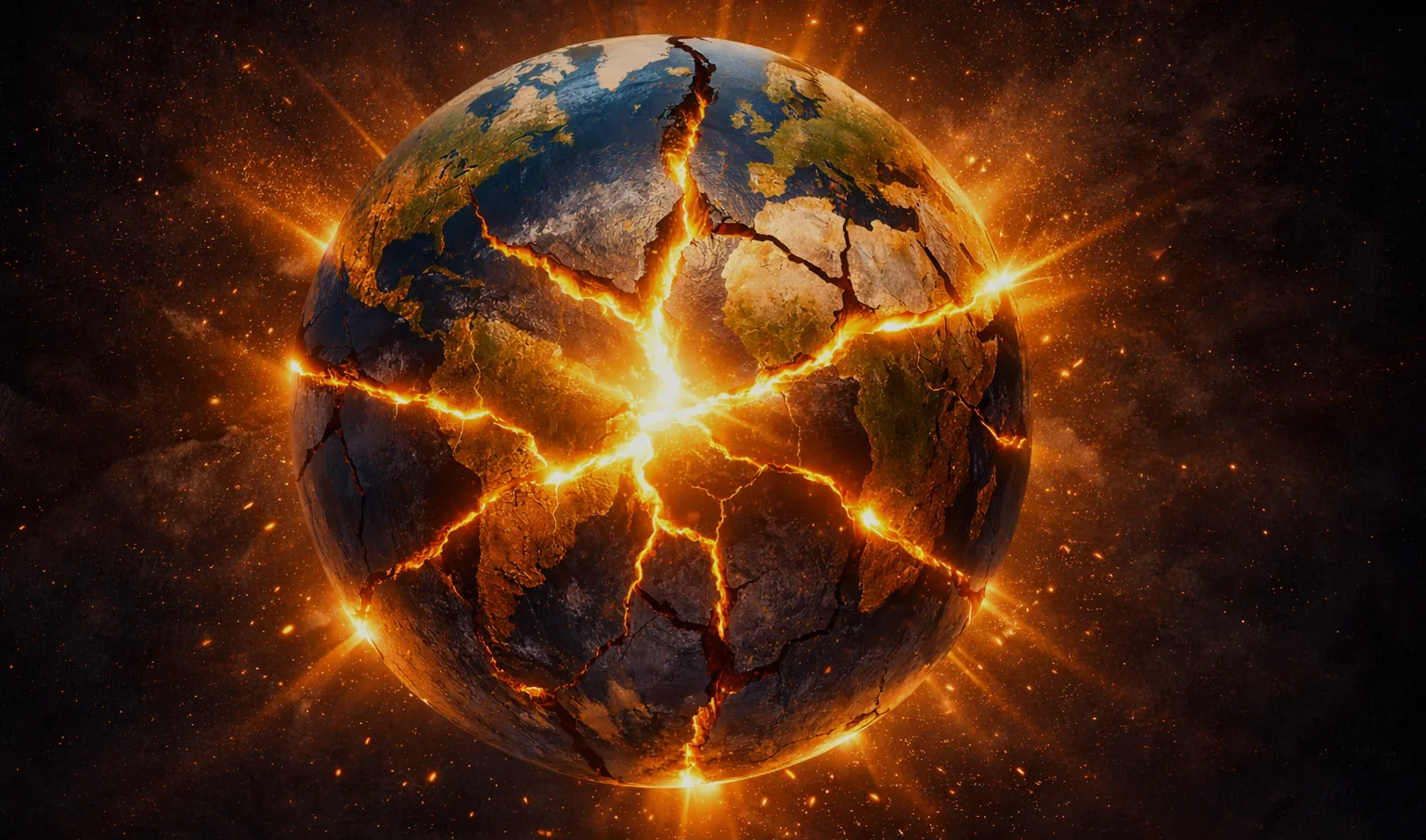
Perceptions of 2026: Order, Symbols, and Rupture
As the world approaches 2026, global politics appears caught between fracture and redefinition. In this essay, Ilya Ganpantsura explores the shifting ontological foundations of the West and the Global South by contrasting Western “emergence” with Southern “manifestation” as rival symbolic responses to technological disruption, cultural realignment, and geopolitical upheaval. At stake is not merely power, but the language, philosophy, and emotional order through which societies interpret history itself.
Ontological Cornerstones of the West and the Global South: Context, Terms, and the Law of History
“The order of history is the history of order.”
— Eric Voegelin
We stand at a fracture in the global everyday order, where attachment to the digitalization of life gives way to an era of heightened sensitivity to human emotions, against the backdrop of events, ideas, and words losing their originality due to the sudden surge of the Artificial Intelligence factor.
We stand at a fracture in the global political order, where attachment to the old world of universal illusions, armed with ideologies of inclusion that deprive people of the right to otherness, is being replaced by a love for home and its traditional order, which binds people to law and secures the equilibrium of identity.
Both the West and the Global South are searching for new emotions and sensations through which to respond to rapid global change. On the eve of 2026, reflections within Western society were increasingly shaped by the word emergence. The thought of the Global South, by contrast, was occupied by the idea of manifestation.
“Emergence” in contemporary Western thinking is politically associated with an ever-stronger rightward turn—the growing popularity of right-wing populists. In the near future, this will mean an intensification of traditionally European, Christian values as a framework for responding to the world. Today, more than ever, the West is searching for answers to the challenge posed by emerging conceptions of national security, replacing old ones. It is approaching a path of avoiding intra-Western conflicts through communication at the level of human cognition and emotional response—acting on the basis of new symbols that will replace those of left-globalist ideology.
Manifestation, in symbolic terms, is an attempt—against the background of the forthcoming SCO summit and the strengthening roles of India, China, and Brazil in the global economy—to institutionalize not only political power, but also cultural and religious traditions. These traditions shape the mentality of a people and influence symbolic diversity, which in turn determines political communication. According to Aristotle, the highest form of communication is political communication. More concretely, a path has been chosen: to form philosophical institutions on the basis of culture, capable of analyzing the present and seeking optimal forms of political communication.
The primary method for achieving this goal lies in the attempt to embed one’s own symbols into strategies of political action, as Europe has already done, drawing on centuries-old traditions of political philosophy. The transition to a new stage in the development of philosophical thought in Asia may be accelerated by political trends driven by the desire to institutionalize one’s own history and traditions—not along Western programs that dictate “decolonization,” but through expanding the global significance of one’s culture. A recent example is the opening of the Grand Egyptian Museum in Cairo as an external manifestation of a new communicative strategy and as a sign of the emergence of a new philosophy.
It is important to note: The political philosophy of the Global South will be formed through levels of communication.
At the same time, a path is opening for construction on the basis of philosophical institutions that the West itself neglects when it becomes a hostage to its own definitions. This provides a rapid impulse for the development of philosophy in South American and Asian countries. The war in Ukraine, the events in Israel, and Iran in June 2025 were all encompassed by the Western mental vocabulary—through formulations such as “the struggle between democracy and authoritarianism,” or “preventing regional destabilization” in the case of attacks on Iran’s nuclear facilities. The West speaks the language of university traditions: a descriptive manner in which events are declared, named, and fitted into an order—rather than the language of manifestation, pain, rupture, duration, and unclear consequences, which is more characteristic of the younger countries of the Global South seeking their place in the world.
Although, at present, Asian philosophy remains more declarative than argumentative, this may soon change. The former philosophical style offers greater dynamism, which is ideally suited to the “developing” countries of the Global South.
“Are the former more gifted than the latter? Do not all men possess the same spiritual nature and the same spiritual capacities? What, then, do some possess that others do not? Only philosophy. Philosophy, therefore, is the cause of all these goods. The usefulness of moral philosophy (philosophia moralis) and civil philosophy (philosophia civilis) is to be measured not so much by the benefits that knowledge of them provides, as by the harm caused by ignorance of them.”
— Thomas Hobbes, Chapter I. On Philosophy
Europe, as a key part of the West, is in the near future likely to descend into an increasingly declarative right-wing traditionalism—a transitional phase in which old globalists are replaced by conservatives. This will slow the dynamics of political processes at the level of collective thinking. However, this does not pose a hidden danger for Europe, given that its philosophy is largely grounded in the dynamic of Christian dialectics between Peter and Paul. The increasingly influential conservative traditionalists attach significance precisely to the Christian vision of thought.
From all that has been said, one fundamental law of history becomes visible. Although the laws of history always act upon our present, at certain moments they emphasize specific prescriptions in order to teach a lesson of balance to our reality.
Balance is the law—the vision of 2026. In contrast to the crushing events of 2025, a year of fractured inherited expectations, when left globalists ceased to dictate the world’s defining vocabulary, politics governed by the law of balance will seek a path of reality in mass consciousness—as a golden mean between law and feeling. And we must remember that balance is by no means the cessation of dynamism, but its natural continuation:
“…we see that even in our enlightened age, when reason raises its throne so high, the wildest fanaticism erects its altars in opposition to it.”
— Voltaire, in a letter to Frederick the Great

Ilya Ganpantsura, a hereditary Ukrainian writer, musician, artist, and human rights advocate, is known for works exploring inner conflicts, historical events, and philosophical ideas. His novellas “Tirade of Wonders 1812”, “Bergman’s Friends”, and the poem “On Books in Verse” have been published on the self-publishing platform Litres.