
The New Cold War: Technology, Sovereignty and the Battle for the Global South
In an increasingly technology-driven world, the struggle for global power is taking new forms. How are technology corporations reshaping geopolitics? Why has China succeeded in building its own technology giants while India has followed a different path? And what does technological sovereignty mean for countries in the Global South? In this interview, Nils Gilman discusses the historical roots of technological competition, the resurgence of state-led industrial policy, the challenges of global governance and the transformative impact of artificial intelligence on education and society. The conversation is hosted by Anirudh Suri of The Great Tech Game Podcast.
Technology, geopolitics and the historical perspective
Anirudh Suri:We are living through a period of intense geopolitical competition in which technology has become central to the struggle for global power. As a historian by training, how does history inform your understanding of the major technological and geopolitical trends unfolding today?
Nils Gilman: We are indeed in a period of geopolitical and geostrategic competition in which technology is at the centre of the story. To some extent, this has always been the case. Since at least the late nineteenth century, the ability to dominate emerging general-purpose technologies has been a crucial component of geopolitical power.
Whether it was coal production, the development of internal combustion engines or the ability to manufacture jet aircraft, technological leadership has consistently shaped the balance of power between nations.
Today, the technologies are different. Artificial intelligence receives considerable attention, but biotechnology, robotics and several other fields are also becoming increasingly important. These technologies are interconnected, and the ability to lead in these areas is crucial to national and regional power.
However, there is something distinctly different about the present period. Technology and the corporations producing it have become much more global than they were historically.
When Henry Ford dominated automobile production, his influence was largely concentrated in the United States and North America. European countries had their own national automobile manufacturers, and capital was predominantly organised along national lines.
Today, companies such as Google, Microsoft, Nvidia, OpenAI and Tesla operate on a global scale. These corporations possess enormous economic and political influence, in some respects exceeding that of nation-states.
The closest historical parallel I can think of is the East India Company, several centuries ago. These corporations have their own interests and are not necessarily aligned with the national interests of any particular country. That makes the current situation quite different from earlier periods.
Technology, economic convergence and extraction
Anirudh Suri:Technology has historically played a dual role. Sometimes it has encouraged economic convergence between nations, while at other times it has produced greater economic divergence. The Industrial Revolution, for example, contributed to the economic rise of Western European countries, partly through industrialisation and partly through colonisation, while many other regions were left behind.
Are you seeing contemporary technology encouraging greater economic convergence, or is it deepening the divide between countries and within societies?
Nils Gilman: When people express concern about foreign companies dominating their economies, several different issues are often mixed together. It is important to distinguish between them. One concern is that when companies from a particular country dominate production in another economy, they can hollow out the domestic economy of the country with which they trade.
There is also a second issue: extraction. Historically, extraction was primarily physical. European and North American companies would arrive in countries in South America, Africa or Asia and construct roads leading directly to mines from which they wanted to extract diamonds, gold, oil or other resources.
Today, with contemporary technology, we also have to consider the extraction of data. The analogy between data and physical resources such as gold or oil is not entirely accurate. Gold and oil exist in the ground before anyone extracts them. Data, however, does not exist in the same way before it is created.
When people interact with their phones or applications, data is generated through those interactions and subsequently extracted. That is a significant difference between contemporary technological extraction and the forms of extraction that characterised earlier periods.
Why has China succeeded in building its own technology companies?
Anirudh Suri: Many countries, including India and several European and Asian economies, have attempted to build their own technology platforms, search engines, social media companies, cloud providers and artificial intelligence models.
Yet they encounter considerable structural obstacles when trying to compete with established global technology corporations.
What explains this difficulty? Is it possible for countries to develop their own technological alternatives?
Nils Gilman: The economies of scale in many technology sectors are very real. Companies and the countries in which they are based enjoy enormous first-mover and scale advantages. That makes it extremely difficult for others to compete.
China is the major exception. China has successfully developed national technology champions, some of which are now outperforming their Western competitors in several sectors. We know the story of electric vehicles, but China has also become extremely dominant in green technology and various supply chains. It has also developed its own national champions in the digital economy.
This was the result of a deliberate strategy. China excluded American technology companies and decided to develop domestic equivalents of Amazon, Google and major messaging services. The Chinese leadership understood the importance of network effects and economies of scale and made a concerted effort to build domestic alternatives. One motivation was the desire to control its information environment.
When Facebook attempted to enter the Chinese market, it was never allowed to establish itself there. The Chinese government was not prepared to allow an American company to collect enormous amounts of information about Chinese citizens. This was not simply about preventing economic extraction. It was also about avoiding technological dependency on platforms that the government might not be able to control.
The Arab Spring, which unfolded a few years later, reinforced these concerns in the eyes of the Chinese leadership. They observed how social media platforms were used during popular uprisings in Egypt and other countries in North Africa and the Middle East. China saw this as confirmation of the risks associated with allowing foreign technology companies to control its information environment.
Smaller countries can also develop their own technological capabilities. Vietnam is an interesting example. It is investing in its own technology stack, including data centres and open-weight AI models, as part of an effort to build technological independence.
This requires sustained and deliberate investment. Vietnam, with a population of around 100 million, is probably among the smaller countries capable of pursuing such a strategy. India could certainly do it. Indonesia probably could as well. But a country such as Malawi would find it much more difficult to develop an entire independent technology ecosystem.
India and China: Two different approaches to technological sovereignty
Anirudh Suri: India and China both experienced colonial domination and emerged from those periods with a sense of historical loss and cultural subordination. However, their approaches to technology have been quite different.
China appears to have concluded that it must protect itself from foreign technological dominance by keeping foreign technology companies out and building its own alternatives.
India, on the other hand, seems to have drawn a different lesson. It has sought greater integration with the global economy, welcomed foreign technology companies and encouraged widespread adoption of their products and services.
The consequences are now visible. China has developed major domestic technology companies, while India missed the opportunity to build globally competitive consumer internet companies during the 2000–2020 period. India is now attempting to catch up in artificial intelligence while continuing to welcome foreign companies.
How do you understand these contrasting approaches, and what do they mean for the technological sovereignty of the two countries?
Nils Gilman: The differences between China and India have deep historical and cultural roots. Historically, China has viewed itself as the Middle Kingdom, the centre of a tributary economic system. It has traditionally maintained a somewhat inward-looking perspective and has not always been particularly welcoming towards foreigners.
India has a very different history. It has historically been a crossroads for people from different parts of the world, with considerable linguistic and religious diversity. It has been a much more multicultural environment. I think India’s historical openness to the outside world is reflected in its continuing approach to technology.
However, it is worth remembering that 20 or 30 years ago, India’s strategy appeared much more successful than China’s. India was becoming a major destination for back-office operations, customer support and technology services. Companies such as Tata and Infosys were becoming increasingly prominent. In the United States, it became commonplace to speak to someone in India when contacting technical support.
At that time, India’s strategy seemed to offer considerable advantages, while China’s decision to maintain a relatively closed technological system was widely viewed as potentially unsuccessful.
The outcome has turned out differently. China has executed its strategy extremely effectively, partly because it possesses an enormous domestic market in which companies can experiment and develop. I would also argue that China has developed the most successful industrial strategy ever created.
Its approach to innovation involves encouraging dozens, sometimes hundreds, of companies to enter a particular market. The government observes which companies and business models perform most effectively across different regions and then selects some of them for expansion at the national level. This approach has worked exceptionally well across several industries.
China’s enormous domestic market gives it an additional advantage. It can experiment internally and scale up successful companies without necessarily depending on access to foreign markets.
India could theoretically pursue a similar approach. However, the Indian government has historically been less effective than the Chinese government in coordinating and implementing large-scale industrial strategies. China’s ability to organise and execute such strategies is one of its greatest advantages.
Thailand and Malaysia: Two models of industrial development
Anirudh Suri: There is an interesting comparison between Thailand and Malaysia in the automobile industry. Both countries, which had relatively similar income levels, wanted to enter automobile manufacturing around 25 years ago. Thailand chose to partner with Japanese automobile companies and become part of their supply chains. Malaysia, on the other hand, attempted to build an entire domestic automobile industry, including its own supply chain. Thailand’s approach appears to have been considerably more successful.
Does this comparison offer lessons for countries pursuing technological sovereignty today? Should countries attempt to build entire AI ecosystems independently, or should they concentrate on developing specific capabilities and becoming part of international supply chains?
Nils Gilman: The comparison between Thailand and Malaysia is particularly interesting. Thailand decided to partner with Japanese automobile manufacturers such as Nissan, Toyota and Honda. It became part of their supply chains, producing components such as drivetrains and other automobile parts.
A similar model developed in Eastern Europe, where suppliers produce components and equipment for German automobile manufacturers. Thailand’s approach worked very well. Today, approximately 400,000 people are employed in its automobile industry.
Malaysia took a different approach. It attempted to follow the South Korean model by developing its own national automobile industry and building the entire supply chain domestically. That strategy did not succeed to the same extent. The last figures I recall suggested that only around 5,000 people were employed in Malaysia’s automobile industry.
The broader lesson from globalisation was that countries could benefit by identifying a specialised segment of an international supply chain in which they could become particularly competitive. By developing expertise in that segment, they could generate economic value without having to control the entire production process.
However, the situation is changing. As globalisation comes under pressure, countries are increasingly interested in building more integrated supply chains for reasons of national security, economic control and strategic autonomy.
This is particularly evident in digital technologies. Countries increasingly want to develop their own AI chips, semiconductor fabrication facilities, data centres, research laboratories, AI models and applications. They also want greater control over data storage and localisation.
In other words, many countries are now pursuing something similar to Malaysia’s earlier strategy of attempting to build an entire domestic industry.
Technological sovereignty and weaponised interdependence
Anirudh Suri: I would argue that technological sovereignty should not necessarily mean technological self-sufficiency or autarky. Sovereignty should mean the ability of a country and its people to make their own political and economic choices. A country could achieve this by controlling certain parts of a technology supply chain while remaining strategically interconnected with other countries. However, global trends such as export controls, geopolitical tensions and deglobalisation seem to be encouraging countries to build entire technological ecosystems independently.
Do you think this is a temporary trend, or have economic and geopolitical conditions changed fundamentally enough to make technological autarky a more viable strategy?
Nils Gilman: Autarky is certainly one strategy for achieving sovereignty. It is a closed approach to achieving a particular kind of independence. However, the relationship between interdependence and sovereignty is complicated.
One important reason countries are moving away from globalisation is that interdependence has been weaponised. This is the central argument developed by Henry Farrell and Abraham Newman in their book Underground Empire: How America Weaponized the World Economy, which examines the concept of weaponised interdependence.
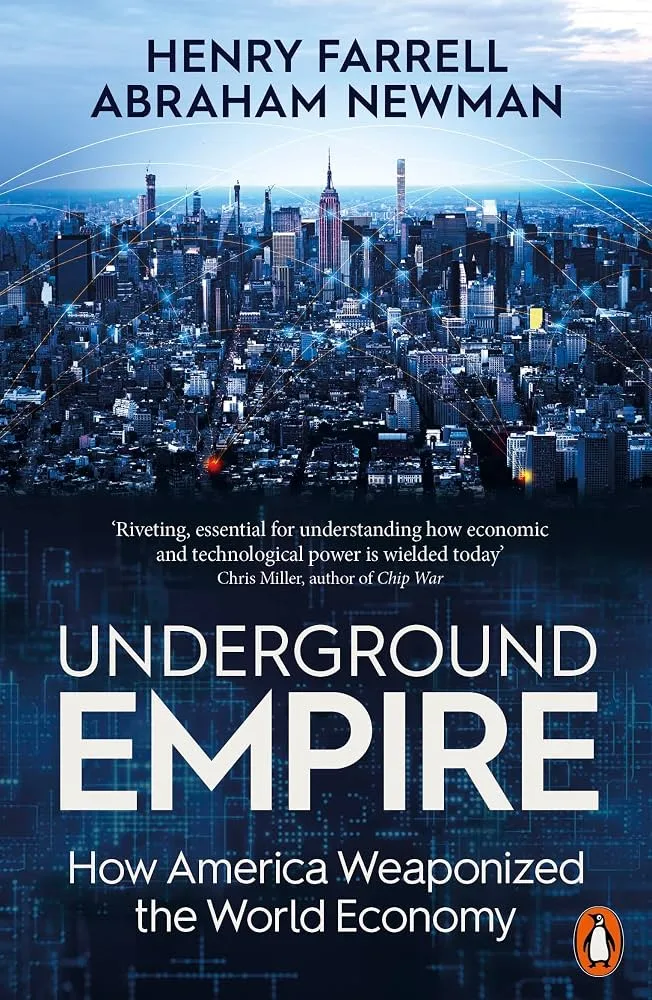
Their discussion begins with the financial system. Because the US dollar is the world’s principal reserve and trading currency, and because the US Treasury can monitor international dollar flows, the United States possesses considerable influence over the global financial system.
Initially, following the September 11 attacks, the United States used these financial networks to track and identify different elements of al-Qaeda. However, once it became possible to use these financial instruments for counterterrorism, they could also be used for other political purposes. The United States subsequently used its financial power against countries such as Iran and against Russia following its invasion of Ukraine in 2022.
Countries are increasingly looking at this situation and asking an important question: What happens when economic interdependence becomes a tool through which another country can exert political pressure? It is one thing to depend on another country when there is mutual trust. It is quite another when that dependence can be used to impose pressure for reasons unrelated to the economic relationship itself.
There is another important reason for dissatisfaction with globalisation. Although globalisation has generated considerable economic growth, much of that growth has been captured by a relatively small economic elite. In North America and Europe, for example, globalisation has contributed to the hollowing out of industries and communities. Wages for the bottom 50 per cent of the population have stagnated for decades.
The promise that globalisation would lift all boats has not been fulfilled for many people, particularly in the Global North. At the same time, we must recognise the extraordinary transformation that has taken place in China.
Thirty years ago, China was regarded in the United States as an economy with enormous potential but relatively little global significance. At that time, approximately 750 million people in China were living below the international poverty line of $2.15 a day. By 2016, that poverty had been virtually eradicated, according to the figures I was referring to.
The speed of this transformation was extraordinary. China became the workshop of the world and came to dominate numerous industries. However, this transformation also contributed to the hollowing out of industries in other parts of the world. Some regions experienced premature deindustrialisation before they had even developed substantial industrial capacity.
Africa provides an example. Chinese goods flooded local markets, often at very competitive prices, but this also crowded out domestic production and sometimes prevented local industries from developing. There is now concern that a similar process could unfold in the digital economy.
The resurgence of the state and the new ideological competition
Anirudh Suri: For several decades, the dominant economic thinking in much of the world emphasised the role of private enterprise and limited government intervention. Industrial policy and state-led economic development largely disappeared from the mainstream policy vocabulary.
Now, however, governments across the world are once again talking about industrial strategies, national champions and state-directed technological development. Are we witnessing a historical pendulum swinging back towards a greater role for the state in the economy?
Nils Gilman: When discussing the Cold War, I often ask what exactly was being competed for. It was not simply a battle of ideas in the abstract. The competition was fundamentally about the Global South and which economic and political models would gain influence there.
Would countries such as Ghana, India, Indonesia and Vietnam adopt a more statist approach to economic development, or would they follow a more laissez-faire model? I think we are entering another period of ideological competition of this kind.
Once again, the competition is largely about winning the support of leaders and governments in the Global South. China has demonstrated a development model that attracts considerable attention. When a country manages to lift hundreds of millions of people out of poverty within a relatively short period, other governments naturally begin to ask whether they can replicate that experience.
Personally, I am sceptical that China’s particular model can be easily reproduced elsewhere. Even the Chinese recognise that their experience is rooted in specific characteristics of Chinese society, including its relationship with the state and its traditions of bureaucratic administration. It is not something another country can simply copy.
What I find particularly interesting today is that two different technological and economic models are being offered to countries. The United States has traditionally promoted an open trading system, offering access to its products, services and technology platforms. Countries are encouraged to use American technology companies and applications, including Google and other digital services.
China is offering a different package. It is proposing to help countries undertake green technology transitions, build 5G telecommunications infrastructure and acquire surveillance technologies that governments can use to monitor their populations. This is part of the broader technological package China is offering to other states.
Of course, this is a simplified description of the two approaches. China also avoids criticising other countries over their domestic political systems and human rights records. The United States, particularly under Donald Trump, has also moved away from its earlier emphasis on such concerns. Countries may therefore choose one model, the other, or some combination of both.
Anirudh Suri: Does this mean we are witnessing the return of the government as a primary economic actor? Are mission-oriented governments and state-directed technological strategies likely to become increasingly important?
Nils Gilman: There is certainly a trend in that direction. However, the challenge is whether governments possess the administrative and institutional capacity to implement such strategies. Do they have honest and competent bureaucracies capable of designing and executing industrial policies?
China has demonstrated this capacity. Some European governments, particularly France, have also been relatively effective. But most governments around the world struggle to exercise effective control even over basic administrative and security functions outside their national capitals. Developing and implementing a comprehensive industrial strategy is therefore an enormous challenge.
One important change is that governments are no longer facing the same ideological resistance to intervention in the economy that characterised the previous decades. However, during that period, the capacity of governments to undertake such interventions was systematically weakened. In many countries, this was done intentionally.
There is an interesting contradiction in the present US government. On the one hand, it talks about developing national champions and protecting domestic industries. On the other, it is weakening the bureaucratic capacity of several government agencies that would be necessary to implement such policies.
Nevertheless, I believe there is a clear movement towards greater state involvement in industrial development. China’s example attracts both admiration and apprehension. Many countries would like to replicate its achievements, but doing so will be extremely difficult because China is a unique case.
Planetary problems and the need for global governance
Anirudh Suri: Let us turn to global governance. In your book Children of a Modest Star: Planetary Thinking for an Age of Crisis, co-authored with Jonathan Blake, you discuss the relationship between planetary problems and planetary solutions.
At a time when national governments are reclaiming certain powers from private corporations, while private companies are increasingly performing functions traditionally associated with governments, how should we understand the idea of planetary governance?
Nils Gilman: In Children of a Modest Star, Jonathan Blake and I argue that globalisation and the international governance system that emerged during the second half of the twentieth century were primarily designed to regulate the movement of things that human beings intentionally move around the world. These include goods, services, money, ideas and people.

The concept of the planetary, however, refers to a different category of flows. These are things that do not necessarily move around the world through deliberate human decisions and do not respect national borders.
International trade exists because countries have borders, different political systems and different economic specialisations. These differences make the exchange of goods and services possible. But carbon molecules in the atmosphere and viruses spreading among human populations do not recognise national borders.
Technology provides another interesting example. Open-weight AI models are being released into the world and spreading across national boundaries. There is very little that individual governments can do to stop these developments.
National governments cannot manage all these risks and challenges independently. The question, therefore, is what kind of institutions we need to address them. Jonathan and I propose creating a new category of narrowly focused, functionally specialised institutions.
These would not be world governments taking away national sovereignty across every area of public life. Instead, they would deal with particular global problems. For example, we could establish an international agency dealing specifically with emerging infectious diseases. Such an institution could have surveillance capabilities across the world and systems for identifying and warning about potential outbreaks.
It would be something like a World Health Organization with stronger powers and more effective monitoring capabilities. The objective is to create institutions that can address specific planetary challenges without requiring the creation of a single centralised world government.
Anirudh Suri: Given the weakening of international institutions such as the United Nations and the increasing emphasis on national sovereignty, do you think this vision of global cooperation is realistic? Is it becoming a pipe dream?
Nils Gilman: In the short term, I do not see much prospect for progress on this front. However, climate change is not going away. It is getting worse.
Governments may not like having their powers taken away, but there is something they dislike even more: being confronted with catastrophic problems that they cannot protect their populations from. Climate change is an example.
The United States, China and India are among the world’s most powerful countries, yet none of them can solve climate change independently. Eventually, they will have to develop some form of cooperative system.
The political situation in the United States has made this more difficult. Under Donald Trump, the country has moved towards reducing support for green technologies and renewable energy while expanding support for fossil fuels.
I believe that, over time, the United States could increasingly be viewed as an ecological equivalent of what was once described as an evil empire during the Cold War. The difference is that this would be an ecological rather than an ideological conflict, with the United States continuing to promote technologies that contribute to environmental destruction across the planet.
Artificial intelligence and the future of universities
Anirudh Suri: Let us move to the impact of technology on society, culture and education. You have written about what the university might look like after artificial intelligence. AI is already changing the way people work and learn.
How is it transforming universities, and how should people think about their careers in this emerging environment?
Nils Gilman: This is a complicated question. The capabilities of contemporary AI systems are already extraordinary, although there is considerable debate about how much more advanced they will become.
I think AI is particularly disruptive to education because of the way universities and educational institutions have traditionally organised learning and evaluation. Historically, education involved two interconnected processes.
The first was to provide students with opportunities to develop their intellectual abilities and acquire the skills required for different kinds of cognitive work. The second was to assess whether they had actually acquired those skills.
In the humanities, students were expected to write essays and research papers. In science, technology, engineering and mathematics, they were expected to solve problem sets. Examinations were designed in similar ways. Students had to demonstrate their understanding by writing essays or solving problems.
The purpose of these exercises was not simply to produce a paper or arrive at the correct answer. It was to make students undertake the intellectual work themselves. Professors could then evaluate whether students had genuinely understood the material.
AI fundamentally disrupts this entire process. If a student is asked to write a paper on the Bengal famine, for example, they can simply enter a prompt and immediately generate a 500-word, 1,000-word or even 5,000-word essay of considerable quality.
The student may read the output and learn something from it, but they have not necessarily undertaken the cognitive work of developing an argument, evaluating different interpretations or understanding why one argument is stronger than another.
The same applies to mathematical and scientific problem sets. If students simply enter problems into an AI system and copy the solutions, they may never learn how to solve those problems themselves. AI is therefore disrupting both the traditional methods of teaching and the methods used to evaluate students.
We need to rethink educational methods from the ground up. The solution cannot simply be to prohibit students from using AI. They will be expected to use these technologies in their future workplaces. If educational institutions fail to teach them how to use AI effectively, they will enter the workplace unprepared. Instead, we need to integrate AI into the educational process.
This will require fundamental changes in the way teachers and professors understand their roles. For example, the traditional model of standing in front of a classroom and delivering lectures is an extremely old-fashioned way of communicating information. We should probably have moved beyond it a long time ago.
Students can already access lectures on YouTube, and AI systems can generate explanations and learning materials tailored to individual requirements. These systems may not always be as good as the most brilliant professors, but they can certainly provide better explanations than many mediocre lectures.
The important question is therefore: What are the things that human beings will still need to do in a world where highly intelligent information systems are widely available? I believe there are several important human capabilities that machines will not replace.
One is the ability to establish relationships of trust. When two people meet and decide to start a business, develop a personal relationship or work together, they need to establish trust. Machines may help facilitate communication, but genuine trust remains fundamentally a human relationship.
Another important capability is what I call goal constitution. This means understanding what we actually want to do with our lives. You can ask an AI system what you should do in the morning. But if you wake up every day without knowing what you want to do and simply ask Claude or another machine to decide for you, you have effectively enslaved yourself to that machine.
Whether we are thinking about individuals, businesses, religious institutions or other organisations, we need to develop our own sense of purpose and direction. Machines may be able to simulate this process, but we should learn to determine our fundamental goals ourselves. Teachers will therefore need to incorporate AI into their teaching in ways that strengthen these uniquely human capacities.
How should educators integrate AI into teaching?
Anirudh Suri: Have you come across interesting examples of teachers or professors successfully integrating AI into their classrooms while ensuring that students continue to develop the intellectual and creative skills they need?
Nils Gilman: I have spoken to many educators about how they are attempting to do this. One particularly interesting example came from a design professor in Spain who has been incorporating visual rendering tools into her teaching.
She begins by showing students an image, perhaps a grassy field with a ruined aqueduct in the background, and asks them to write a prompt that will reproduce the image as closely as possible. The first attempt rarely produces an exact reproduction. She then asks students to revise their prompts repeatedly until they get closer to the intended result.
The important lesson is that students must first have a clear idea of what they want to produce before asking the machine to generate it. They should not simply submit a vague prompt and accept whatever the AI produces. The machine should help them realise their ideas and accelerate the production process, but it should not replace the original act of thinking.
She also uses AI in examinations. For example, she might show students an image of a mirror hanging on a wall and give them five minutes to reproduce it using an AI tool. She evaluates their work on two dimensions: how closely the generated image matches the original and how efficiently they use their prompts or tokens.
This teaches students to understand their objectives, communicate them effectively to the machine and use the technology efficiently. Another exercise involves asking students to generate an image of a futuristic city.
They are given five minutes to create their images. The professor then displays all the images on a screen and facilitates a discussion about which ones are the best. Students discuss the strengths of different images and the choices involved in producing them. For example, how realistic should an image be? Should it be more imaginative or fantastical?
This encourages students to develop their sense of taste and judgement. A machine can generate several images, but deciding which one is best involves human judgement. These are interesting examples of how AI can be integrated into education without allowing it to replace the essential intellectual and creative capacities that students need to develop.
Technology, culture and enduring human values
Anirudh Suri: Let us turn to the relationship between technology and culture. Throughout history, every new technology has generated concerns that it will fundamentally transform humanity. Yet many basic human characteristics seem to have remained unchanged.
People continue to be driven by greed, power and other impulses that philosophers discussed thousands of years ago. Are we overestimating the impact of contemporary technology on human culture, or is today’s technological transformation genuinely different from earlier ones?
Nils Gilman: I do think there are important differences today. Of course, every generation has experienced its own anxieties about new technologies. People reacted strongly when television first appeared, just as they did when the internet emerged.
There is no question that technology changes culture. For example, the internet and digital applications have dramatically transformed the way people establish romantic relationships, particularly in the United States and much of Western Europe. Dating applications have become one of the primary ways people meet potential partners. At the same time, we should avoid exaggerating some of the consequences.
There are frequent claims that nobody reads books anymore. It is true that many people find it increasingly difficult to concentrate on reading because their attention is constantly fragmented. But people are still reading. In fact, more books were purchased in the United States last year than in any previous year in its history, although purchasing books does not necessarily mean that everyone reads them.
I think there is still an appetite for reading and intellectual engagement. Technology is changing the ways in which people access information and consume culture, but I am not sure it is fundamentally changing all the underlying human appetites.
There are also important aspects of human life that remain relatively unaffected by technological developments. Getting along with our parents, siblings and children, building meaningful friendships and investing time, energy and emotion in relationships are enduring human concerns.
These are central themes in the writing of authors such as Elif Shafak, and I do not think they are going away. Personally, I try to be quite intentional about how I integrate technology into my relationships.
Some technologies can be harmful when used in inappropriate ways. Different forms of communication are suited to different purposes. For example, trying to resolve a serious personal conflict through text messages is rarely effective. That does not mean text messaging is a bad technology. It simply means we need to understand how and when to use different technologies.
Books, magazines and recommended thinkers
Anirudh Suri: Before we conclude, I have two final questions. First, are there any books, magazines, newsletters or other publications you would recommend to our audience?
Nils Gilman: I read very widely and eclectically. I should certainly recommend my own magazine, NOEMA. It is a publication that I think people should read.
More generally, I believe the most important thing is to read broadly and engage with different kinds of ideas and perspectives. There are two websites I use regularly that may not be particularly well known. The first is Arts & Letters Daily (AL Daily). It is a curated collection of interesting articles and writing from a wide range of English-language magazines and publications. It brings together material from many different sources and is an excellent way to discover worthwhile reading.
The second is Memorandum, which I use to follow American politics. It is particularly useful for keeping track of political developments and the day-to-day discussions taking place among political figures and commentators in the United States. These are two resources I would recommend.
Anirudh Suri: And finally, are there any thinkers or potential podcast guests working at the intersection of technology, society and culture whom you would recommend?
Nils Gilman: One person I have relied on considerably and have previously invited onto my own podcast is Andrew McAfee, a researcher at MIT. He and his co-author Erik Brynjolfsson are associated with the book The Second Machine Age. Andrew is extremely knowledgeable about technology, but he is also an engaging person to talk to. I think he would be an excellent guest.
Anirudh Suri: That is a wonderful recommendation. I have read his books and followed his work, and many of his ideas have informed my own writing.
Thank you, Nils. This has been a fascinating conversation. I would also like to endorse your recommendation of NOEMA. The magazine covers a remarkable range of subjects and publishes thoughtful work that is particularly important in today’s increasingly distracted world.
Thank you for joining us.
Nils Gilman: Thank you very much for having me.
This interview was originally published on theThe Great Tech Game Podcast, with Anirudh Suri YouTube channel under the title “Fighting A New Cold War For The Global South” and is reproduced here in an edited text format.


Anirudh Suri is a non-resident scholar with Carnegie India, where his research and writing focus on technology, artificial intelligence and geopolitics. He is the author of The Great Tech Game: Shaping Geopolitics and the Destinies of Nations, and host of The Great Tech Game Podcast. He is also the Managing Partner at India Internet Fund, a US and India based technology-focused venture capital fund.