
Soil, Sheep and Self-Reliance: The Story of Kalawati Ninama
In a small village in Rajasthan’s tribal heartland, Kalawati Ninama has transformed the way her family lives and earns. Once dependent on wage labour to make ends meet, she has built a more secure livelihood by bringing together natural farming, livestock, a nutrition garden, poultry and biogas. Her journey shows how local resources, practical knowledge and women’s collective strength can create pathways to genuine self-reliance.
About forty-two kilometres from Rajasthan’s Banswara district, in the tribal heartland of Ghatol block, lies a small village called Ubapana. This is where Kalawati Ninama and her family make their home, and their days unfold much like those of their neighbours bustling mornings, long hours of farm labour through the afternoon, and evenings spent tending livestock. Kalawati, who studied up to the eighth grade, lives here with her husband Dhulji Ninama and their four children.
For this family, farming and livestock were once simply a means of putting food on the table. Today they have become the sturdy foundation of something far greater: genuine self-sufficiency. Even with limited resources, a willingness to work hard and an openness to new methods transformed not just the family’s finances but Kalawati herself she has become a source of inspiration for many women in the area.
A decade ago, Kalawati and Dhulji owned fewer than twenty animals. Farming and animal husbandry went on side by side, but neither brought in enough to cover the household’s needs. Even in a good monsoon year, the land wasn’t fertile enough to yield grain for all twelve months, and the herd was too small to promise any steady income. More often than not, the family had to seek wage labour elsewhere to get by. Whenever Dhulji left the village in search of work, the entire burden — the household, the children, the fields, the animals fell on Kalawati alone. Rising before dawn to feed and water the livestock, then tending the fields, all while looking after the children: none of it was easy to juggle at once.
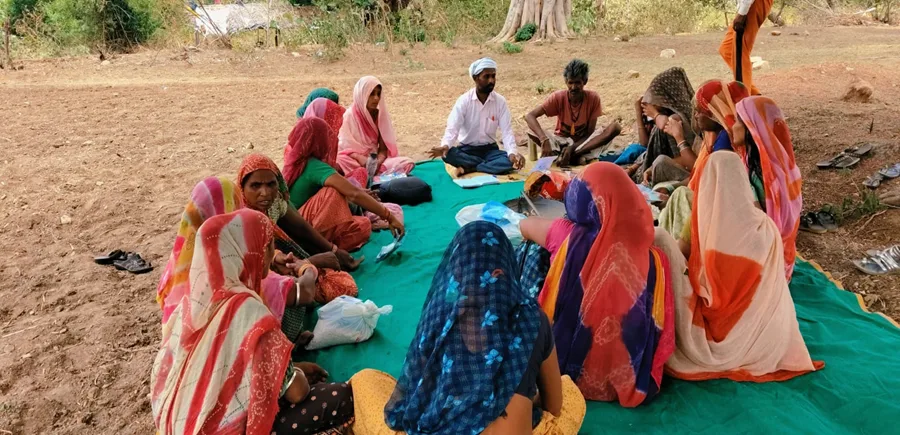
The turning point came in 2021, when Kalawati and Dhulji connected with the Vaagdhara Through the efforts of Manilal Damor, the facilitator working in their village, the family began receiving guidance through the Saksham Samuh and Gram Swaraj Samuh self-help groups built around the idea of honest farming, honest livestock-rearing, and making full use of government schemes and local resources. These group meetings were never just about passing on information; they became a space where the village’s women could learn from one another and swap notes on what worked. Kalawati listened closely at every session and then tried to put the lessons into practice in her own courtyard and fields. When something wasn’t clear, she wasn’t shy about asking the facilitator to explain it again, and again, until it made sense. That persistence would go on to become her greatest strength.
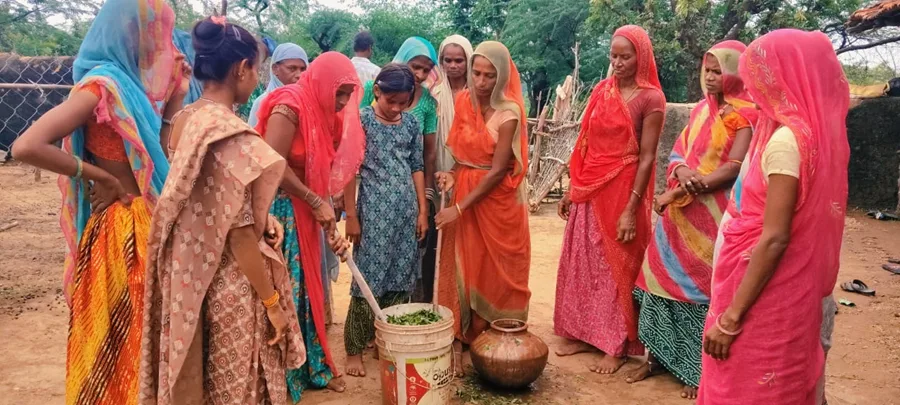
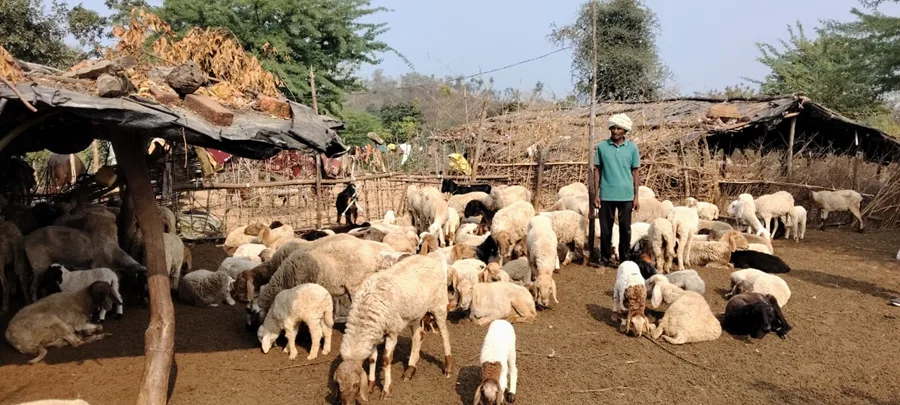
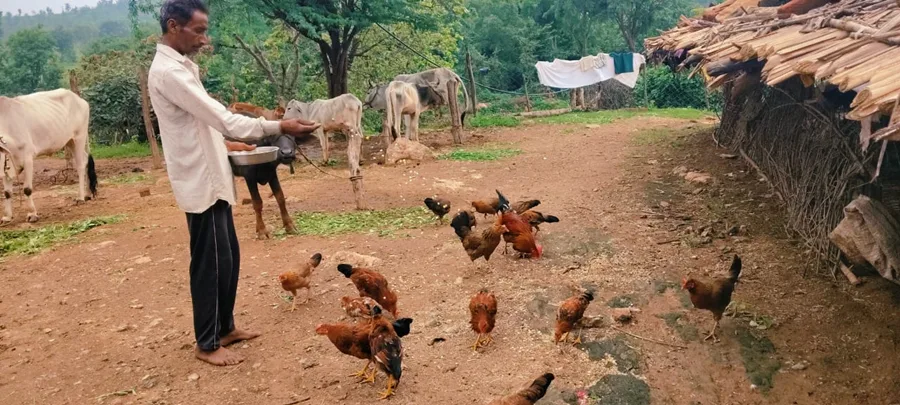
Over time, the way the family farmed and raised animals began to change. Kalawati started using homemade organic preparations on her fields dashparni, jeevamrit, neemastra, kandapani and brahmastra inexpensive, sustainable alternatives to chemical fertilisers and pesticides. What she liked most was that these mixtures cost almost nothing to make, since they could be prepared from things already lying around the house and farm; this cut her dependence on the market and trimmed her expenses. Alongside this, she took up timely vaccination for her animals, mineral supplements for the goats, composting cattle dung into organic manure, and the ukeda method of decomposing waste into fertiliser. Kalawati and Dhulji also put real effort into building up their livestock. A herd that once numbered under twenty has now grown to roughly eighty sheep, eighteen goats, two bullocks, four buffaloes and thirty-five hens. None of this happened overnight it grew a little each year, through careful nursing of sick animals and timely vaccination drives. The livestock is no longer just a source of milk and wool for the household; it has become the family’s most dependable stream of income. In an ordinary year, animal husbandry alone brings in somewhere between one and one-and-a-half lakh rupees, and that figure climbs higher during the sheep-selling season. A family that once had to wander far from home in search of wage work now earns a steady living from the animals standing right in its own courtyard.
Alongside the livestock, Kalawati has also developed a nutrition garden right around her home. In this modest plot she grows eight to ten kinds of vegetables brinjal, bottle gourd, tomato, ridge gourd, sponge gourd, broad beans, hyacinth beans and cowpea giving the family fresh, nourishing produce all year round. It has also saved them the fifteen to twenty thousand rupees they used to spend annually buying vegetables from the market, while noticeably improving the quality and nutrition of their meals. Green vegetables now find their way onto the children’s plates regularly, and it shows in their health.
The family has also grown smarter about using local resources on its farmland. Manure from their own animals around eight hundred kilograms of it now goes into their five bigha of farmland each season, helping keep the soil fertile. Around the house, Kalawati has planted a range of fruit-bearing and multipurpose trees: mango, jackfruit, mahua, guava, custard apple, papaya, tamarind, mulberry, ber, chikoo, banana and amla. In the years ahead these trees will not only bear fruit but also provide shade, firewood, and help the soil retain moisture. Bit by bit, the land around her home has turned into a multi-purpose model of livelihood that weaves together farming, livestock, nutrition and natural resources a system where every resource feeds into another and nothing goes to waste.
A biogas plant has played its own quiet but important part in this journey toward self-reliance. Installed with technical guidance from Vaagdhara, the family now uses it for all their cooking. Kalawati says that since the biogas unit was installed, they no longer need to buy cooking-gas cylinders, saving roughly one thousand to fifteen hundred rupees every two months. It has also done away with much of the daily grind of gathering firewood from the forest.
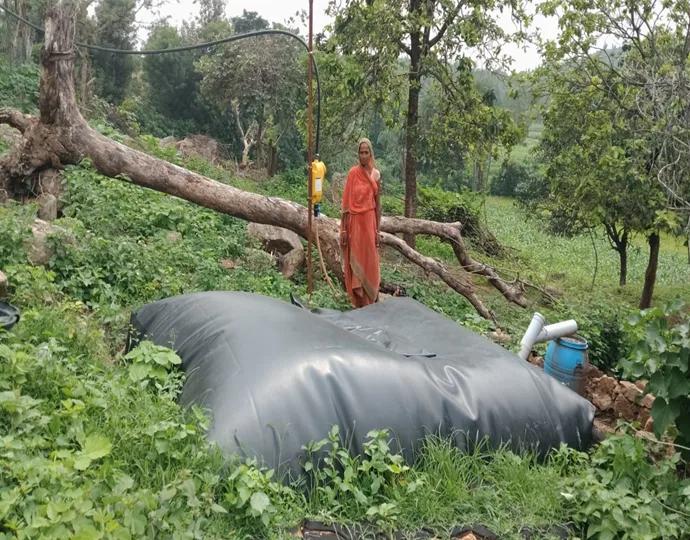
The benefits of the biogas plant don’t end in the kitchen even the leftover slurry is put to use. Kalawati spreads it as fertiliser on her chilli patch. In effect, dung from the animals first powers the kitchen through biogas, and what’s left behind returns to enrich the soil. Livestock, energy and farming feed into one another this way, giving the family’s livelihood a sturdier, more sustainable base.
This income also allowed Kalawati to set up a borewell to irrigate her fields. With it, she waters her land through the year and grows different crops season by season one kind during the monsoon, another through winter and summer. The fields are rarely left idle, and the land is put to full use. Farming, livestock, poultry and the nutrition garden together have opened up multiple streams of income for the family, so that no single source carries all the risk. If the harvest falls short in a given year, income from the livestock cushions the blow; if selling the animals takes longer than expected the vegetables and poultry help tide things over. It’s this diversity that keeps the family secure through every season.
Kalawati did not walk this path alone. Platforms like the Saksham Samuh and Gram Swaraj Samuh gave the village’s women a place to sit together, share their experiences, and learn from each other’s missteps. Kalawati herself now teaches newer members the very methods she once learned from facilitator Manilal Damor. In this way, knowledge and experience keep passing from one woman to the next, drawing the whole village gradually into a shared circle of learning.
Today, Kalawati’s family no longer needs to leave home in search of wage labour. They earn their living right there in the village a flock of eighty sheep in the courtyard, along with goats, buffaloes, bullocks and hens; fields thick with standing crops; a nutrition garden bursting with greens; and a kitchen running on biogas.
Kalawati never let hardship define her. Instead, she used the land, livestock, water and natural resources around her wisely, and gave her family’s livelihood a new and far more secure direction. Through the nutrition garden, livestock-rearing, organic manure, natural farming, poultry and biogas she has taken up, she has built a genuinely self-reliant household proof that with grit and determination, a woman can chart a new course not just for her own family, but for her whole community.
Vikas Parashram Meshram is a development professional, writer, and grassroots storyteller with extensive experience in rural livelihoods, community development, and social-sector programmes. His work focuses on documenting grassroots innovations, sustainable livelihoods, women’s empowerment, agriculture, natural resource management, and rural development. Through his writing, he brings the experiences and voices of rural communities to a wider audience, highlighting practical solutions and stories of social and economic transformation.