
The Evental Dimensions of the Youth Uprising
The Delhi youth uprising was more than a moment of protest; it was a political event that disrupted established forms of power, resistance and political imagination. In this essay, K. Vinod Chandran explores the uprising through the ideas of the “Event,” the politics of desire, the carnivalesque character of Gen Z resistance, and the role of political interventions in transforming a youth agitation into a wider popular movement.
While the youth uprising in Delhi concluded successfully, the core issues it raised remain unresolved. A steady stream of articles and studies—both praising and critically analyzing the movement—continues to flood social media and academic journals. Now that the initial euphoria of the uprising has begun to fade, what is revealed when we look back with the clarity that a month’s distance provides? What lessons does it offer to democratic movements resisting the Hindutva-Zionist regime?
The days from July 20th to 25th were moments when history shifted its course. These were legendary days when the youth of India reclaimed democracy and shook the state to its very core. They were days when the historical and authoritarian dams burst, allowing the timeless flow of an “Event” to surge forth. The magical illusions of fear and hatred spun by twelve years of Modi’s rule in India were shattered by the subversive laughter of the Gen Z protesters. Having dismantled democratic institutions, imprisoned dissidents, internally fractured India through communal and ethnic violence, stripped away civil liberties, derailed the education and examination systems, denied employment opportunities to the youth, and held the entire populace hostage—this Modi regime was finally put on trial by the youth on the streets of Delhi.
They minorized Indian politics and the discourses of power. They attacked the patriarchal, archaic sensibilities and grand narratives of Hindutva with humorous counter-narratives. They challenged the official, pious, and dominant speech of the old order with a youthful language forged from love, mockery, and rage. Across the nation, they overturned the upper-caste, elderly sensibility that spewed communal venom, replacing it with a minor sensibility brimming with love, solidarity, and wit. They subverted the commands of “daddies” and “uncles” through the playful language of parody. Ultimately, they confronted the affects of fear, hatred, and malice with the affective forces of empathy, fellowship, and humor.
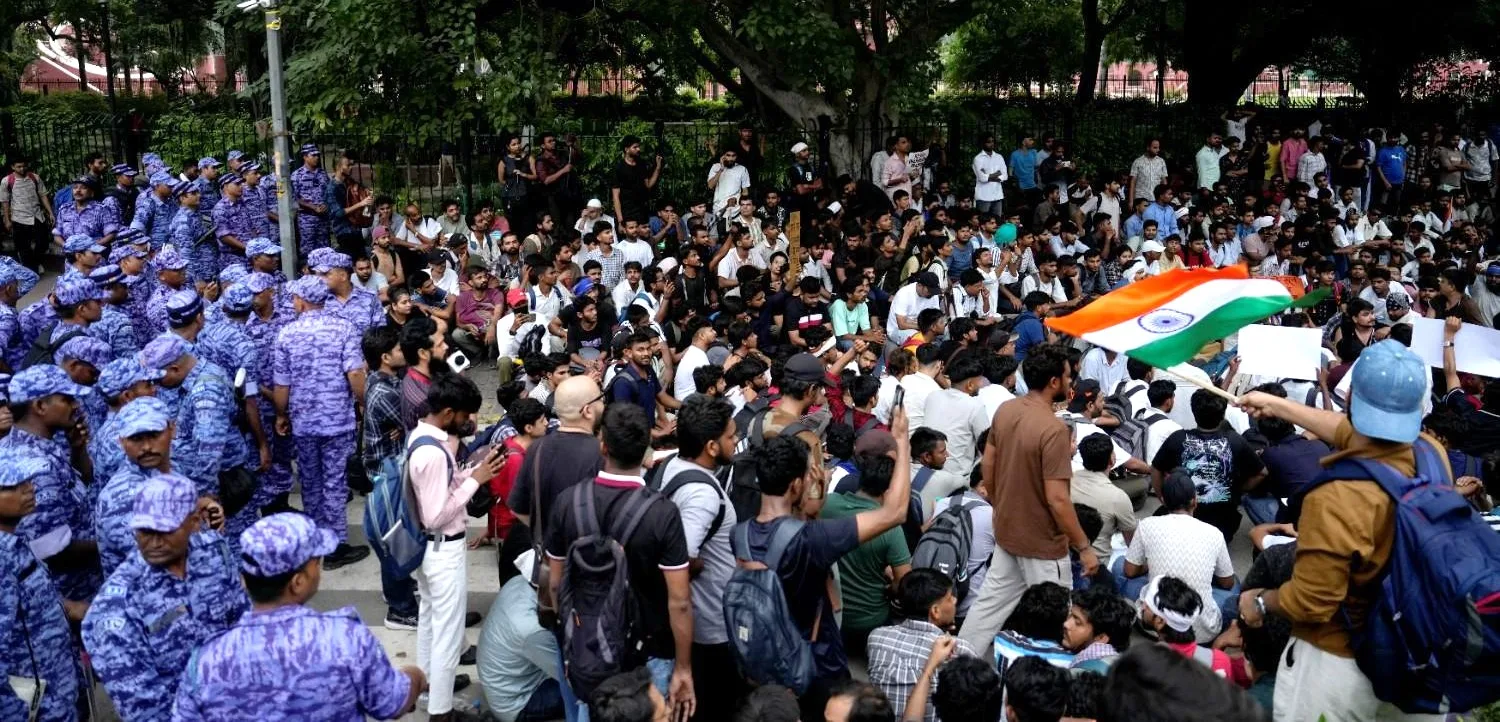
The younger generation celebrated resistance as a form of play and festival. Transcending the divides of caste, religion, and gender, the youth joined hands against the state. Mocking, enticing, and provoking a police force that lay in wait to hunt them down with shock batons, nail-studded metal lathis, tear gas shells, and pellet guns, they marched toward the high-security zone of the Parliament building. Surviving police brutality and smashing through barricades, they surged through the streets of Delhi with songs and dance steps. Bearing parodies, slogans dripping with satire, and placards, they performed street plays, reclaiming the avenues and royal roads of Delhi.
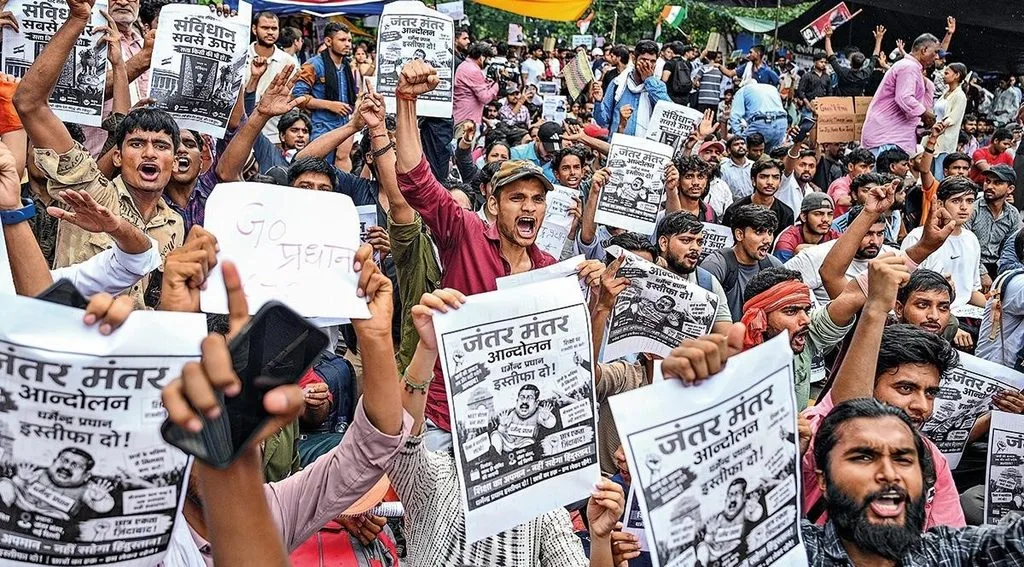
They played a game of hide-and-seek with charging, lathi-wielding policemen, floating through the streets while surfing through music-infused reels, memes, and videos. Capturing instances of police violence on their mobile cameras, they broadcast them across the nation. Dressed up in bizarre effigies and costumes of Batman, Spider-Man, Superman, and Iron Man, they transformed the protest march into a festive carnival. Beneath the torrents of water cannons, young men and women performed a rain dance. They stalled policemen advancing for a lathi charge by breaking into the national anthem. In moments of lull, they handed flowers to the officers, disarming and bewildering them with playful banter and mischievous smiles. Spotting the state-sponsored thugs who hid among the police to assault them, they singled them out, chased them away with ridicule, and captured their faces on camera.
They multiplied like cockroaches; like cockroaches, they flew, crawled, pounced, and vanished right through the ranks of the police. Then, these cockroaches transformed into butterflies and birds, breaching police cordons and barricades to soar freely into the vast skies of Delhi. Even though the government attempted to thwart the protesters by suspending metro services, shutting down the entry points to Delhi, intercepting vehicles, and cutting off the internet, the heavy influx of tens of thousands of youths into Jantar Mantar continued unabated. Parents and citizens from various walks of life stepped forward to join this novel form of resistance. Courageous young men and women, who shielded their friends by absorbing the blows of the lathis onto their own bodies, rewrote the historical epics of love and endurance. Support arrived from every corner of the nation. Protesters at Jantar Mantar equitably distributed food packets sent to them by sympathizers from distant lands. Teams of doctors and volunteers camped on-site to provide medical aid to the injured. Legal aid teams arrived voluntarily to offer counsel. Gurudwaras and mosques stood as pillars of support for the students. Service-minded Sikhs set up systems to supply food and water to the demonstrators. Beneath the scorching sun, students rhythmically fanned one another, chanting slogans, singing, and dancing. By night, youths belonging to diverse castes, religions, and regions spread out paper and mats beneath the protest-tents at Jantar Mantar, sleeping together as a single family while strangers and unfamiliar sympathizers hand-fanned them—scenes that became sublime portraits of a collective experience. By reclaiming these public moments of love, unity, and fellowship, the youth of India set a new paradigm for the world. What distinguishes this “cockroach uprising” from the violent Gen Z protests seen in Bangladesh, Sri Lanka, and Nepal is its non-violent, creative, and dialogical methods of resistance.
The youth agitation possessed numerous dimensions, layers, and trajectories. Within it, multiple temporalities, registers, modes, and styles of resistance converged. By championing non-violence, this youth uprising elevated the Gandhian tradition of Satyagraha to a new domain. The satire, parodies, and digital vocabularies of humor deployed by Gen Z were not merely hollow, amusing statements; ultimately, they were profound assertions of truth. Harsh Mander, a thinker on resistance movements, fittingly termed these young protesters “Instagram Satyagrahis.” The demonstrators proudly upheld the portraits and ideals of both Gandhi and Ambedkar. Gandhian modes of Satyagraha, Ambedkarite ideals, Dalit struggle tactics, the innovative digital warfare of Gen Z, and the militant resistance styles of student organizations like AISA, SFI, AISF, and NSUI all harmonized in perfect, flawless synchronicity. Meanwhile, the Sikh Nihang clans—attired in blue, wearing blue turbans, and carrying their traditional swords, spears, and quoits (chakrams) to protect the students—evoked powerful memories of the historic 2020–21 farmers’ movement. In this protest-event, which ruptured contemporary historical continuity and initiated a new history, every era of resistance was reincarnated. The counter-memories and counter-histories of the people were reassembled and mobilized. The very politics, language, and tactics of resistance underwent a process of minorisation (a Deleuzean concept).
As Arundhati Roy remarked, the cockroach protesters were the offspring of an unholy union between a judge and a joke. This was a rebellion born of insult, humiliation, and wounded self-esteem. Becoming cockroach was the political and theatrical response of the younger generation to a derogatory remark by Chief Justice Suryakant, who had demeaned unemployed youth as lazy and parasitic like cockroaches. In fact, the satirical tagline of the CJI’s website became “The Voice of the Idle and the Unemployed.” As a formulaic signifier of magical and creative metamorphosis, that word marked the birth of a new subjectivity. It was through this subjective transformation—the youth’s becoming cockroach—that the Gen Z uprising gathered the spiritual courage to shatter the illusory web of fear and hatred spun by Hindutva. Through this creative assemblage of cockroach and youth, they gained the power to reclaim the sovereign moments of love, fellowship, play, and laughter. The evolutionary resilience of the cockroach species—its ability to multiply, spread out, crawl, crouch, fly, dodge, and hide, thereby suffocating the enemy—was developed into a novel strategy of resistance. The survival tactics of this rare species, capable of outliving even nuclear radiation and overcoming the harshest adversities, were channeled directly into the theatre of protest. Rejecting centralized leadership systems in favor of a decentralized, rhizomatic structure, the cockroach uprising distinguished itself from conventional party-political struggles. The protesters successfully transformed “cockroach” from a term of contempt into a vital word of self-empowerment and pride.
The secret to the success of the cockroach uprising lies in its ability to develop a novel aesthetics and erotics of resistance. This new sensibility, where satire and romance converge, is precisely what distinguishes it from other modes of struggle. The ironic and satirical style of the cockroach protest stood in sharp contrast to the lyrical, classical sensibilities of conventional movements. It was entirely devoid of ideological rigidities, gravity, and formalities. The form of this Indian Gen Z protest departed completely from the leader-centric and mechanical structures of routine demonstrations. The carnivalisation of resistance, as discussed by Anand Teltumbde (“In Defence of the Profanity of the Protesters”, Wire, July 30, 2026) serves as the primary element that distinguishes the cockroach uprising from other uprisings. After all, it is through the subversive aesthetic devices of satire and parody that carnivals overturn official discourses of power. As Mikhail Bakhtin observed, the carnival attacks hierarchical, elite language, claims of purity and decorum, and the sacred halos of authority. Through this process of profanation and desecration, the cockroach uprising completely shattered the Modi regime’s aura of invincibility. Ultimately, laughter was their weapon of choice.
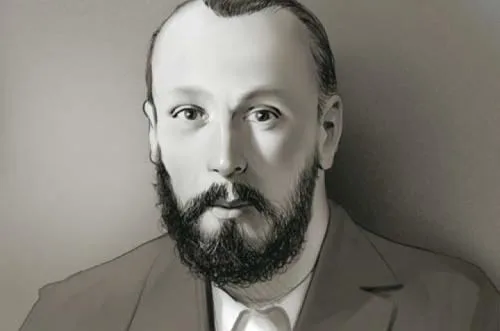
Jantar Mantar was transformed into a popular assembly that reclaimed the public sphere of dialogue and democratic debate. The uprising succeeded in forging deep alliances among opposition parties and generating widespread public solidarity. Much like the 1968 French student revolution, the movement became a forum for diverse ideologies, politico-cultural perspectives, and ideas. It brought together Gandhians, Ambedkarites, radical revolutionary organizations, environmental activists, left-wing movements, and human rights defenders into constructive dialogue. Gen Z and the older generations, workers and teachers, parents and students, writers, the general public, minorities, Dalits, organized political movements, unorganized sectors, and farmers—all showed a profound willingness to engage with one another. Even the political parties within the INDIA bloc, which had been actively fighting among themselves, set aside their rivalries and united to ensure the success of the youth struggle.
2
Numerous articles and essays analyzing the Gen Z uprising from theoretical and political standpoints have appeared in international and national media outlets and academic journals. Renowned thinkers and writers such as Harsh Mander, Apoorvanand, Anand Teltumbde, Arundhati Roy and Nivedita Menon have written notable pieces providing deep insights into the various dimensions of the uprising. However, my objective here is to bring to the forefront certain paramount undercurrents and theoretical dimensions that pierce straight to the very core of the movement—aspects that, in my view, most of these analyses have notably overlooked.
1. Evental Dimensions
The youth uprising in Delhi was an unprecedented “political event” that transformed the landscape of Indian politics and history. However, while the political thinkers and writers mostly grew ecstatic over the spectacular emergence of the cockroach uprising, they failed to comprehend or comprehensively chart its evental dimensions. A conceptual inertia or blindness prevented them from comprehensively evaluating the trajectories, consequences, and political possibilities generated by the struggle.
What, then, is an Event?
Events are social tremors that erupt unpredictably, much like earthquakes or tsunamis. They are natural disasters of the human condition, bursting forth within society, culture, politics, history, language, sensibility, thought, and lived experience. They rupture and reconfigure existing social and political structures, ushering in an entirely new horizon of possibilities. They transform what was previously deemed impossible into the possible. The French Revolution, the Russian Revolution, and the Indian Independence Movement are classical examples of political events. Similarly, I consider the 1968 French student uprising, the Arab Spring, and the 2020–21 Indian farmers’ protest to belong to this category of political “Events.” It is precisely as such a political event that we must view the youth uprising in Delhi. It is these evental dimensions that I have attempted to chart here through the illustration of those five days from July 20th to 26th.
2. The Politics of Desire
Yet, when faced with the paramount questions of how an Event occurs, or who its creators are, philosophers of the Event generally maintain a striking silence. This remains an unresolved theoretical puzzle that they have left unaddressed. They successfully illuminate the unpredictability of the Event, its complex processes of differential repetition, and the chain of consequences it generates. However, they do not venture into the question of which deep reservoirs of human nature and culture yield this mysterious, disaster-like emergence and disappearance. My objective here is to comprehensively analyze the trajectories and shifting dynamics of the protest, bringing to the forefront certain paramount undercurrents and theoretical dimensions that define the rhizomatic nature of this youth agitation.”. If Alain Badiou concentrates primarily on the subjectivity constructed after the Event and its subsequent political consequences, thinkers like Foucault and Deleuze do offer some insights into the role of human subjectivity in creating an Event. Nevertheless, even they fail to theorize the intrinsic interconnectedness between the Event and desire.
I contend that Events are tremors emerging from the depths of human desire—and even more so, from feral desire, the unconscious. They are the historical explosions of humanity’s primal urge.
My position here is that this very explosion of desire constitutes the historical core of the youth protest-event in Delhi. The youth’s becoming cockroach represents the entry point into these transformations of desire—the initial step in a journey toward a series of “becomings.” The youth protest-event must be viewed as a molecular theatrical process of metamorphosis, wherein the youth and the populace of India are transformed from cockroaches into butterflies, birds, storms, vortices, and cyclones. The CJP movement merely acted as the catalyst for such an event of transformation.
The festive dimension of the uprising signifies the micro-politics of desire. While many of the thinkers mentioned earlier elaborate on the carnivalesque nature of the uprising—and their insights are indeed relevant—they fail to fully capture the desire-driven essence of the festival. It cannot be confined merely to the parodies and social farces described by Bakhtin. Does not the eruptive laughter of the protesters, which pierces state power, signify an explosive expression of desire and the yearning for love?
3. Rahul Gandhi’s Interventions
The heavy influx of tens of thousands of youths into Jantar Mantar was triggered when the police forcibly removed Sonam Wangchuk from his fasting venue and hospitalized him. Consequently, the number of students surged into the tens of thousands, eventually crossing fifty thousand, alongside a steady rise in broader public participation. Although the police and the RAF unleashed brutal violence against the Gen Z march toward Parliament (Sansad Chalo) on July 20th, they failed to dampen the revolutionary spirit of the youth. Instead, the struggle grew even more passionate and resilient. Following this police brutality, the government strategically faced two options: either succumb to the demands of the youth, or isolate the youth uprising and crush it through demonic force. The latter would involve covertly planting agent provocateurs among the non-violent agitators to instigate violence against the police, thereby engineering a pretext to unleash a barbaric crackdown on the youth. After all, Amit Shah is notoriously adept at fabricating such machinations to eliminate his adversaries.
This imminent danger was averted when the Congress and the INDIA bloc, united under the leadership of Rahul Gandhi, declared their unequivocal support for the agitation and actively joined the struggle. This marked the next evental leap in the CJP movement. On July 21st, protesting the brutal assault on the youth, the INDIA bloc paralyzed parliamentary proceedings. In both houses of Parliament, Rahul Gandhi and Mallikarjun Kharge demanded that not just Dharmendra Pradhan, but Modi and Amit Shah as well, must be held accountable. Chanting slogans demanding that Modi and Amit Shah either apologize or resign for the violence, Rahul Gandhi led a flash march of Congress and INDIA bloc leaders toward Modi’s residence at around 3:30 PM. Although the police intercepted the march at several points, the leaders forged ahead unhindered. “When the demonstration reached the high-security zone outside Modi’s residence at 7, Lok Kalyan Marg, a massive police force blocked them with barricades. The opposition leaders then sat down on the main road, launching an immediate dharna.
As the struggle, which was initially directed at Dharmendra Pradhan, shifted its focus squarely onto Modi, the rulers grew panicked. They realized that with the entry of the opposition parties, the entire trajectory of the uprising was changing. The three-and-a-half-hour dharna saw the participation of the Chief Ministers of Kerala and Karnataka, alongside MPs and prominent leaders from parties like the Congress, CPI(M), and the Samajwadi Party. Sensing danger, the regime dispatched two union ministers to the protest site to placate Rahul Gandhi. However, as Rahul Gandhi adamantly insisted that they would not back down until Modi himself responded, the police force moved in, using raw power to arrest and remove Rahul Gandhi, Priyanka Gandhi, and other leaders and MPs. While resisting the police use of force, Rahul Gandhi made an ironic statement that served as a profoundly meaningful message to the Indian populace: “Democracy in India is happening now.”
Rahul Gandhi’s timely and strategic maneuvers played a pivotal role in steering the youth uprising toward its temporary victory. These interventions by the Congress and the INDIA bloc allies were decisive in transforming the youth struggle into a massive popular uprising. In the days that followed, the uprising evolved into a grand mass movement, the likes of which post-independence India had never witnessed before. The youth rebellion spread like wildfire across various states, including Maharashtra, Bihar, West Bengal, Odisha, and Chhattisgarh. Panicked by the realization that the momentum of the struggle was turning squarely against them, the Modi regime was forced to sit down for talks with the youth, ultimately finding itself compelled to remove Dharmendra Pradhan.
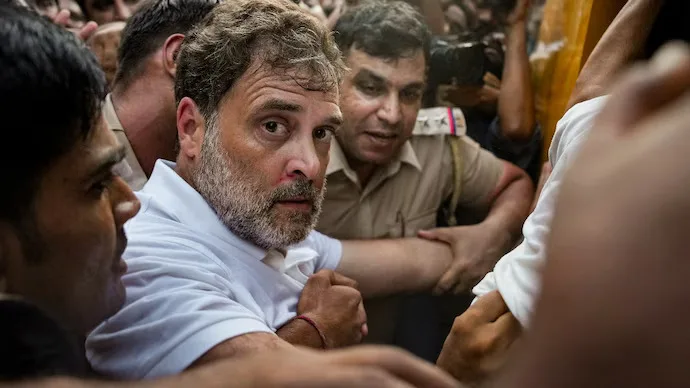
Image Courtesy: Indiatoday
It is the convergence of these diverse currents of desire that transformed the Gen Z uprising into a monumental Event. If the wave unleashed by the youth uprising advanced all the way to the gates of the high-security Parliament zone, the flash march led by Rahul Gandhi brought this surging tide of people straight to the heavily fortified perimeter of Modi’s residence. The state’s sanctuaries of power, once deemed inaccessible to dissenters, shuddered under the impact of this evental torrent. Yet, political thinkers in India have failed to document this critical second momentum in the trajectory of the youth uprising with the significance it truly deserves.
3
With the resignation of Dharmendra Pradhan, the youth uprising drew to a close. The tidal waves of the Event—which had shaken the state and rewritten the equations of power—receded. The thunderclaps and tremors of transformation subsided, as they do with all tectonic events. Much like natural disasters, Events are inherently ephemeral. As Alain Badiou theorizes, it is these fleeting cycles of appearance and disappearance that define an Event. Yet, even when the Event itself dissolves, the chain of consequences it leaves behind continues unabated, sowing the seeds of change across society. It is this very sequence of consequences that renders the Event immortal.
The contingency of Events—their unpredictable emergence and disappearance, alongside their ephemeral nature—renders the post-evental landscape highly volatile. Counter-evental forces will mobilize their entire might to launch a retaliatory strike aimed at crushing the forces of the Event. This is the enduring lesson of history, and it is precisely what is unfolding today. With the conclusion of the uprising, the state has already intensified its retaliatory measures against the demonstrators. Following its temporary retreat, the Indian state has begun rearing its bruised fangs to strike back at the agitators. It has launched a full-scale counter-offensive using its absolute power. This was clearly signaled by the Prime Minister’s Independence Day speech from the ramparts of the Red Fort. In his address, Modi insinuated that while they had succeeded in eliminating armed Naxals, “intellectual Naxals” (Dimagi Naxalites) still remained, and eradicating them would be the next objective. For Modi, the label “Naxal” has always been a code word to designate dissidents and resisters. To praise youth power on one hand, while systematically destroying the youth on the other—this is the deceptive corporate event-management apparatus currently being orchestrated by the state.
The task now before democrats is to remain faithful to the Event, and to advance its politics by consolidating its consequences. Rather than retreating from the struggle, the Congress and the INDIA bloc, under the leadership of Rahul Gandhi, are currently engaged in efforts to sustain the politics of desire and the Event. They are doing so by fanning the remaining embers of the agitation, redirecting its focus squarely toward Amit Shah, Modi, and the RSS, and intensifying their dialogue with the student youth. The paramount question now is whether these efforts can successfully forge a mass freedom movement that binds together India’s farmers, workers, and youth.
Featured Image: A protest gathering near Jantar Mantar in New Delhi on July 20, 2026, where demonstrators and security forces assembled ahead of a planned march to Parliament.Credit PTI
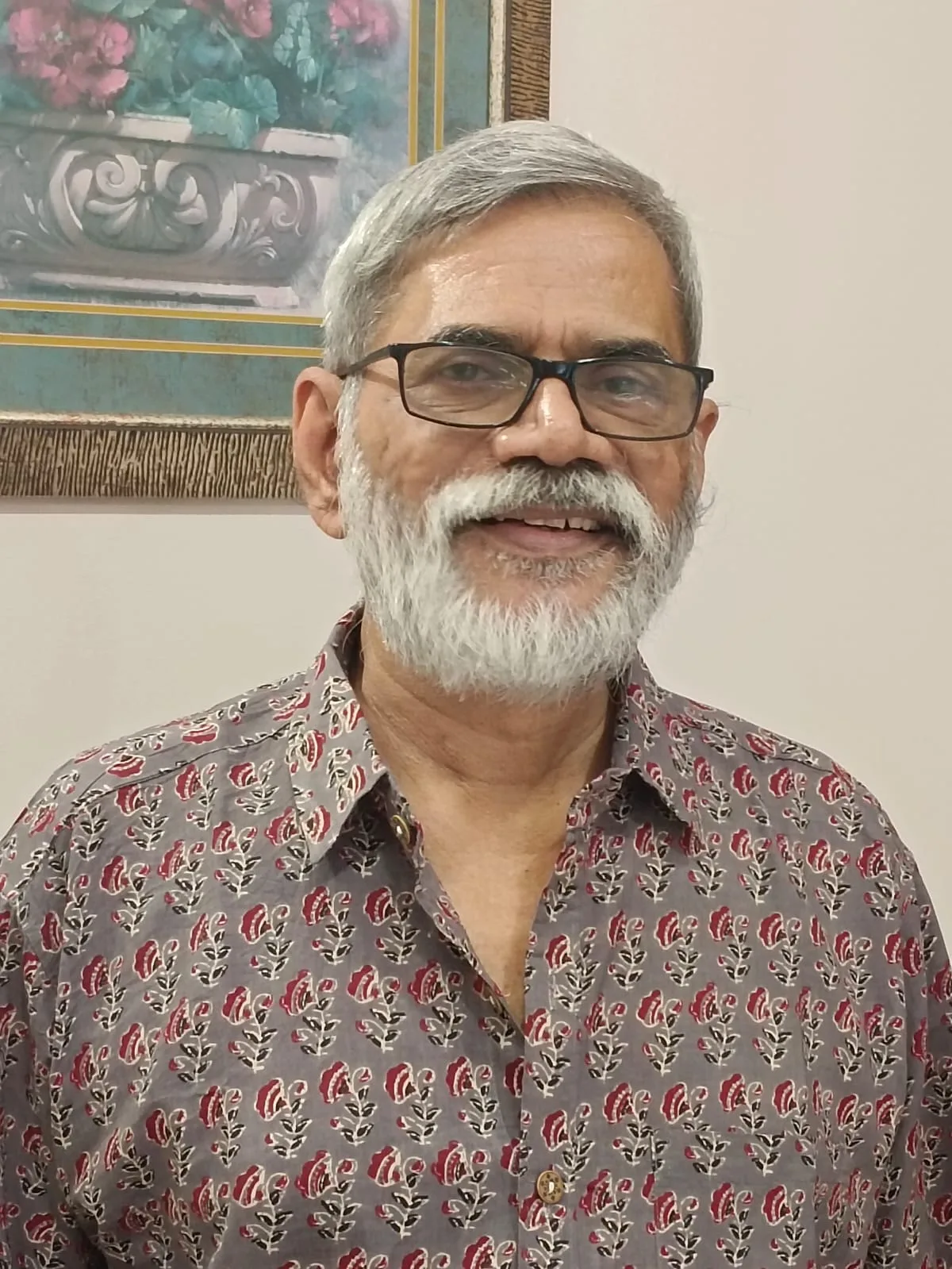
He earned his PhD in History from JNU in 2005. His research focused on an inquiry into narratives of power and identity in Kerala, based on the historical novels of C. V. Raman Pillai. He retired in 2011 while serving as the Head of the Department of History at Sree Kerala Varma College, Thrissur.He has written numerous papers and essays in both English and Malayalam in the fields of literary criticism, cultural studies, intellectual history, and philosophy. His book Gurunērangaḷ, published in July 2025 (Freelance Books, Thrissur), rethinks the Kerala Renaissance and the poetry and philosophy of Narayana Guru through a novel meta-historical perspective.