
Environmental woes and the role of Indigenous knowledges
In this deeply reflective essay, Natasha Tassell-Matamua explores the urgent need to reimagine humanity’s relationship with the natural world. Drawing on Indigenous worldviews, she contrasts the Western notion of “sustainability” with an Indigenous ethic of care, reciprocity, and kinship with the Earth. At a time when ecological collapse looms large, she argues that embracing Indigenous knowledge systems may offer humanity its most profound opportunity for renewal and balance.
10 Minutes Read
Our environmental legacy
Substantial and immediate human behavioural changes are necessary to address the environmental crises faced by the global community. Yet, arguments about whether we should make changes and how we begin to make such changes, continue. I’m not going to discuss if climate change is real or not. I think that argument or debate or opinion detracts away from the fact that, as a collective of sentient beings on this earth, we are influencing the natural world in ways that we have not done so before in human history (at least as far as we know), and as a consequence, we face some serious environmental woes.
For example, greenhouse gas emissions are contributing to global increases in land and sea temperatures, and we, the human species, through a variety of activities and consumerist behaviours, are by far the largest contributors to those emissions. While forests still cover about 30 % of the world’s land area (really? Only 30 %!!), in the 16 years between 1990 and 2016, we, the human species, managed to chop down enough trees to fill an area larger than the size of South Africa. We, the human species, have contributed to a 73 % decline in monitored species populations, and that’s just in the last 50 years. Many species are going extinct at a rate that is roughly 1,000 to 10,000 times what would occur naturally without human intervention.
Indeed, there is little disagreement among the scientific community that humans are driving unprecedented ecological change. I’m sure many of you are not naïve to details of these environmental changes – that have come about almost entirely through our own (i.e., human) behaviour. While it might look like we have crossed the point of no return, and indeed some are adamant that we have, there are others who believe that while we are indeed on the precipice, there is still hope if we act now.
Consequently, environmental discourse and action is now moving toward greater acknowledgement of Indigenous peoples and their role in the preservation of ecosystems. While Indigenous peoples comprise only 5 % of the world’s population and despite their long histories of colonisation and land dispossession, they manage or hold tenure over a quarter of the world’s land surface, support a substantial amount of global biodiversity – that is, the variety and variability of life on earth – and do so effectively. I think it is fair to say that this is by no means insignificant. And, this effectiveness means that, in our time of environmental dire straits, Indigenous knowledges have become a much sought-after commodity for those who are environmentally minded.
Indigenous knowledges
Indigenous knowledges might be defined as a cumulative body of knowledges, practices and beliefs evolving through adaptive processes and handed down across generations by cultural transmission, about the relationship of living beings (including humans) with one another and with their environment. To unpack that definition further, Indigenous knowledges are empirically based wisdom that have and continue to inform behaviours and practices that enable Indigenous peoples, where they are able, to sustain their immediate environments in non-exploitative and non-damaging ways, ensuring a natural equilibrium is maintained for generations to come.
This body of knowledge that informs these sustainable practices, is itself informed by worldviews that acknowledge the inherent interconnectedness of all material and non-material things, across time, place and space, including of course humans and the wider ecosystem that we dwell within. As noted by Tu’itahi and colleagues [7, p. 75]: Core features of Indigenous worldviews are the interactive relationship between spiritual and material realms, intergenerational and collective orientations, that Mother Earth is a living being – a “person” with whom we have special relationships that are a foundation for identity, and the interconnectedness and interdependence between all that exists, which locates humanity as part of Mother Earth’s ecosystems alongside our relations in the natural world.
As an example, the cultural beliefs, values and practices of the Indigenous Māori of Aotearoa New Zealand are intimately connected to te taiao – the natural environment. Everything in nature is believed to have descended from Papatūānuku, the great Earth Mother. All beings, animals, insects, birds, fungi, plants, rocks, mountains, rivers, fish, the ocean, among others, are treated as living entities who are the children of Papatūānuku, herself a child of the universe. Notably, humans are considered as the youngest sibling in the hierarchy of creation. All other entities were manifested into existence before humans, and as such, we are reliant as a species on the nurturance of such entities for our very survival.
Metaphysically, all things have a singular spiritual origin, that descends back to the creation of the universe. Physically, everything is in one way or other bound to everything else, which means that all beings, human and non-human, exist in a state of ongoing inter-relativity with each other. What happens to one, ultimately affects all others. This perspective or belief or system of thought is inherent in, for example, whakataukī or proverbs specific to the Indigenous Māori of Aotearoa, such as the following: “Mai i kāhui maunga ki Tangaroa. Ko au te awa, ko te awa ko au”, which translates to “The river flows from the mountain to the sea. I am the river and the river is me.”
The essence of this inter-relativity stems from one of the most important ontological assumptions inherent to the psyche of Indigenous Māori, which is known as whakapapa. While often referred to as genealogy, whakapapa translates as the ‘layers of descent from one point to another,’ and denotes a system of organization that binds all living beings together through a common lineage. What this highlights, I believe, is that if you inherently endorse the inter-relativity of the past, present and future; the inter-relativity of yourself with the wider ecosystem; and, notably you acknowledge your reliance on the wider ecosystem for your own wellbeing and survival; then this must create a sense of responsibility and obligation to care for and protect and respect that ecosystem as if you were caring for and protecting and respecting your own mother, or child, or grandparent.
Focus on care
This notion of care is at the forefront of the Indigenous psyche when it comes to the natural world. By this I mean that actions, behaviours, and practices as they relate to the environment are guided by an agenda of care, as opposed to one of sustainability. The term sustainability has connotations of non-changeability, of permanence, and when used in relation to the environment it implies a one-directional relationship; that is, humans are the arbiters of ensuring that the natural world is sustained, and that we hold domain over the natural world and have the power and the control to ensure that the environment remains unchanged and permanent (or not).
Indigenous peoples recognise that permanence of anything is an illusion, as is the idea that humans hold dominion over the natural world. The natural world remains, in spite of us. An Indigenous Māori proverb reflects this idea: Whatungarongaro te tangata, toitū te whenua, meaning “As man disappears, the land remains.” Everything in the universe is in a constant state of flux, of ebb and flow. The universe exists in cycles, and this is reflected in the natural world. Therefore, the concept of sustainability being the human-made power to maintain a permanent state of anything, becomes irrelevant.
This does not mean that Indigenous peoples do not see the relevance of looking after the natural world. Of course, we do. But instead of the notion of sustainability, the idea of care is what guides actions oriented toward the environment. And, this care, as previously noted, is about honouring the environment as if it is a relative that one is inextricably linked to through genealogy. This care is about recognising the reciprocal relationship that exists between humans and the natural world. This care involves the very awareness that everything has a place and is part of the symbiotic web of connection that transcends spatial and temporal boundaries. This care is about recognising that those who come after us will inherit the consequences of our actions.
In te reo Māori (the Māori language), the word tiaki is used when referencing ideas of care, safeguarding, and nurturing. Recently, tiaki has been increasingly applied to environmental policy and resource management, conceptualised by the term kaitiakitanga. Kai is a prefix that when applied to tiaki means ‘caretaker, guardian, conservator, or trustee.’ Consequently, kaitiakitanga literally means the circumstance of watching or guarding (Williams, as cited by3), preserving, fostering, protecting, and sheltering. Yet to view the term as simply meaning ‘guardianship’ or ‘stewardship’ is an oversimplification and misinterpretation, because such English terms do not reflect the values that underpin kaitiakitanga. Such values include notions of protection and preservation, but also extend to aroha (love), awhi (support), and manaaki (acknowledging and uplifting another’s spirit), among others.
The enactment of kaitiakitanga then manifests in many ways, such as in the gentle and intentional utterance of gratitude that you give to the kūmara (sweet potato) you harvest from your own garden, knowing it will be sustaining your family, and honouring that gratitude by returning nutrients in the form of the skin that is peeled off the kūmara, back to the soil in your garden.
Kaitiakitanga might manifest as putting back the small fish that you caught in the river, knowing that the small fish must grow into its reproductive prime, so that there can continue to be fish into the future, while also knowing that the small fish is part of a much wider ecosystem that exists beyond your own food needs.
Kaitiakitanga might manifest through planting native trees in your backyard to provide shade from the summer sun, while also knowing that the bees pollinate the flowers of those trees that then turn into berries, which are then eaten by native birds, and that the native birds are a necessary part of a connected system as they spread the seeds from the fruit of those trees so that more trees can grow and the cycle can perpetuate.
While these actions are perhaps stereotypical and generalised examples, inherent to them all is a deep understanding and acknowledgement that we are part of an intricate web whereby all beings, human and non-human, are connected across time, place, and space. Therefore, one cannot be a guardian or steward and enact care without recognising that one is, through the web of interconnection, also the recipient of guardianship and stewardship and care from the natural environment. Although I would like to think that this way of thinking is not unique to Indigenous peoples, it most certainty epitomises the ontology that informs Indigenous knowledges, and it is what makes Indigenous peoples so successful at enacting care of the natural world.
Conclusion
In 2020, I gave a keynote address at the annual conference of the New Zealand Psychological Society. The initial impetus for writing my keynote address was one catalysed by the ponderings of a person locked down, being deeply reflective. Five years on, little has changed. The environment continues to deteriorate at an unprecedented rate and in unprecedented ways, and still, we continue on, at least in the Western world, discussing it, but not necessarily acting with urgency to change the situation in any meaningful way.
Governments have power to effect immediate change. They have power to make us conform. Covid lockdown was evidence of this, and also evidence of the fact that, by and large, we can and do conform. Without going into the underlying drivers of that conformity, lockdown suggested to me at least that, even if we don’t have the inclination, we do have the capacity to immediately alter our behaviours and our way of life and living on the directives of authorities.
However, the enduring and obvious threat of environmental catastrophe has failed to move us in the same immediate way. Global environmental woes don’t seem to have quite the same pull power as a global pandemic or the same pull power as that of wars, when it comes to authorities making meaningful directives, or to humans making enduring and beneficial behavioural changes. Perhaps the environment, due to its inherently reciprocal, nurturing and caring nature, just does not incite the same existential fears in us as pandemics and wars do.
What then will it take before we look upon the environment with the same urgency as we give to other global threats, and with the same care and consideration that we might bestow upon a relative? It seems that what is required is an ontological shift in the way that we view the environment, but also in how we view ourselves. Perhaps the elevation of Indigenous knowledges into the very psyche of the global populace, might be a necessary part of that shift. Five years on from my initial keynote address, I hope this piece might play some role in doing that.
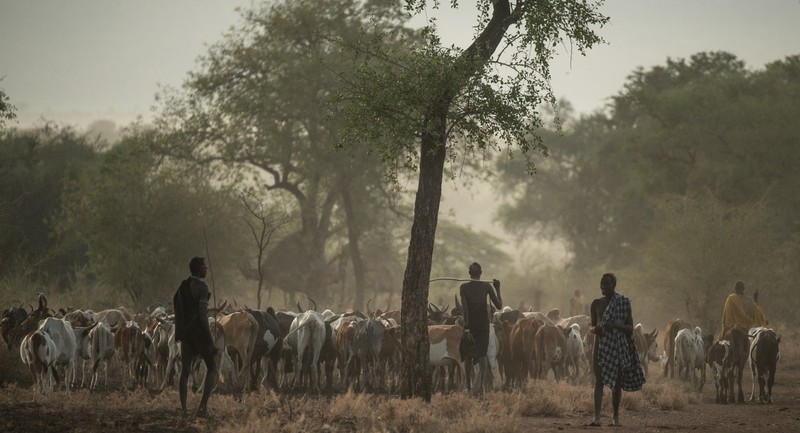
Featured Image: Indigenous people and cattle in the Omo valley, Ethiopia. Image © Markus Mauthe / Greenpeace.
References
1 Amnesty International
Indigenous peoples’ rights
https://www.amnesty.org/en/what-we-do/indigenous-peoples/ (2024)
2 S.T. Garnett, N.D. Burgess, J.E. Fa, A. Fernandez-Llamazares, Z. Molnar, C.J. Robinson, J.E.M. Watson, K.K. Zander, B. Austin, E.S. Brondizio, N.F. Collier, T. Duncan, E. Ellis, H. Geyle, M.V. Jackson, H. Jonas, P. Malmer, B. McGowan, A. Sivongxay, I. Leiper
A spatial overview of the global importance of indigenous lands for conservation
Nat Sustain, 1 (2018), pp. 369-374, 10.1038/s41893-018-0100-6
View at publisherView in ScopusGoogle Scholar
3 M. Kawharu
Kaitiakitanga: a Maori anthropological perspective of the Maori socio-environmental ethic of resource management
4 J Polynesian Soc, 109 (4) (2000), pp. 349-370
M. Marsden, T.A. Henare
Kaitiakitanga: a definitive introduction into the holistic worldview of the Māori
T.A.C. Royal (Ed.), The Woven universe: Selected Writings of Rev. Māori Marsden, Estate of Rev. Māori Marsden (2003), pp. 54-72
5 E. Mchale
What is ecocide?
https://www.kew.org/read-and-watch/what-is-ecocide (2020)
6.Ministry for the Environment & Stats NZ (2023). New Zealand’s environmental reporting series: our atmosphere and climate 2023. Retrieved from environment.govt.nz.
7. S. Tu’tahi, H. Watson, R. Egan, M.W. Parkes, T. Hancock
Waiora: the importance of indigenous worldviews and spirituality to inspire and inform planetary health promotion in the anthropocene
Glob Health Promot, 28 (4) (2021), pp. 73-82, 10.1177/17579759211062261
8 WWF
The Living World Report 2024 – A system in Peril
WWF (2024)
Gland, Switzerland
Courtesy: www.sciencedirect.com

Natasha Tassell-Matamua, PhD is an Associate Professor in the School of Psychology at Massey University and founding Director of the Centre for Indigenous Psychologies. She is of Indigenous Māori, Cook Islands and European descent. Her research focusses on the very specialized area of near-death and other exceptional experiences of consciousness. She investigates and writes about the implications of such experiences for enhancing understandings about the nature of consciousness, as well as their interface with spirituality and Indigenous knowledges. Natasha is an Associate Editor for EXPLORE and the journal Psychology of Consciousness. She is an Advisory Board member for the International Association of Near-Death Studies, and Board member of the Academy for the Advancement of Postmaterialist Science.