
Arunachal Pradesh: Indigenous Communities Resist Siang Mega Dam Project Amid Police Crackdown
Indigenous communities in Arunachal Pradesh are intensifying their resistance to the proposed 11,500 MW Siang Upper Multipurpose Project, citing threats to their ancestral lands, river systems, livelihoods and cultural heritage. Amid allegations of police brutality, arrests and restrictions on peaceful protests, a press conference organised by Youth for Himalaya brought together community representatives, activists and journalists to highlight the escalating situation in the Siang Valley and call for solidarity across the Himalayan region.
Youth for Himalaya organised an online press conference on Monday, bringing together voices from Arunachal Pradesh and across the Himalayan region to draw attention to the escalating situation in the Siang Valley, where communities are resisting the proposed 11,500 MW Siang Upper Multipurpose Project (SUMP).
The proposed mega hydropower project has raised serious concerns among Indigenous communities about the future of their ancestral lands, river systems, livelihoods, cultural heritage and territorial rights. For communities in the Siang region, the project represents more than an infrastructure proposal: it is a decision with far-reaching implications for their ability to determine their own future.
Events on 23 October 2026, including what community members described as police brutality, arrests and the detention of young activists under the Arunachal Pradesh Unlawful Activities (Prevention) Act, 2014 (APUAPA), for raising their voices against the project, have brought questions of democratic rights, freedom of expression and the right to peaceful protest into sharp focus.
These events have also raised concerns about the safety and security of residents participating in the movement. Community members continue to express concern about the situation on the ground, the well-being of those affected by alleged police excesses, and people’s ability to exercise their right to peaceful protest.
Resistance to the proposed project has a history spanning nearly four decades, with opposition among local communities growing steadily over the years. Despite changes in government, the tribal communities whose ancestral lands are earmarked for the dam have consistently maintained their opposition. Of the several tribal communities living in the region, the Adis are the largest and share a profound cultural and historical bond with the river. They refer to it as Aane Siang, meaning Mother Siang. For generations, these communities have built their lives around the river and its surrounding forests and landscapes. Their cultural practices, spiritual traditions, religious beliefs and agricultural systems are closely tied to the Siang and the ecosystems it sustains.
Community members from the Siang Valley, including Tagori Mize, spokesperson for the Siang Indigenous Farmers’ Forum (SIFF), and Dubit Siram, general secretary of the SIFF Youth Wing, shared their accounts.
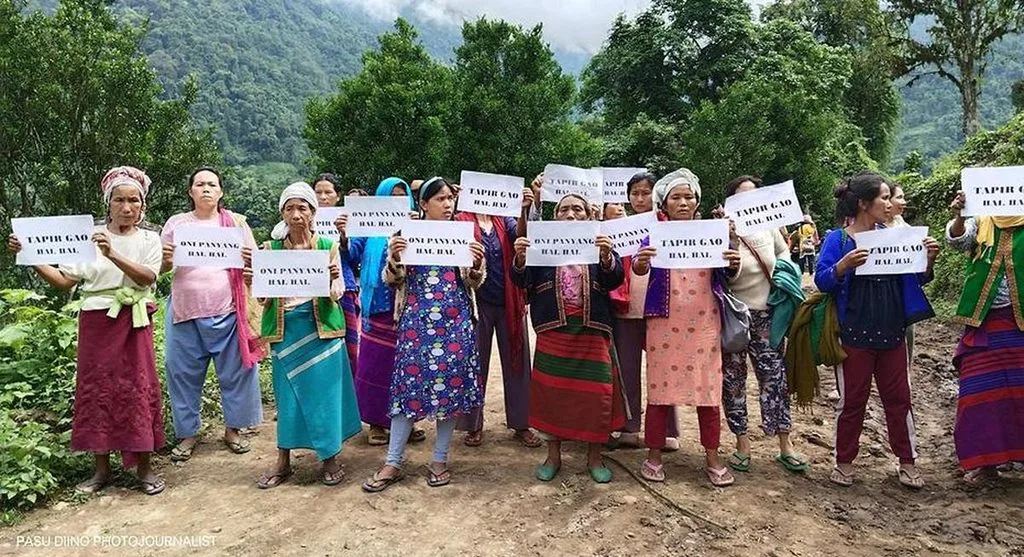
Tagori Mize said that community members and individual landowners had never been informed or consulted about the proposed dam project. Instead, he alleged, unlawful means were being used to manufacture majority consent, with signatures obtained by misleading people. He also pointed to a deep lack of trust arising from the absence of credible information about the project. Despite several meetings with government representatives to raise their concerns, he said, no meaningful effort had been made to address their apprehensions or take the community into confidence.
He also questioned the repeated invocation of national security, asserting that the people of the region are equally part of the nation. “Our forefathers protected this land against the British. We are proud Indians, yet we are being treated as though we do not belong to this country.”
Dubit Siram said that the law was being applied differently to company and government representatives than to ordinary people. “There seems to be one set of rules for those in power and another for the common people. Nine Gao Burahs have been either terminated or suspended in Siang district for their opposition to the dam. Government officials are being intimidated with notices to support the dam.”
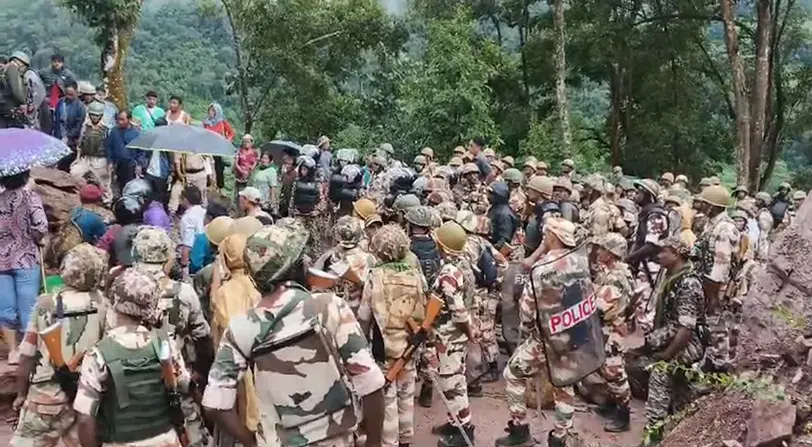
Siram also said that more than 3,000 paramilitary personnel had been deployed across three Adi districts: East Siang, Siang and Upper Siang. He added that the Rapid Action Force (RAF) had been airlifted to Pasighat following the protest there on 23 October.
Asked about the current situation and community safety, Siram said: “The region is in the middle of its harvest season, yet people’s movement is being severely restricted. Even farmers are not allowed to travel in groups to their fields, disrupting their ability to carry out essential agricultural activities.”
The tense situation has also begun to affect residents’ everyday lives and mobility in the valley. Siram described the experience of an elderly woman:
“An elderly woman, aged over 60, was on her way to her fields when she was caught in a lathi charge. She had no involvement in or knowledge of the ongoing protests. As she attempted to escape, security personnel struck her with a stone and strangled her with her scarf, leaving her with two fractured ribs. When she tried to seek help, her phone was smashed and its battery removed. She was subsequently taken into judicial custody and detained overnight, despite her injuries. The fractures were later confirmed through an X-ray.”
“In villages across Upper Siang district, particularly in the Geku area, one individual has been slapped with more than 19 FIRs, while FIRs have also been filed against many other people,” Siram said.
Siram also expressed concern about what he described as a growing campaign against individuals from the region. Bhanu Tatak, a lawyer and researcher who is also SIFF’s legal adviser, has repeatedly been subjected to what Siram characterised as media trials. He said this was part of a wider attempt to vilify citizens who raise concerns and question the project.
The press conference also criticised media coverage of the CBI case concerning alleged FCRA violations involving Bhanu Tatak. The speakers argued that, rather than reporting the specific allegations in the FIR—which they described as non-compliance with registration requirements and income-tax filing obligations—some media outlets had portrayed the protests as foreign-funded. They said this coverage undermined the sentiments of local people.
According to a report by Bengia Ajum in The Arunachal Times, NHPC, the proponent of the dam, reportedly spent ₹10.9 crore on media outreach involving several national media outlets and digital influencers.
Tongam Rina, deputy editor of The Arunachal Times, was unable to attend the online press conference but sent a statement expressing her concerns.
“The government need not force the people to choose violence, but that is exactly what it wants in order to fully utilise its violent force to gain entry into their villages and the river. As an activist and reporter who has documented the people’s struggle for years, I know Siang has demonstrated that the state’s forceful militarisation will be met with resistance. Siang isn’t just a river; it is the identity of the entire Indigenous Adi community,” Rina wrote.
At the heart of the resistance to SUMP lies the relationship between the Siang River and the communities that have lived alongside it for generations. The river is inseparable from their cultural practices, livelihoods, ancestral territories, collective memory and understanding of the natural world. The proposed project raises concern about the possible displacement of communities, the submergence of ancestral lands, ecological changes and the long-term consequences for future generations. For residents, the question is not simply one of infrastructure development, but of who gets to decide the future of their river and their homeland.
The press conference concluded with a collective call for the immediate release of all those arrested, the withdrawal of FIRs filed against members of the people’s movement, and the demilitarisation of the region.
The speakers also urged the government to initiate a genuine dialogue with affected communities, ensuring that their concerns, rights and voices are meaningfully included in decisions concerning their land, rivers and future.
A call for solidarity across the Himalayas
Developments in the Siang Valley reflect the wider challenges confronting communities across the Himalayan region, where large hydropower and infrastructure projects continue to raise critical questions about displacement, ecological security, community rights and democratic participation.
The Himalayas have long been viewed as a frontier for strategic and developmental expansion, often at the expense of their ecological fragility and the communities that inhabit them.
Yet the region’s vulnerability demands a more cautious approach to infrastructure development. The devastating floods in Nepal and the glacial lake outburst flood (GLOF) in Sikkim’s Teesta basin offer important lessons about the risks associated with poorly planned infrastructure and development in fragile mountain ecosystems.
These experiences underscore the need for greater scrutiny of large-scale projects, particularly their cumulative impacts on mountain landscapes, ecosystems and communities.
The experiences of people in Arunachal Pradesh deserve to be heard beyond the region. Communities across the Himalayas share interconnected rivers and ecosystems, as well as concerns about the future of their lands and livelihoods.
Source note: This report is based on information and statements shared during an online press conference organised by Youth for Himalaya.
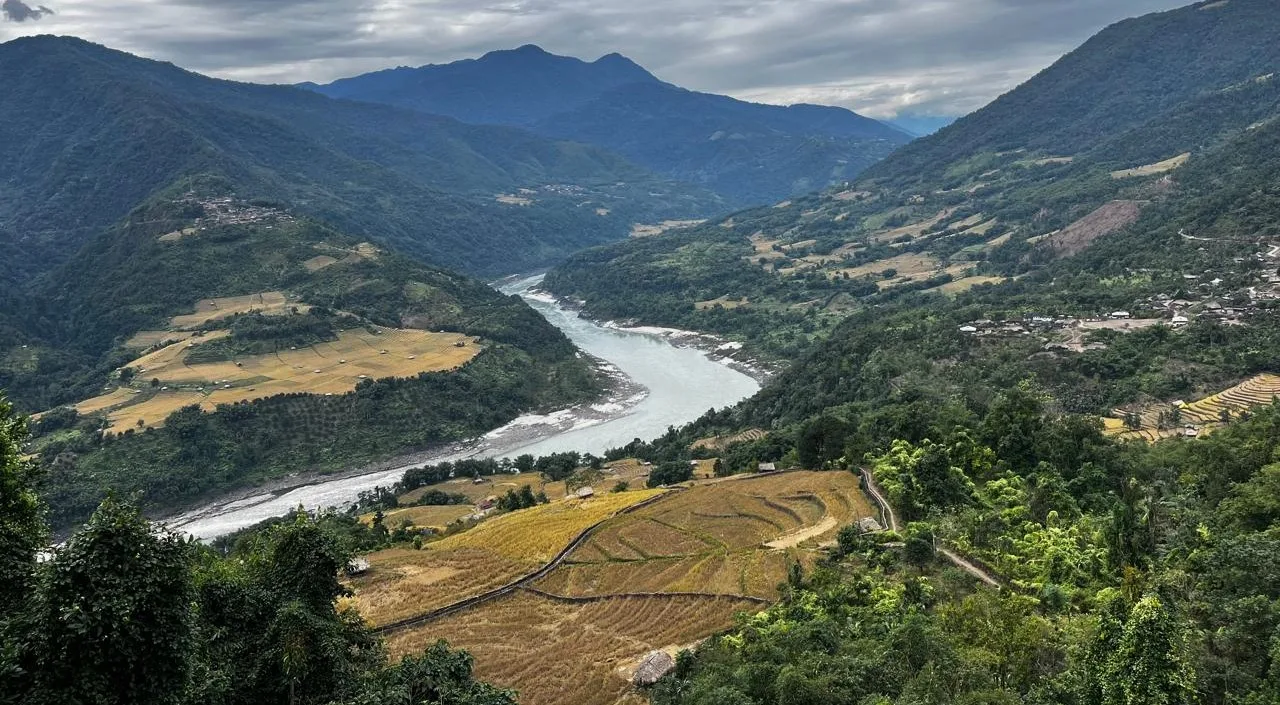
Featured Image:The Siang Valley, Courtesy:eastmojo.com

Panthi Desk is the editorial team of Panthi.in, producing and editing articles, explainers and summaries on issues of social justice, democracy, ecology and economic systems.