
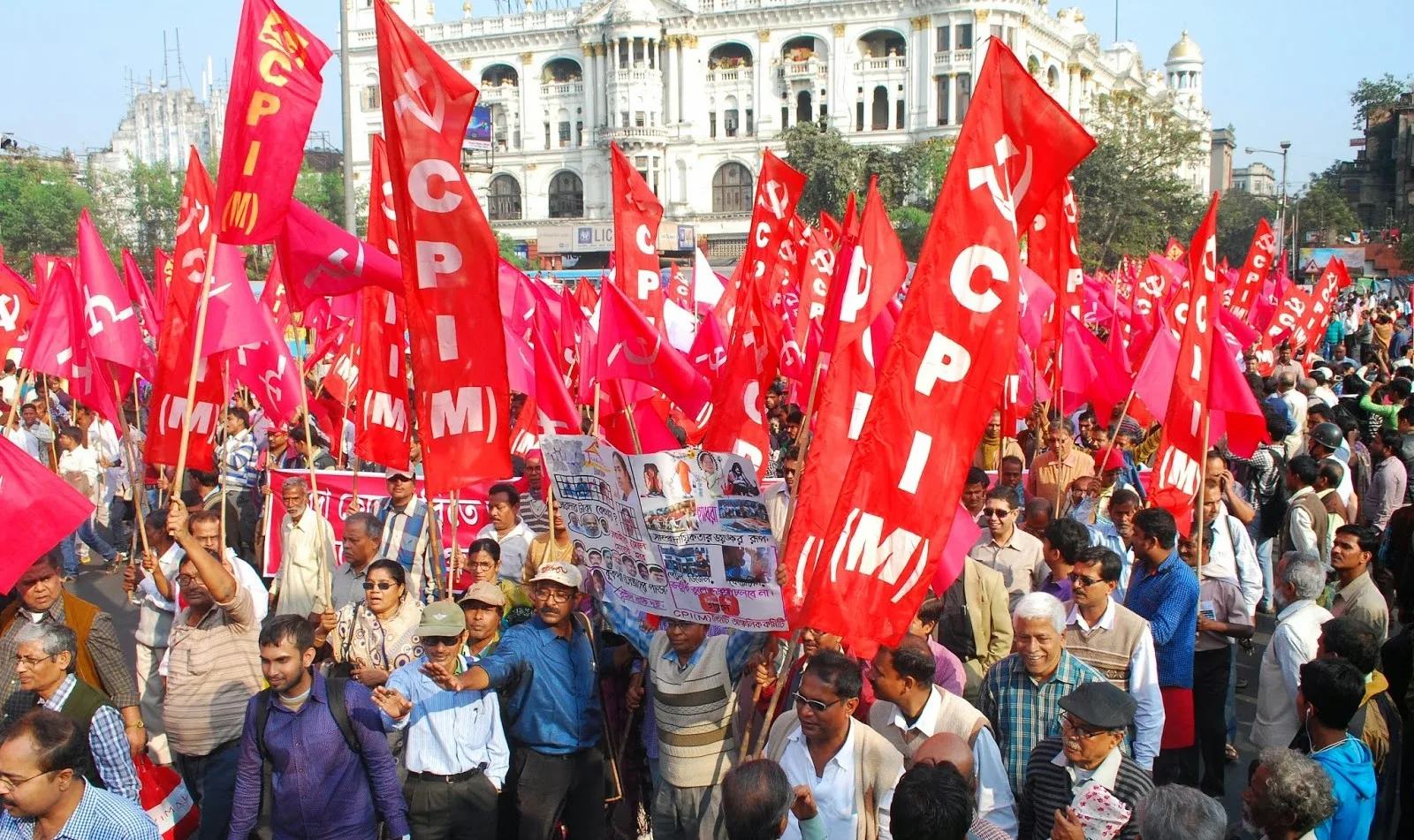
Soft Hindutva’ Is Not Realism, It’s Surrender: Economist Arun Kumar on CPI(M)’s Kerala Crisis
Retired JNU economics professor Arun Kumar argues that the CPI(M)’s apparent ideological shift in Kerala is not merely an electoral tactic but the outcome of decades of global and national political changes. In this interview with Abhish K. Bose, he examines the decline of communist movements, the rise of majoritarian politics, and why embracing “soft Hindutva” weakens the Left instead of strengthening it. He also discusses Kerala’s changing social landscape, migration, electoral compulsions, and the future of Left politics in India.
The CPI(M) — the torchbearer of Left politics in Kerala — appears to be undergoing a tangible transformation in both ideology and practice. From its tacit acceptance of privatization in education, to organizing the AyyappaSangamam in what many see as an overture to the majority community, to its conspicuous silence over the SNDP Yogam general secretary’s vitriolic remarks against Muslims, the party seems to be executing a decisive rightward pivot.This ideological somersault is unprecedented in the party’s history, both in Kerala and nationally. How would you explain these overtures by the Kerala Left, at a time when its political space is shrinking across India? Is this pragmatic adaptation to survive electorally in a changing social landscape, a calculated realignment with majoritarian sentiment, or evidence of a deeper ideological exhaustion within the party?
There are several factors working simultaneously at present which are leading to a rightward drift. These are local, national and global.
Since the mid-1970s, globally there has been a rightward drift in social, political and economic spectrum globally and nationally. This has been slowly working itself out in the Communist parties for the last 50 years. Communist and socialist parties have disappeared in Europe. They have weakened considerably in much of the developing world, including India. Only pockets have survived.
Capitalism has managed to ward off the ideological pressures it faced in the post Second World War period. So, now it has become a challenge for the communists how much ideological purity can they maintain in economic, political and social terms.The decline of the Soviets and 180 degree turn of China led to the decline of communist and socialist ideology globally. It presented a picture of TINA (There is no Alternative), a term coined by Mrs. Thatcher in 1978, to the world. The collapse of the Soviet bloc in 1991 put the nail in the coffin. China is doing well and has become a superpower but it is an example of state capitalism and not of ‘Socialism with a difference’, as the Chinese try to present themselves.
Indian communists did not develop an independent path towards communism and remained followers of either the Soviet or the Chinese communist parties. As these parties weakened, the Indian Communist parties also weakened and could not work with the masses with ideological clarity.
Trotsky had said that it is not possible to have communism in one nation alone. And, especially in the most backward capitalist country, Russia. Lenin believed that in history a conjuncture has to be seized and transformation attempted. Mao in China attempted cultural revolution to ingrain ideology in day to day life but that did not succeed and led to massive disruption in the nation and discrediting of the idea of ideological purity.
In a capitalist nation if a state tries to apply communist ideas, it will not succeed because it cannot control policies and resources. There will be an assault on it from the capitalist forces surrounding it. It will come in the way of its development. Capital will flee to other states as has happened in India. Capital left West Bengal for Maharashtra and Gujarat due to labour militancy. The most industrialized state has become a backward and poor state over the last 70 years. Much of its industry became sick and closed down. Kerala also did not get any major industries due to militancy of labour. So, in spite of Kerala having the best socio-economic indicators of India, youth has to go outside for work. They have been migrating in large numbers to the Gulf or outside the State to Tamil Nadu, etc.
In a capitalist nation, electoral politics is one of power and money. And that brings with it corruption. That has also afflicted the communist parties and undermined their ideological purity. In the 1950s and 1960s money was coming from the Soviets and the Chinese which had weakened the communists’ grass roots movement. The communist parties weakened due to this loss of connect with the people as the leadership got selected from above and not below. There was theorizing but lack of connect with the people and their issues.
Increasingly the communist parties did not look very different from the mainstream political parties and thrived on parliamentary power politics. This weakened their ideological moorings and they became left of center. Their trade unions became economistic fighting for economic gains for their cadre rather than organizing the vast unorganized sector of the country.
There was also the splintering of the communist party into many factions because of the compromises being made by the leadership. The purists left the party to create a new faction. The leadership justified itself as having to work with the parliamentary system and competing for influence on the terms of the mainstream parties.
The Communist parties could not evolve an Indian alternative to the programmes of the mainstream parties. When they came to power in Kerala, W Bengal and Tripura, their programme was not very different than that being followed in other states of India. Yes there was the bargardar movement in W Bengal and land to the tiller. But then Singoor and Nandigram put paid to the CPI(M) rule and now a rightwing party has come to power.
Kerala, has been seeing anti-incumbancy with Left Front and the UDF coming to power one after the other. Why this lack of consolidation once the Left came to power? Left has not been able to present itself as a clear alternative around which people could be mobilized. So, the floating vote switches around rather than getting converted to increased vote for the Left.
The Left Front finds itself competing on the grounds that the others are creating. Like the BJP focusing on Hindutva and creating anti-Muslim sentiment.
CPI(M) built its hegemony in Kerala on land reforms, trade unions, and a secular mass base of minorities, Dalits, and Ezhavas. Does this rightward pivot risk hollowing out that historic coalition? When the party mirrors the social conservatism it once fought, what distinct political product is it offering the working class and oppressed castes?
Since Kerala has not been able to offer adequate work to its people, forcing them to migrate in large numbers from Kerala, the hold of the Left on the public has weakened in spite of the excellent social indicators. Those who migrate and their families who receive remittances tend to become more individualistic and identify less with the collective spirit. This undermines the Left thinking and reinforces marketization and the Right ideology. Social conservatism takes root and the Left is also forced to adjust its programme to the changed thinking. Its political platform also becomes economistic and it is unable to continue to mobilize the oppressed unorganized sector.
Nationally, the CPI(M) projects itself as the principal anti-BJP force defending constitutional secularism. In Kerala, it is seen organizing _Ayyappa Sangamam_ and soft-pedaling Hindutva-adjacent rhetoric. How does the party reconcile this contradiction? Is Kerala becoming a laboratory for a “Left-Hindutva” compact that the central leadership cannot publicly endorse but privately condones?
Under pressure from the Right, local and state level factors become crucial for mobilization of people who are increasingly influenced by the diversionary Hindutava philosophy. It may be called “Left-Hindutva” philosophy but represents a confusion in thinking. It may also be referred to as “soft Hindutva” which other non- BJP parties are also practicing to different extent. This is being referred to as “realism” but it keeps weakening the Left movements.
In 2018, the CPI(M) took a constitutionalist stand on Sabarimala and paid an electoral price in 2019. In 2026, it appears to be overcorrecting through symbolic appeasement. But if majoritarian consolidation is the BJP’s game, can the Left win by playing it? Does mimicking your opponent only legitimize their frame and accelerate the erosion of Kerala’s secular public sphere?
If the BJP sets the agenda and the Left follows in it then it will keep losing. If the Left is unable to mobilize the marginalized in society it will lose out when it allows the BJP to set the political and social agenda.

A journalist with 18 years of experience Abhish K Bose was a staffer at The Times of India and The Deccan Chronicle - Asian Age. As a contributor, his interviews and articles have been published in Frontline magazine, The Wire, The Print, The Telegraph, The Federal, The News Minute, Scroll, The Kochi Post, The Leaflet, The Hindu.com, Outlook.com Countercurrents.org and the Asian Lite international published out of London