
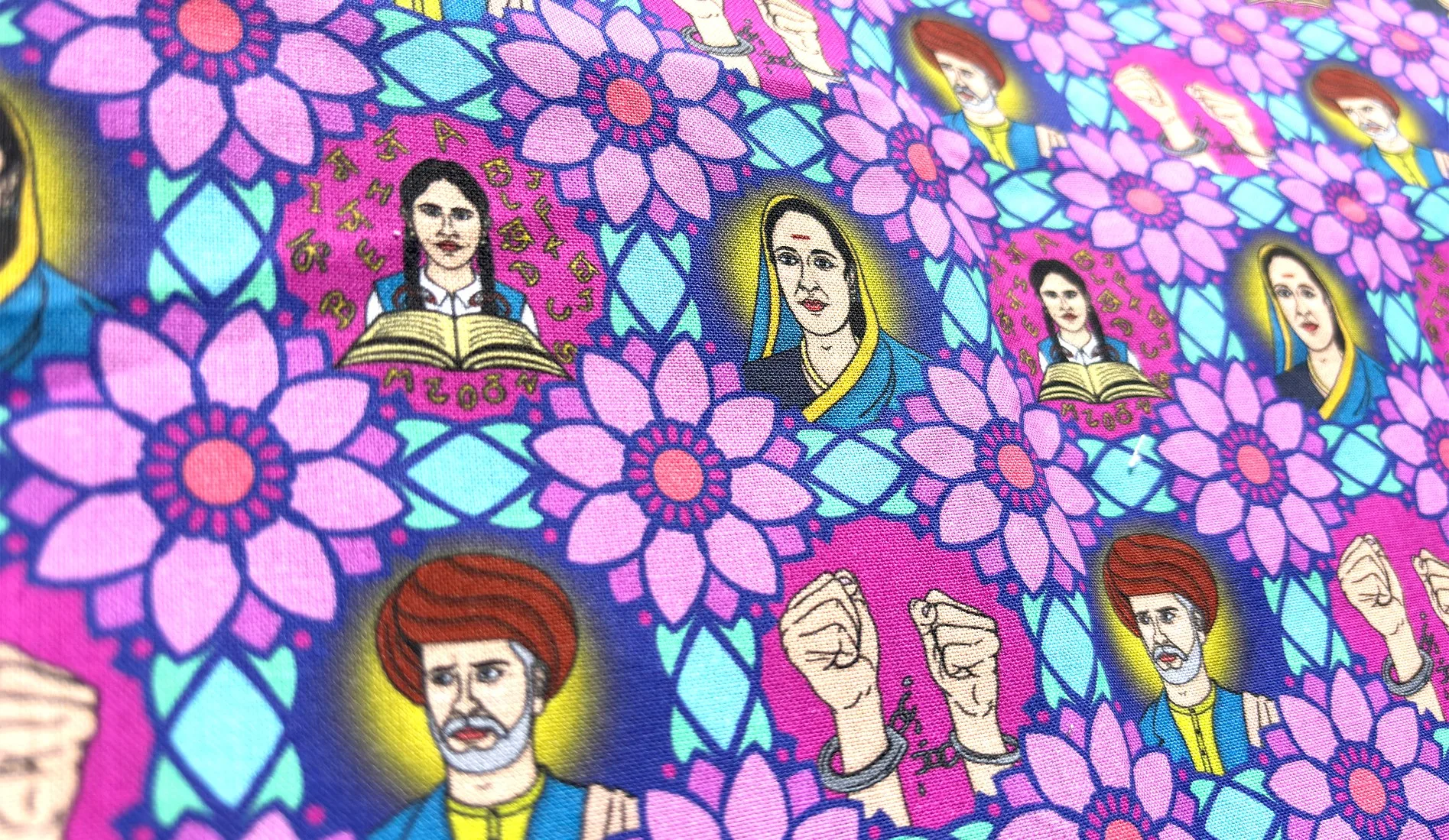
Aesthetics of Annihilation: Anti-Caste Design as Cultural Resistance
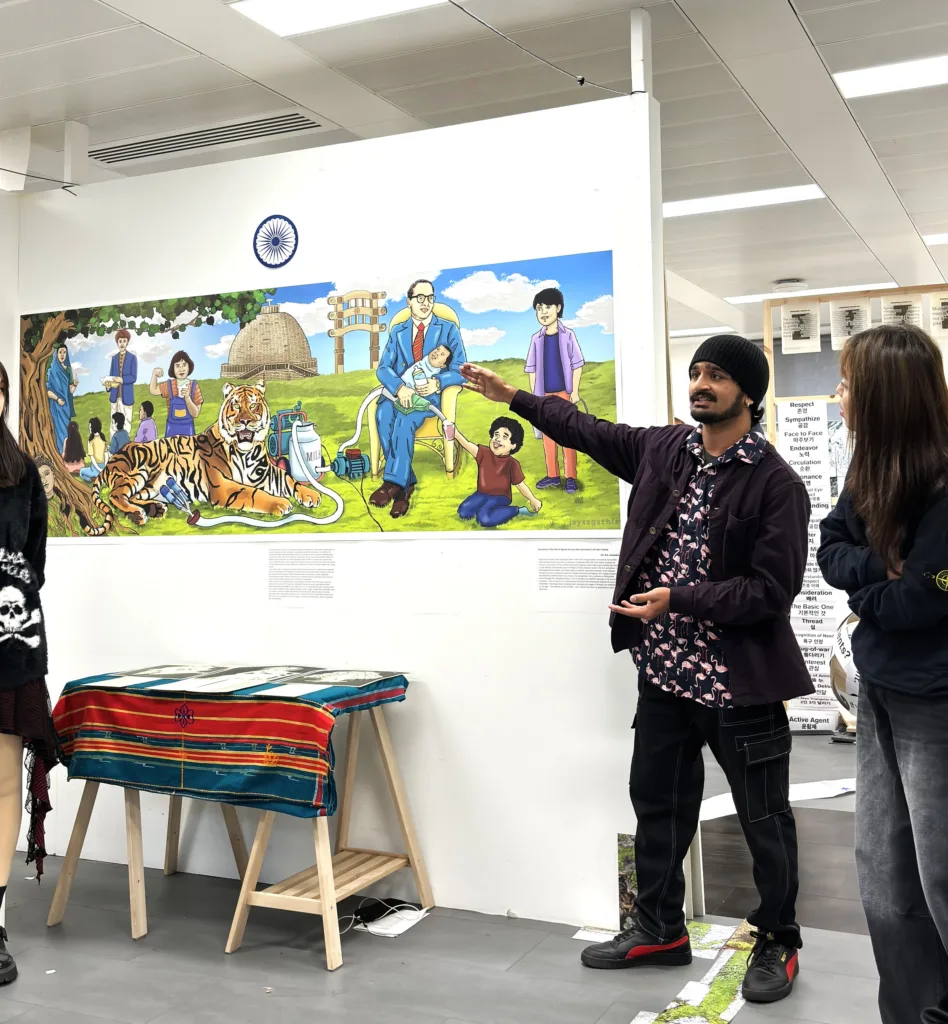
In a society where caste operates not only through institutions but also through everyday aesthetics-dress, taste, purity, and visibility-design becomes a deeply political act. In this conversation, Jay Sagathia, illustrator, communication designer, and anti-caste activist from Gujarat, reflects on how his lived experience as a Dalit and his Ambedkarite ideological grounding shape his creative practice. From reclaiming textiles as a site of assertion to challenging savarna dominance in art and fashion, Jay’s work reimagines visual culture as a space of resistance, dignity, and collective memory.
This interview explores how cloth becomes protest, how aesthetics become ideology, and how design can participate in the unfinished project of annihilating caste.
Jay Sagathia is an illustrator, communication designer, and anti-caste activist from Gujarat, India. In 2024, he earned his Master of Arts in Visual Communication from the Royal College of Art. Prior to that, he completed a Master’s in Visual Arts with a specialization in illustration from Maharaja Sayajirao University, Baroda, in 2022. He also holds a Bachelor of Design in Fashion Communication from the National Institute of Fashion Technology in Gandhinagar which he completed in 2020.
Jay’s work critiques the caste system and fosters global conversations on the issue. Through his illustrations, Jay aims to share insights into the caste system and celebrate the diverse cultures of marginalised communities. His art serves as a representation of the Dalit community and addresses the misrepresentations they often face in popular culture.
Can you tell us about your social and political journey? How did questions of caste enter your life and your creative practice?
I knew about the caste we belonged even before I started my primary school education. During 1st standard , I clearly remember there was a column in our attendance sheet mentioning every student’s caste. I was born and brought up in Rajkot city of Gujarat, one of the most regressive and caste obsessed city where according to the research 80% of the city still lives under caste segregation. Moreover, my extended family lived in village so during summer vacation I used to spend my time over at village. Since villages are the den of caste system as Dr. Ambedkar says I was well informed about the untouchability and dominant castes like Rajput and Patels live in the village.
Moreover my father, who was a railway employee, used to tag me along in BAMCEF rallies and SC/ST employee union meeting from very early on. Babasaheb Dr. B.R. Ambedkar’s photograph had been always accompanied by the picture of my late grandparents in the living room. Family atmosphere has always been very assertive therefore I was introduced to caste very early in my life.
Several incidence happened throughout the life from being told by agent that “we don’t sale house to harijans”, caste violence and eve teasing by Rajput men towards my cousins, a beggar puked out water offered by mother, reservations taunts from professor and students alike and innumerous other things that we have to face. When I was studying at National Institute of Fashion Technology Gandhinagar during 2017 I came across a video showing photographs of manual scavengers taken by Padma Shri Sudharak Olwe. It had a very deep impact on me and I tried to replicate one his photograph into ink drawing where a boy is fully drenched into a gutter. I shared this artwork online and got appreciated for it. I strongly felt that I found a purpose and proper way to utilise my skills. Later, I started participating in local protests and started creating work around theme of caste.
Which thinkers, movements, or lived struggles have most shaped your ideological framework?
Dr.B.R.Ambedkar is my prime source of inspiration and I have a very deep reverence towards him. Manyavar Kanshiram in his speech say, which I firmly believe, “Dr Ambedkar already applied a lot of brain and intellect so we don’t need to. We just need to follow whatever path he mentioned.”Jyotiba and Savitrimai Phule’s Satyashodhak movement, many saints of Bhakti movement and in the contemporary time Anti-Race movement especially by black intellectuals like Malcolm X and Martin Luther King Jr. has shaped my framework. Moreover, the teachings of Tathagat Buddha has helped me in understanding the complexities of life and how to deal with it. The constant struggle of being a Dalit in a Brahmanical society definitely shapes your thinking process, the connections you make, the spaces you share, the way you speak , I mean everything has been shaped according to the societal position I come from and It has shaped my ideology prominently. My position gives a new lens to the society which is normal for me but not for the others who are accustomed to Brahmanical point of view especially in arts and culture.
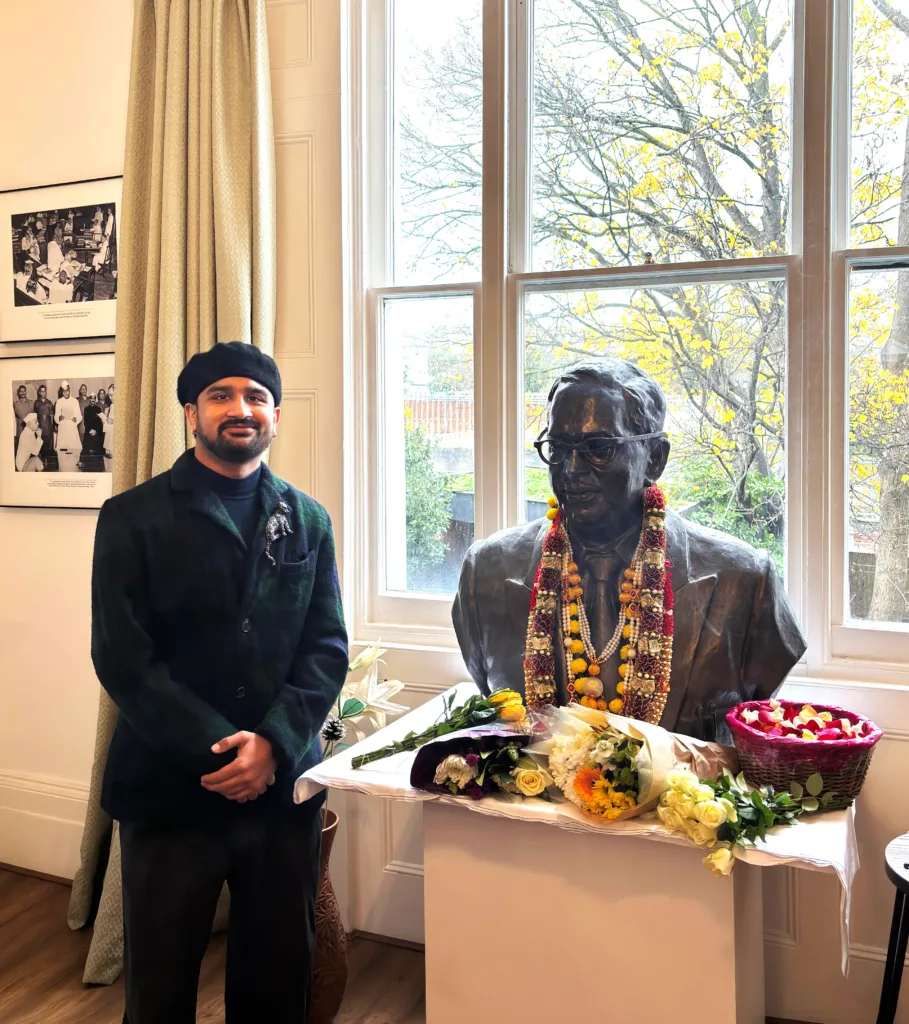
Your Anti-Caste Textile Design project uses clothing and fabric as a political medium. Why did you choose textiles rather than more conventional visual formats?
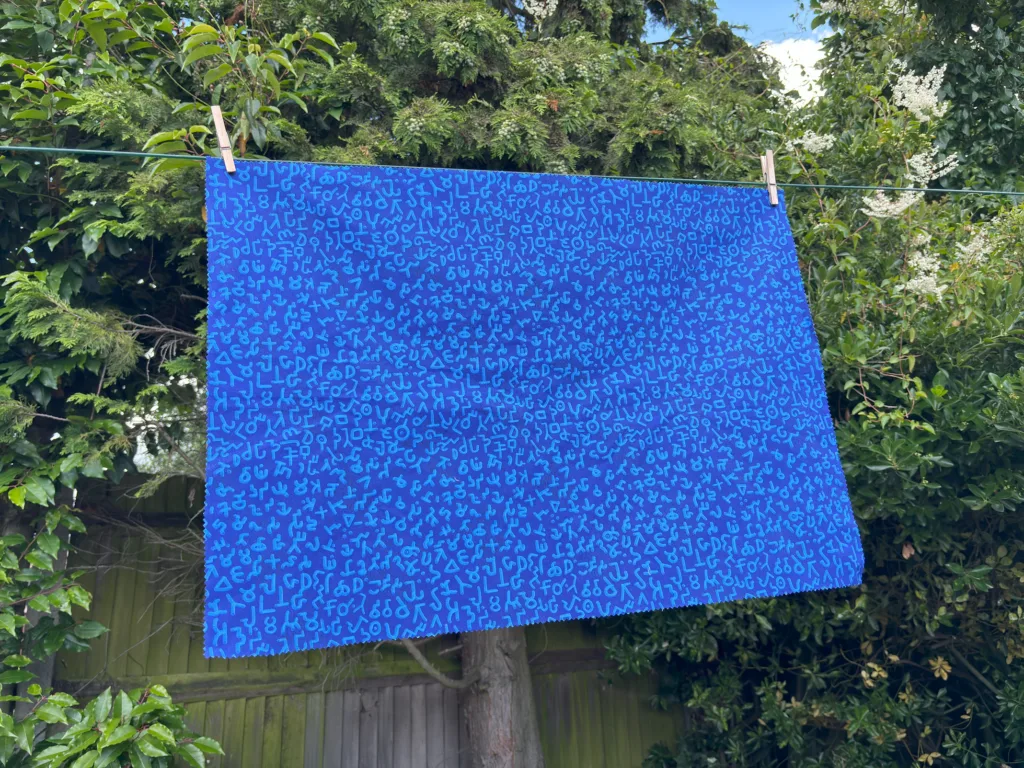
‘Roti-Kapda-Makaan’(Bread-Cloth-House) are the basic necessity of every human being. Textile has become very integral part of life for a modern human being. Moreover, In India, clothes have been used as caste markers since last 2000 year. There are mentions of strict dress codes in Hindu scriptures like Vedas and Manusmriti. Even today newspapers are filled with headlines where Dalits are being killed for wearing good clothes or sporting a moustache. Brahminical society cannot tolerate a dalit who wears stylish clothes. Their entire image of a Dalit being poor, shabby and wretched gets uprooted when a dalit person asserts through clothing.As I said Dr. Ambedkar is my prime source of inspiration. He was a stylish man of his time, very conscious about his sartorial choices – an iconic dandy. I studied at National institute of Fashion Technology majoring in Fashion Communication. Moreover, I come from a caste who is traditionally attached to weaving and embroidery. You see, I had so many reasons to choose textile as my medium.
How do you see design functioning as a form of resistance against caste?
What can design do that academic or activist language sometimes cannot? Design is a process of solving problems using creative interventions. Creativity has been at the core of a modern human life. Professionally and academically, the design practice has been dominated by the Savarna-Upper caste people and therefore it has been always been caste blind. Design has been always savarna-centric. Therefore, the practice of art and design of marginalised castes has always been appropriated by savarna designers. For instance, Upper caste Fashion designer shamelessly uses craft and art of Dalit/aadivasi artisans in the name of common Indian heritage. History says that once they were the only one who used to consider these practices impure but since in a neoliberal capitalism, they find ways to commodify the culture of marginalised without even addressing the social plight of them. They earn in millions but an artisan remains anonymous. Academia might have limitations to only stay on theories and activism only operates within NGOs but design deals with many basic life problems from creating products, creating services, critiquing visual culture etc and it has potential to be understood beyond languages and regions and has a strong potential of being a community participatory practice.
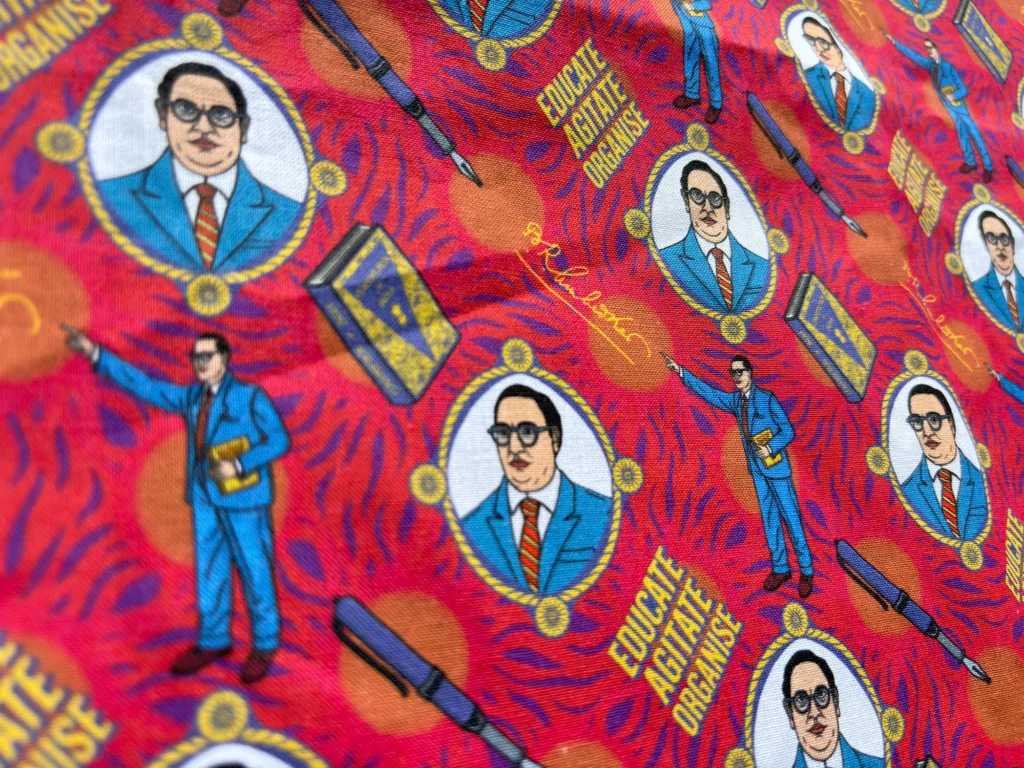
Many of your patterns foreground figures like Ambedkar, Savitribai Phule, and the Buddha. What do these icons mean to you personally and politically?
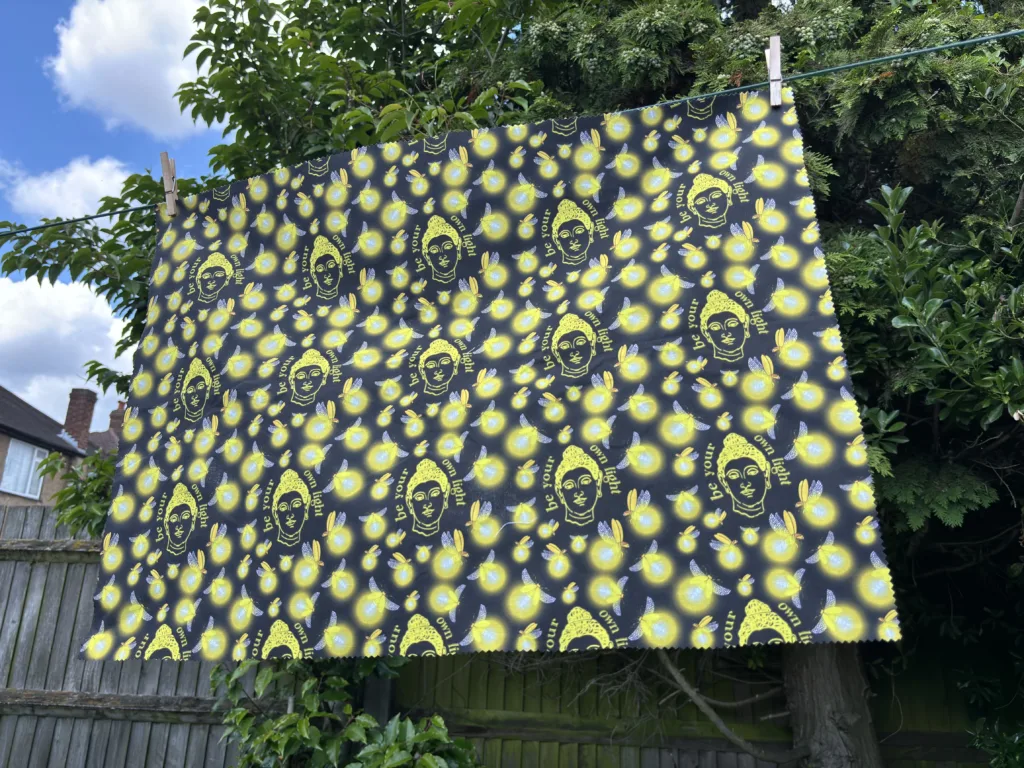
I am an Ambedkarite Buddhist. That’s the only ideology; I want to attach myself with. Dr Ambedkar was inspired by his predecessors Jotiba Phule and Savitrimai Phule, who paved the way for education of Dalits and women. Dr Ambedkar revived the Dhamma of Buddha and emancipated millions like me. These icons strongly inspire me and I only follow their path. As a designer and artist, I do my best to portray their ideals through creative way.
Caste operates not only through institutions but also through everyday aesthetics such as dress, taste, purity, and hierarchy. How does your work intervene in this everyday visual regime?
My work plays a role to assert our existence and thrive. Caste has always decided what to wear and what not to wear, those who go outside these artificial barriers have to face consequences. Many have died for merely sporting a moustache or wearing nice clothes or just keeping Dr Ambedkar’s ringtone. In such circumstances, even freely choosing to wear dignified clothes becomes a symbol of rebellion and freedom. Putting the icons on the garment makes it more powerful and it has potential to connect with everyone who has faced the same fate of caste – Pan India and even abroad. It is more about creating a culture.
How do you negotiate the tension between making your designs accessible and keeping their political sharpness intact?
My politics is about humanity and equality and I cannot dilute my political sharpness. I have experienced who believes in humanity and equality, my designs are always accessible to them.
Do you consciously think about who wears these textiles, where they are worn, and in what social spaces?
Yes of course. People who follow and consider themselves Ambedkarites are the ones who are going to adorn the apparels. Especially during the Ambedkarite Buddhist festivals like Ambedkar jayanti , Buddha poornima, Dhammacakra pravartan day etc. and also where they want to feel visible without drawing any negative attention from Casteists.
Could you walk us through your creative process from research and contextualization to the final textile?
My inspirations include Indian local textile crafts and African textiles. I took inspiration from Black Dandyism and Power Dressing Style of 1970s-1980s. Moreover, Dr Ambedkar has strongly advised to well dress to the community in his many public addresses. He himself was a really stylish man who used to adorn a three-piece suit. In London, I went to British museum and V&A to study Buddhist iconographies and symbols. All these bits and pieces got stitched together to create the final tapestry.
How important is historical research, Dalit literature, and archival memory in your design practice?
It is important to establish a historical premises and Dalit literature affirms the practice I am doing as a designer. It assures that as a designer I am not misrepresenting my community in any way. But most importantly, the lived experience teaches the most. How upper caste perceives nicer clothes only with them and when I wear them, they assume subconsciously that I am one of them. It makes my task easy to navigate in the space dominated by savarnas.
Anti-caste symbols are increasingly entering mainstream fashion and design. How do you view this visibility. Does it empower or risk dilution and appropriation?
Not really, I have only seen maximum of 2 or 3 designers who are working in this direction and I believe all are doing well in their own design language and they are also from the community. I want these designs to be seen as a culture adopted by many. It has only risk of appropriation when a savarna tries to enter the market to become a creator. If a savarna wants to really support the cause then they should be the customers.
What challenges do you face while working in a market-driven design ecosystem that is often hostile or indifferent to anti-caste politics?
Since it’s an ideology driven design, it has always worked in the side streams rather than mainstream. Since my ecosystem revolves around my people, I haven’t really felt any challenges till now as such.
Have you encountered resistance, backlash, or censorship because of your work?
During my studies in India, I realised many of my professors hailing from upper caste background either reject the my ideas or do not acknowledge it at all. One of my reason to go abroad for further studies. They might acknowledge other marginalisations presented by other students in their artwork but as soon as caste comes to the table, they tend to only comment on technical aspects of artwork like composition, proportions, line quality etc. Many times, the classmates tend to identify my caste by themes I show through my artwork and later create a hostile behaviour towards me.I haven’t really faced any criticism on any online platform as such. Incidences of caste slurs and verbal abuse are quite common online.
Have you encountered resistance, backlash, or censorship because of your work? 14. Can anti-caste design exist outside capitalist consumption, or is it inevitably entangled with the market?
This should not be seen as Che Guevara print T-shirt made by companies in a neo-liberal capitalist market. Those ones who only killed him. I am an Ambedkarite and these designs are made to assert ourselves and made by us. Every product has tendency to fall in that pit and I believe one should be cautious about it from first. Feminist, Ecology, Queer and Black movement has been commodified especially in the west and these has not been the case with anticaste movement. So, one can only be vigilant about not being appropriated by savarnas.
How do you balance survival as a designer with political integrity?
Honestly, it is difficult and exhaustive. If a person like me wants to get a job in private companies as a designer is very difficult citing caste. Moreover, if a recruiter finds my portfolio which is full of works talking about caste annihilation and assertion then the chances are very low especially in India. This problem made me think to pursue further studies abroad and I came to London to study at Royal college of Art. Things are better here but the people here lack context and there is also a dearth in jobs especially for the recent immigrants. I such case, I have worked part time and as a freelancer to support myself. That’s the only way I have found.
What kind of visual future do you imagine for anti-caste politics in India?
I want a future where there is no news headline about a dalit being beaten or murdered for doing the most normal thing. There is a strong need to create a visual culture in terms of festivals, films, clothing, singing etc that asserts us and makes a savarna upper caste think thousand times before committing a crime.
What advices would you give to young Dalit, Bahujan, Adivasi, and anti-caste designers who want to politicise their creative practice?
People who come from Dalit, Shudra and Adivasi background has a strong and beautiful heritage of art and design be it ceramics, clothing, apparels, folk art and dance, sculpture and the list go on . It has been appropriated by people who aren’t part of this culture. It’s high time to take back the credits and flourish ourselves.
Finally, what does liberation look like to you–not just politically, but aesthetically?
A place where blue equals saffron equals black equals white equals red equals pink equals green equals yellow and so on!
‘Begampura is the name of the city,a place without grief or anxiety. No worry about taxes or property, no fear of mistakes or downfall. Now I have found this most excellent place, where there is lasting safety my companions. Divine sovereignty is stable and eternal, none are second or third-all are equal. Says Ravidas, the emancipated tanner, those living in this city are my friends.’ – Sant Ravidas
Just as Saint Ravidas designed the space Begumpura.
Featured Image: Textile design by Jay Sagathia
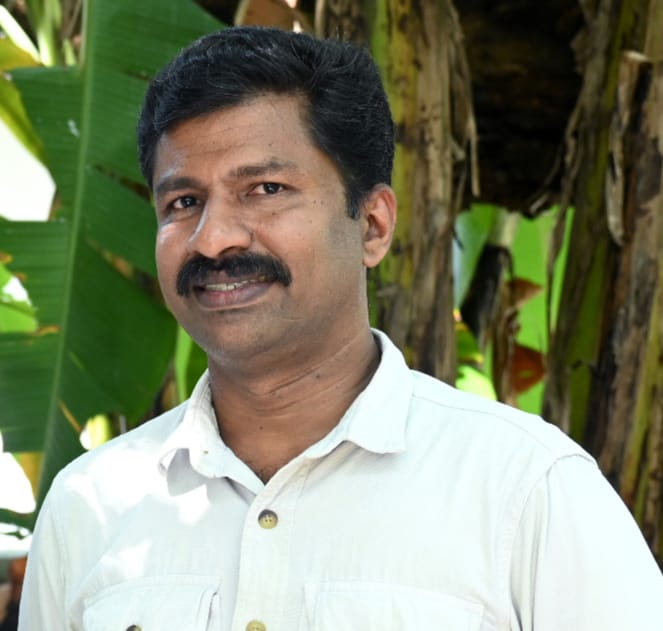
A.K Shiburaj began his journalism career in 2000 with the publication of Samvadam magazine from Kozhikode. He later worked as a teacher on the Maldives island and engaged in social work across North Indian states. He practiced organic farming for a time and served as the Assistant Editor of Keralayam Magazine (Web). He is now a freelance journalist and an advocate for civil society and social movements. He is a recipient of the Maja Koene Social Journalist Award in 2025.