

The Colonial Origins of Imperial Secularism: A Genealogy of Modern Violence
Modern violence rarely announces itself as cruelty. It arrives clothed in the language of reason, law, and humanitarian necessity. This article by Asokakumar V traces how that language was forged, not in the Enlightenment, but in the crucible of colonial conquest.
From Faith to Reason — The Legal Birth of Colonial Violence Part 1
“Modernity is neither a totally coherent object nor a clearly bounded one, and many of its elements originate in relations with the histories of peoples outside Europe.”
—Talal Asad, Formations of the Secular
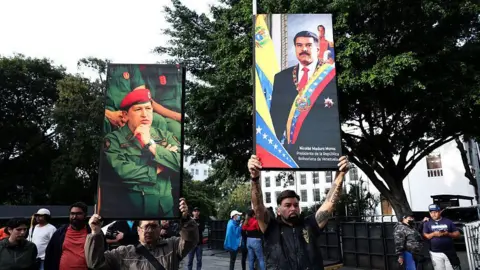
In the name of pure secular reason—narco-terrorism, criminal law, and security—the United States justified its attack on Caracas and the capture of Venezuela’s president. U.S. authorities declared that President Nicolás Maduro and his wife, Cilia Flores, would be tried in New York on charges of involvement in narco-terrorism, recasting geopolitical violence as a neutral legal act.
All previous U.S. attacks and military interventions, from Vietnam, Iraq, and Afghanistan to Libya, Syria, Yugoslavia, Panama, and now Venezuela, have been justified through recurring forms of secular reasoning articulated by American imperial power. Whether framed as the defence of democracy, the enforcement of international law, the protection of human rights, the containment of terrorism, or the suppression of narco-criminality, each intervention has been presented as a rational and humanitarian necessity. Does this pattern reveal an imperial secularism that acts in the name of universal humanism while normalising violence as a moral duty?
From the outset of colonial expansion, invasion, domination, and the extraction of wealth have been rendered legitimate through forms of secular reasoning presented as universal, neutral, and rational. Here, “secular” refers not to the absence of religion but to the invocation of an ostensibly universal rationality—natural law, economic interest, and civilizational progress—as the supreme authority guiding political action, thereby displacing theological justification.
Secularism is usually narrated as the crowning achievement of Western modernity—the final liberation of reason from the darkness of faith and from the political bonds between church and monarchy (Kumar 2024). This mainstream narrative presents the rise of secularism as an internal evolution of Western thought—an inheritance of Europe’s own intellectual tradition. The moment from which Western secularism is said to emerge has often been regarded as the boundary between political modernity and the irrational politics of authoritarianism.
Today, this legacy endures. When world leaders reduce complex human tragedies to political calculations or strategic provocations, they are speaking the language of this secular logic. Our ensuing helplessness—the sense that we are merely watching a scripted play of power—is itself a product of this system. This essay will excavate the origins of this system, arguing that the marriage between Aristotelian natural law and colonial expansion forged a tool for violence that continues to shape our world, rendering the screams of the oppressed into mere data points in a secular calculus of power.
The Shipwreck of Faith on the Shores of Precious Metals
The first glimmer of secular reasoning may not have arisen in the writings of Enlightenment thinkers, but in the ambitions of rulers and their loyal advisers who dispatched explorers toward the unseen lands beyond the Atlantic. Following the methods of Portugal and Spain, the monarchs of England and France enthusiastically joined the race for exploration, investing heavily in overseas expeditions at the close of the fifteenth century. Portugal and Spain questioned the legality of explorations undertaken by other European kingdoms, since the papal bulls had divided the non-European world exclusively between them (Ashrafyan 2020; Bergenroth 1862, 33–36).
In 1496 Henry VII of England “tempted by the lure of gold and spices, and anxious not to be excluded by the Spaniards and Portuguese, had authorized John Cabot to `conquer and possess’ in the name of the King of England any territory he should come across on his North Atlantic voyage not yet in Christian hands” (Elliott 2006, loc. 234). The Italian bankers who financed the monarchs of Spain and Portugal were also major lenders to the British, French, and Dutch ventures of overseas expansion (Guidi Bruscoli 2012). John Cabot in 1497, sailing under the English flag toward the northern Atlantic. He was soon followed by French expeditions to South America and later to North America (Encyclopaedia Britannica 2025).
In 1541, French plans to establish colonies in Canada provoked formal protests from Spain. In response, France effectively repudiated both the papal bulls and the doctrine of discovery without possession. The French king asserted that “Popes hold only spiritual jurisdiction, and it does not lie with them to distribute lands among kings,” and that “passing by and discovering with the eye was not taking possession” (Slattery 2005, 61). Similarly, when Spain protested in 1580 to Elizabeth I over Francis Drake’s incursions into its claimed sphere, the English queen replied that popes had no authority to grant the world to princes, that she owed no allegiance to the papacy, and that mere symbolic gestures—such as erecting monuments or naming rivers—did not constitute legitimate possession (Slattery 2005, 67).
The immense wealth that flowed into Western Europe in the form of precious metals extracted from the New World by the Spanish undermined the traditional religious ethics of the other European ruling dynasties that followed Spain into the conquest of the Americas during the early decades of the sixteenth century. They seized this fortune by attacking Spanish ships, issuing royal licenses to privateers in the Atlantic and other waterways near their coasts to plunder the wealth of the New World (Andrews 1964). Under the pressure of royal plunder on the seas and massive investments in naval expeditions, kings—intoxicated by ambition—found worldly justifications to repudiate the papal bulls.
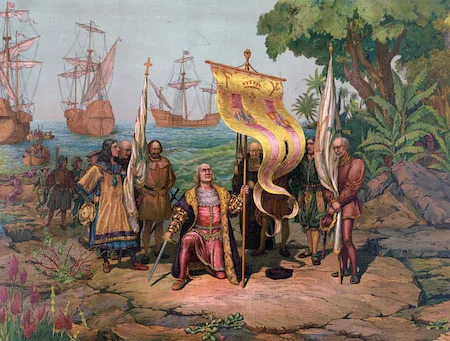
Thus, Columbus’s triumphant voyage ended as a shipwreck of faith: the discovery of the New World shattered the theological geography of Christendom and exposed the limits of the Church’s authority in defining the moral order of an expanded world. Compelled by the lure of the New World’s treasures, they set sail toward new continents of reason, abandoning the familiar shores of faith. The revival of Aristotelian commentary in the Renaissance shows that scholars and clerics turned to Aristotle to make sense of a rapidly changing intellectual world (Lines 2024).
School of Salamanca: Catholic Reasoning for the New World
Perhaps the first legal challenge of reason to the papally sanctioned sovereign rights of Portugal and Spain did not come from their rival kingdoms, such as England or France. Astonishingly, it arose from within the Spanish Empire itself. The legitimacy of Spain’s and Portugal’s claims was questioned by the sixteenth-century Spanish Dominican friar and Professor of Theology Francisco de Vitoria, who did so by applying principles of natural law- a philosophical and legal theory that posits the existence of a set of inherent laws derived from nature and universal moral principles, which are discoverable through reason. As Carolina Kenny wrote, ” Vitoria strongly refutes these premises and in the course of denying the traditional basis for Spanish rights over the Indians, he constructs a system of law which displaces divine law and its administrator, the Pope, and replaces it with natural law administered by a secular sovereign” (Kenny 2015).
In 1539, Vitoria rejects the idea that Spain could claim the newly encountered territories merely on the basis of discovery. Drawing on the principle of res nullius (thing of no one), he notes that such a title applies only to things without an owner. As he explains, “The law of nations … expressly states that goods which belong to no owner pass to the occupier. Since the goods in question here had an owner, they do not fall under this title. Therefore, … this title … provides no support for possession of these lands, any more than it would if they had discovered us.”(Benton and Straumann 2010, 21). Thus, he advanced a secular argument rejecting the validity of the papal bulls that legitimised the English and French monarchs—together with the Portuguese and Spanish—in defending their race and extending their dominions beyond the Atlantic.
Rooted in the Thomistic tradition (the philosophical synthesis developed by Thomas Aquinas), early sixteenth-century scholasticism emerged within the Catholic Church as an effort to weave Christian theology together with the rational principles of Aristotelian philosophy (which holds that reality can be understood through reason and observation—that is, by systematically studying the natural world and human experience) (O’Meara 2020). Its principal centre was the University of Salamanca in Spain, where theologians and jurists such as Francisco de Vitoria and his companions such as Domingo de Soto developed a new moral and legal philosophy for a rapidly expanding world (Brett 1997, 123).
They foresaw the limitations of the papal bulls if applied to the non-Christian world(Benton and Straumann 2010, 19-20).
In De Indis (On The American Indians) Vitoria states undoubtedly, “the pope is not the civil or temporal master of the whole world, in the proper meaning of ‘dominion’ and ‘civil power’…. he has no spiritual jurisdiction over the infidel, as our adversaries themselves admit….. the pope has no temporal power over these barbarians, or any other unbelievers..” (Vitoria 1991, 260-262). Yet the question went beyond the rivalries among European dynasties over the right to conquer. It raised a deeper and more troubling problem: how could the inhuman brutality inflicted upon the natives be justified within any framework of law or morality?
Here, the morality rooted in Christian spirituality—which recognises all human beings as children of God, whether they dwell in the Old World or the New—stood as a restraint against the brutality unleashed upon the natives. This conviction inspired figures such as Bartolomé de Las Casas (1484–1566)—a Spanish lawyer, clergyman, writer, and activist best known for his work as a historian and social reformer—who denounced the Spanish conquest as a mortal sin against divine law and human conscience (Hanke 1974). For Las Casas, the natives of the Americas were rational beings endowed with the same soul and dignity as Christians, and thus no war or enslavement could be justified in the name of religion or empire (Las Casas 1974, 39).
While sharing Las Casas’s moral concern, Vitoria argued from reason rather than revelation: the rights of the natives derived not from baptism or belief but from the natural law common to all humanity (Vitoria 1991, 244). By grounding justice in the universal reason of mankind rather than in Christian faith alone, Vitoria transformed a theological compassion into the first philosophical critique of empire (Benton and Straumann 2010, 20-26). Thus, he placed both the natives of the New World and the explorers who crossed the Atlantic before the same tribunal of natural law, as beings endowed with equal rights and bound by the same moral obligations.
At first, Vitoria stood firmly—like Las Casas—in affirming that the peoples of the New World were human beings equal to the Spanish, possessing the same natural rights to property and political authority (Vitoria 1991, 250-251). But he later extended his reasoning to include the natural rights of the visitors: the universal right to travel, to communicate, to dwell in, and to conduct commerce throughout the world, irrespective of territorial sovereignty or religious difference.
Vitoria argues that the Spanish have a natural-law right to travel to and live among the Indigenous peoples, provided they cause no harm. Because natural law declares that resources such as the sea, rivers, ports, and common lands are universally shared, Indigenous communities cannot lawfully bar Spaniards from accessing or using them. If certain resources—like gold in common land or pearls in the sea—are open to both locals and outsiders, then the “barbarians” would be acting unjustly if they prevented Spaniards from enjoying the same access. (Vitoria 1991, 278-280). Additionally, he maintains that the right to spread one’s religion is guaranteed by natural law. Therefore, if Indigenous peoples try to block Spaniards from preaching Christianity, the Spaniards may continue to evangelize even without the locals’ consent. After attempting peaceful persuasion, they are permitted to use force—including waging war—if that is necessary to secure the conditions required to preach the Gospel safely (Vitoria 1991, 285). ” if the barbarians deny the Spaniards what is theirs by the law of nations, they commit an offence against them. Hence, if war is necessary to obtain their rights(ius suum), they may lawfully go to war” (Vitoria 1991, 282).
Spanish colonisation was not a war fought between the armies of rival kingdoms; rather, it was the territorial encroachment of a people from an alien nation upon the autonomous societies of the New World. Antony Anghie writes, “Having dismissed the old medieval jurisprudence based on the notion that the Pope exercised universal authority, Vitoria clears the way for his own version of secular international law”(Anghie 2005, loc. 685).
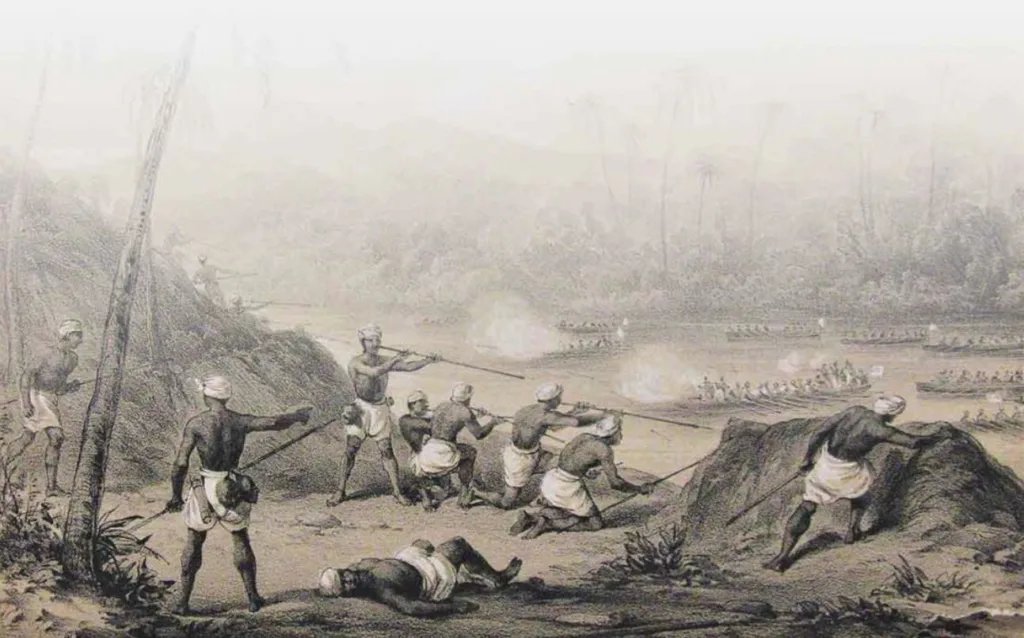
However, Vitoria’s universalism contained a fatal hierarchy. Vitoria not only invoked natural law to place the Indians on an equal footing with the Spaniards in order to justify the privatisation of property in the New World under the rubric of equal rights to the commons, but he also used the same legal framework to construct and enforce distinctions between the natives and the colonizers. He argues that although the Indigenous people are not completely irrational, they are so close to it that they are incapable of establishing or managing a properly ordered civil society. Because of this, he claims, they lack suitable laws and competent political leaders. He further contends that they are unable even to run their own households effectively, pointing to their absence of writing, arts and crafts (both intellectual and manual), organised farming, manufacturing, and other practices essential for human life. From this, he suggests that one could claim it is in their best interest for the Spanish rulers to assume control over their governance, appoint officials to administer their affairs, or even assign them new masters—provided that such intervention could be shown to benefit them (Vitoria 1991, 290).
Although Francisco de Vitoria is often celebrated as the “father of international law”, especially for his role in articulating universal principles that apply to all peoples and nations, the deeper significance of his work is frequently overlooked: he constructed these principles in direct response to the Spanish conquest of the Americas,and therefore international law as he formulated it was born within a colonial context (Anghie 2005, loc. 493).
If we are willing to acknowledge the proclaimed perfection, prominence, and impartiality of this natural law, we must also recognise its tragic consequence: within five decades of Columbus’s first voyage, most of the tribes in the West Indies had been exterminated by the Spaniards—punished, in effect, for denying the so-called universal rights of their invaders (Cook 1998). In this transformation, secular reason replaced faith as the authority of empire. Perhaps the influx of abundant treasure into Church holdings, the royal palace, and mercantile circles compelled the Spanish jurists of the School of Salamanca to resist the growing theological critiques of the New World plunder and the brutality unleashed soon after Columbus’s voyage.
(to be continued)
Featured Image: Fire at Fuerte Tiuna, Venezuela’s largest military complex, is seen from a distance after a series of explosions in Caracas on Jan. 3, 2026. Photo: AFP via Getty Images

He was a teacher at the Marancheri Government Higher Secondary School in Malappuram district. He is involved in and writes on environmental and social issues. He was the editor of the magazine One Land One Life. He has published the books Green Revolution: The Fruit of the Fruit of Evil, White Rice that Gives Disease, Environmental Action at Home and School, Disease-Spawning Chemical Fertilizer, and the Political Psychology of Neo-Liberalism and Universal Worship in Malayalam and the book Disease-Spawning Chemical Fertilizer, published by Other India Press in English. He writes articles in periodicals that focus on cultural politics in the post-colonial context. He is active in Kerala Bio-Agricultural Committee and Good Food Movement-Ponnani.