
RSS at 100: Ideology, Strategy, and the Future of Hindutva Politics
In this concluding part of the two-part interview, Abhish K. Bose continues his conversation with political theorist Pradip Kumar Datta on the evolving strategies and contradictions of the RSS as it approaches its centenary.
This section examines the Sangh’s engagement with education, its tactical flexibility in politics, the social conditions behind the rise of Hindutva, and the organisational mechanisms that sustain the Sangh Parivar’s expansion, offering a critical reflection on the future trajectory of Hindutva politics in India.
Read Part One
Part Two
What successes has the RSS achieved in its efforts to indoctrinate students through its educational initiatives, shaping young minds and perpetuating its ideology?
This is a difficult question to answer in the absence of sufficient ethnographic evidence that could indicate the degree to which students have been actually indoctrinated. It is quite possible that growing control over the education system will generate a stronger lurch to right wing fundamentalism in future. This has been – according to Ilan Pappe, the historian – the experience of Israel which has seen a steady takeover of its educational institutions by right wing ideologies.
While education – especially at the primary levels – may not produce an ideal RSS cadre, it generates a sense of community with fellow members who share – even if loosely – an ideological commitment to Hindutva. Some may join the RSS while the majority may not. But the latter may also provide the personnel who can influence public opinion in their private capacities or as public actors.
My personal experience in public universities suggests that the influence of Hindutva is still limited. While appointments have been taken over by the university administration, the problem that Hindutva faces are two-fold. The first is the relative lack of employment opportunities. The second is the limitedness of a persuasive intellectual culture; Hindutva intellectuals have to draw a line to thinking beyond which they cannot venture. Hindutva has to suppress the drive for curiosity and experimentation that is a key aspect of university level student life; thirdly, it has to contend with the intellectual heritage of a liberal-left intellectual culture that has strong historical roots in in many strands of the nineteenth century reform movements and in both the freedom movement as well as the post-colonial decades. At best Hindutva proponents can be intellectually parasitic on contemporary theories as for instance on post colonialism. Nevertheless it has to also contend with the multiple debates that post-colonial thought has generated – as well as its critiques. But it is not possible for Hindutva to do this given the necessity of imposing clear intellectual boundaries. Post Coloniality has to be turned into a dogma.
How does the RSS reconcile its professed animosity towards Christians and leftists with its electoral compulsions and pragmatic political maneuvering?
Tactical and strategic flexibility has never posed a problem for the Parivar especially after its turn to mass politics. The decisive move was made in tactically formally suspending its internal Constitution in order to un-ban itself. More importantly, the Parivar is guided by the conviction that ultimately – whatever compromises they make in the short-term – they will be able to Hinduise the local populations through different means ranging from violence to ideological dissemination and to breaking up its religious and political opposition into different factions. Hence, they can tolerate the eating of beef in certain north east areas while raging against its consumption in other places in India. Or ally with Christian groups in Kerala while its front organizations attack churches elsewhere.
What factors enabled the Ramjanmabhoomiagitation to transcend its upper-caste roots and garner nationwide support, potentially masking its inherent contradictions and anti-Mandal overtones?
The most important reason was the loss of moral authority of the Congress. Since the beginning of anti-colonial mass mobilization, Congress had assumed the mantle of the voice of the Indian Nation. It had managed to produce its own brand of Socialism that combined economic self-dependence (that helped Big Capital) with populist concern for the poor and a multi-religious, multi-caste, multi-class alliance that defined the country for its first twenty years or so. It began to decisively lose its moral authority and hence the idea of the Nation that it represented from the Emergency. Although the Congress recovered electorally with the break-up of the Janata government, it took a decisive turn to an increasing mix of soft Hindu Nationalism with liberalized economic policies in the 1980’s, culminating in the turn to Globalisation in the 1990’s. In a sense, the distintegration of the ruling idea of the Nation was undermined by its author.
The Hindutva combined took a calculated risk to initiate a pan Indian movement through the Ramjanbhumi campaign. This is something that none of the non- Congress opposition parties risked themselves in doing. Instead, they increasingly turned to regional or caste identity to mobilise their constituencies. They lacked a pan- Indian movement promising a new vision of the Nation and eliciting widespread support for it. It was the failure of the non-Congress opposition as much as the Congress for producing a vacuum instead of a fresh foundation for the Nation.
The anti-Mandal agitation also helped a great deal for the popularity of the BJP for it consolidated the upper castes in a way that had not happened before. It may be remembered that the middle class (made up mainly by upper castes) had expanded under liberalization in the 1980’s and their social influence was increasing. On the other hand, once the Mandal reservations had been passed it was becoming clear that it tended to serve only the dominant sections of the lower castes. This in turn led to fragmentation of the lower caste social constituency, making it easier for the BJP to co-opt sections as and when electoral compulsions required it.It should be mentioned in this context that the BJP has been very flexible in projecting an image of an all-in-unity of castes by fore-fronting low caste leaders.
As the Sangh Parivar expands its tentacles, incorporating diverse affiliates like the VHP and Bajrang Dal, how does it maintain control and coordination, avoiding the pitfalls of vigilantism and extremism?
The Sangh Parivar, that is, the RSS with its cluster of affiliates is not a new phenomenon. But this fact only underlines the success of the Parivar in keeping itsflock together for so long. This is in contrast to the Left and to all other political formations in the country which have all splintered in the course of their development.
There is of course the organizational reason. The RSS has developed a subtle and effective way of co-ordinating different mass fronts. This is due to threereasons. The first is that RSS personnel dominate all the main fronts. The second is that the RSS cadres (especially of the earlier vintage) are trained from childhood to possess some basic ideas of which discipline is a key element. This is a learning that tends to stick to them through their lives especially since – unlike the Left – they do not cater to recruits who have been intellectually converted together with their experience of political and social life. Thirdly, the RSS has developed a skill in managing its constituents even when they pull in different directions; even more significantly, they can pull themselves back from their constituents from time to time as happened in the 1984 elections when they supported the Congress.
There is also another fundamental reason connected to their idea of Hindu identity. Hindutva has emerged from a long-standing discourse about Hindu identity which says that Hindus are a dying race because they are disunited. Lack of unity, according to this line of reasoning, causes a lack of vitality and the strength to combat other religious groups. Hence to lose unity is to lose identity and to surrender oneself to certain death. Hindutva identity is premised on this existential anxiety which makes it difficult if not suicidal in their self-image to actually break off from their fellow members.
How is the Swadeshi Jagran Manch recalibrating its stance on economic policies, responding to the escalating import of consumer and industrial goods, and the nuances of the “Make in India” initiative?
The SJM appears to have given up its tactical opposition to liberalization policies in recent times. Instead, it has joined in the celebration of the government’s Atmanirbhar campaign and India’s growth rate. Its activities are now restricted to addressing potential problem areas, especially amongst the youth. The most important one they have identified is that of employment and for this they are spearheading a movement for self-employment, dissuading the youth from seeking government jobs. Together with this, the SJM also seeks to address rural crisis by encouraging the government to help agro-industries such as cold storages, food processing units and so on. In addition, they are campaigning for social issues flagged off by the RSS such as increasing fertility rates while also advocating measures to censor OTT content of apparently pornographic material. In short, it is playing a supportive role to the government and to the RSS.
The shift from being an in-house critic of the BJP to becoming one of its supportive pillars, may reflect a realization that the economic dissatisfactions of the youth that could pose a serious challenge to the domination of Hindutva itself.
Ends
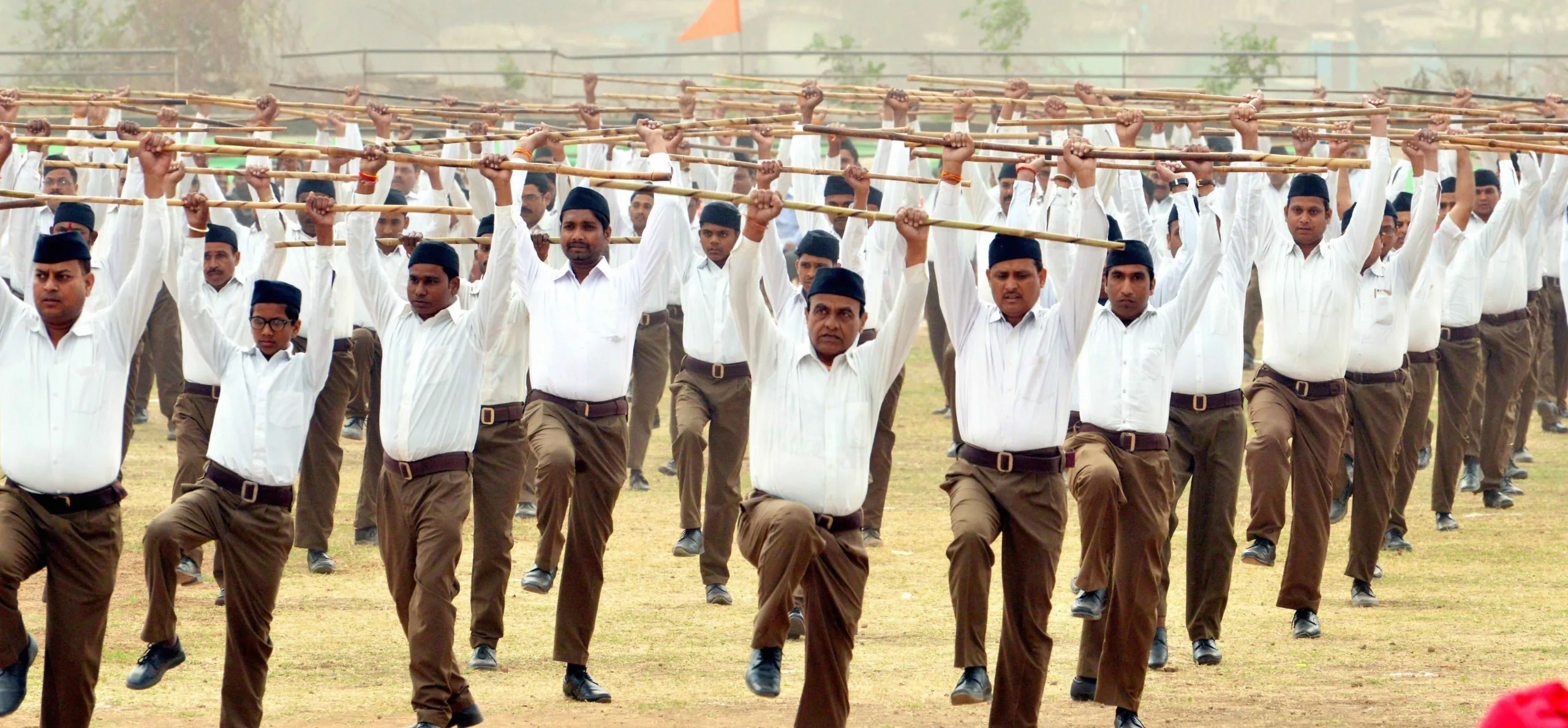
Featured Image: File photo of RSS workers practicing yoga. Photo: PTI
A journalist with 18 years of experience Abhish K Bose was a staffer at The Times of India and The Deccan Chronicle - Asian Age. As a contributor, his interviews and articles have been published in Frontline magazine, The Wire, The Print, The Telegraph, The Federal, The News Minute, Scroll, The Kochi Post, The Leaflet, The Hindu.com, Outlook.com Countercurrents.org and the Asian Lite international published out of London