
Realigning with the times: The evolving politics of the LDF in Kerala
In an interview with Abhish K. Bose, Dr. Sarath Sasikumar discusses the challenges faced by the Left Democratic Front (LDF) in Kerala, including the decline of traditional industries, erosion of its working-class base, and rise of the BJP. He emphasizes the need for the Left to adapt and innovate its politics to address changing voter dynamics and maintain its relevance.
Dr. Sarath Sasikumar is a political scientist and researcher specialising in Left politics, caste, and social justice in contemporary India. He holds a PhD in Political Science from the Centre for Political Studies, Jawaharlal Nehru University, New Delhi. His work critically examines the intersections of Marxism and identity politics, with a particular focus on how Left-Wing movements adapt to the challenges posed by the global right-wing resurgence. Dr. Sasikumar is currently a guest lecturer at Sree Kerala Varma College, Thrissur, affiliated with the University of Calicut.
How have the structural changes in Kerala’s political economy, particularly the decline of traditional industries like coir, cashew, and handloom impacted the Left Democratic Front’s (LDF) electoral performance in affected areas, considering the erosion of its traditional working-class base and the challenges faced by these industries in adapting to modernization and market trends?
The core vote base of the LDF has been historically shaped through class mobilisations at different arenas of economic life. The decline of traditional industries mentioned above (along with the decline in agricultural production as well as the reduced participation of the Malayali labourers in agricultural-related work) has led to a situation where conventional forms of trade union mobilisation have become challenging. This makes the class cleavages more blurred, and even when class organisations exist, they work more in an institutionalised framework rather than a confrontational atmosphere. Class cohesion and class fervour that is associated with it are rapidly giving way to individual-oriented neoliberal governmentality. Party affiliations become more flexible in such an atmosphere, and are no longer connected to the daily survival of the working classes. In the actual voting, it is reflected by the stark decline in the percentage of unwavering LDF votes and an increase in the percentage of floating votes. Outside the electoral politics, it also affects the extra-parliamentary struggles that the Communist parties wage, and has consequently reduced the role of class organisations (trade unions, peasants’ organisations etc) in the political praxis.
What does the Left Democratic Front’s historic low vote share of 33.3% in Kerala in the 2024 general elections reveal about the shifting dynamics of allegiance and voter loyalty, particularly in light of the BJP’s growing presence and changing voter demographics in the state?
One of the clear messages from the 2024 Lok Sabha election results in Kerala is the decline of bipolarity, a characteristic of Kerala politics that has persisted for decades. It has emerged as an undeniable reality that the BJP has emerged as a third force. Naturally, it also indicates a tectonic shift in the social alignments that have been shaping the bipolar coalition politics in Kerala. Cultural-religious questions associated with an overarching Hindu identity have overridden many of the hitherto discussed questions regarding economic and social justice. A scenario where partisan allegiance to the LDF has diminished has come into existence. While the LDF is still capable of considerably expanding its voter support in favourable circumstances (like in the 2021 Assembly elections), the core voter base that supports the LDF irrespective of the contingencies in the electoral sphere has shrunk. A significant section of the population actively fuels up discussions on cultural identity, large-scale development, rejuvenation of lost traditions etc, and the LDF is susceptible to the new narratives they unleash. This warrants a deeper restyling of LDF’s politics in order to survive.
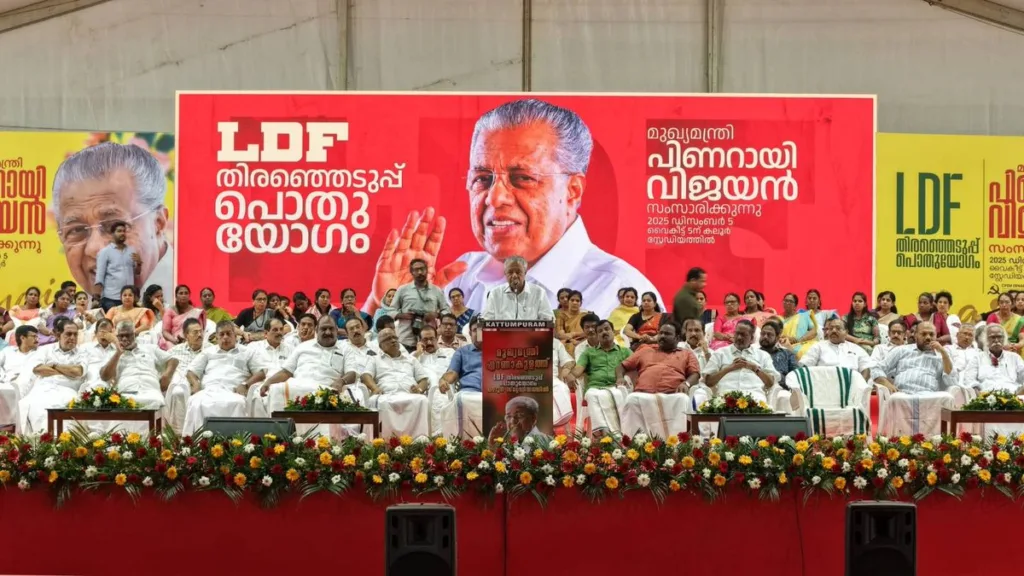
LDF election campaign meeting in Kaloor stadium, Ernakulam, addressed by Polit Bureau member and Kerala Chief Minister Pinarayi Vijayan and other leaders.
Does the Left’s strategic flexibility in pursuit of long-term political gains, particularly when class demands are not immediate priorities, manifest as ideological compromise, potentially leading to appeasement of communal forces and erosion of its core values. Can you analyse such evident compromises for political gains made by the left recently?
The criticism that the Left is deviating from its core values and compromising with regressive forces is rampant. However, many of those criticisms lack precision and fail to situate the Left’s praxis within a larger context. A Left formation operating within a hostile context is bound to keep its strategy updated, flexible and, above all, creative. So, it would be wrong to brand every modification in praxis as a heresy. In the context of Kerala, immediate class demands have been fulfilled to a large extent, and even to defend those achievements there is a need to expand the social base of the movement and get more entrenched in social life. As long as the steps taken by the movement are in tandem with the larger transformatory goals, they need not be deemed as deviations or compromises.
In short, it is better to comprehend innovations in the praxis by linking it to the larger ideological and programmatic evolutions rather than sticking to an idealist vision of ideological purity. This does not mean that the Left in Kerala is free of ideological deviations and retreats from its agenda of progressive social transformation. Many of the policies that the Left adopts are completely devoid of any ideological justification or a link towards long-term ideological goals. They just serve the purpose of everyday politics and make it difficult to find any difference between the Left and the status quoist mainstream parties. This phenomenon has been famously referred to as ‘empiricisation’ by Prabhat Patnaik. In the day to day praxis of the Left in Kerala this has been manifesting in different forms such as nepotism in government-controlled appointments, hypocritical U-turns in matters of progressive social reforms, political patronage provided to police atrocities etc. What needs to be underscored is that in such instances, the problem is not tactical compromises for the sake of survival of the long-term transformative vision, but ulterior motives of the political actors that runs contrary to the ideological vision and the inability of the party machinery to place effective measures for rectification.
Is the Left in Kerala undergoing a strategic shift from traditional class-based politics to populism, potentially diluting its core ideology and altering its approach to addressing working-class needs, or can it balance populist measures with class politics to broaden its appeal without alienating its traditional supporters who prioritise class politics?
The populist tendencies that the Left in Kerala is exhibiting need not be in contradiction with class analysis, class mobilisation and class struggle. Kerala has a peculiar situation where urgent class demands of the working class have been resolved to a large extent and class struggle has been institutionalised. Considering this, it is quite appropriate for the Left to attempt to a widening of its social base, without relinquishing its commitment to the working classes. The attempts to forge a larger popular unity based on (sub) nationalist identity and egalitarian vision shall not be equated with right-wing populism that undermines institutions, demonise the yearnings for social justice, and engages in destruction of reason. In other words, populist tendencies being displayed by the Left in Kerala is not in itself a problem.
The blurring of class distinctions and the rise of an upper middle class from the ranks of the basic classes has further necessitated a refashioning of politics in a way that takes into consideration the aspirations of the better-to-do classes. The real litmus test in this context will be the Left’s ability to address the issues of the most marginalised sections who have been placed at the outlier of the Kerala model. Their calls for radical redistribution will have to be managed wisely. Also, there shall be conscious attempts to win over the middle classes to the working class politics rather than completely submitting to the middle-class aspirations. The possibility of maintaining the balance is again connected to the larger question of commitment to the transformative vision. If that is lost and the better-to-do sections of the societies are unconditionally pampered, the very class nature of the party will undergo a metamorphosis.
Is the CPM’s decline in West Bengal, Tripura, and Kerala a symptom of a deeper ideological crisis, or is it a tactical failure to adapt to changing voter dynamics, particularly with the BJP increasing its influence and allegations of corruption within the CPM’s Kerala leadership?
It is wrong to frame it as an ‘either/or question’. An ideological crisis is, inter alia, a crisis to correctly theorise changing voter dynamics, rise of the forces of reaction and corruption within the ranks of the party. In other words, practical challenges get intense when there is ideological insolvency and ideological crisis erupts when new realities that the praxis throws up cannot be met within the existing contours of ideology. The decline of the Left in its strongholds also needs to be understood with a sense of this deeper connection between theory and praxis. On the one side, the newer questions with which the masses are grappling with falls outside the boundaries of the movement’s ideological understanding. And, on the other, even in matters where there is ideological clarity the movement gets bereft of the correct tactics to manage the situation. Both a deeper analysis of the social situation and smarter moves of manoeuvre are needed for the Left to remain relevant.
Has the CPM’s transformation into a corporatized entity with multiple business interests led to a disconnect between its party interests and the needs of the working class, effectively de-radicalizing the communist movement and reorienting its use of violence and mobilization towards advancing party interests rather than class struggle?
The accusation that the CPI(M) has transformed into a ‘corporatized entity with multiple business interests’ is quite vague. Of course, it is beyond doubt that organised efforts to intervene in the economic life through cooperative societies have been made by the CPI(M). But, whether that makes it a corporatised entity is doubtful. As far as I know, serious studies that problematize how the interventions in cooperative sector affects the revolutionary potential of the party don’t exist. What we have are superficial commentaries that exaggerate those efforts and fictitiously indicate that the CPI(M) exists like a mafia-like entity. There is no concrete instances before us of involvement in cooperative societies hindering the advancement of working class politics. On the contrary, the potential of such interventions in developing alternatives to the capitalist dynamics needs to be explored deeply. Its high time the efficacy of such attempts by a vanguard party in building up alternative ways of lives be effectively theorised. The observations regarding violence and mobilisation for vested interests (rather than class struggle) also seems too vague.
Does the CPM’s tendency to prioritize individual leaders, such as Pinarayi Vijayan, over collective leadership and ideological principles signal a shift towards a more authoritarian or right-wing approach within the party, potentially compromising its left-wing ideology?
It would be an exaggeration to say that collective leadership and ideological principles have completely given way to promotion of individual leaders like Pinarayi Vijayan. However, tendencies to concentrate power in a single leader do exist. It is not unprecedented though. The Leninist organisational principles have been abused throughout history to promote cults of personality surrounding individual leaders. A deeper critique of the organisational principles itself may have to evolve in order to get rid of such tendencies for ever. The categories of ‘Left-wing’ and ‘Right-wing’ cannot be employed only on the basis of existence of concentration of power.
Anyway, it is doubtless that such tendencies will hamper the active development of inner-party debates and eventually retard its growth. In the current scenario, what can be loosely referred to as the ‘Pinarayi cult’is also characterised by intolerance towards criticisms, unapologetic display of extravagance, glorification of state repression when it is beneficial to the CPI(M) etc. In the contemporary Indian scenario, such a style of politics feeds to and legitimises what the Hindutva right-wing does and discredits the Left’s attempts to place itself as a democratising force. In short, the tendency discussed above has emerged as a challenge that warrants immediate rectification.
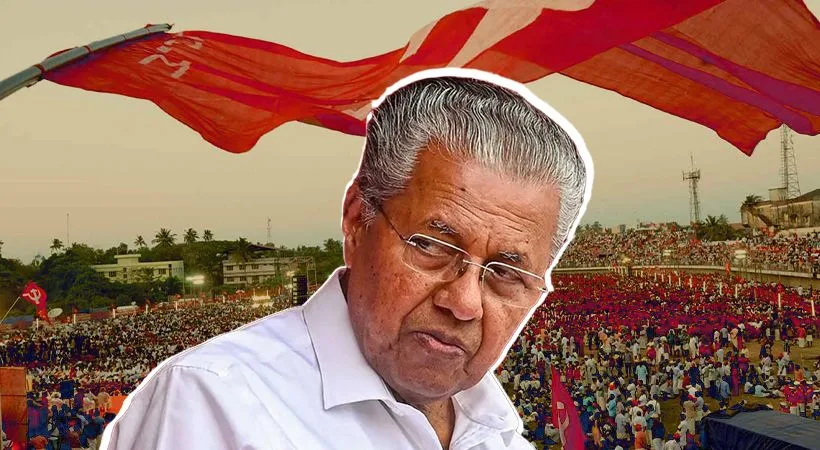
Featured Image: Pinarayi Vijayan, an Indian politician who has served as the 12th Chief Minister of Kerala and also serving as leader of the house in legislative assembly.

A journalist with 18 years of experience Abhish K Bose was a staffer at The Times of India and The Deccan Chronicle - Asian Age. As a contributor, his interviews and articles have been published in Frontline magazine, The Wire, The Print, The Telegraph, The Federal, The News Minute, Scroll, The Kochi Post, The Leaflet, The Hindu.com, Outlook.com Countercurrents.org and the Asian Lite international published out of London