
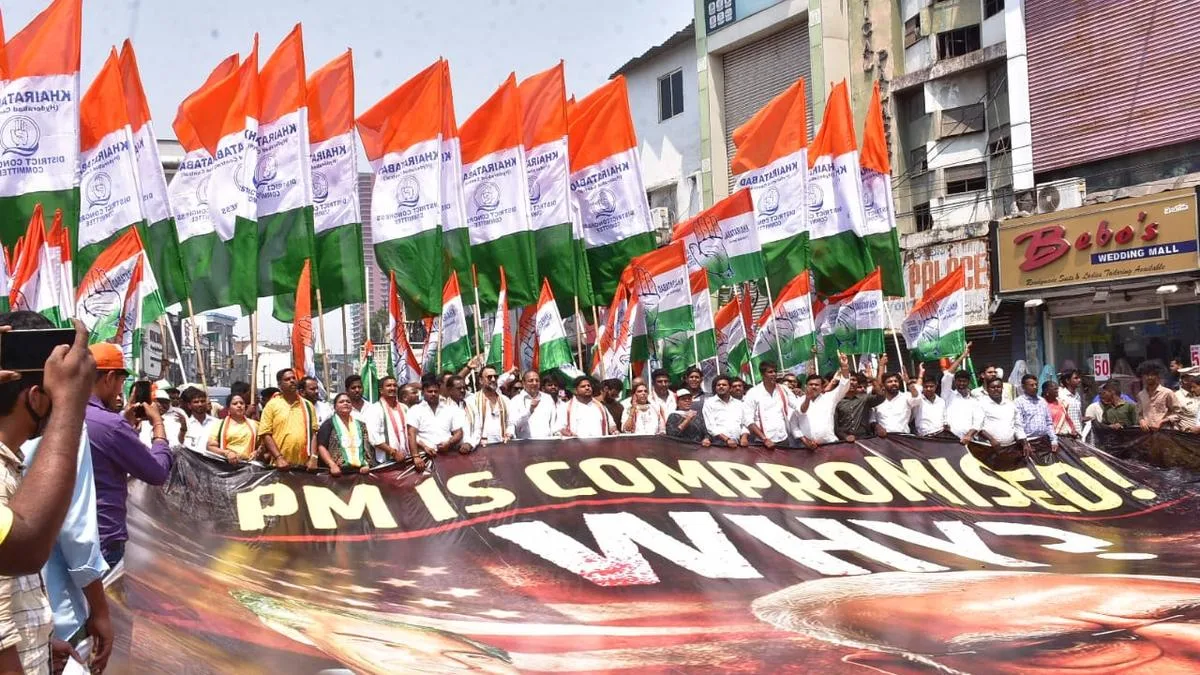
Emergence of a new Congress; Towards a second independence struggle
In this provocative essay, Prof. B. Rajeevan argues that India is witnessing a critical political moment marked by the rise of a corporate-backed, majoritarian regime that threatens democratic institutions. Drawing parallels with the anti-colonial struggle, he calls for a “second independence movement” and reimagines the Indian National Congress as a potential vehicle for democratic resistance. The article examines the transformation of political forces in India, the crisis of the Left, and the urgent need to build a broad-based movement rooted in the aspirations of the marginalized.
With the end of British colonial rule on August 15, 1947, the curtain fell on India’s freedom struggle. In the last seven and a half decades, when Indians themselves began to rule India, India has once again fallen into the clutches of a domestic fascist political force. We have not yet understood the threat of tyranny inherent in this shift with the seriousness it deserves. While maintaining the framework of liberal parliamentary democracy, this fascist force can completely subjugate India to a totalitarian theocracy by subverting Indian democracy through legal amendments and politicizing the Election Commission and the judiciary. This situation poses a formidable challenge to the great culture of the diverse Indian people and to the Indian democracy that relies on its strengths.
To combat this great calamity, those who love India must once again come forward for the freedom of life of the Indian people in a new freedom struggle, just as they did during the struggle against colonial slavery. But in this new freedom struggle, what political movement is there today that can take up the freedom of the Indian people as a pan Indian force, just as it did during the anti-British struggle? When we seek the answer to this great question of urgent importance, we do not see any other movement before us today than the Indian National Congress, which is trying to rise as a new democratic force to take up this mission.
The main reason for this discovery is that the neo-fascist forces that are conquering India have realized this reality before anyone else. They have found that the Indian National Congress, which has established itself in the hearts of the Indian people through the freedom struggle, is the main enemy they have to face even today. In other words, the only enemy that the Sangh Parivar forces fear the most is the Congress. All the political applications of the BJP are centered around the main slogan of ‘Congress-free India’. Narendra Modi kept repeating this slogan loudly throughout the 2014 election rallies. The BJP is repeating it even today. It is regrettable that the BJP’s realization about the Congress has not yet reached the parties in the ‘India Front’ led by the Congress or the Congress cadres themselves.
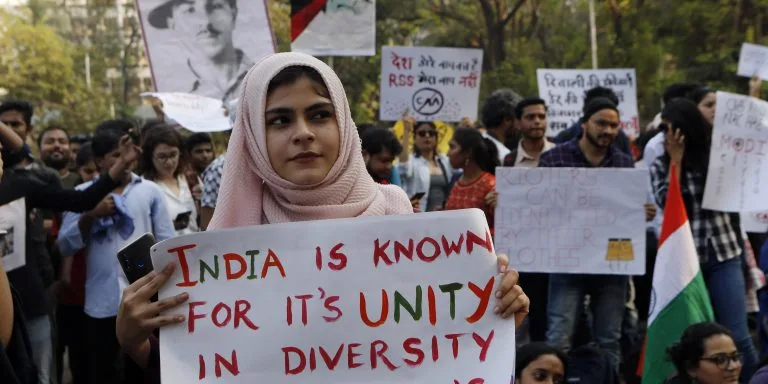
Narendra Modi has been repeatedly saying in his speeches that the relevance of the Indian National Congress ended with independence and that is why Gandhi had said that the Congress should be dissolved. Moreover, Narendra Modi has been repeating that the Congress, which has become historically irrelevant, has today become a haven for Muslim extremists and Maoists and that as such, the Congress is a movement that is threatening Indian democracy. Thus, in this context, we need to consider very seriously Narendra Modi’s argument that the Congress is an outdated movement and that it has become a disaster for India today, by taking Gandhi as an ally to validate his slogan of a ‘Congress-free India’.
We must not forget that the arguments raised by Narendra Modi and the BJP cadre against the Congress, with the full conviction that the RSS’s dream of transforming India into a Hindu religious state cannot be realized unless India is freed from the influence of the Indian National Congress, implicitly acknowledge the Congress’s undisputed place in Indian political life as a democratic force. Therefore, we need to find out what new political force the Indian National Congress, which inspires fear in them, represents in the changed world situation.
Mahatma Gandhi did not say that the Congress should be dissolved after independence in the sense that Narendra Modi is spreading today. With independence, we got ‘parliamentary Swaraj’ and there was still a long way to go towards ‘Purna Swaraj’, so Gandhi meant that the Congress should transform into a new movement that would not be confined to governance alone but would reach out to the people at the grassroots level. But we know that the Congress party, which was engaged only in governance, did not undergo such a transformation. That is why the Left movements and socialists saw the Congress as the party of the Indian capitalist class. That assessment was correct. The government in independent India, starting with Nehru, was ultimately one that served the interests of the growing Indian national capitalism and capital. Thus, the Congress, which functioned as a political movement of the Indian ruling class, disintegrated through the power grab and became nothing more than the Congress that represented the millions of Indian underclassmen in the freedom struggle. The old Congress essentially disappeared with the arrival of Indira Gandhi, who tried to paralyze Indian democracy by declaring a state of emergency, and Manmohan Singh, who opened the Indian economy to global neoliberal capitalism and privatization. It was in the vacuum of this political orphanhood that the Indian people faced that the BJP, casting its net of Hindutva politics, came to power.
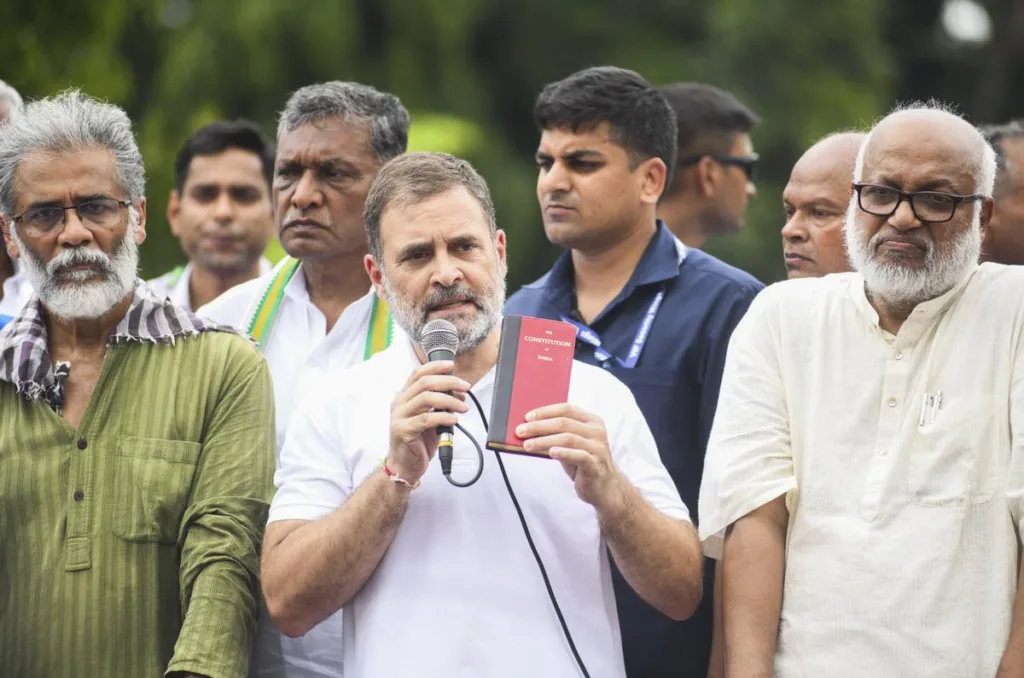
Today, the rural population, consisting of farmers, manual workers and workers, who are the source of strength of Indian democracy, has begun to seep into the depths of anger against Narendra Modi and his group, who are ruling this great country with the support of the global corporate giants that have conquered the world. Not only the farmers’ protests against Narendra Modi’s agricultural bill that subordinates the Indian agricultural system to the corporates, and the widespread opposition to the Citizenship Amendment Act, but also the people’s crushing of Modi’s political illusions in the last parliamentary elections are clear signs of the anger that is bubbling up at the base of Indian people’s lives against Modi’s corporate broker rule. It is in this context that an alternative democratic political framework is essential to take up and unite the new movements of the free will forces of resistance of the Indian people that bound British imperialism. Today, this historic mission has fallen into the hands of the new Indian National Congress, which is emerging under the leadership of Rahul Gandhi and leading the ‘India Front’. Because this Congress is not the old Congress. It cannot be the Congress of Indira Gandhi or Manmohan Singh. This Congress, which is not ruling and is on the enemy side of corporates and brokers, therefore, the only way is to become a Congress that can stand on the side of the poor crores of people, as Gandhi said. This changing Congress will now stand at the forefront to take up the forces of resistance of the Indian people, as it did during the freedom struggle, to free India from the clutches of the global corporate fascist coalition led by Narendra Modi.
Although it is in its early stages, the Left-Socialist parties that are part of the ‘India Front’ have not fully recognized the nature of this new incarnation of the Indian National Congress, which is standing against the corporate fascist alliance that is plundering the lives of the Indian people and nature. The Left movements have always been firm in their stance that the Indian National Congress is the party of the Indian national capitalist class. The only dispute among the Left parties was about what approach to take towards its mitigation. But today, the Indian Left parties are unable to stand firm on this stance. This is because the global ‘integration’ of capital that occurred towards the end of the last century has transformed the world economy and politics to a new stage. With the transformation of national capitalist systems into a global system, and with capital being concentrated in global corporations operating across national borders, the old national capitalist class, which was responsible for the country, no longer exists. With this, national capitalist regimes are falling into the hands of various types of fascists who act as brokers serving corporate interests. This is what happened in India too. This is the historical logic behind the overthrow of liberal capitalist democracy and the rise of an anti-democratic fascist force in India.
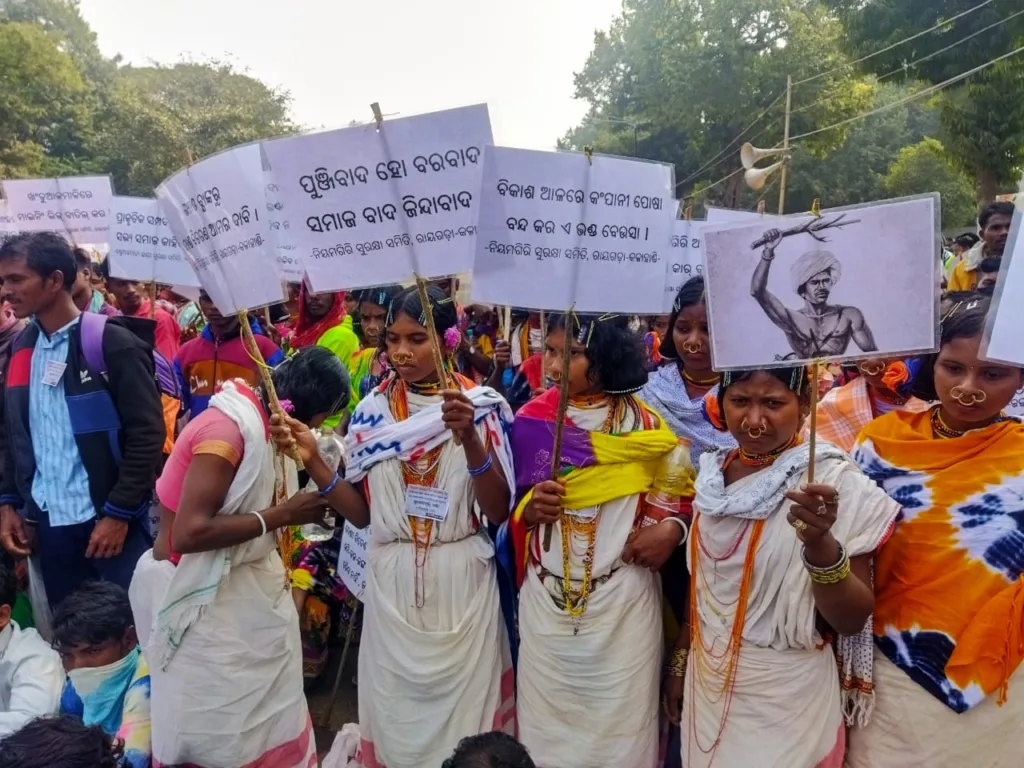
Thus, with the economic foundation of the national capitalist class itself destroyed, the Congress that serves it, the Congress of national capitalism, the main enemy of the Left movements, is historically irrelevant. The Congress that is now beginning to emerge is the Congress of the poor and underprivileged millions, as envisioned by Gandhi, a new Congress that is trying to take on the forces of popular alternative democracy against the fascist regime in the corporate broker.
The first to recognize this liberating political possibility are a section of Congress leaders who have yet to shake off the decaying remnants of the old Congress; and the Left movements whose old revolutionary political strategies are outdated.
Featured image: Protest against Narendra Modi lead governments legislation approval in 2019 Photo credit / Hinustan Times
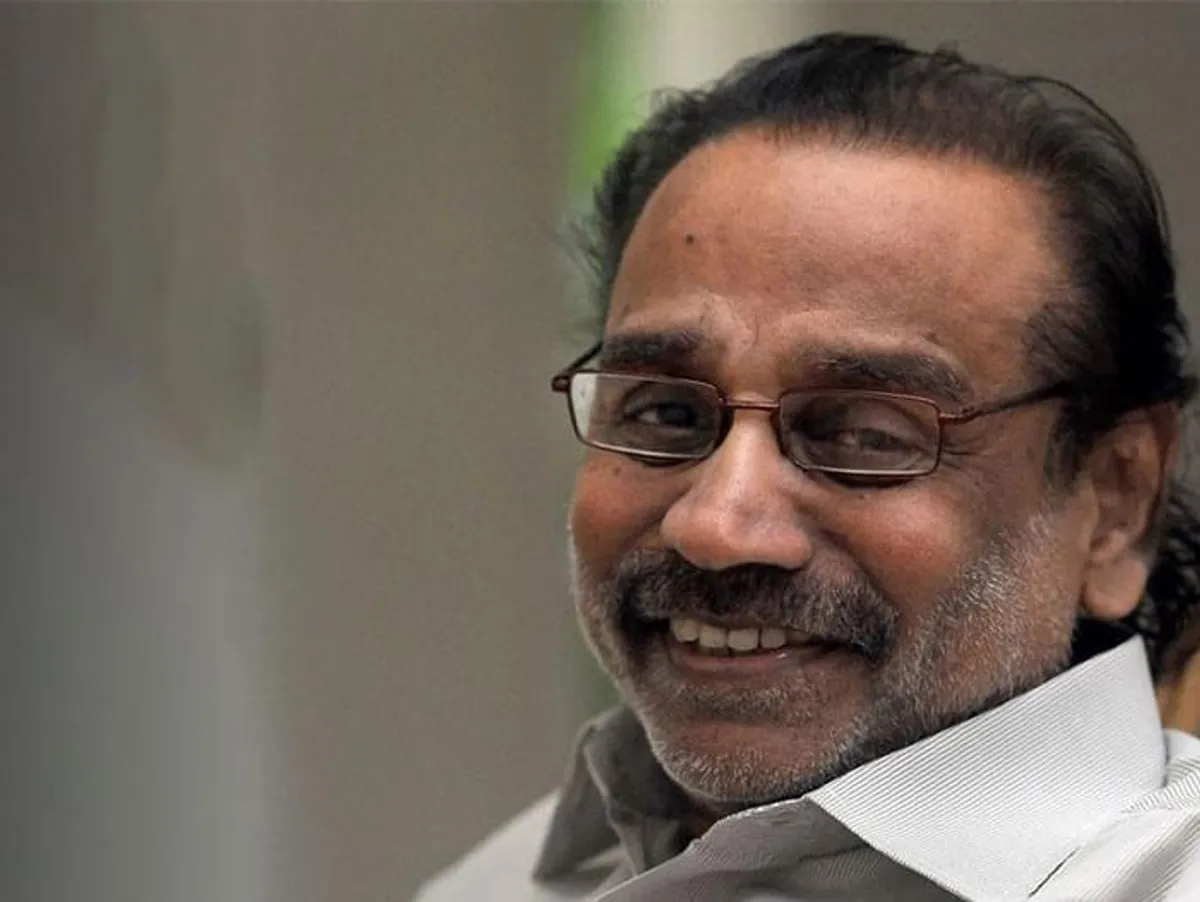
B Rajeevan began his career as a teacher in various government colleges in 1971 in Kerala. In 1975, he took part in protest against the Emergency, during which he was detained and subjected to torture. Since 1969, he has published numerous essays and books on a wide range of subjects, including philosophy, politics, aesthetics, history, cinema, and literature, earning him several prestigious awards.