
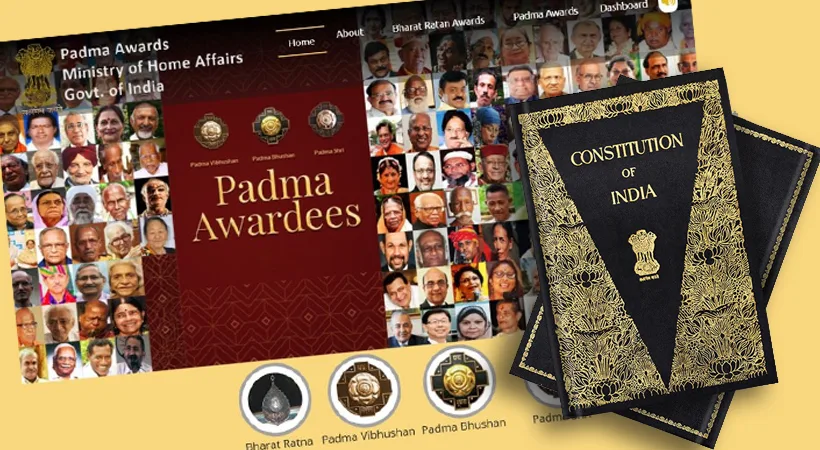
Democracy Cannot Rank Its Citizens: A Constitutional Critique of National Awards
National awards such as the Bharat Ratna, Padma Vibhushan, Padma Bhushan, and Padma Shri are often celebrated as instruments to recognize exceptional service to the nation. However, this paper argues that such awards are fundamentally incompatible with the egalitarian and democratic vision of the Indian Constitution. Rooted in a feudal and colonial tradition of state-bestowed honor, these awards symbolically recreate hierarchies among citizens, contradicting the constitutional principles of equality, fraternity, and popular sovereignty. Despite judicial validation of their legality, national awards operate as de facto titles, undermining Articles 14 and 18 of the Constitution. This paper critically examines the constitutional, philosophical, and democratic implications of national awards and argues for their abolition in favor of more egalitarian forms of recognition.
Introduction
The Indian Constitution represents a radical break from India’s feudal, caste-ridden, and colonial past. It seeks to replace inherited status with equal citizenship, hierarchy with fraternity, and privilege with rights. Against this backdrop, the continuation of national awards such as the Bharat Ratna, Padma Vibhushan, and Padma Shri raises serious constitutional and democratic concerns.
While these awards are defended as symbolic gestures to honor merit and service, they perpetuate a culture of state-sanctioned hierarchy that is antithetical to constitutional morality. In a democracy founded on the principle that “We, the people” are sovereign, the very act of the state selectively elevating individuals above others reflects a feudal mindset incompatible with republican values.
Feudal Origins of State-Bestowed Honors
Historically, honors and titles were instruments of feudal and monarchical power. Kings and emperors conferred titles to secure loyalty, reward service, and reinforce hierarchical social orders. Under British colonial rule, titles such as Sir, Rai Bahadur, and Khan Bahadur were used to co-opt Indian elites into the imperial structure. The framers of the Indian Constitution were acutely aware of this history. Dr. B.R. Ambedkar viewed titles as tools of social domination and elitism (Ambedkar,1936). Consequently, the Constitution explicitly abolished titles under Article 18, signaling a conscious rejection of feudal values. National awards, though stripped of formal legal privileges, continue this tradition in symbolic form. They preserve the feudal idea that the state possesses moral authority to rank citizens based on perceived greatness.
Article 18 and the Abolition of Titles
Article 18(1) of the Indian Constitution states:
“No title, not being a military or academic distinction, shall be conferred by the State.”
The intent behind this provision was not merely legal but philosophical. The Constituent Assembly debates reveal a clear desire to eliminate all markers of artificial superiority that could undermine democratic equality. Although national awards are not hereditary or legally enforceable, they function as social titles. Recipients routinely prefix or suffix these honors to their names, gaining enhanced social prestige, access, and influence. This directly violates the spirit of Article 18, even if courts have upheld their technical legality.
Judicial Interpretation: The Balaji Raghavan Case
In Balaji Raghavan v. Union of India (1996), the Supreme Court upheld the constitutional validity of national awards, arguing that they are not “titles” under Article 18 as long as:
- They are not hereditary
- They do not confer legal privileges
- They are not used as prefixes or suffixes
However, this judgment itself acknowledges the risk of misuse and symbolic inequality. The Court cautioned that if awards were used as titles, they could violate Article 18. The Court recommended forming a high -level committee to select recipients based on strict criteria to ensure the integrity of the awards.
Critically, the judgment focused on formal legality rather than constitutional morality—a concept later emphasized in cases such as Navtej Singh Johar & Ors v. Union of India (2018) and Government of NCT of Delhi v. Union of India (2018).
Thus, while national awards may survive constitutional scrutiny in a narrow legal sense, they fail the broader test of constitutional ethics.
Article 14: Equality Before Law and Symbolic Hierarchies
Article 14 guarantees:
“Equality before the law and equal protection of the laws.”
While national awards do not create legal inequality, they establish symbolic inequality, which is equally damaging in a society striving to dismantle entrenched hierarchies of caste, class, and gender. The state’s endorsement of certain individuals as “exceptional citizens” contradicts the democratic principle that all citizens are equal participants in the political community. As political theorist Hannah Arendt argued, democracy collapses when honor replaces equality as the basis of citizenship (Arendt,1958)
Fraternity and the Preamble
The Preamble of the Constitution commits India to securing:
“Justice, Liberty, Equality and Fraternity.”
Fraternity, as Ambedkar emphasized, is not possible without equality. National awards undermine fraternity by promoting competition for state recognition rather than solidarity among citizens. They reinforce a culture of hero-worship and individual glorification, diverting attention from collective struggles, grassroots movements, and anonymous labor that sustain democracy.
Political Patronage and Elite Capture
In practice, national awards have been repeatedly criticized for:
Political favoritism
Ideological bias
Overrepresentation of elites
Underrepresentation of marginalized communities
This reflects what sociologist Pierre Bourdieu called symbolic capital—the conversion of cultural recognition into social and political power (Bourdieu,2007). Instead of democratizing honor, national awards consolidate elite dominance, making them instruments of soft power for the ruling establishment.
Against Popular Sovereignty
In a republic, sovereignty lies with the people—not with the state acting as an arbiter of merit. The idea that the state can officially declare who is “worthy” of national honor contradicts republican citizenship, where dignity is inherent, not bestowed. As Jean-Jacques Rousseau argued, true democracy rejects distinctions among citizens beyond what is necessary for governance(Rousseau,1762).
Counter-Arguments and Rebuttal
Argument: Awards Promote Excellence
It is argued that awards incentivize excellence and public service. However, genuine excellence does not require state validation. Democratic societies thrive when recognition emerges organically through public respect, peer acknowledgment, and institutional accountability—not ceremonial hierarchy.
Argument: Awards Are Merely Symbolic
Symbols matter deeply in constitutional democracies. As the Supreme Court itself has held in S.R. Bommai v. Union of India (1994), symbolism is integral to constitutional culture. Symbolic inequality reinforces real inequality. Symbols matter deeply in constitutional democracies. As the Supreme Court itself has held in S.R. Bommai v. Union of India (1994), symbolism is integral to constitutional culture. Symbolic inequality reinforces real inequality. In a constitutional democracy, symbols are not just decoration or formality—they strongly influence how people think and behave. The Supreme Court said that symbols help shape the values and culture of the Constitution. When the State uses symbols that suggest some people are superior to others (for example, titles, honors, or special recognition), it can slowly create or strengthen real inequality in society. Even if the inequality starts only at a symbolic level, it can affect attitudes, opportunities, and treatment in real life.
Alternatives to National Awards
Strengthening institutions rather than individuals
Collective recognition of movements, organizations, and communities
Transparent, non-hierarchical civic acknowledgments
Material support rather than symbolic glorification
Conclusion
National awards such as the Bharat Ratna, Padma Vibhushan,Padma Bhushan,and Padma Shri represent a continuation of feudal and colonial traditions of state-bestowed honor. While constitutionally permissible in a narrow legal sense, they violate the deeper values of equality, fraternity, and popular sovereignty enshrined in the Indian Constitution. In a society struggling to overcome centuries of hierarchy and exclusion, the state must abandon practices that reinforce symbolic superiority. True democracy does not elevate a few—it empowers all. The abolition of national awards would mark a decisive step toward realizing the Constitution’s transformative promise.
(Acknowledgement: The author would like to acknowledge the support received from artificial intelligence–based tools during the preparation of this manuscript, as well as the application of transhumanist perspectives in the conceptual framework of the study.)
References
Ambedkar, B. R. (1936). Annihilation of Caste: An Undelivered Speech. (Speech prepared for the annual conference of the Jat-Pat-Todak Mandal of Lahore, but not delivered). Self-Published.
Arendt, H. (1958). The Human Condition. Chicago: University of Chicago Press.
Balaji Raghavan and S. P. Anand v. Union of India, (1996) 1 SCC 361 (Supreme Court of India).
Bourdieu, P. (1979). A Social Critique of the Judgement of Taste. Editions de Minuit.
Constituent Assembly Debates -Volume VII (4th November 1948 to 8th January 1949): Constituent Assembly Debates: Official Report, Government of India.
Constitution of India. (1950). Preamble. Government of India.
Constitution of India. (1950). Article 14: Equality Before Law. Government of India.
Constitution of India. (1950). Article 18: Abolition of Titles. Government of India..
Navtej Singh Johar v. Union of India, (2018) 10 SCC 1 (Supreme Court of India).
Rousseau, J. J. (1762). Social Contract. Amsterdam: Chez Marc Michel Rey.
S. R. Bommai v. Union of India, (1994) 3 SCC 1 (Supreme Court of India).?
This article was origninally published in Mainstream Weekly

Jos Chathukulam is a Professor of Political Economy and Director of the Centre for Rural Management (CRM), Kottayam, Kerala. His academic work focuses on public policy, decentralisation, public finance, local governance, development studies, and political economy in India, with a special emphasis on Kerala. Prof. Chathukulam has authored and edited several influential books and research papers, and has served as a policy advisor to governments and international agencies. He is widely recognised for his critical engagement with development paradigms and for advocating sustainable, people-centred alternatives in economic and governance practices.
- Abolition of titles India
- Annihilation of Caste
- B R Ambedkar on equality
- Bharat Ratna debate
- Constitutional morality India
- Democracy in India
- Equality and citizenship
- Feudal mindset in democracy
- Fraternity in Constitution
- Jos Chathukulam
- National Awards India
- Padma Awards criticism
- Padma Bhushan
- Padma Shri
- Padma Vibhushan
- Reforming national awards
- Rousseau social contract