
Chief Raoni: The Face of Indigenous Climate Activism
Ebin Gheevarghese’s article profiles Chief Raoni Metuktire, the 93 year old Kayapó leader who has become the most recognizable face of Indigenous climate activism. From his early life in the Xingu forests to the global stage of COP-30, Raoni’s lifelong fight against deforestation and extractive projects stands as a reminder that the survival of the Amazon and the planet depends on the knowledge and leadership of Indigenous peoples.
How an Amazonian chief with a lip plate became the world’s most recognizable environmental icon
At ninety-three, Chief Raoni Metuktire arrived at the United Nations Climate Conference in Belém in a wheelchair, his feather headdress catching the equatorial light, the ceremonial lip plate, unmistakable even in the throng of delegates. He was greeted by nearly 400 indigenous leaders who have gathered for the parallel People’s Summit, but his presence carries a weight beyond ceremony. For more than half a century, Raoni has been the Amazon’s emissary to a world that has rarely listened.
Born in the early 1930s in Krajmopyjakare (now Kapôt) in Mato Grosso, Raoni’s nomadic childhood unfolded in a forest that seemed infinite. “Nature was all around us,” he says in his native Kayapó. “There were many animals. We could make long trips, travel across the land. There wasn’t anything stopping us. The forest was big.”
Over half a century later, a fifth of that forest has vanished. Since NASA began satellite monitoring in 1972, there has been a “radical transformation across the southern and eastern frontiers,” according to Douglas Morton, an Earth system scientist at NASA’s Goddard Space Flight Center. “People are no longer clearing 10 hectares at a time. People are clearing 10,000 hectares in a weekend with tractors.”
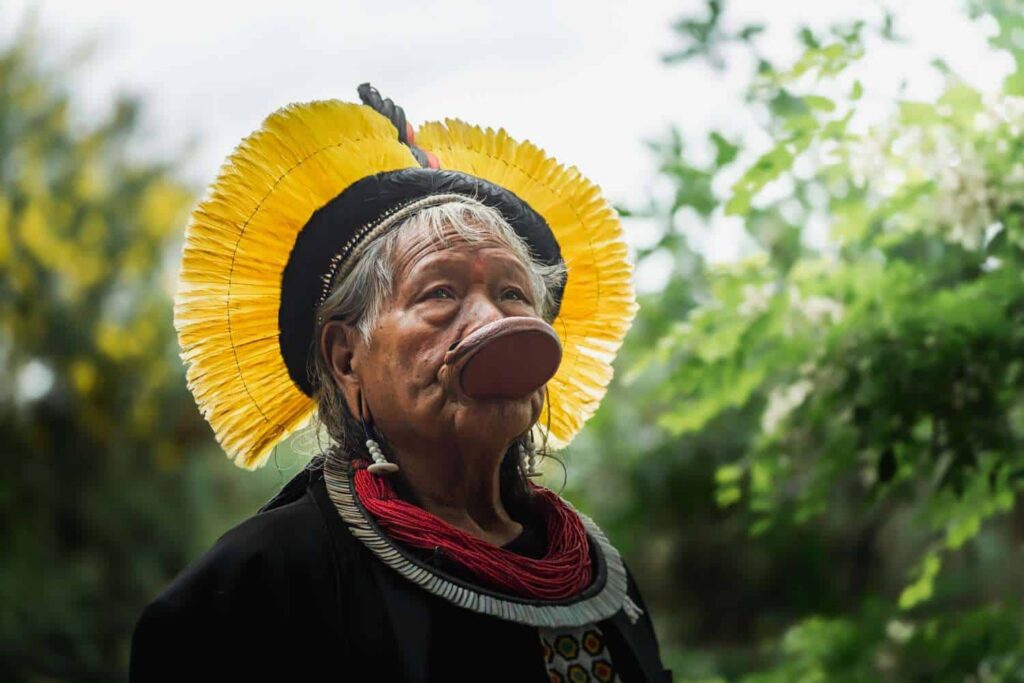
Making of a Global Icon
Raoni’s path from the Xingu basin to international climate summits began with an encounter in 1954, when he met the Villas Bôas brothers, Brazilian indigenists who opened a portal between worlds. He learned Portuguese, navigating what his people called the “Kuben’s” world or the outsiders’ realm, while never relinquishing his Kayapó identity. By the late 1950s, he was meeting with Brazilian President Juscelino Kubitschek and King Leopold III of Belgium.
But it was a Belgian filmmaker, Jean-Pierre Dutilleux, who catalyzed Raoni’s transformation into a global symbol. The 1977 documentary “Raoni,” featuring Marlon Brando’s narration, was nominated for an Academy Award and introduced the world to the Kayapó chief with the distinctive lip plate and an uncompromising message: the forest’s survival was humanity’s survival. He later had a fall out with the director.
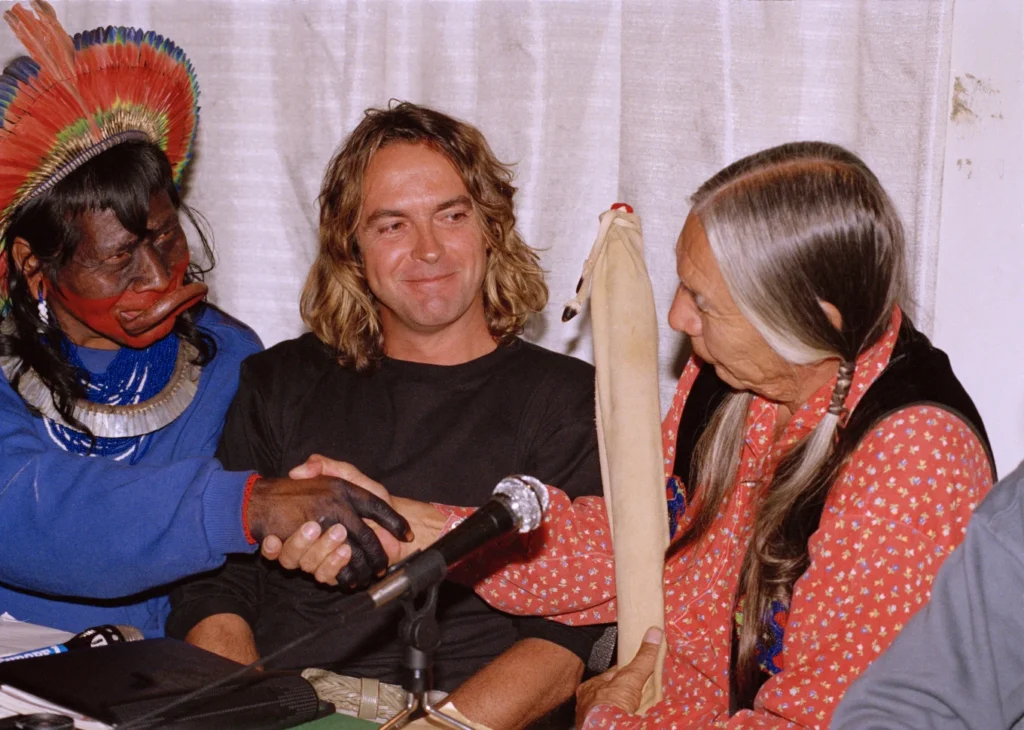
In 1989, Raoni travelled to 17 countries with Sting from April to June, a tour that launched what became a dozen foundations devoted to rainforest protection. Sting, then at the height of his fame, told journalists he believed “Raoni’s a contradiction to all our values and we have to challenge those values… I think they’re highly evolved people, highly evolved to their environment to the extent that they can live there and not destroy it.”
Co-founded by Sting, Trudie Styler, and Dr. Franca Sciuto, the Rainforest Foundation began with a promise made to Raoni to help the Kayapó obtain legal rights to their traditional land. This commitment was fulfilled in 1992. By 1993, Raoni’s vision became reality: the Xingu Indigenous Lands were unified across multiple territories, spanning over 180,000 square kilometers.
French President Jacques Chirac would later call him a “living symbol of the fight for the environment.”
The Unfinished Battle
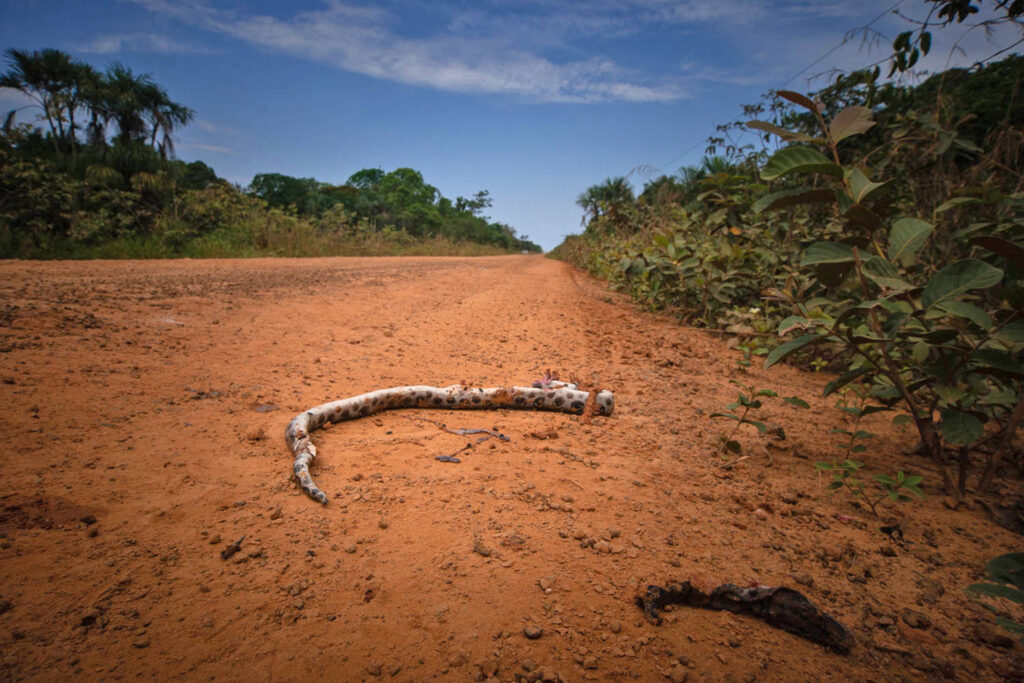
Now, in the coastal rainforest city of Belém, where the Amazon meets the Atlantic, Raoni arrives with a message stripped of diplomatic niceties. “These projects destroy rivers and lands and they are continuing to do it. I don’t like it. I had said long ago that there will be many very bad consequences for us,” he tells Reuters, his grandson translating from Kayapó. The projects he references are impossible to miss: a highway being paved through primary forest, the Ferrogrão railway ( 1,000-kilometer artery designed to transport grain through the Amazon) and, most controversially, the recent license granted to Petrobras to explore for offshore oil 500 kilometers from the Amazon River’s mouth.
At the People’s Summit opening, Raoni said: “I support President Lula, but he must listen to us… He must respect us. I will make an appointment with him, and, if necessary, I will give him a talking-to so that he listens to me.”
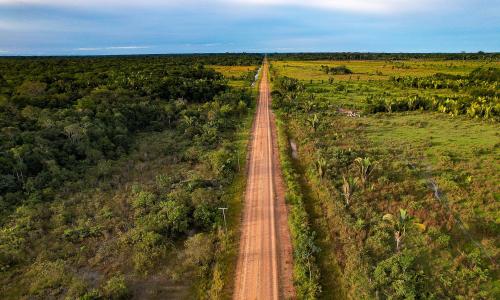
When a new road pierces the Amazon rainforest–An unpaved stretch of the BR-319, between Humaitá and Porto Realidade. Photograph: Alberto César Araújo/Amazônia Real
Raoni was one of the figures who symbolically presented Lula with the presidential sash during his inauguration for a third term in 2023.
At a packed meeting at the Federal Public Prosecutor’s Office during COP-30, Raoni took the microphone and made a forceful appeal: “I want to speak one more time! Listen carefully: let’s unite! We cannot allow this drilling to happen. We must be strong and continue fighting to prevent this drilling from taking place.” His words resonated with indigenous communities from Oiapoque to the upper Xingu, peoples whose territories are threatened by what they see as a government prioritizing extraction over preservation.

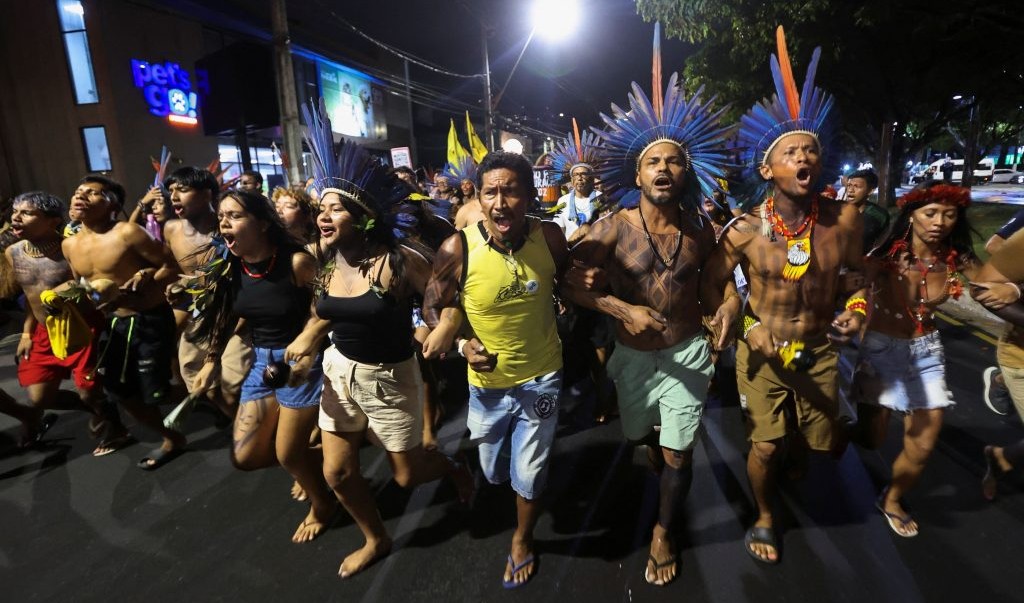
Dozens of indigenous protesters forced their way into the COP-30 venue, clashing with security guards in a dramatic confrontation that left two security workers injured. Dona Neves Arara Vermelha, a member of the Arapiuns ethnic group, defended the action: “No one committed any acts of banditry. It was to draw attention.”
What Science Says
Historian Jean-Baptiste Fressoz cautions against technological solutionism, urging societies to make political choices about what emissions are genuinely necessary: “The central issue for ecological problems remains: raw materials, which never became obsolete. Become serious about an absolute reduction in material and energy use, and that is only possible with degrowth and a circular economy.”
A 2024 systematic review published in ScienceDirect analyzed 648 peer-reviewed empirical case studies and found that locally controlled, indigenous-led conservation resulted in consistently more positive ecological and social outcomes than externally controlled conservation efforts. Formalizing tenure for indigenous lands in Brazil’s Atlantic Forest objectively improved forest outcomes; forest cover increased and deforestation decreased after lands received tenure, with statistically significant results sustained across multiple regions.
As one 2025 review from the Interdisciplinary Centre for Conservation Science mapped across 182 peer-reviewed studies: frequency and long-term integrity of ecological outcomes—forest cover, forest quality, species richness—were highest when indigenous and local communities had stewardship.
Indigenous territories represent 13% of Brazil’s national territory but account for only 1% of native vegetation loss since 1985, according to MapBiomas. By contrast, deforestation rates on lands managed by states or private interests remain dramatically higher. Robin Wall Kimmerer, the Potawatomi botanist, articulates the philosophy underlying this success: “The call for land protection cannot be one of removing Indigenous and local people from land, but of harmonizing people and land, of aligning economies with the laws of nature.”
She shares the ethic of “honorable harvest”: “When you get to the woods, you don’t just start grabbing everything in sight. We’re taught never to take the first plant that you see, and that means you’ll never take the last. This is a prescription with inherent conservation value.”
The Climate Math
The stakes extend far beyond Brazil. A healthy rainforest evaporates massive amounts of water, adding cooling and irrigation to much of the Americas while acting as a giant carbon sink. Through deforestation, land use change and climate change, the southern Amazon is today 1 to 2 degrees Celsius hotter than it was 40 years ago. Roughly 5% of the Amazon is no longer suitable for rainforest at all, turning into savannah or drier forests.
If current trends continue, another 590,000 square kilometers of the Amazon will be lost by 2050, according to the World Resources Institute.
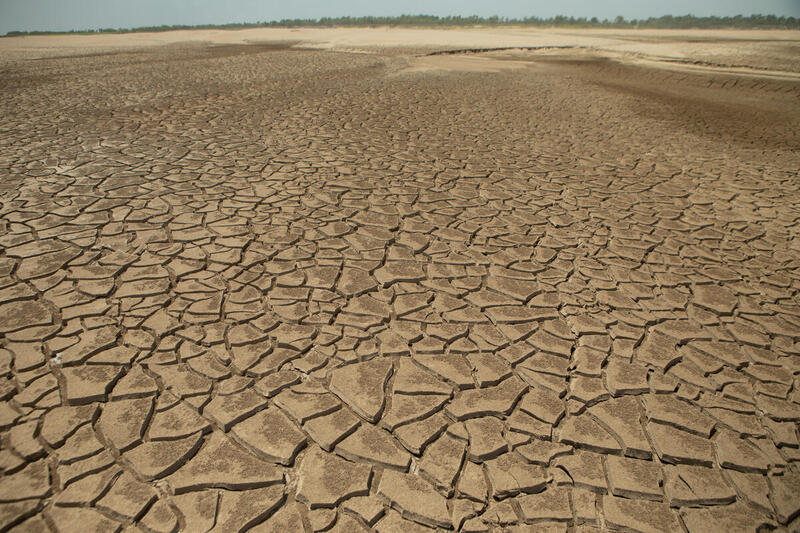
Raoni has witnessed the changes firsthand. “I want the forest to be preserved to lessen the heat on the Earth [and so] we have good air to breathe. We need shade. This is what I have been saying but nobody listens to me and they have deforested forests all around our lands.”
Raoni lives in a hut in Metuktire village, owns nothing, and holds to a philosophy that binds the Kayapó to the fate of their forest. “You non-Indigenous people, perhaps you should have listened and thought about your children, thought about your grandchildren, so that the forest can live and contribute to the lives of new generations, of your grandchildren,” he says.
Just weeks before COP-30, he received the Liberatum Cultural Honour in London, honoring him as a “living symbol of the fight for the preservation of the Amazon rainforest.” There have been multiple efforts to nominate him for the Nobel Peace Prize, supported by President Lula and French President Emmanuel Macron. But Raoni remains unmoved by accolades. As he often says: “I am not fighting for medals. I am fighting for life.”
Twilight and Testament
“The banks in your country here must stop sending money to Brazil, investing in deforestation. We must talk together and take care of what’s left of the forest not just for our sake but for white people and everyone,” says Raoni.
The question hanging over COP-30 is whether this time will be different. Brazilian President Lula told the leaders’ summit that participants should be “inspired by Indigenous peoples and traditional communities—for whom sustainability has always been synonymous with their way of life.” But inspiration without power is empty rhetoric.
Raoni is calling for legal protections for tribal lands, authority over forest management, and an end to projects that prioritize extraction over preservation. Deforestation rates dropped to less than 10,000 square kilometers in 2023 as President Lula bolstered enforcement after the Bolsonaro years, but the licensing of oil exploration and infrastructure projects suggests competing priorities.
Raoni criticized several Brazilian projects in particular, including plans to pave a highway through the forest and the recent license allowing Petrobras to explore offshore. None of these projects, he said, will benefit local populations. “If these bad actions continue, we will have problems,” he warned.
Raoni’s message remains achingly simple: The forest is not a resource to be managed or a sink to be monetized. And the people who have protected it for millennia know better than anyone how to keep it alive.
Featured Image: Indigenous people walk together as they participate in a demonstration on the sidelines of the UN Climate Change Conference (COP30), in Belém, Brazil, November 11, 2025. REUTERS/Anderson Coelho

Independent journalist exploring the intersections of politics, climate, art, and culture