
Capitalism and Democracy Are Incompatible- Rethinking Education, Gandhi and Social Justice in India
In this concluding part, Manindra Nath Thakur reflects on education, neoliberalism, and Gandhi’s legacy, offering a sharp critique of capitalism’s tensions with democracy while exploring how knowledge, politics, and social justice can be reimagined in India.
Read Part 1
Part 2
How can education and critical pedagogy be leveraged as a transformative force to subvert dominant narratives and myths that perpetuate religious and caste hierarchies?
In capitalist societies, education generally functions as part of the ideological state apparatus. Mainstream educational institutions offer limited space for genuine academic freedom, as the state maintains control over both curriculum content and pedagogical frameworks. Even in socialist states, the situation has often been more restrictive, with education closely monitored to serve state interests.
In countries like India, where education has historically been state-sponsored, textbook content has frequently been the subject of political controversy. These institutions rarely encourage critical thinking that challenges dominant social norms or questions the legitimacy of prevailing political systems. Universities, for the most part, tend to emphasize administrative social sciences—those that produce bureaucratic or policy-oriented knowledge—over transformative social sciences aimed at structural change.
This model of education is primarily designed to produce skilled personnel who can serve the state’s administrative needs by offering analytical and policy inputs. The perspective from which social sciences are taught in these institutions is rarely oriented toward social transformation or revolutionary change.
What is needed is the creation of new educational institutions—initiated and supported by social movements—that draw strength from popular participation and focus on reinterpreting religious, cultural, and moral resources from the standpoint of the oppressed. These institutions should actively seek to dismantle caste, racial, and gender-based hierarchies, and prejudices. Across the world, various experiments in radical education and pedagogy have demonstrated the potential for such alternatives.
India, too, has a rich legacy of educational experiments during the freedom struggle that challenged the colonial ideological apparatus. These alternative institutions subjected religion, morality, and social institutions to critical scrutiny in pursuit of universal human liberation.
Education must be reoriented toward problem-solving, collective action, and political transformation with the goal of building an egalitarian society. This does not imply that existing institutions are devoid of potential. On the contrary, social movements must actively engage with them, challenge their dominant narratives, and influence their research agendas.
The growing distance between intellectuals and mass movements has profoundly shaped the nature of knowledge being produced and consumed. Reconnecting intellectual inquiry with the struggles and aspirations of the people is essential for reimagining education as a tool of liberation rather than domination.
Did Gandhi’s recourse to Hindu prayer meetings as a precursor to political mobilization tacitly acknowledge that religious identity is an indispensable catalyst for political mobilization in India, effectively conceding that secularism and civic nationalism are insufficient to galvanize the masses? In doing so, did he inadvertently legitimize the notion that political power in India can only be accessed and exercised through the invocation of religious identity, potentially perpetuating a paradigm that undermines the principles of a pluralistic and inclusive democracy?
Gandhi’s approach to the question of religious and caste identities was to acknowledge their social and emotional power while seeking ways to engage with and transform them. He recognized the processes of identity-identification and identity-formation as rooted in lived experience, and not merely ideological constructs. His daily prayer meetings became symbolic sites of communal dialogue, bringing together people from different religious backgrounds.
At a time when the modern, secular-educated middle class was still a small minority, Gandhi chose not to adopt the Western notion of secularism that calls for the strict separation of religion from politics. Instead, he openly embraced his Hindu identity while simultaneously asserting his respect for and engagement with all religions. He saw religion not as a private matter, but as a moral and spiritual resource that could be mobilized for public good. For Gandhi, religion provided a critical standpoint against the coloniser’s ideology of possessive individualism and materialism.
Through his political engagement with religion and his social engagement with religious communities, Gandhi developed a unique moral agency that allowed him to critique all religions—even while remaining deeply religious himself. His philosophy and practice bear striking resemblance to the principles of Liberation Theology: a framework that acknowledges the emotional and spiritual dimensions of religion while using it as a means to challenge oppression.
Gandhi’s approach offered a way to appreciate religion as a meaningful and powerful human experience, without allowing it to devolve into identity-based conflict or sectarian politics. It was this vision that helped maintain a fragile yet enduring democratic ethos in post-independence India.
Today, as communal forces grow more influential and identity-based polarization deepens, Gandhi’s legacy offers one of the few remaining pathways of hope. His experiments in social healing—grounded in empathy, dialogue, and moral courage—remain profoundly relevant as tools to sustain and rejuvenate Indian democracy. His ability to hold communities together without denying their differences offers a model that needs urgent revival.
Can the Indian state’s embrace of neoliberal economic policies be seen as a tacit acceptance of the limits of secularism and social justice, as the pursuit of economic growth and globalization takes precedence over addressing structural inequalities and communal divisions, and what are the implications of this trade-off for the future of Indian democracy?
The relationship between neoliberal economics, secularism, and social justice is far more complex than it is often portrayed. To understand this dynamic, one must first recognize that India is an emerging capitalist economy. The initial phase of welfare-oriented economic policies did not aim to dismantle capitalism; rather, they paved the way for its expansion. Colonialism had already integrated India into the global capitalist system, establishing a trajectory of development shaped by the imperatives of the world market. Neoliberal economics, in this sense, is not an aberration but a logical continuation of this historical process.
The Indian state, despite its formal commitments to welfare and democracy, functions essentially as a capitalist state. Its primary role is to support and facilitate the dominant mode of production—capitalism. While there have been deviations from this role, largely for the sake of legitimacy, the overall trend has been toward the consolidation of capitalist relations. Neoliberal policies have accelerated the process of wealth accumulation, leading to greater centralization and concentration of capital in fewer hands. These policies are fundamentally anti-people because capitalism, by its very nature, is at odds with the principles of democracy and equality. In its neoliberal phase, this contradiction has become even more stark.
As neoliberalism deepens economic inequality, it inevitably generates widespread popular discontent. To prevent this discontent from turning against the state and the economic elite, identity politics is often deployed as a diversionary tactic. This helps explain the rise of aggressive identity-based mobilizations in the neoliberal era. The ascendancy of the market undermines not only social justice but all forms of justice, as market logic is driven solely by profit, not by values of equity or solidarity.
Neoliberal capitalism is also likely to intensify structural inequalities—along lines of caste, gender, religion, and region—if doing so serves capital accumulation. As a matter of common sense, capitalism benefits a few, whereas democracy is meant to serve the many. These two systems are structurally incompatible. Their uneasy coexistence—a “marriage of convenience”—has reached its limits.
Capitalism is driven by the principle of greed, which historically was tempered by a parallel commitment to the common good. However, as revealed by global analyses of the 2008 financial crisis, this balancing act has collapsed. Capitalism today appears more voracious than ever, having largely abandoned any concern for the public interest. As a result, it has become increasingly exploitative and reliant on the state to manage and suppress public discontent.
In this new context, the state is evolving into a techno-authoritarian apparatus—centralized, opaque, and repressive. It is more likely to resort to surveillance, coercion, and even militarism to maintain control. This trend poses a serious threat to the survival of democracy. If left unchecked, the combination of neoliberal capitalism and authoritarian governance will erode the very foundations of democratic life.
Did Gandhi’s fervent opposition to separate electorates for Dalits, ostensibly to preserve Hindu unity, betray a profound bias towards maintaining the hegemony of Hinduism, thereby compromising the political and social interests of the Dalit community? In doing so, did Gandhi’s actions exemplify a form of ‘Hindu majoritarianism’ that undermined the principles of social justice and equality, rendering his legacy politically problematic?
Gandhi’s opposition to separate electorates for Dalits, as articulated during the Poona Pact of 1932, must be understood within the broader philosophical and political framework he espoused—a framework deeply rooted in moral reform, social harmony, and the transformative potential of religion. While at first glance, his refusal to support separate electorates may appear to reflect a bias towards maintaining Hindu hegemony, a more layered reading reveals the complexity of his position and its contradictions.
Gandhi’s rejection of separate electorates was not simply a political manoeuvre to preserve Hindu unity but part of a larger ethical vision. He viewed the Hindu social order as morally degraded by untouchability and believed that its reform must come from within. His approach was to reclaim and transform Hinduism, not to abandon or repudiate it. In this sense, Gandhi did not deny the oppression of Dalits. Instead, he sought their upliftment through the internal moral regeneration of Hindu society. He saw separate electorates as a form of segregation that would crystallize caste divisions rather than overcome them.
However, this idealistic position carried significant limitations. By opposing separate political representation for Dalits, Gandhi arguably subordinated their immediate political empowerment to a long-term moral project that remained largely within the framework of upper-caste Hindu reformism. In this respect, one could argue that his stance, though not rooted in overt majoritarianism, nonetheless functioned to maintain the symbolic and institutional dominance of Hinduism—particularly upper-caste interpretations of it.
This raises a critical tension in Gandhi’s legacy. While he opposed untouchability with sincerity and risked his life for Hindu-Muslim and intra-Hindu reconciliation, his emphasis on internal religious unity sometimes came at the cost of recognizing the distinct political aspirations of oppressed communities. Dr. B.R. Ambedkar, by contrast, grounded his politics on the principles of social justice and structural transformation. For Ambedkar, without separate electorates, Dalits would remain politically invisible and structurally disempowered within the majoritarian logic of Hindu society.
Gandhi’s actions may be understood as opening up the possibility of a reformist moral vision—one that placed transformative potential within dominant communities, trusting in their capacity for self-reflection and ethical change. Rather than insisting on institutional safeguards from the outset, he pursued a path rooted in moral persuasion and inner reform. While this approach created space for inter-community dialogue and ethical introspection, it also carried the risk of reinforcing existing hierarchies. Yet, by challenging many oppressive aspects of Hinduism through his life and politics, Gandhi also left open the possibility for reimagining religious identity as a source of healing rather than domination.
In conclusion, Gandhi’s legacy in this regard is complex and contested. He remains a figure of immense moral courage and political creativity, yet his framework fell short in confronting the full structural implications of caste. Rather than rendering his legacy politically obsolete, this tension invites a deeper reflection on how ethical visions of unity must be constantly interrogated through the lens of social justice and the lived experiences of the marginalized. Gandhi’s project, if reinterpreted critically—much like liberation theology—can still offer resources for social healing, but only when it is in honest dialogue with the radical demands of equality articulated by thinkers like Ambedkar.
Ends
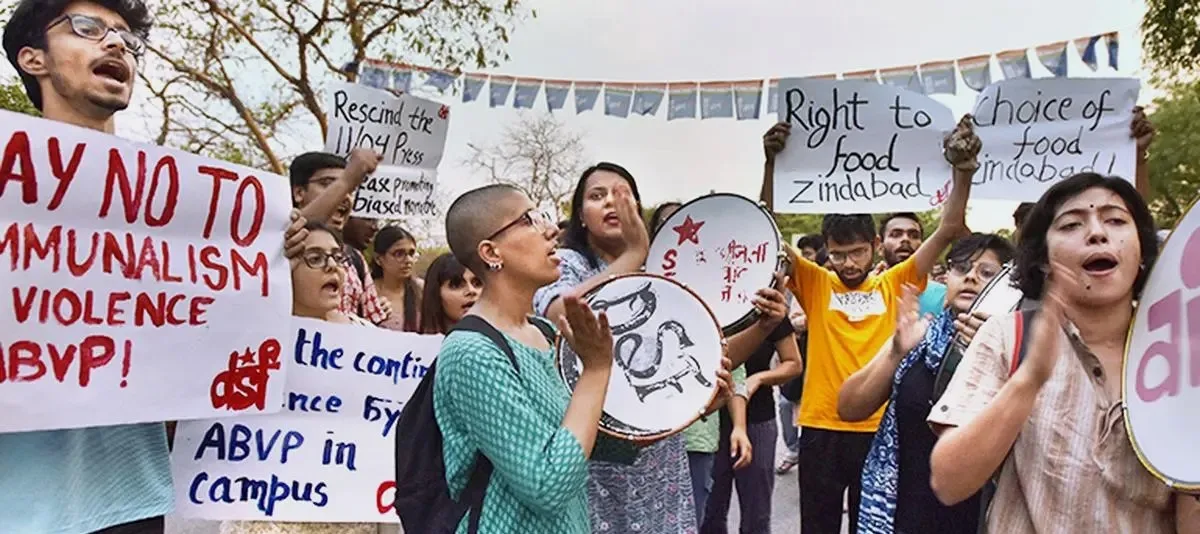
Featured Image: Students of New Delhi‘s Jawaharlal Nehru University protest against the violence on the campus in April 2022. Indian universities have been witnessing an attack on their democratic setup and are being targeted for imbibing and enabling a culture of resistance. Courtesy: Frontline

A journalist with 18 years of experience Abhish K Bose was a staffer at The Times of India and The Deccan Chronicle - Asian Age. As a contributor, his interviews and articles have been published in Frontline magazine, The Wire, The Print, The Telegraph, The Federal, The News Minute, Scroll, The Kochi Post, The Leaflet, The Hindu.com, Outlook.com Countercurrents.org and the Asian Lite international published out of London
- Ambedkar vs Gandhi
- capitalism vs democracy
- caste and politics India
- education and social change
- feminist movements India
- Gandhi political thought
- identity politics india
- Indian democracy crisis
- liberation theology politics
- manindra nath thakur
- neoliberalism and democracy
- radical education India
- religion and politics india
- social justice india
- social movements india
- universities and ideology